
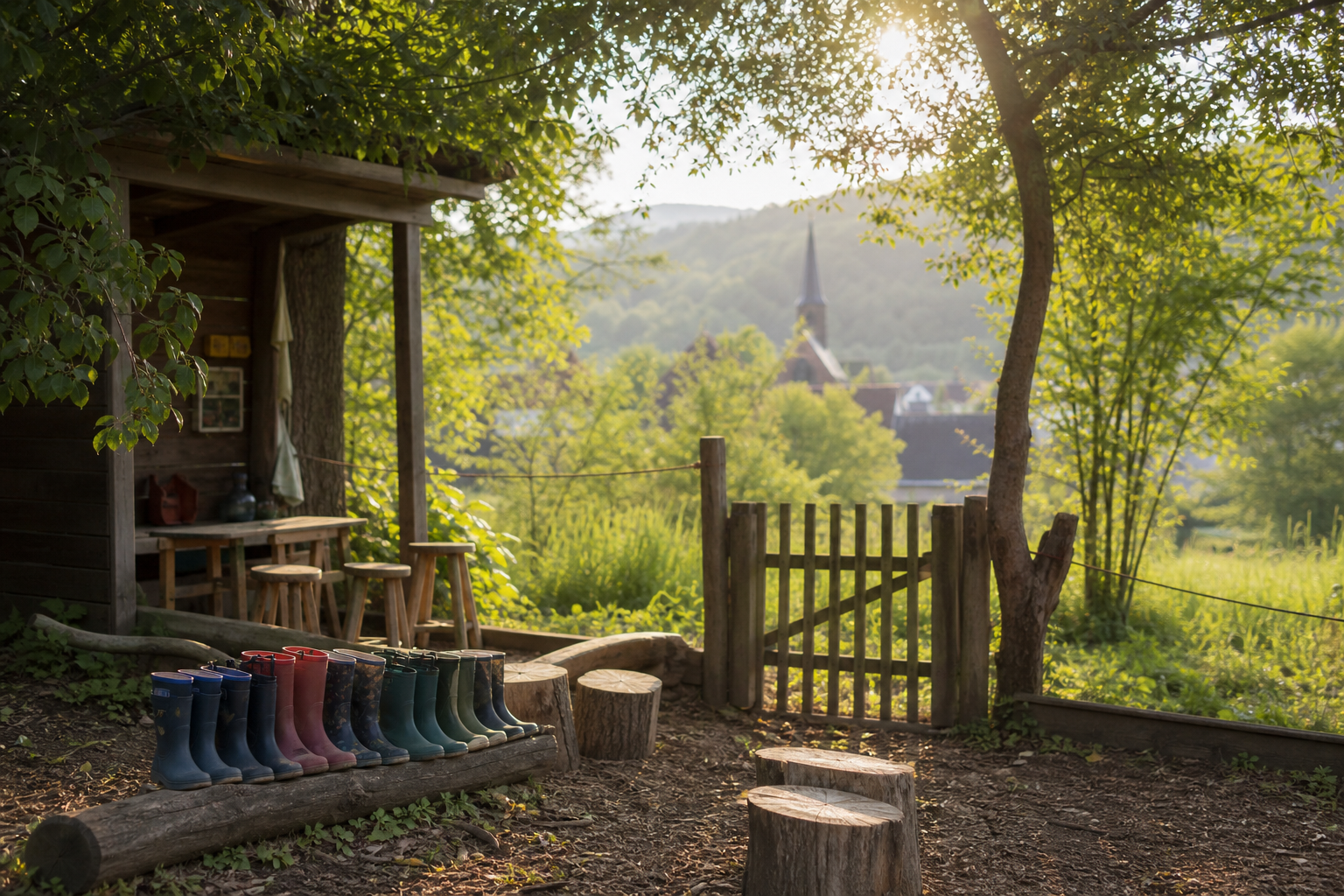
Symbolbild mithilfe von KI erstellt
Demographics Are Changing the Daycare Landscape
Daycare Places Become Available: Why the First Kindergartens Are Now Closing
For years, the same sentence applied in many cities and municipalities in Baden-Württemberg: There is a shortage of daycare places. Waiting lists, provisional groups, and the pressure to create new facilities shaped the debate. Now, the situation is shifting in some places—not across the board, but noticeably: Declining birth rates are meeting a childcare offering that was expanded during the peak phases of shortage. This is leading, for the first time, to decisions that long seemed unthinkable: closures, mergers, and the "decommissioning" of individual locations.
An example of this is Ruppertshofen in the Ostalb district. There, the nature kindergarten "Zitronenfalter" is to close in September. According to the municipality, only seven registrations were received for the coming daycare year—despite 20 available places. The municipal council decided to close it by a narrow majority (7:5) based on the information available.
Too Few Registrations—and a Calculation That No Longer Adds Up
The "Zitronenfalter" has stood at the edge of Ruppertshofen for around eight years. Educationally, the facility focuses on nature experiences: going outside, observing, playing—plants and animals are part of everyday life, not just excursions. For some families, this is the decisive point. Accordingly, disappointment is great among parents who appreciate the concept and see the closure as a step backward.
At the town hall, the decision was justified with the question of whether independent operation can still be justified with such low occupancy. The public debate is not just about the absolute number of children, but about the fixed costs that arise even when groups are only half full: staff must be maintained, locations must be operated and secured, substitutes organized, requirements met. For Ruppertshofen, amounts of more than 130,000 euros per year were mentioned for continued operation; in the administration's internal calculations, the range is even clearer depending on occupancy: even with ten children, the deficit would have been between about 110,000 and 145,000 euros, and even with full occupancy of 20 children, it would still have been in the five-digit range.
The municipality announced that affected children will be offered places in other municipal facilities from the coming kindergarten year. In addition, the site is to continue to be used after the closure—for example, for other daycare groups in the town.
The Trend Reversal Is Not Only Reaching Rural Areas
Ruppertshofen is not an isolated case. While some regions continue to complain about a lack of childcare places, other municipalities are finding that groups are no longer filling up. Notably, the development is not limited to small communities.
In Aalen, for example, the municipal council cleared the way at the end of April to provisionally close the Catholic kindergarten St. Martin (Aalen-Ebnat) at the start of the 2026/2027 kindergarten year and to merge the daycare center with another facility in a new building in the future. The decisive factor there was a changed needs assessment—and the indication from the city administration that the number of children is likely to decline. The decision is explicitly designed to be adjustable: minutes and templates provide options to correct individual steps later or to reactivate locations if demand turns out differently than forecast.
Fewer Births—but No Simple All-Clear
The demographic background has become clearer. According to the Baden-Württemberg State Statistical Office, around 98,400 children were born alive in 2023—about 6,100 fewer than in 2022. This means that the number of births fell below 100,000 for the first time since 2014. The average number of children per woman in the state also fell from 1.50 (2022) to 1.44 (2023). At the same time, the data show strong regional differences—with significantly higher values in some districts and significantly lower ones in major cities.
For municipal needs planning, this means: Anyone closing groups today must calculate very carefully how stable the forecasts are. Influx, housing construction, labor migration, new development areas—all of this can overturn planning within a few years. Conversely, too large a network of locations can permanently burden budgets if the number of children falls and personnel and operating costs rise.
Between the Need to Save and the Educational Mandate
With the first closures, the political debate is shifting. Municipalities are looking at occupancy, deficits, and the question of whether each location can remain financially viable in its current form. Critics warn against interpreting the new situation too quickly as "problem solved."
Education economist Dieter Dohmen considers it risky to cut places while children are still arriving too late or not at all in care—especially those who would particularly benefit from early support. His core argument: Declining birth rates may ease the statistics, but they do not automatically solve the social and educational tasks that daycare centers are supposed to fulfill—from language development to supporting families in difficult situations.
The case of Ruppertshofen thus shows more than the end of a single nature kindergarten. It stands for a new phase in childcare: No longer just "How do we create enough places?", but increasingly "Which structures can we afford in the long term—and which do we still need despite declining child numbers?" The answers will vary by region. But the conflicts—between budget realities, educational standards, and uncertain forecasts—are likely to be similar in many places.
Frequently Asked Questions
Sources
- https://www.swr.de/swraktuell/baden-wuerttemberg/ulm/trendwende-kita-in-ruppertshofen-muss-schliessen-100.html, 03.06.262026
- https://www.schwaebische-post.de/ostalb/aalen/stadt-aalen/aalen-gemeinderat-beschliesst-kita-schliessung-st-martin-ebnat-94290841.html, 04.05.2026
- https://www.statistik-bw.de/presse/pressemitteilungen/pressemitteilung/baden-wuerttemberg-zahl-der-geburten-ist-weiter-gesunken/, 15.07.2024