
Roggenburg
Kirchpl. 2, 89297 Roggenburg-Schießen, Deutschland
Pilgrimage Church of the Nativity of Mary in Schießen | History & Organ
The Pilgrimage Church of the Nativity of Mary in Schießen is one of the defining spiritual places in the Roggenburg region, combining history, art, music, and vibrant pastoral care in a small space. It is located in the district of Schießen in the municipality of Roggenburg, a place that has been closely connected to the Premonstratensian monastery of Roggenburg for centuries. The current church is not just a house of worship, but the result of a strong pilgrimage tradition that developed from a veneration of Mary in the late 17th century. This is precisely why it is so exciting for visitors: Here, village piety, baroque architecture, and a cultural influence that is still palpable today come together. Those looking for the Pilgrimage Church of the Nativity of Mary in Schießen, the history of the church, or information about organ concerts, directions, and images will find in Schießen a place where religious tradition and regional identity particularly overlap. ([roggenburg.de](https://www.roggenburg.de/tourismus-and-kultur/ortsinformationen/geschichte/gemeindeteile/schiessen-schleebuch-und-unteregg))
History of the Pilgrimage in Schießen
The history of the church begins with a remarkable development in the village of Schießen. The municipality of Roggenburg records that Schießen was first mentioned in documents in 1248 as "Schiezen" and belonged to the monastery of Roggenburg for many centuries. A decisive factor for the pilgrimage was the initiative around 1680 by the Premonstratensian Father Severin Ott, who was responsible for pastoral care. He secretly had a copy of the venerated image of Our Lady of Snow made from the pilgrimage church in Haupeltshofen. This image quickly gained such great veneration in Schießen that the influx of believers soon exceeded the capacity of the existing small village church. The official parish describes that the Marian image was consecrated on the Feast of the Presentation of the Lord in 1681 and was set up for public veneration. This moment already shows how closely religious practice and architectural history are intertwined in Schießen: It was not an abstract plan that started it all, but a concrete movement of piety supported by the local people. ([roggenburg.de](https://www.roggenburg.de/tourismus-and-kultur/ortsinformationen/geschichte/gemeindeteile/schiessen-schleebuch-und-unteregg))
From the growing influx, the spacious pilgrimage church we see today was built between 1681 and 1686. The municipality of Roggenburg explicitly names the years 1681 to 1685 as the construction phase of the new church, while the parish dates the construction from 1681 to 1686 and notes the consecration on July 21, 1686, by the auxiliary bishop of Augsburg, Eustach von Westernach. Thus, Schießen was already a significant pilgrimage site in the region in the 17th century. Later, in 1781, the church was magnificently renovated and repainted for the centenary celebration of the pilgrimage. The political history also left its mark: After the dissolution of the imperial abbey of Roggenburg in 1802, the once-popular pilgrimage almost fell into oblivion due to the pilgrimage ban imposed by Count Montgelas. Nevertheless, the church remained a source of identity for the place. Since 1805, Schießen has been its own parish again, and since 1984, it has been cared for once more by Premonstratensian Fathers from Roggenburg. This sequence helps to understand why the Pilgrimage Church of the Nativity of Mary in Schießen is still regarded as a symbol of continuity: It tells not only of baroque piety but also of revival, care, and ecclesiastical roots across generations. ([roggenburg.de](https://www.roggenburg.de/tourismus-and-kultur/ortsinformationen/geschichte/gemeindeteile/schiessen-schleebuch-und-unteregg))
Architecture and Baroque Furnishings of the Church
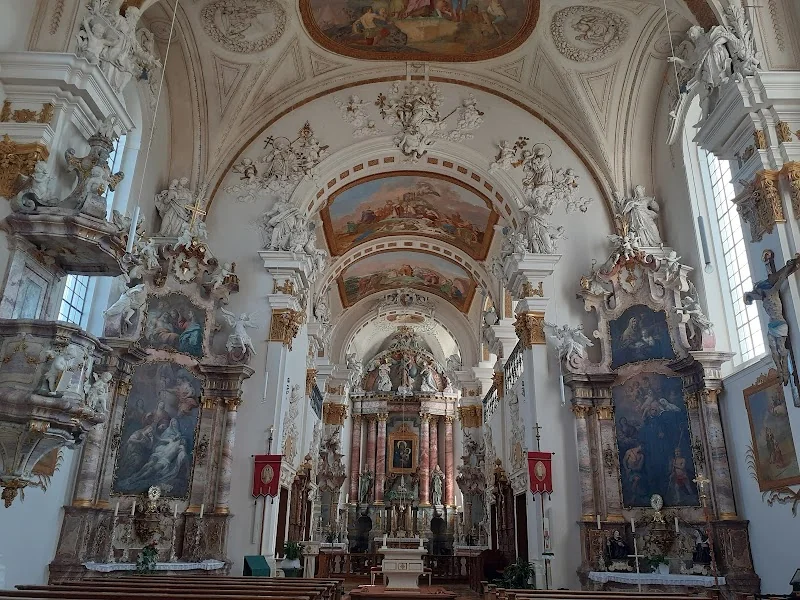
Architecturally, the Pilgrimage Church of the Nativity of Mary is a particularly impressive example of a baroque wall pillar church. According to Wikipedia, it was built from 1682 to 1686 on the orders of the abbot of the Roggenburg monastery based on a design by Valerian Brenner. The building consists of a nave, choir, and a recessed, semi-circular apse in the east; additionally, a bell tower rises above the northern part of the nave next to the choir. This tower was raised with an octagonal section that houses the clock and bell chamber, topped with an onion dome. Such elements are typical of southern German baroque and give the building an almost festive lightness despite its religious function. The interior also follows a clear yet elegant order: The nave is vaulted with a barrel vault, while the choir features a cross-ribbed vault. This basic form already shows that Schießen was not conceived as a simple village church but as a representative pilgrimage space with high art historical aspirations. ([de.wikipedia.org](https://de.wikipedia.org/wiki/Mari%C3%A4_Geburt_%28Schie%C3%9Fen%29))
The baroque furnishings were refined over decades. The municipality of Roggenburg names the artists Christian Eitele with his stucco marble altars and Konrad Huber with the ceiling frescoes for the renewal during the centenary celebration from 1778 to 1781. Wikipedia adds that Konrad Huber executed the ceiling paintings in 1779/80, that the high altar was created in 1791, and that the side altar retables were also painted by Huber. In the western gable, there is a niche with a statue of Christ created around 1682, and in the apse, there is a statue of Mary. Above the choir arch, a relief commemorates the Immaculate Conception. These details are what make the church so appealing to art-interested visitors: It is not an anonymous sacred space but a richly composed ensemble where architecture, painting, sculpture, and liturgical function are harmonized. The official description of the municipality emphasizes that the hall building is equipped with solid splendor and remains of considerable effect. Combined with the rural surroundings, this creates an atmosphere that is both intimate and village-like while possessing surprisingly high artistic merit. ([roggenburg.de](https://www.roggenburg.de/tourismus-and-kultur/ortsinformationen/geschichte/gemeindeteile/schiessen-schleebuch-und-unteregg))
The Holzhey Organ, Music, and Sound Space
A central highlight of the church is the historical organ. The Wikipedia description mentions an organ built in 1796 by Johann Nepomuk Holzhey with 16 registers, two manuals, and a pedal on the upper gallery. This instrument belongs to the rich context of southern German organ building art of the late 18th century. The name Holzhey is a strong signal for connoisseurs: It stands for craftsmanship precision, tonal diversity, and an architecture that fits well into baroque spaces. In a church like the Nativity of Mary, such an organ does not act merely as a technical detail but as part of the overall experience. The sound interacts with vaults, frescoes, and ornate altars, thus being atmospherically enhanced. Visitors searching for "holzhey organ schießen" or "organ concerts schießen" will find here not only a historical instrument but a vibrant musical place with genuine regional resonance. ([de.wikipedia.org](https://de.wikipedia.org/wiki/Mari%C3%A4_Geburt_%28Schie%C3%9Fen%29))
The official parish website reports that the historical Holzhey organ was renewed and renovated in 1995, and since then, organ concerts have been held regularly in the parish church. This is particularly important for the perception of the church, as it shows that the Nativity of Mary is not just a monument to be viewed but a space that is still regularly used acoustically today. The musical activity adds additional vibrancy to the place. Those visiting the church as part of a concert experience not only liturgical music but also a place where liturgical tradition, local community, and cultural program design come together. Furthermore, the event calendar of the Roggenburg monastery regularly lists the Church of the Nativity of Mary in Schießen as a meeting point or venue. This makes it clear: The church is not a closed museum but part of an active cultural network. For SEO search queries related to concert experiences, organ evenings, and spiritual music formats, this is a particularly important aspect because this mix of historical substance and current use defines the attractiveness of the location. ([kloster-roggenburg.de](https://www.kloster-roggenburg.de/web/de/pfarreiengemeinschaft/pfarreien/schiessen.php))
Directions, Parking, and Visits around Roggenburg-Schießen
For practical planning, the location of the church is a clear advantage. The address is Kirchplatz 2 in 89297 Roggenburg-Schießen, right in the middle of the village and well integrated into the village structure. Those arriving by car will find a good infrastructure in the vicinity of the Roggenburg monastery: The official travel page mentions quick access via the A7, A8, and A96 highways, as well as large free parking lots on the monastery grounds. Additionally, Parking Lot 3 is highlighted with two electric charging stations. This is especially interesting for visitors who want to combine a trip to the Roggenburg region with a visit to the church. Even though the church itself does not have its own well-documented visitor parking garage, the regional infrastructure shows that getting there and arriving is uncomplicated. For search queries like "directions schießen" or "parking schießen," this practical information is particularly relevant as it provides realistic orientation for the visit. ([kloster-roggenburg.de](https://www.kloster-roggenburg.de/web/de/informationen/anfahrt.php?utm_source=openai))
The municipality of Roggenburg refers to the Osterbachweg for another useful orientation. It states that the starting point of the approximately 6.5-kilometer tour is the parking lot at the community center in Schießen and that the last part of the path leads to the noteworthy former pilgrimage church of the Nativity of Mary. This information is valuable for walkers, hikers, and families as it shows how the church fits into the local recreation of the region. Visitors can therefore not only drive directly to the church but also reach the place via a scenic round path. The route itself offers panoramic views of Roggenburg, Schleebuch, and Schießen, resting places, and nature observations; at the end, the church stands as a cultural highlight. This combination of practical accessibility and scenic embedding makes the visit particularly pleasant. Those preferring a quieter journey can also take the train to Weißenhorn and then take the bus to Roggenburg. This makes the region easily accessible even without a car. For SEO keywords related to directions, parking, and location, this provides clear, genuine information that is immediately useful for visitors. ([roggenburg.de](https://www.roggenburg.de/tourismus-and-kultur/ausflugsziel/wanderwege/wanderweg-2-osterbachweg?utm_source=openai))
Services, Organ Concerts, and a Vibrant Parish
The Pilgrimage Church of the Nativity of Mary is not only a historical building but primarily part of an active parish. The official site describes Schießen as its own parish with the branches of Schleebuch and Unteregg. Since 1984, the parish has been cared for again by Premonstratensian Fathers from the Roggenburg monastery. Additionally, the parish website refers to the service schedule, baptism Sundays, pastoral care offerings, church and monastery tours, as well as various groups and committees. This shows that the place is closely integrated into today’s ecclesiastical work both liturgically and organizationally. Visitors searching for "pilgrimage roggenburg" or current church life in Schießen will find here not just mere monument preservation but a palpably lived parish. The historical space continues to be used, cared for, and filled with new forms of ecclesiastical presence. ([kloster-roggenburg.de](https://www.kloster-roggenburg.de/web/de/pfarreiengemeinschaft/pfarreien/schiessen.php))
This use becomes particularly vibrant through music and events. The parish explicitly mentions that since the renovation of the Holzhey organ, organ concerts have been held regularly. In addition, the event calendar of the monastery lists the Church of the Nativity of Mary in Schießen as a meeting point for concerts and cultural formats. Even recent events show that the church currently plays a role: The calendar includes dates with the meeting point "Church of the Nativity of Mary, Schießen" and notes on program changes at this location. For visitors, this means that a visit does not have to be limited to quiet contemplation. The church can also be the destination of a musical evening, a spiritual program, or a thematic tour. Particularly in combination with the strong local Marian devotion and the baroque furnishings, this creates a location that is both spiritually and culturally convincing. Thus, anyone looking for a destination with historical depth, musical quality, and genuine regional roots will find in Schießen a place that credibly fulfills these expectations. The Pilgrimage Church of the Nativity of Mary is therefore an example of how religious places in rural areas can become lasting cultural reference points. ([kloster-roggenburg.de](https://www.kloster-roggenburg.de/web/de/pfarreiengemeinschaft/pfarreien/schiessen.php))
Images, Location in the Village, and Walking Paths to the Pilgrimage Church
Those who want to get a picture before the visit will find reliable visual sources. The Wikimedia Commons category for the church documents media related to the Nativity of Mary in Schießen, including interior views and exterior shots. The municipality of Roggenburg and the parish also use their own images to present the church in the local context. This is particularly useful for search queries like "images of pilgrimage church nativity of mary schießen roggenburg" because it allows one to find both classic documentation shots and current location views. Especially for a building with such rich interior decoration, images help to better capture the spatial effect before one is on site. The statue of Mary in the apse, the baroque altar space, and the artistic richness of the vaulted surfaces can only be approximated in photos, but at least well prepared. By combining images and location information, one gets a very good sense of what makes this place special. ([commons.wikimedia.org](https://commons.wikimedia.org/wiki/Category%3AMari%C3%A4_Geburt_%28Schie%C3%9Fen%29?utm_source=openai))
As a destination for a walk or pilgrimage, the church is also attractive. The municipality describes the Osterbachweg as a circular path with beautiful views of Roggenburg, Schleebuch, and Schießen, with resting places, panoramic lounges, and orchards. At the end, the path leads to the noteworthy Pilgrimage Church of the Nativity of Mary. This is an ideal setting for people who want to plan not just a visit to a church but a whole day trip. The interplay of nature, village structure, and sacred building creates the charm. Additionally, the Roggenburg monastery refers to the church in Schießen as a popular destination for pilgrimages alongside the monastery church and the Wannen chapel. This means the church is not viewed in isolation but as part of a spiritual network of paths in the region. This context is also important for search queries related to the "pilgrimage church nativity of mary": The place stands not only for architecture but for movement, arrival, and meditative paths between monastery, village, and landscape. This is precisely what creates its special appeal. ([roggenburg.de](https://www.roggenburg.de/tourismus-and-kultur/ausflugsziel/wanderwege/wanderweg-2-osterbachweg))
Sources:
Mehr anzeigenWeniger anzeigen
Pilgrimage Church of the Nativity of Mary in Schießen | History & Organ
The Pilgrimage Church of the Nativity of Mary in Schießen is one of the defining spiritual places in the Roggenburg region, combining history, art, music, and vibrant pastoral care in a small space. It is located in the district of Schießen in the municipality of Roggenburg, a place that has been closely connected to the Premonstratensian monastery of Roggenburg for centuries. The current church is not just a house of worship, but the result of a strong pilgrimage tradition that developed from a veneration of Mary in the late 17th century. This is precisely why it is so exciting for visitors: Here, village piety, baroque architecture, and a cultural influence that is still palpable today come together. Those looking for the Pilgrimage Church of the Nativity of Mary in Schießen, the history of the church, or information about organ concerts, directions, and images will find in Schießen a place where religious tradition and regional identity particularly overlap. ([roggenburg.de](https://www.roggenburg.de/tourismus-and-kultur/ortsinformationen/geschichte/gemeindeteile/schiessen-schleebuch-und-unteregg))
History of the Pilgrimage in Schießen
The history of the church begins with a remarkable development in the village of Schießen. The municipality of Roggenburg records that Schießen was first mentioned in documents in 1248 as "Schiezen" and belonged to the monastery of Roggenburg for many centuries. A decisive factor for the pilgrimage was the initiative around 1680 by the Premonstratensian Father Severin Ott, who was responsible for pastoral care. He secretly had a copy of the venerated image of Our Lady of Snow made from the pilgrimage church in Haupeltshofen. This image quickly gained such great veneration in Schießen that the influx of believers soon exceeded the capacity of the existing small village church. The official parish describes that the Marian image was consecrated on the Feast of the Presentation of the Lord in 1681 and was set up for public veneration. This moment already shows how closely religious practice and architectural history are intertwined in Schießen: It was not an abstract plan that started it all, but a concrete movement of piety supported by the local people. ([roggenburg.de](https://www.roggenburg.de/tourismus-and-kultur/ortsinformationen/geschichte/gemeindeteile/schiessen-schleebuch-und-unteregg))
From the growing influx, the spacious pilgrimage church we see today was built between 1681 and 1686. The municipality of Roggenburg explicitly names the years 1681 to 1685 as the construction phase of the new church, while the parish dates the construction from 1681 to 1686 and notes the consecration on July 21, 1686, by the auxiliary bishop of Augsburg, Eustach von Westernach. Thus, Schießen was already a significant pilgrimage site in the region in the 17th century. Later, in 1781, the church was magnificently renovated and repainted for the centenary celebration of the pilgrimage. The political history also left its mark: After the dissolution of the imperial abbey of Roggenburg in 1802, the once-popular pilgrimage almost fell into oblivion due to the pilgrimage ban imposed by Count Montgelas. Nevertheless, the church remained a source of identity for the place. Since 1805, Schießen has been its own parish again, and since 1984, it has been cared for once more by Premonstratensian Fathers from Roggenburg. This sequence helps to understand why the Pilgrimage Church of the Nativity of Mary in Schießen is still regarded as a symbol of continuity: It tells not only of baroque piety but also of revival, care, and ecclesiastical roots across generations. ([roggenburg.de](https://www.roggenburg.de/tourismus-and-kultur/ortsinformationen/geschichte/gemeindeteile/schiessen-schleebuch-und-unteregg))
Architecture and Baroque Furnishings of the Church
Architecturally, the Pilgrimage Church of the Nativity of Mary is a particularly impressive example of a baroque wall pillar church. According to Wikipedia, it was built from 1682 to 1686 on the orders of the abbot of the Roggenburg monastery based on a design by Valerian Brenner. The building consists of a nave, choir, and a recessed, semi-circular apse in the east; additionally, a bell tower rises above the northern part of the nave next to the choir. This tower was raised with an octagonal section that houses the clock and bell chamber, topped with an onion dome. Such elements are typical of southern German baroque and give the building an almost festive lightness despite its religious function. The interior also follows a clear yet elegant order: The nave is vaulted with a barrel vault, while the choir features a cross-ribbed vault. This basic form already shows that Schießen was not conceived as a simple village church but as a representative pilgrimage space with high art historical aspirations. ([de.wikipedia.org](https://de.wikipedia.org/wiki/Mari%C3%A4_Geburt_%28Schie%C3%9Fen%29))
The baroque furnishings were refined over decades. The municipality of Roggenburg names the artists Christian Eitele with his stucco marble altars and Konrad Huber with the ceiling frescoes for the renewal during the centenary celebration from 1778 to 1781. Wikipedia adds that Konrad Huber executed the ceiling paintings in 1779/80, that the high altar was created in 1791, and that the side altar retables were also painted by Huber. In the western gable, there is a niche with a statue of Christ created around 1682, and in the apse, there is a statue of Mary. Above the choir arch, a relief commemorates the Immaculate Conception. These details are what make the church so appealing to art-interested visitors: It is not an anonymous sacred space but a richly composed ensemble where architecture, painting, sculpture, and liturgical function are harmonized. The official description of the municipality emphasizes that the hall building is equipped with solid splendor and remains of considerable effect. Combined with the rural surroundings, this creates an atmosphere that is both intimate and village-like while possessing surprisingly high artistic merit. ([roggenburg.de](https://www.roggenburg.de/tourismus-and-kultur/ortsinformationen/geschichte/gemeindeteile/schiessen-schleebuch-und-unteregg))
The Holzhey Organ, Music, and Sound Space
A central highlight of the church is the historical organ. The Wikipedia description mentions an organ built in 1796 by Johann Nepomuk Holzhey with 16 registers, two manuals, and a pedal on the upper gallery. This instrument belongs to the rich context of southern German organ building art of the late 18th century. The name Holzhey is a strong signal for connoisseurs: It stands for craftsmanship precision, tonal diversity, and an architecture that fits well into baroque spaces. In a church like the Nativity of Mary, such an organ does not act merely as a technical detail but as part of the overall experience. The sound interacts with vaults, frescoes, and ornate altars, thus being atmospherically enhanced. Visitors searching for "holzhey organ schießen" or "organ concerts schießen" will find here not only a historical instrument but a vibrant musical place with genuine regional resonance. ([de.wikipedia.org](https://de.wikipedia.org/wiki/Mari%C3%A4_Geburt_%28Schie%C3%9Fen%29))
The official parish website reports that the historical Holzhey organ was renewed and renovated in 1995, and since then, organ concerts have been held regularly in the parish church. This is particularly important for the perception of the church, as it shows that the Nativity of Mary is not just a monument to be viewed but a space that is still regularly used acoustically today. The musical activity adds additional vibrancy to the place. Those visiting the church as part of a concert experience not only liturgical music but also a place where liturgical tradition, local community, and cultural program design come together. Furthermore, the event calendar of the Roggenburg monastery regularly lists the Church of the Nativity of Mary in Schießen as a meeting point or venue. This makes it clear: The church is not a closed museum but part of an active cultural network. For SEO search queries related to concert experiences, organ evenings, and spiritual music formats, this is a particularly important aspect because this mix of historical substance and current use defines the attractiveness of the location. ([kloster-roggenburg.de](https://www.kloster-roggenburg.de/web/de/pfarreiengemeinschaft/pfarreien/schiessen.php))
Directions, Parking, and Visits around Roggenburg-Schießen
For practical planning, the location of the church is a clear advantage. The address is Kirchplatz 2 in 89297 Roggenburg-Schießen, right in the middle of the village and well integrated into the village structure. Those arriving by car will find a good infrastructure in the vicinity of the Roggenburg monastery: The official travel page mentions quick access via the A7, A8, and A96 highways, as well as large free parking lots on the monastery grounds. Additionally, Parking Lot 3 is highlighted with two electric charging stations. This is especially interesting for visitors who want to combine a trip to the Roggenburg region with a visit to the church. Even though the church itself does not have its own well-documented visitor parking garage, the regional infrastructure shows that getting there and arriving is uncomplicated. For search queries like "directions schießen" or "parking schießen," this practical information is particularly relevant as it provides realistic orientation for the visit. ([kloster-roggenburg.de](https://www.kloster-roggenburg.de/web/de/informationen/anfahrt.php?utm_source=openai))
The municipality of Roggenburg refers to the Osterbachweg for another useful orientation. It states that the starting point of the approximately 6.5-kilometer tour is the parking lot at the community center in Schießen and that the last part of the path leads to the noteworthy former pilgrimage church of the Nativity of Mary. This information is valuable for walkers, hikers, and families as it shows how the church fits into the local recreation of the region. Visitors can therefore not only drive directly to the church but also reach the place via a scenic round path. The route itself offers panoramic views of Roggenburg, Schleebuch, and Schießen, resting places, and nature observations; at the end, the church stands as a cultural highlight. This combination of practical accessibility and scenic embedding makes the visit particularly pleasant. Those preferring a quieter journey can also take the train to Weißenhorn and then take the bus to Roggenburg. This makes the region easily accessible even without a car. For SEO keywords related to directions, parking, and location, this provides clear, genuine information that is immediately useful for visitors. ([roggenburg.de](https://www.roggenburg.de/tourismus-and-kultur/ausflugsziel/wanderwege/wanderweg-2-osterbachweg?utm_source=openai))
Services, Organ Concerts, and a Vibrant Parish
The Pilgrimage Church of the Nativity of Mary is not only a historical building but primarily part of an active parish. The official site describes Schießen as its own parish with the branches of Schleebuch and Unteregg. Since 1984, the parish has been cared for again by Premonstratensian Fathers from the Roggenburg monastery. Additionally, the parish website refers to the service schedule, baptism Sundays, pastoral care offerings, church and monastery tours, as well as various groups and committees. This shows that the place is closely integrated into today’s ecclesiastical work both liturgically and organizationally. Visitors searching for "pilgrimage roggenburg" or current church life in Schießen will find here not just mere monument preservation but a palpably lived parish. The historical space continues to be used, cared for, and filled with new forms of ecclesiastical presence. ([kloster-roggenburg.de](https://www.kloster-roggenburg.de/web/de/pfarreiengemeinschaft/pfarreien/schiessen.php))
This use becomes particularly vibrant through music and events. The parish explicitly mentions that since the renovation of the Holzhey organ, organ concerts have been held regularly. In addition, the event calendar of the monastery lists the Church of the Nativity of Mary in Schießen as a meeting point for concerts and cultural formats. Even recent events show that the church currently plays a role: The calendar includes dates with the meeting point "Church of the Nativity of Mary, Schießen" and notes on program changes at this location. For visitors, this means that a visit does not have to be limited to quiet contemplation. The church can also be the destination of a musical evening, a spiritual program, or a thematic tour. Particularly in combination with the strong local Marian devotion and the baroque furnishings, this creates a location that is both spiritually and culturally convincing. Thus, anyone looking for a destination with historical depth, musical quality, and genuine regional roots will find in Schießen a place that credibly fulfills these expectations. The Pilgrimage Church of the Nativity of Mary is therefore an example of how religious places in rural areas can become lasting cultural reference points. ([kloster-roggenburg.de](https://www.kloster-roggenburg.de/web/de/pfarreiengemeinschaft/pfarreien/schiessen.php))
Images, Location in the Village, and Walking Paths to the Pilgrimage Church
Those who want to get a picture before the visit will find reliable visual sources. The Wikimedia Commons category for the church documents media related to the Nativity of Mary in Schießen, including interior views and exterior shots. The municipality of Roggenburg and the parish also use their own images to present the church in the local context. This is particularly useful for search queries like "images of pilgrimage church nativity of mary schießen roggenburg" because it allows one to find both classic documentation shots and current location views. Especially for a building with such rich interior decoration, images help to better capture the spatial effect before one is on site. The statue of Mary in the apse, the baroque altar space, and the artistic richness of the vaulted surfaces can only be approximated in photos, but at least well prepared. By combining images and location information, one gets a very good sense of what makes this place special. ([commons.wikimedia.org](https://commons.wikimedia.org/wiki/Category%3AMari%C3%A4_Geburt_%28Schie%C3%9Fen%29?utm_source=openai))
As a destination for a walk or pilgrimage, the church is also attractive. The municipality describes the Osterbachweg as a circular path with beautiful views of Roggenburg, Schleebuch, and Schießen, with resting places, panoramic lounges, and orchards. At the end, the path leads to the noteworthy Pilgrimage Church of the Nativity of Mary. This is an ideal setting for people who want to plan not just a visit to a church but a whole day trip. The interplay of nature, village structure, and sacred building creates the charm. Additionally, the Roggenburg monastery refers to the church in Schießen as a popular destination for pilgrimages alongside the monastery church and the Wannen chapel. This means the church is not viewed in isolation but as part of a spiritual network of paths in the region. This context is also important for search queries related to the "pilgrimage church nativity of mary": The place stands not only for architecture but for movement, arrival, and meditative paths between monastery, village, and landscape. This is precisely what creates its special appeal. ([roggenburg.de](https://www.roggenburg.de/tourismus-and-kultur/ausflugsziel/wanderwege/wanderweg-2-osterbachweg))
Sources:
Pilgrimage Church of the Nativity of Mary in Schießen | History & Organ
The Pilgrimage Church of the Nativity of Mary in Schießen is one of the defining spiritual places in the Roggenburg region, combining history, art, music, and vibrant pastoral care in a small space. It is located in the district of Schießen in the municipality of Roggenburg, a place that has been closely connected to the Premonstratensian monastery of Roggenburg for centuries. The current church is not just a house of worship, but the result of a strong pilgrimage tradition that developed from a veneration of Mary in the late 17th century. This is precisely why it is so exciting for visitors: Here, village piety, baroque architecture, and a cultural influence that is still palpable today come together. Those looking for the Pilgrimage Church of the Nativity of Mary in Schießen, the history of the church, or information about organ concerts, directions, and images will find in Schießen a place where religious tradition and regional identity particularly overlap. ([roggenburg.de](https://www.roggenburg.de/tourismus-and-kultur/ortsinformationen/geschichte/gemeindeteile/schiessen-schleebuch-und-unteregg))
History of the Pilgrimage in Schießen
The history of the church begins with a remarkable development in the village of Schießen. The municipality of Roggenburg records that Schießen was first mentioned in documents in 1248 as "Schiezen" and belonged to the monastery of Roggenburg for many centuries. A decisive factor for the pilgrimage was the initiative around 1680 by the Premonstratensian Father Severin Ott, who was responsible for pastoral care. He secretly had a copy of the venerated image of Our Lady of Snow made from the pilgrimage church in Haupeltshofen. This image quickly gained such great veneration in Schießen that the influx of believers soon exceeded the capacity of the existing small village church. The official parish describes that the Marian image was consecrated on the Feast of the Presentation of the Lord in 1681 and was set up for public veneration. This moment already shows how closely religious practice and architectural history are intertwined in Schießen: It was not an abstract plan that started it all, but a concrete movement of piety supported by the local people. ([roggenburg.de](https://www.roggenburg.de/tourismus-and-kultur/ortsinformationen/geschichte/gemeindeteile/schiessen-schleebuch-und-unteregg))
From the growing influx, the spacious pilgrimage church we see today was built between 1681 and 1686. The municipality of Roggenburg explicitly names the years 1681 to 1685 as the construction phase of the new church, while the parish dates the construction from 1681 to 1686 and notes the consecration on July 21, 1686, by the auxiliary bishop of Augsburg, Eustach von Westernach. Thus, Schießen was already a significant pilgrimage site in the region in the 17th century. Later, in 1781, the church was magnificently renovated and repainted for the centenary celebration of the pilgrimage. The political history also left its mark: After the dissolution of the imperial abbey of Roggenburg in 1802, the once-popular pilgrimage almost fell into oblivion due to the pilgrimage ban imposed by Count Montgelas. Nevertheless, the church remained a source of identity for the place. Since 1805, Schießen has been its own parish again, and since 1984, it has been cared for once more by Premonstratensian Fathers from Roggenburg. This sequence helps to understand why the Pilgrimage Church of the Nativity of Mary in Schießen is still regarded as a symbol of continuity: It tells not only of baroque piety but also of revival, care, and ecclesiastical roots across generations. ([roggenburg.de](https://www.roggenburg.de/tourismus-and-kultur/ortsinformationen/geschichte/gemeindeteile/schiessen-schleebuch-und-unteregg))
Architecture and Baroque Furnishings of the Church
Architecturally, the Pilgrimage Church of the Nativity of Mary is a particularly impressive example of a baroque wall pillar church. According to Wikipedia, it was built from 1682 to 1686 on the orders of the abbot of the Roggenburg monastery based on a design by Valerian Brenner. The building consists of a nave, choir, and a recessed, semi-circular apse in the east; additionally, a bell tower rises above the northern part of the nave next to the choir. This tower was raised with an octagonal section that houses the clock and bell chamber, topped with an onion dome. Such elements are typical of southern German baroque and give the building an almost festive lightness despite its religious function. The interior also follows a clear yet elegant order: The nave is vaulted with a barrel vault, while the choir features a cross-ribbed vault. This basic form already shows that Schießen was not conceived as a simple village church but as a representative pilgrimage space with high art historical aspirations. ([de.wikipedia.org](https://de.wikipedia.org/wiki/Mari%C3%A4_Geburt_%28Schie%C3%9Fen%29))
The baroque furnishings were refined over decades. The municipality of Roggenburg names the artists Christian Eitele with his stucco marble altars and Konrad Huber with the ceiling frescoes for the renewal during the centenary celebration from 1778 to 1781. Wikipedia adds that Konrad Huber executed the ceiling paintings in 1779/80, that the high altar was created in 1791, and that the side altar retables were also painted by Huber. In the western gable, there is a niche with a statue of Christ created around 1682, and in the apse, there is a statue of Mary. Above the choir arch, a relief commemorates the Immaculate Conception. These details are what make the church so appealing to art-interested visitors: It is not an anonymous sacred space but a richly composed ensemble where architecture, painting, sculpture, and liturgical function are harmonized. The official description of the municipality emphasizes that the hall building is equipped with solid splendor and remains of considerable effect. Combined with the rural surroundings, this creates an atmosphere that is both intimate and village-like while possessing surprisingly high artistic merit. ([roggenburg.de](https://www.roggenburg.de/tourismus-and-kultur/ortsinformationen/geschichte/gemeindeteile/schiessen-schleebuch-und-unteregg))
The Holzhey Organ, Music, and Sound Space
A central highlight of the church is the historical organ. The Wikipedia description mentions an organ built in 1796 by Johann Nepomuk Holzhey with 16 registers, two manuals, and a pedal on the upper gallery. This instrument belongs to the rich context of southern German organ building art of the late 18th century. The name Holzhey is a strong signal for connoisseurs: It stands for craftsmanship precision, tonal diversity, and an architecture that fits well into baroque spaces. In a church like the Nativity of Mary, such an organ does not act merely as a technical detail but as part of the overall experience. The sound interacts with vaults, frescoes, and ornate altars, thus being atmospherically enhanced. Visitors searching for "holzhey organ schießen" or "organ concerts schießen" will find here not only a historical instrument but a vibrant musical place with genuine regional resonance. ([de.wikipedia.org](https://de.wikipedia.org/wiki/Mari%C3%A4_Geburt_%28Schie%C3%9Fen%29))
The official parish website reports that the historical Holzhey organ was renewed and renovated in 1995, and since then, organ concerts have been held regularly in the parish church. This is particularly important for the perception of the church, as it shows that the Nativity of Mary is not just a monument to be viewed but a space that is still regularly used acoustically today. The musical activity adds additional vibrancy to the place. Those visiting the church as part of a concert experience not only liturgical music but also a place where liturgical tradition, local community, and cultural program design come together. Furthermore, the event calendar of the Roggenburg monastery regularly lists the Church of the Nativity of Mary in Schießen as a meeting point or venue. This makes it clear: The church is not a closed museum but part of an active cultural network. For SEO search queries related to concert experiences, organ evenings, and spiritual music formats, this is a particularly important aspect because this mix of historical substance and current use defines the attractiveness of the location. ([kloster-roggenburg.de](https://www.kloster-roggenburg.de/web/de/pfarreiengemeinschaft/pfarreien/schiessen.php))
Directions, Parking, and Visits around Roggenburg-Schießen
For practical planning, the location of the church is a clear advantage. The address is Kirchplatz 2 in 89297 Roggenburg-Schießen, right in the middle of the village and well integrated into the village structure. Those arriving by car will find a good infrastructure in the vicinity of the Roggenburg monastery: The official travel page mentions quick access via the A7, A8, and A96 highways, as well as large free parking lots on the monastery grounds. Additionally, Parking Lot 3 is highlighted with two electric charging stations. This is especially interesting for visitors who want to combine a trip to the Roggenburg region with a visit to the church. Even though the church itself does not have its own well-documented visitor parking garage, the regional infrastructure shows that getting there and arriving is uncomplicated. For search queries like "directions schießen" or "parking schießen," this practical information is particularly relevant as it provides realistic orientation for the visit. ([kloster-roggenburg.de](https://www.kloster-roggenburg.de/web/de/informationen/anfahrt.php?utm_source=openai))
The municipality of Roggenburg refers to the Osterbachweg for another useful orientation. It states that the starting point of the approximately 6.5-kilometer tour is the parking lot at the community center in Schießen and that the last part of the path leads to the noteworthy former pilgrimage church of the Nativity of Mary. This information is valuable for walkers, hikers, and families as it shows how the church fits into the local recreation of the region. Visitors can therefore not only drive directly to the church but also reach the place via a scenic round path. The route itself offers panoramic views of Roggenburg, Schleebuch, and Schießen, resting places, and nature observations; at the end, the church stands as a cultural highlight. This combination of practical accessibility and scenic embedding makes the visit particularly pleasant. Those preferring a quieter journey can also take the train to Weißenhorn and then take the bus to Roggenburg. This makes the region easily accessible even without a car. For SEO keywords related to directions, parking, and location, this provides clear, genuine information that is immediately useful for visitors. ([roggenburg.de](https://www.roggenburg.de/tourismus-and-kultur/ausflugsziel/wanderwege/wanderweg-2-osterbachweg?utm_source=openai))
Services, Organ Concerts, and a Vibrant Parish
The Pilgrimage Church of the Nativity of Mary is not only a historical building but primarily part of an active parish. The official site describes Schießen as its own parish with the branches of Schleebuch and Unteregg. Since 1984, the parish has been cared for again by Premonstratensian Fathers from the Roggenburg monastery. Additionally, the parish website refers to the service schedule, baptism Sundays, pastoral care offerings, church and monastery tours, as well as various groups and committees. This shows that the place is closely integrated into today’s ecclesiastical work both liturgically and organizationally. Visitors searching for "pilgrimage roggenburg" or current church life in Schießen will find here not just mere monument preservation but a palpably lived parish. The historical space continues to be used, cared for, and filled with new forms of ecclesiastical presence. ([kloster-roggenburg.de](https://www.kloster-roggenburg.de/web/de/pfarreiengemeinschaft/pfarreien/schiessen.php))
This use becomes particularly vibrant through music and events. The parish explicitly mentions that since the renovation of the Holzhey organ, organ concerts have been held regularly. In addition, the event calendar of the monastery lists the Church of the Nativity of Mary in Schießen as a meeting point for concerts and cultural formats. Even recent events show that the church currently plays a role: The calendar includes dates with the meeting point "Church of the Nativity of Mary, Schießen" and notes on program changes at this location. For visitors, this means that a visit does not have to be limited to quiet contemplation. The church can also be the destination of a musical evening, a spiritual program, or a thematic tour. Particularly in combination with the strong local Marian devotion and the baroque furnishings, this creates a location that is both spiritually and culturally convincing. Thus, anyone looking for a destination with historical depth, musical quality, and genuine regional roots will find in Schießen a place that credibly fulfills these expectations. The Pilgrimage Church of the Nativity of Mary is therefore an example of how religious places in rural areas can become lasting cultural reference points. ([kloster-roggenburg.de](https://www.kloster-roggenburg.de/web/de/pfarreiengemeinschaft/pfarreien/schiessen.php))
Images, Location in the Village, and Walking Paths to the Pilgrimage Church
Those who want to get a picture before the visit will find reliable visual sources. The Wikimedia Commons category for the church documents media related to the Nativity of Mary in Schießen, including interior views and exterior shots. The municipality of Roggenburg and the parish also use their own images to present the church in the local context. This is particularly useful for search queries like "images of pilgrimage church nativity of mary schießen roggenburg" because it allows one to find both classic documentation shots and current location views. Especially for a building with such rich interior decoration, images help to better capture the spatial effect before one is on site. The statue of Mary in the apse, the baroque altar space, and the artistic richness of the vaulted surfaces can only be approximated in photos, but at least well prepared. By combining images and location information, one gets a very good sense of what makes this place special. ([commons.wikimedia.org](https://commons.wikimedia.org/wiki/Category%3AMari%C3%A4_Geburt_%28Schie%C3%9Fen%29?utm_source=openai))
As a destination for a walk or pilgrimage, the church is also attractive. The municipality describes the Osterbachweg as a circular path with beautiful views of Roggenburg, Schleebuch, and Schießen, with resting places, panoramic lounges, and orchards. At the end, the path leads to the noteworthy Pilgrimage Church of the Nativity of Mary. This is an ideal setting for people who want to plan not just a visit to a church but a whole day trip. The interplay of nature, village structure, and sacred building creates the charm. Additionally, the Roggenburg monastery refers to the church in Schießen as a popular destination for pilgrimages alongside the monastery church and the Wannen chapel. This means the church is not viewed in isolation but as part of a spiritual network of paths in the region. This context is also important for search queries related to the "pilgrimage church nativity of mary": The place stands not only for architecture but for movement, arrival, and meditative paths between monastery, village, and landscape. This is precisely what creates its special appeal. ([roggenburg.de](https://www.roggenburg.de/tourismus-and-kultur/ausflugsziel/wanderwege/wanderweg-2-osterbachweg))
Sources:
Upcoming Events
No events found
Frequently Asked Questions
Reviews
Marcel Sarot
11. August 2025
Beautiful and interesting baroque church.
franz wolfinger
16. September 2025
On the homepage of the neighboring monastery Roggenburg, you can find detailed information about the parish of Schießen and its associated church, which is why I won't elaborate further. In any case, anyone who gets near Schießen is strongly advised to take a break here for a visit! No one will be disappointed. 👍
Thomas Atzinger
6. September 2025
A magnificent baroque church with good acoustics.
W. G.
4. December 2025
A beautiful pilgrimage church, I am honestly impressed! A must-see!!
Uwe Kunzi
15. September 2025
Very beautiful baroque church with very good acoustics.