
Ulm
Vestgasse 1, 89073 Ulm, Deutschland
City Library Ulm | Opening Hours & Online Catalog
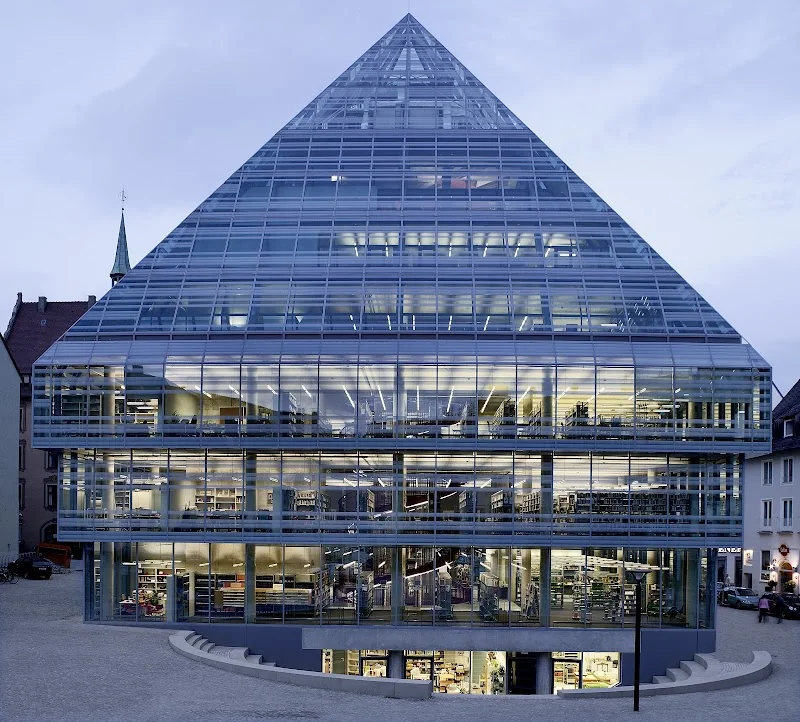
The City Library Ulm is much more than a place to borrow books. Located at Vestgasse 1, it combines the classic central library with a children's library, historical collections, digital services, and a modern makerspace. Those looking for opening hours, catalog, login, online borrowing, or extensions will find a library that consistently integrates analog reading, academic research, and digital use. The location serves as an urban meeting point and learning space for people from Ulm and the surrounding region, as access is not limited to residents of the city. This makes the library particularly interesting for anyone seeking a quiet workspace, current media, reliable online offerings, and an architecturally striking building. With its glass pyramid, district libraries, and mobile library, it covers a wide range of needs and offers a mix of everyday practice and cultural depth. ([stadtbibliothek.ulm.de](https://stadtbibliothek.ulm.de/allgemeine-infos/fragen-und-antworten))
Opening Hours, Locations, and Return Times in Ulm
The key orientation data for a visit is quickly clear: The central library and the district libraries of the City Library Ulm are closed on Mondays, Sundays, and public holidays. The central library at Vestgasse 1 is open from Tuesday to Friday from 10:00 AM to 7:00 PM. On Saturdays, the regular hours with staff are from 10:00 AM to 2:00 PM, followed by an extra time without library staff until 7:00 PM. This service-free time is explicitly suitable for reading, working, borrowing, and returning, but not for services requiring direct expert advice, such as registration, specific inquiries, interlibrary loan, or technical support. For returns outside regular opening hours, there are fixed time slots in the entrance area of the central library: Mondays from 7:30 AM to 6:00 PM, Tuesdays to Fridays from 7:30 AM to 10:00 AM and 7:00 PM to 7:15 PM, and Saturdays from 8:30 AM to 10:00 AM; on Swearing Monday, returns are also possible from 7:30 AM to 10:30 AM. Media from district libraries may not be deposited there. ([stadtbibliothek.ulm.de](https://stadtbibliothek.ulm.de/vor-ort/standorte-und-oeffnungszeiten))
The library includes several clearly separated locations with their own opening hours. The children's library is located at Vestgasse 1, just like the central library. The district library Böfingen is located at Haslacher Weg 93 and is open from Tuesday to Friday from 2:30 PM to 5:30 PM. The district library Eselsberg at Stifterweg 70 opens on Tuesdays from 10:00 AM to 12:00 PM and 2:30 PM to 6:00 PM, as well as Wednesdays to Fridays from 2:30 PM to 6:00 PM. The district library Weststadt at Moltkestraße 10 is accessible on Tuesdays from 10:00 AM to 12:00 PM and 2:30 PM to 6:00 PM, as well as Wednesdays to Fridays from 2:30 PM to 6:00 PM. The district library Wiblingen at Buchauer Straße 9 offers service hours on Tuesdays and Wednesdays from 2:30 PM to 5:30 PM, Thursdays from 1:00 PM to 5:30 PM, and Fridays from 10:00 AM to 12:00 PM and 2:30 PM to 5:30 PM. Additionally, the mobile library complements the network and visits various stops in a biweekly rotation. Those arriving by car should know: There is no parking directly at the building; the nearest paid parking garage is the underground garage at Am Rathaus, with further options being Fischerviertel, Kornhaus, and Frauenstraße. ([stadtbibliothek.ulm.de](https://stadtbibliothek.ulm.de/vor-ort/standorte-und-oeffnungszeiten))
Catalog, Login, and Online Account at the City Library Ulm
Among the most searched terms related to the City Library Ulm are catalog, login, account, and OPAC, and this is exactly where the library is very well positioned digitally. Through the catalog search, users can find media, place reservations, and use the advanced search, for example, when looking for a specific author or edition. To log in to the online catalog, users use their personal user number and the associated password. Online registration is also possible: The library's FAQ explains that one can first register digitally in the catalog and then complete the registration on-site or via email. For the initial registration, one typically needs an ID card or alternatively a passport with a registration certificate. Children under 14 years also require parental consent. This is particularly convenient for families, students, and people who do not live directly in Ulm, as the City Library explicitly makes its offerings accessible to non-residents as well. ([stadtbibliothek.ulm.de](https://stadtbibliothek.ulm.de/allgemeine-infos/fragen-und-antworten))
The basic digital offering also includes the WLAN SU-FREE, which is available in the library. This is helpful for anyone researching on-site, working on documents, or wanting to open digital content directly on their own device. Also important for orientation is the location magazine. Media marked as magazine stock are not freely accessible in the glass pyramid but are located in external rooms; they can be ordered and are usually available the next working day. The library makes it easy for its users to find specialized or less frequently borrowed media. Additionally, there is a dedicated section for digital offerings on the website, and the library's homepage links directly to account, loan periods, and media search. Those quickly searching for a specific book, magazine, or newspaper thus have a central digital entry point that meaningfully complements the on-site visit. This way, the search term catalog not only becomes a search engine but a real service path for research, reservation, and borrowing. ([stadtbibliothek.ulm.de](https://stadtbibliothek.ulm.de/allgemeine-infos/fragen-und-antworten))
Library Card, Extension, and Return in Ulm
A particularly important search topic is the library card. The City Library Ulm clearly states that the card is generally valid for one year and does not automatically renew. The extension can be done online through the personal user account or on-site at the information desk, where payment can also be made at the cash machine. This is helpful if one regularly uses their media or wants to permanently unlock digital offerings such as online borrowing and catalog access. When applying for a new card, one must bring an ID or passport along with a registration certificate to the library. For children under 14 years, parental consent is also required. If the card is lost, the loss must be reported; a new card will be issued in person. The library also states replacement fees: €2.50 for children and teenagers up to 18 years and €5 for adults. It is also worth mentioning that the library does not limit itself to a local target group: People without residence in Ulm or the immediate vicinity can also open a user account on-site or online and borrow media. ([stadtbibliothek.ulm.de](https://stadtbibliothek.ulm.de/allgemeine-infos/fragen-und-antworten))
Loan periods and return methods are also clearly regulated. According to the FAQ, books, board games, and music CDs can be borrowed for four weeks, and media can be extended up to three times, but magazines and bestsellers can only be extended once. Extensions are possible online in the user account or by phone around the clock. When returning media on-site, users use the self-checkout in the ground floor of the central library, and in the district libraries, the information desk. If an email address is provided, the library informs users before the loan period expires. Late fees apply for overdue items: for children, €0.10 per day and item, up to a maximum of €5, and for all other users, €0.30 per day and item, up to a maximum of €12. A practical addition is the return box in the entrance area of the central library with fixed opening hours. Those wanting a return receipt should return items during regular opening hours. On-site, fees can be paid in cash, with a debit card, or credit card; online, payment is possible via the user account using PayPal or credit card. Thus, the library is also very user-friendly organized in the area of borrowing and deadlines. ([stadtbibliothek.ulm.de](https://stadtbibliothek.ulm.de/allgemeine-infos/fragen-und-antworten))
Online Borrowing, E-Books, and Digital Offers for Home
The keyword online borrowing is one of the strongest signals for the digital use of the City Library Ulm, and the official pages make the offering very clear: Through online borrowing, eMedia for children and adults are available for borrowing. This includes novels and non-fiction books as eBooks, audiobooks as eAudios, music as eMusic, films as eVideos, as well as magazines and newspapers as ePapers. Additionally, e-learning is offered. The use is free for customers with a valid library card. This is one of the great advantages of the City Library, as it allows reading and listening not only on-site but also at home, on the go, or while traveling. The login is done via the online borrowing page with the known library user data: the user number is the card number, and the password is the date of birth in the format DD.MM.YYYY. The number can be found on the back of the library card under the barcode, including leading zeros. Those with technical questions are referred to the help pages of online borrowing; for problems with eMedia, the online borrowing contact form should be used. ([stadtbibliothek.ulm.de](https://stadtbibliothek.ulm.de/online/onleihe))
The loan periods are also transparent: eBooks, eAudios, eMusic, and eVideos are usually loaned for 14 days, while ePapers vary by medium, from one hour for daily newspapers to one day. Reservations for titles are free, but a maximum of five per library card. For use, the library recommends a current and compatible browser on a PC or laptop, as well as the online borrowing app for iOS or Android. At the same time, it points out that the system may not be compatible with all devices and platforms equally due to technical and licensing reasons. This is a fair and realistic assessment that helps users set their expectations correctly. Additionally, the City Library Ulm mentions e-learning and other digital sub-areas such as encyclopedias and online newspaper access on its website. So, anyone looking for a library that consists of more than just shelves but also considers a real digital everyday life will find a very broad offering in Ulm. ([stadtbibliothek.ulm.de](https://stadtbibliothek.ulm.de/online/onleihe))
Makerspace, Workspaces, and Events in the Glass Pyramid
A standout distinguishing feature of the City Library Ulm is its makerspace in the central library. The area is located on the ground floor of the glass pyramid and is accessible during the opening hours of the central library. It is explicitly intended for individuals and groups and follows the motto from idea to project. The library describes several workshop areas, including a digital and electronics workshop, a robotics workshop, a media workshop, and a textile workshop. In the digital workshop, among other things, 3D printers, pen plotters, and laser cutters can be used; the electronics workshop focuses on experimenting and repairing. The robotics workshop works with Arduino and NAO robots, the media workshop supports photography, video, light, and audio, and the textile workshop is equipped with professional sewing machines, overlock, coverlock, and embroidery machines. After an initial instruction, the devices may be used freely, and for larger projects lasting three hours or more, the library recommends prior consultation with the makerspace team. Particularly interesting for schools: groups of up to eight participants can work there. ([stadtbibliothek.ulm.de](https://stadtbibliothek.ulm.de/global/datenpool/organisationseinheiten/stadt-ulm/kultur/stadtbibliothek-ulm/makerspace))
However, the makerspace is just one component of the usability on-site. The library's FAQ also mention learning and workspaces in the glass pyramid, as well as printing, scanning, and copying options. The central library offers barrier-free access via two elevators, as well as accessible restrooms. The restrooms are spread over several floors, making the stay in the building more pleasant. Events are also an important topic: the homepage and event pages of the library regularly list readings, storytelling offers, workshops, the Silent Book Club, and formats for media literacy. The makerspace itself is complemented by instructions and regular appointments, so the place not only provides equipment but also educational support. Those looking for a place where reading, technology, creativity, and learning intersect will find an unusually versatile offering at the City Library Ulm. This is a clear strength of the institution, especially for families, student groups, and creative adults. ([stadtbibliothek.ulm.de](https://stadtbibliothek.ulm.de/allgemeine-infos/fragen-und-antworten))
Historical Collection and Architecture of the City Library Ulm
The City Library Ulm is not only modern but also historically exceptional. Its history dates back to a testamentary foundation by the Münsterpfarrer Ulrich Krafft from April 1, 1516. This makes it one of the oldest city libraries in Germany. The historical collection is correspondingly impressive: around 40,000 titles from before 1800 are included, as well as 470 manuscripts and fragments from the Middle Ages and early modern period, along with 620 incunabula. Among the special items is mentioned a single surviving copy of the lottery book by Lorenzo Spirito. The collections of the families Schad and Schermar are also part of this historical heritage. For those interested in book history, intellectual history, or regional tradition, the City Library is therefore much more than a general lending library. It is also a place of memory that has grown over centuries and remains scientifically relevant to this day. ([stadtbibliothek.ulm.de](https://stadtbibliothek.ulm.de/vor-ort/historischer-bestand?utm_source=openai))
Equally defining is the architecture of the central library. The building was opened in April 2004 after three years of construction and was designed by Gottfried Böhm. The glass pyramid reaches a height of 35 meters, with a red-painted spiral staircase and a double elevator shaping the interior impression. The reading café offers a panoramic view of the rooftops of Ulm's old town and the cathedral, while the west-facing forum allows for events. The FAQ also mention a spatial division with a lecture hall for 90 people, lending and return on the ground floor, children's library on the first floor, and reading café with gallery on the fifth floor. Technically interesting is also the RFID system for self-checkout: several stations for lending and return are available on the ground floor, with additional checkout terminals on the upper floors. This speeds up processes and relieves staff for consultation and programming. The combination of historical depth, architectural presence, and digital self-service makes the City Library Ulm a location that stands out both in content and space. ([stadtbibliothek.ulm.de](https://stadtbibliothek.ulm.de/allgemeine-infos/fragen-und-antworten))
Sources:
Mehr anzeigenWeniger anzeigen
City Library Ulm | Opening Hours & Online Catalog
The City Library Ulm is much more than a place to borrow books. Located at Vestgasse 1, it combines the classic central library with a children's library, historical collections, digital services, and a modern makerspace. Those looking for opening hours, catalog, login, online borrowing, or extensions will find a library that consistently integrates analog reading, academic research, and digital use. The location serves as an urban meeting point and learning space for people from Ulm and the surrounding region, as access is not limited to residents of the city. This makes the library particularly interesting for anyone seeking a quiet workspace, current media, reliable online offerings, and an architecturally striking building. With its glass pyramid, district libraries, and mobile library, it covers a wide range of needs and offers a mix of everyday practice and cultural depth. ([stadtbibliothek.ulm.de](https://stadtbibliothek.ulm.de/allgemeine-infos/fragen-und-antworten))
Opening Hours, Locations, and Return Times in Ulm
The key orientation data for a visit is quickly clear: The central library and the district libraries of the City Library Ulm are closed on Mondays, Sundays, and public holidays. The central library at Vestgasse 1 is open from Tuesday to Friday from 10:00 AM to 7:00 PM. On Saturdays, the regular hours with staff are from 10:00 AM to 2:00 PM, followed by an extra time without library staff until 7:00 PM. This service-free time is explicitly suitable for reading, working, borrowing, and returning, but not for services requiring direct expert advice, such as registration, specific inquiries, interlibrary loan, or technical support. For returns outside regular opening hours, there are fixed time slots in the entrance area of the central library: Mondays from 7:30 AM to 6:00 PM, Tuesdays to Fridays from 7:30 AM to 10:00 AM and 7:00 PM to 7:15 PM, and Saturdays from 8:30 AM to 10:00 AM; on Swearing Monday, returns are also possible from 7:30 AM to 10:30 AM. Media from district libraries may not be deposited there. ([stadtbibliothek.ulm.de](https://stadtbibliothek.ulm.de/vor-ort/standorte-und-oeffnungszeiten))
The library includes several clearly separated locations with their own opening hours. The children's library is located at Vestgasse 1, just like the central library. The district library Böfingen is located at Haslacher Weg 93 and is open from Tuesday to Friday from 2:30 PM to 5:30 PM. The district library Eselsberg at Stifterweg 70 opens on Tuesdays from 10:00 AM to 12:00 PM and 2:30 PM to 6:00 PM, as well as Wednesdays to Fridays from 2:30 PM to 6:00 PM. The district library Weststadt at Moltkestraße 10 is accessible on Tuesdays from 10:00 AM to 12:00 PM and 2:30 PM to 6:00 PM, as well as Wednesdays to Fridays from 2:30 PM to 6:00 PM. The district library Wiblingen at Buchauer Straße 9 offers service hours on Tuesdays and Wednesdays from 2:30 PM to 5:30 PM, Thursdays from 1:00 PM to 5:30 PM, and Fridays from 10:00 AM to 12:00 PM and 2:30 PM to 5:30 PM. Additionally, the mobile library complements the network and visits various stops in a biweekly rotation. Those arriving by car should know: There is no parking directly at the building; the nearest paid parking garage is the underground garage at Am Rathaus, with further options being Fischerviertel, Kornhaus, and Frauenstraße. ([stadtbibliothek.ulm.de](https://stadtbibliothek.ulm.de/vor-ort/standorte-und-oeffnungszeiten))
Catalog, Login, and Online Account at the City Library Ulm
Among the most searched terms related to the City Library Ulm are catalog, login, account, and OPAC, and this is exactly where the library is very well positioned digitally. Through the catalog search, users can find media, place reservations, and use the advanced search, for example, when looking for a specific author or edition. To log in to the online catalog, users use their personal user number and the associated password. Online registration is also possible: The library's FAQ explains that one can first register digitally in the catalog and then complete the registration on-site or via email. For the initial registration, one typically needs an ID card or alternatively a passport with a registration certificate. Children under 14 years also require parental consent. This is particularly convenient for families, students, and people who do not live directly in Ulm, as the City Library explicitly makes its offerings accessible to non-residents as well. ([stadtbibliothek.ulm.de](https://stadtbibliothek.ulm.de/allgemeine-infos/fragen-und-antworten))
The basic digital offering also includes the WLAN SU-FREE, which is available in the library. This is helpful for anyone researching on-site, working on documents, or wanting to open digital content directly on their own device. Also important for orientation is the location magazine. Media marked as magazine stock are not freely accessible in the glass pyramid but are located in external rooms; they can be ordered and are usually available the next working day. The library makes it easy for its users to find specialized or less frequently borrowed media. Additionally, there is a dedicated section for digital offerings on the website, and the library's homepage links directly to account, loan periods, and media search. Those quickly searching for a specific book, magazine, or newspaper thus have a central digital entry point that meaningfully complements the on-site visit. This way, the search term catalog not only becomes a search engine but a real service path for research, reservation, and borrowing. ([stadtbibliothek.ulm.de](https://stadtbibliothek.ulm.de/allgemeine-infos/fragen-und-antworten))
Library Card, Extension, and Return in Ulm
A particularly important search topic is the library card. The City Library Ulm clearly states that the card is generally valid for one year and does not automatically renew. The extension can be done online through the personal user account or on-site at the information desk, where payment can also be made at the cash machine. This is helpful if one regularly uses their media or wants to permanently unlock digital offerings such as online borrowing and catalog access. When applying for a new card, one must bring an ID or passport along with a registration certificate to the library. For children under 14 years, parental consent is also required. If the card is lost, the loss must be reported; a new card will be issued in person. The library also states replacement fees: €2.50 for children and teenagers up to 18 years and €5 for adults. It is also worth mentioning that the library does not limit itself to a local target group: People without residence in Ulm or the immediate vicinity can also open a user account on-site or online and borrow media. ([stadtbibliothek.ulm.de](https://stadtbibliothek.ulm.de/allgemeine-infos/fragen-und-antworten))
Loan periods and return methods are also clearly regulated. According to the FAQ, books, board games, and music CDs can be borrowed for four weeks, and media can be extended up to three times, but magazines and bestsellers can only be extended once. Extensions are possible online in the user account or by phone around the clock. When returning media on-site, users use the self-checkout in the ground floor of the central library, and in the district libraries, the information desk. If an email address is provided, the library informs users before the loan period expires. Late fees apply for overdue items: for children, €0.10 per day and item, up to a maximum of €5, and for all other users, €0.30 per day and item, up to a maximum of €12. A practical addition is the return box in the entrance area of the central library with fixed opening hours. Those wanting a return receipt should return items during regular opening hours. On-site, fees can be paid in cash, with a debit card, or credit card; online, payment is possible via the user account using PayPal or credit card. Thus, the library is also very user-friendly organized in the area of borrowing and deadlines. ([stadtbibliothek.ulm.de](https://stadtbibliothek.ulm.de/allgemeine-infos/fragen-und-antworten))
Online Borrowing, E-Books, and Digital Offers for Home
The keyword online borrowing is one of the strongest signals for the digital use of the City Library Ulm, and the official pages make the offering very clear: Through online borrowing, eMedia for children and adults are available for borrowing. This includes novels and non-fiction books as eBooks, audiobooks as eAudios, music as eMusic, films as eVideos, as well as magazines and newspapers as ePapers. Additionally, e-learning is offered. The use is free for customers with a valid library card. This is one of the great advantages of the City Library, as it allows reading and listening not only on-site but also at home, on the go, or while traveling. The login is done via the online borrowing page with the known library user data: the user number is the card number, and the password is the date of birth in the format DD.MM.YYYY. The number can be found on the back of the library card under the barcode, including leading zeros. Those with technical questions are referred to the help pages of online borrowing; for problems with eMedia, the online borrowing contact form should be used. ([stadtbibliothek.ulm.de](https://stadtbibliothek.ulm.de/online/onleihe))
The loan periods are also transparent: eBooks, eAudios, eMusic, and eVideos are usually loaned for 14 days, while ePapers vary by medium, from one hour for daily newspapers to one day. Reservations for titles are free, but a maximum of five per library card. For use, the library recommends a current and compatible browser on a PC or laptop, as well as the online borrowing app for iOS or Android. At the same time, it points out that the system may not be compatible with all devices and platforms equally due to technical and licensing reasons. This is a fair and realistic assessment that helps users set their expectations correctly. Additionally, the City Library Ulm mentions e-learning and other digital sub-areas such as encyclopedias and online newspaper access on its website. So, anyone looking for a library that consists of more than just shelves but also considers a real digital everyday life will find a very broad offering in Ulm. ([stadtbibliothek.ulm.de](https://stadtbibliothek.ulm.de/online/onleihe))
Makerspace, Workspaces, and Events in the Glass Pyramid
A standout distinguishing feature of the City Library Ulm is its makerspace in the central library. The area is located on the ground floor of the glass pyramid and is accessible during the opening hours of the central library. It is explicitly intended for individuals and groups and follows the motto from idea to project. The library describes several workshop areas, including a digital and electronics workshop, a robotics workshop, a media workshop, and a textile workshop. In the digital workshop, among other things, 3D printers, pen plotters, and laser cutters can be used; the electronics workshop focuses on experimenting and repairing. The robotics workshop works with Arduino and NAO robots, the media workshop supports photography, video, light, and audio, and the textile workshop is equipped with professional sewing machines, overlock, coverlock, and embroidery machines. After an initial instruction, the devices may be used freely, and for larger projects lasting three hours or more, the library recommends prior consultation with the makerspace team. Particularly interesting for schools: groups of up to eight participants can work there. ([stadtbibliothek.ulm.de](https://stadtbibliothek.ulm.de/global/datenpool/organisationseinheiten/stadt-ulm/kultur/stadtbibliothek-ulm/makerspace))
However, the makerspace is just one component of the usability on-site. The library's FAQ also mention learning and workspaces in the glass pyramid, as well as printing, scanning, and copying options. The central library offers barrier-free access via two elevators, as well as accessible restrooms. The restrooms are spread over several floors, making the stay in the building more pleasant. Events are also an important topic: the homepage and event pages of the library regularly list readings, storytelling offers, workshops, the Silent Book Club, and formats for media literacy. The makerspace itself is complemented by instructions and regular appointments, so the place not only provides equipment but also educational support. Those looking for a place where reading, technology, creativity, and learning intersect will find an unusually versatile offering at the City Library Ulm. This is a clear strength of the institution, especially for families, student groups, and creative adults. ([stadtbibliothek.ulm.de](https://stadtbibliothek.ulm.de/allgemeine-infos/fragen-und-antworten))
Historical Collection and Architecture of the City Library Ulm
The City Library Ulm is not only modern but also historically exceptional. Its history dates back to a testamentary foundation by the Münsterpfarrer Ulrich Krafft from April 1, 1516. This makes it one of the oldest city libraries in Germany. The historical collection is correspondingly impressive: around 40,000 titles from before 1800 are included, as well as 470 manuscripts and fragments from the Middle Ages and early modern period, along with 620 incunabula. Among the special items is mentioned a single surviving copy of the lottery book by Lorenzo Spirito. The collections of the families Schad and Schermar are also part of this historical heritage. For those interested in book history, intellectual history, or regional tradition, the City Library is therefore much more than a general lending library. It is also a place of memory that has grown over centuries and remains scientifically relevant to this day. ([stadtbibliothek.ulm.de](https://stadtbibliothek.ulm.de/vor-ort/historischer-bestand?utm_source=openai))
Equally defining is the architecture of the central library. The building was opened in April 2004 after three years of construction and was designed by Gottfried Böhm. The glass pyramid reaches a height of 35 meters, with a red-painted spiral staircase and a double elevator shaping the interior impression. The reading café offers a panoramic view of the rooftops of Ulm's old town and the cathedral, while the west-facing forum allows for events. The FAQ also mention a spatial division with a lecture hall for 90 people, lending and return on the ground floor, children's library on the first floor, and reading café with gallery on the fifth floor. Technically interesting is also the RFID system for self-checkout: several stations for lending and return are available on the ground floor, with additional checkout terminals on the upper floors. This speeds up processes and relieves staff for consultation and programming. The combination of historical depth, architectural presence, and digital self-service makes the City Library Ulm a location that stands out both in content and space. ([stadtbibliothek.ulm.de](https://stadtbibliothek.ulm.de/allgemeine-infos/fragen-und-antworten))
Sources:
City Library Ulm | Opening Hours & Online Catalog
The City Library Ulm is much more than a place to borrow books. Located at Vestgasse 1, it combines the classic central library with a children's library, historical collections, digital services, and a modern makerspace. Those looking for opening hours, catalog, login, online borrowing, or extensions will find a library that consistently integrates analog reading, academic research, and digital use. The location serves as an urban meeting point and learning space for people from Ulm and the surrounding region, as access is not limited to residents of the city. This makes the library particularly interesting for anyone seeking a quiet workspace, current media, reliable online offerings, and an architecturally striking building. With its glass pyramid, district libraries, and mobile library, it covers a wide range of needs and offers a mix of everyday practice and cultural depth. ([stadtbibliothek.ulm.de](https://stadtbibliothek.ulm.de/allgemeine-infos/fragen-und-antworten))
Opening Hours, Locations, and Return Times in Ulm
The key orientation data for a visit is quickly clear: The central library and the district libraries of the City Library Ulm are closed on Mondays, Sundays, and public holidays. The central library at Vestgasse 1 is open from Tuesday to Friday from 10:00 AM to 7:00 PM. On Saturdays, the regular hours with staff are from 10:00 AM to 2:00 PM, followed by an extra time without library staff until 7:00 PM. This service-free time is explicitly suitable for reading, working, borrowing, and returning, but not for services requiring direct expert advice, such as registration, specific inquiries, interlibrary loan, or technical support. For returns outside regular opening hours, there are fixed time slots in the entrance area of the central library: Mondays from 7:30 AM to 6:00 PM, Tuesdays to Fridays from 7:30 AM to 10:00 AM and 7:00 PM to 7:15 PM, and Saturdays from 8:30 AM to 10:00 AM; on Swearing Monday, returns are also possible from 7:30 AM to 10:30 AM. Media from district libraries may not be deposited there. ([stadtbibliothek.ulm.de](https://stadtbibliothek.ulm.de/vor-ort/standorte-und-oeffnungszeiten))
The library includes several clearly separated locations with their own opening hours. The children's library is located at Vestgasse 1, just like the central library. The district library Böfingen is located at Haslacher Weg 93 and is open from Tuesday to Friday from 2:30 PM to 5:30 PM. The district library Eselsberg at Stifterweg 70 opens on Tuesdays from 10:00 AM to 12:00 PM and 2:30 PM to 6:00 PM, as well as Wednesdays to Fridays from 2:30 PM to 6:00 PM. The district library Weststadt at Moltkestraße 10 is accessible on Tuesdays from 10:00 AM to 12:00 PM and 2:30 PM to 6:00 PM, as well as Wednesdays to Fridays from 2:30 PM to 6:00 PM. The district library Wiblingen at Buchauer Straße 9 offers service hours on Tuesdays and Wednesdays from 2:30 PM to 5:30 PM, Thursdays from 1:00 PM to 5:30 PM, and Fridays from 10:00 AM to 12:00 PM and 2:30 PM to 5:30 PM. Additionally, the mobile library complements the network and visits various stops in a biweekly rotation. Those arriving by car should know: There is no parking directly at the building; the nearest paid parking garage is the underground garage at Am Rathaus, with further options being Fischerviertel, Kornhaus, and Frauenstraße. ([stadtbibliothek.ulm.de](https://stadtbibliothek.ulm.de/vor-ort/standorte-und-oeffnungszeiten))
Catalog, Login, and Online Account at the City Library Ulm
Among the most searched terms related to the City Library Ulm are catalog, login, account, and OPAC, and this is exactly where the library is very well positioned digitally. Through the catalog search, users can find media, place reservations, and use the advanced search, for example, when looking for a specific author or edition. To log in to the online catalog, users use their personal user number and the associated password. Online registration is also possible: The library's FAQ explains that one can first register digitally in the catalog and then complete the registration on-site or via email. For the initial registration, one typically needs an ID card or alternatively a passport with a registration certificate. Children under 14 years also require parental consent. This is particularly convenient for families, students, and people who do not live directly in Ulm, as the City Library explicitly makes its offerings accessible to non-residents as well. ([stadtbibliothek.ulm.de](https://stadtbibliothek.ulm.de/allgemeine-infos/fragen-und-antworten))
The basic digital offering also includes the WLAN SU-FREE, which is available in the library. This is helpful for anyone researching on-site, working on documents, or wanting to open digital content directly on their own device. Also important for orientation is the location magazine. Media marked as magazine stock are not freely accessible in the glass pyramid but are located in external rooms; they can be ordered and are usually available the next working day. The library makes it easy for its users to find specialized or less frequently borrowed media. Additionally, there is a dedicated section for digital offerings on the website, and the library's homepage links directly to account, loan periods, and media search. Those quickly searching for a specific book, magazine, or newspaper thus have a central digital entry point that meaningfully complements the on-site visit. This way, the search term catalog not only becomes a search engine but a real service path for research, reservation, and borrowing. ([stadtbibliothek.ulm.de](https://stadtbibliothek.ulm.de/allgemeine-infos/fragen-und-antworten))
Library Card, Extension, and Return in Ulm
A particularly important search topic is the library card. The City Library Ulm clearly states that the card is generally valid for one year and does not automatically renew. The extension can be done online through the personal user account or on-site at the information desk, where payment can also be made at the cash machine. This is helpful if one regularly uses their media or wants to permanently unlock digital offerings such as online borrowing and catalog access. When applying for a new card, one must bring an ID or passport along with a registration certificate to the library. For children under 14 years, parental consent is also required. If the card is lost, the loss must be reported; a new card will be issued in person. The library also states replacement fees: €2.50 for children and teenagers up to 18 years and €5 for adults. It is also worth mentioning that the library does not limit itself to a local target group: People without residence in Ulm or the immediate vicinity can also open a user account on-site or online and borrow media. ([stadtbibliothek.ulm.de](https://stadtbibliothek.ulm.de/allgemeine-infos/fragen-und-antworten))
Loan periods and return methods are also clearly regulated. According to the FAQ, books, board games, and music CDs can be borrowed for four weeks, and media can be extended up to three times, but magazines and bestsellers can only be extended once. Extensions are possible online in the user account or by phone around the clock. When returning media on-site, users use the self-checkout in the ground floor of the central library, and in the district libraries, the information desk. If an email address is provided, the library informs users before the loan period expires. Late fees apply for overdue items: for children, €0.10 per day and item, up to a maximum of €5, and for all other users, €0.30 per day and item, up to a maximum of €12. A practical addition is the return box in the entrance area of the central library with fixed opening hours. Those wanting a return receipt should return items during regular opening hours. On-site, fees can be paid in cash, with a debit card, or credit card; online, payment is possible via the user account using PayPal or credit card. Thus, the library is also very user-friendly organized in the area of borrowing and deadlines. ([stadtbibliothek.ulm.de](https://stadtbibliothek.ulm.de/allgemeine-infos/fragen-und-antworten))
Online Borrowing, E-Books, and Digital Offers for Home
The keyword online borrowing is one of the strongest signals for the digital use of the City Library Ulm, and the official pages make the offering very clear: Through online borrowing, eMedia for children and adults are available for borrowing. This includes novels and non-fiction books as eBooks, audiobooks as eAudios, music as eMusic, films as eVideos, as well as magazines and newspapers as ePapers. Additionally, e-learning is offered. The use is free for customers with a valid library card. This is one of the great advantages of the City Library, as it allows reading and listening not only on-site but also at home, on the go, or while traveling. The login is done via the online borrowing page with the known library user data: the user number is the card number, and the password is the date of birth in the format DD.MM.YYYY. The number can be found on the back of the library card under the barcode, including leading zeros. Those with technical questions are referred to the help pages of online borrowing; for problems with eMedia, the online borrowing contact form should be used. ([stadtbibliothek.ulm.de](https://stadtbibliothek.ulm.de/online/onleihe))
The loan periods are also transparent: eBooks, eAudios, eMusic, and eVideos are usually loaned for 14 days, while ePapers vary by medium, from one hour for daily newspapers to one day. Reservations for titles are free, but a maximum of five per library card. For use, the library recommends a current and compatible browser on a PC or laptop, as well as the online borrowing app for iOS or Android. At the same time, it points out that the system may not be compatible with all devices and platforms equally due to technical and licensing reasons. This is a fair and realistic assessment that helps users set their expectations correctly. Additionally, the City Library Ulm mentions e-learning and other digital sub-areas such as encyclopedias and online newspaper access on its website. So, anyone looking for a library that consists of more than just shelves but also considers a real digital everyday life will find a very broad offering in Ulm. ([stadtbibliothek.ulm.de](https://stadtbibliothek.ulm.de/online/onleihe))
Makerspace, Workspaces, and Events in the Glass Pyramid
A standout distinguishing feature of the City Library Ulm is its makerspace in the central library. The area is located on the ground floor of the glass pyramid and is accessible during the opening hours of the central library. It is explicitly intended for individuals and groups and follows the motto from idea to project. The library describes several workshop areas, including a digital and electronics workshop, a robotics workshop, a media workshop, and a textile workshop. In the digital workshop, among other things, 3D printers, pen plotters, and laser cutters can be used; the electronics workshop focuses on experimenting and repairing. The robotics workshop works with Arduino and NAO robots, the media workshop supports photography, video, light, and audio, and the textile workshop is equipped with professional sewing machines, overlock, coverlock, and embroidery machines. After an initial instruction, the devices may be used freely, and for larger projects lasting three hours or more, the library recommends prior consultation with the makerspace team. Particularly interesting for schools: groups of up to eight participants can work there. ([stadtbibliothek.ulm.de](https://stadtbibliothek.ulm.de/global/datenpool/organisationseinheiten/stadt-ulm/kultur/stadtbibliothek-ulm/makerspace))
However, the makerspace is just one component of the usability on-site. The library's FAQ also mention learning and workspaces in the glass pyramid, as well as printing, scanning, and copying options. The central library offers barrier-free access via two elevators, as well as accessible restrooms. The restrooms are spread over several floors, making the stay in the building more pleasant. Events are also an important topic: the homepage and event pages of the library regularly list readings, storytelling offers, workshops, the Silent Book Club, and formats for media literacy. The makerspace itself is complemented by instructions and regular appointments, so the place not only provides equipment but also educational support. Those looking for a place where reading, technology, creativity, and learning intersect will find an unusually versatile offering at the City Library Ulm. This is a clear strength of the institution, especially for families, student groups, and creative adults. ([stadtbibliothek.ulm.de](https://stadtbibliothek.ulm.de/allgemeine-infos/fragen-und-antworten))
Historical Collection and Architecture of the City Library Ulm
The City Library Ulm is not only modern but also historically exceptional. Its history dates back to a testamentary foundation by the Münsterpfarrer Ulrich Krafft from April 1, 1516. This makes it one of the oldest city libraries in Germany. The historical collection is correspondingly impressive: around 40,000 titles from before 1800 are included, as well as 470 manuscripts and fragments from the Middle Ages and early modern period, along with 620 incunabula. Among the special items is mentioned a single surviving copy of the lottery book by Lorenzo Spirito. The collections of the families Schad and Schermar are also part of this historical heritage. For those interested in book history, intellectual history, or regional tradition, the City Library is therefore much more than a general lending library. It is also a place of memory that has grown over centuries and remains scientifically relevant to this day. ([stadtbibliothek.ulm.de](https://stadtbibliothek.ulm.de/vor-ort/historischer-bestand?utm_source=openai))
Equally defining is the architecture of the central library. The building was opened in April 2004 after three years of construction and was designed by Gottfried Böhm. The glass pyramid reaches a height of 35 meters, with a red-painted spiral staircase and a double elevator shaping the interior impression. The reading café offers a panoramic view of the rooftops of Ulm's old town and the cathedral, while the west-facing forum allows for events. The FAQ also mention a spatial division with a lecture hall for 90 people, lending and return on the ground floor, children's library on the first floor, and reading café with gallery on the fifth floor. Technically interesting is also the RFID system for self-checkout: several stations for lending and return are available on the ground floor, with additional checkout terminals on the upper floors. This speeds up processes and relieves staff for consultation and programming. The combination of historical depth, architectural presence, and digital self-service makes the City Library Ulm a location that stands out both in content and space. ([stadtbibliothek.ulm.de](https://stadtbibliothek.ulm.de/allgemeine-infos/fragen-und-antworten))
Sources:
Upcoming Events
No events found
Frequently Asked Questions
Reviews
Helen Ribeiro
7. April 2026
I love this place. A huge library with vast options for reading and researching, and also a calm place where you can study or chill while having a coffee cup ☕📚
Dingwen Yuan
10. June 2026
Love it, there are many books I liked except one I didn't find and it's very cozy.
Misha Horb
19. October 2024
Nice place for tourists too. Coffee, view, place to sit, and to read. Recommend. * But also remember that this is a library where people speak quietly.
Ramona Duma
16. October 2023
Very modern landmark of the city - the contrast of the pyramid-shaped glass building to the historic town hall is also eye-catching.
Frank Richi
10. March 2020
Beautiful place with summer concerts outside!