
Ulm
Weinhof 12, 89073 Ulm, Deutschland
Schwörhaus Ulm | Opening Hours & Exhibition
The Schwörhaus Ulm is much more than a historical building at Weinhof. It is a place where Ulm's history, city identity, and vibrant memory come together. Those searching for Schwörhaus Ulm opening hours, Schwörhaus Ulm exhibition, Weinhof 12 Ulm, photos, or maps will find a house that has shaped the character of the city for centuries. The Schwörhaus houses the House of City History and the City Archive of Ulm; the historic vaulted hall showcases the most important stages of Ulm's city history. At the same time, the place remains closely connected to the Schwör tradition, which makes Schwör Monday one of the most visible highlights in Ulm's annual calendar. The building stands at the oldest core of the city and combines historical substance with modern mediation, free admission, and a clear service profile for guests, researchers, and history enthusiasts. Therefore, anyone who wants not just to see a sight but to truly understand Ulm will find in the Schwörhaus a particularly dense and authentic access to the city. ([ulm.de](https://www.ulm.de/tourismus/stadtgeschichte/schicksalstage-und-orte/schwoerhaus))
Opening Hours and Admission at Schwörhaus Ulm
For many visitors, planning begins with the simplest but most important question: When is Schwörhaus Ulm open? The city history exhibition on the ground floor is accessible from Tuesday to Sunday from 11 AM to 5 PM; it is closed on public holidays. This makes the visit particularly suitable for a relaxed stroll through the old town, for a cultural morning, or as a program point before a walk to the cathedral, the town hall, or the nearby city center. The reading room of the city archive in the Schwörhaus, on the other hand, has its own hours: Monday from 8:30 AM to 12:00 PM, Tuesday and Wednesday additionally in the afternoon until 5:00 PM, Thursday until 6:00 PM. A reservation is recommended for archive visits to ensure that workspaces and archival materials can be prepared accordingly. Those specifically looking for opening hours often seek more orientation: In the Schwörhaus, this structure is clearly and friendly resolved. Visitors receive a publicly accessible exhibition on one hand and a professionally organized archive area on the other, which neatly separates research and use. This makes the place attractive for both spontaneous guests and planning researchers. ([stadtarchiv.ulm.de](https://stadtarchiv.ulm.de/ausstellungen/stadtgeschichtliche-dauerausstellung))
Admission is also a strong argument for a visit. The city history exhibition at Schwörhaus Ulm is free, making the location particularly interesting for families, school classes, cultural travelers, and anyone who wants to dive into Ulm's history without significant planning risks. Free here does not mean superficial, but deliberately low-threshold: Access to city history, exhibition rooms, and historical atmosphere should be open. Additionally, the barrier-free accessibility is explicitly confirmed at the location. Therefore, anyone searching for Schwörhaus Ulm free admission, opening hours, or exhibition will not find a classic museum with complicated pricing models, but a public historical site with clear times and good usability. This is also helpful for travelers who have little time and need to adjust their route in the old town spontaneously. Especially in conjunction with the address Weinhof 12, the proximity to the town hall, and the open character of the exhibition, it becomes clear: The Schwörhaus is not just a monument to look at, but an actively usable place of the city. ([stadtarchiv.ulm.de](https://stadtarchiv.ulm.de/ausstellungen/stadtgeschichtliche-dauerausstellung))
Exhibition, City Archive, and Ulm History
The actual core of the house is the permanent city history exhibition in the historic vaulted hall. There, the most important events and themes of Ulm's history from its beginnings to the present are told. The presentation works with exhibits, models, large-scale displays, and interactive media installations. This makes the tour not only informative but also vivid and varied. Particularly noteworthy is the architectural backdrop: The Schwörhaus is the only Schwörhaus from the imperial city period worldwide that was specifically built for the purpose of the Schwör tradition. The exhibition is therefore not only historically significant in content but also spatially embedded in a building that is itself part of history. On the west wall of the exhibition room, there are still block stones from the early 13th century that belonged to the older palace fortification. This makes the transition from the palace to the city directly visible in the space. For visitors, a very immediate experience of time is created: One does not just look at panels but stands in a place where medieval building substance, urban memory, and modern museum didactics come together. ([stadtarchiv.ulm.de](https://stadtarchiv.ulm.de/ausstellungen/stadtgeschichtliche-dauerausstellung))
However, the profile of the House of City History includes not only the exhibition but also the archive itself. The City Archive of Ulm is one of the oldest and most significant city archives in Germany and preserves an exceptionally rich collection: files, documents, council minutes, photographic collections, and other historical records. In the building at Weinhof, the historical collections and the permanent city history exhibition are housed; further collections are stored in other city facilities. It is important for the public that the house does not present itself as a closed administrative unit but as the memory of the city and as a central point of contact for questions about Ulm's history. This also includes publications, archive education for children and young people, educational work, and events. Particularly interesting is also the planned permanent exhibition on Albert Einstein and his Ulm family, which has been part of the House of City History since 2019. Thus, the Schwörhaus becomes a place where local history, scientific research, and mediation converge. This is exactly what makes the location relevant for search queries like City Archive Ulm, House of City History Ulm, or Schwörhaus Ulm exhibition. ([stadtarchiv.ulm.de](https://stadtarchiv.ulm.de/global/datenpool/organisationseinheiten/stadt-ulm/kultur/haus-der-stadtgeschichte-stadtarchiv))
History of the Schwörhaus at Weinhof
The history of the Schwörhaus does not begin with the construction of 1612, but much earlier. Weinhof is the oldest core of the city, and a royal palace has been documented there as early as 854. The city of Ulm did not randomly erect a landmark of its self-affirmation at this location, but on a site that has concentrated power, trade, and urban development for centuries. Initially, a smaller Schwörhäuslein stood on Weinhof, which was connected to Luginsland. When this building was demolished in 1612 due to dilapidation, it was decided not to relocate the oath act to any other place but to build a representative Schwörhaus. This is where the historical significance of the building lies: It was built as a stage for urban self-assertion. Later fires and war damage led to reconstructions in 1785 and again after 1944. The current building is therefore the result of a long series of renewals, during which the place has retained its function and symbolic power despite all the destruction. Those interested in Schwörhaus Ulm history recognize here a rare example of how urban tradition and architectural continuity intertwine over many centuries. ([ulm.de](https://www.ulm.de/tourismus/stadtgeschichte/schicksalstage-und-orte/schwoerhaus))
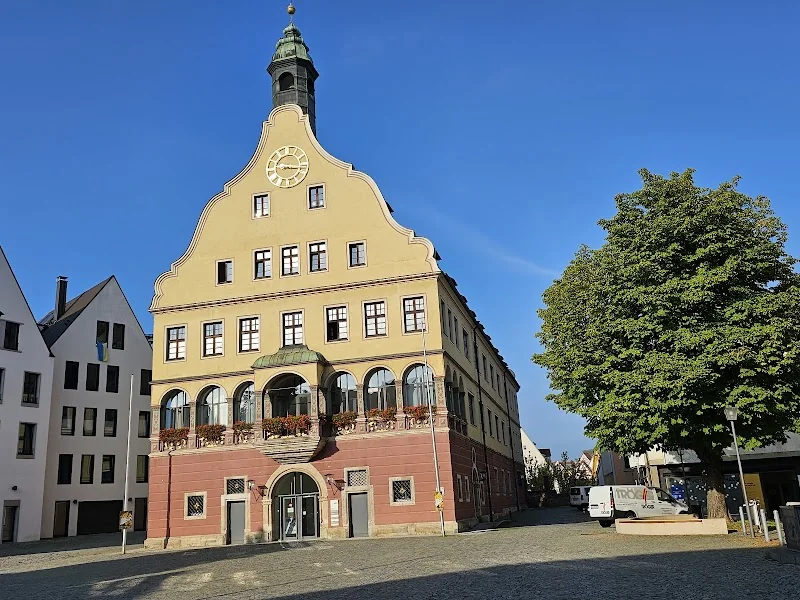
The Schwörhaus is particularly closely associated with Schwör Monday. Every year on the penultimate Monday of July, the Mayor of Ulm reports from the balcony of the Schwörhaus about the past year and renews the historical oath to the city constitution. This tradition connects to the Great Schwörbrief of 1397 and is understood as an expression of civic self-determination. The building is thus not only a museum house but an active place of political-cultural memory. The forecourt is also part of this: There is the Christof Fountain with a late Gothic figure of Christopher, which adds another historical layer to the square. Ulm's city history is therefore not told abstractly at this point but made visible in the urban space. Additionally, the Schwörhaus has recently been recognized as a place of German democracy history, which underscores the significance of the house beyond mere local history. For visitors searching for Schwörhaus Ulm photos, Schwör Monday Ulm, or history, this place offers an extraordinary interplay of ritual, architecture, and historical narrative. ([tourismus.ulm.de](https://tourismus.ulm.de/de/entdecken/sehen-und-erleben/sehenswuerdigkeiten/historisches/schwoerhaus-ulm?utm_source=openai))
Access, Parking, and Location in the Ulm Old Town
The Schwörhaus is centrally located at Weinhof 12 in 89073 Ulm and thus in the middle of the historic old town. Those arriving by car should know: There is no parking directly at the house. The nearest paid parking garage is called the underground garage at the town hall. Other nearby paid parking garages include Fischerviertel, Kornhaus, and Frauenstraße. For most guests, this is practical because the walk from there to the old town remains short and the visit can be well combined with a city stroll. Especially for search queries like Schwörhaus Ulm parking or Schwörhaus Ulm access, this information is crucial as it avoids unnecessary detours. The house is located in an area that is already strongly accessible on foot, so the last meters can be easily covered on foot. Those arriving by car can comfortably park in one of the surrounding garages and then experience Weinhof as a historical backdrop. The location is an advantage but also a hint at the typical structure of Ulm's city center: narrow, historical, pedestrian-friendly, and rather designed for short distances than for direct access right to the door. ([stadtarchiv.ulm.de](https://stadtarchiv.ulm.de/global/datenpool/organisationseinheiten/stadt-ulm/kultur/haus-der-stadtgeschichte-stadtarchiv))
The Schwörhaus is also easily accessible by public transport. The next stop is called Rathaus, which clearly facilitates orientation for visitors. From there, one can quickly reach Weinhof and thus directly into the historical core of the city experience. For anyone searching for Schwörhaus Ulm or Schwörhausgasse Ulm in maps or navigation services, the official address Weinhof 12 is the most reliable orientation. Especially in historical city locations, there are often spelling variants and search variants like Schwörerhaus Ulm or Schwörhausgasse, but for the journey, the clear house address ultimately counts. The good accessibility in the center is a plus for day visitors who are only planning a short stay, as well as for researchers visiting the reading room. Thanks to the barrier-free accessibility, usage is additionally facilitated. Thus, the Schwörhaus becomes not only a destination for culture enthusiasts but also a well-manageable place for anyone looking to efficiently plan their route in the city center. ([stadtarchiv.ulm.de](https://stadtarchiv.ulm.de/global/datenpool/organisationseinheiten/stadt-ulm/kultur/haus-der-stadtgeschichte-stadtarchiv))
Photos, Schwörsaal, and Practical Visiting Tips at Schwörhaus Ulm
Many people are not only looking for information but first for pictures: Schwörhaus Ulm photos, maps, or impressions from the balcony, from the vaulted hall, or from Weinhof. This place is very grateful for that, as it combines striking architecture with an urban environment that is immediately recognizable. Weinhof itself is a public square in front of the House of City History and is also used for cultural formats. This creates a lively environment where history and present do not disturb each other but complement each other. The perspective on the building is particularly attractive because the historical character of the house does not act through museum distance but through proximity. Therefore, those who photograph discover not just a facade but a narrative made of stone, balcony, square, and urban space. For a visit, it is worthwhile to plan a guided tour of the city history exhibition; this is conducted by the Ulm/Neu-Ulm Touristik GmbH. Thus, a short stop becomes a content-rich stay, where one better understands the building and its significance. This combination makes the Schwörhaus so strong for search queries with photos, exhibition, and history. ([ulm.de](https://www.ulm.de/kultur/ulmer-paradekonzerte?utm_source=openai))
The Schwörsaal is also an exciting additional aspect for many visitors. With the conversion of the Schwörhaus into the House of City History, a room was created that is suitable for special occasions. The hall is air-conditioned, barrier-free accessible, and designed for up to 20 people, although it is located in a historical environment. This includes, among other things, Wi-Fi, projector, screen, moderation set, and other components for small conferences or receptions. This mix of history and usability is remarkable because it shows that the Schwörhaus is not a static monument but a lively place of the city. Therefore, anyone searching for Schwörhaus Ulm capacity or a special room for small appointments will find here a very exclusive solution in a historical setting. For the regular museum visit, this means: The house is not only worth seeing but also functional and well organized. Those who plan their visit cleverly can combine the tour of the exhibition with a stroll through Weinhof, a look at the Christof Fountain, and a detour into the old town. This mix of history, cityscape, and practical accessibility makes the Schwörhaus one of the most interesting addresses in Ulm. ([tagen.ulm.de](https://tagen.ulm.de/tagen/de/locations/historisch/schwoersaal-ulm?utm_source=openai))
Sources:
Show moreShow less
Schwörhaus Ulm | Opening Hours & Exhibition
The Schwörhaus Ulm is much more than a historical building at Weinhof. It is a place where Ulm's history, city identity, and vibrant memory come together. Those searching for Schwörhaus Ulm opening hours, Schwörhaus Ulm exhibition, Weinhof 12 Ulm, photos, or maps will find a house that has shaped the character of the city for centuries. The Schwörhaus houses the House of City History and the City Archive of Ulm; the historic vaulted hall showcases the most important stages of Ulm's city history. At the same time, the place remains closely connected to the Schwör tradition, which makes Schwör Monday one of the most visible highlights in Ulm's annual calendar. The building stands at the oldest core of the city and combines historical substance with modern mediation, free admission, and a clear service profile for guests, researchers, and history enthusiasts. Therefore, anyone who wants not just to see a sight but to truly understand Ulm will find in the Schwörhaus a particularly dense and authentic access to the city. ([ulm.de](https://www.ulm.de/tourismus/stadtgeschichte/schicksalstage-und-orte/schwoerhaus))
Opening Hours and Admission at Schwörhaus Ulm
For many visitors, planning begins with the simplest but most important question: When is Schwörhaus Ulm open? The city history exhibition on the ground floor is accessible from Tuesday to Sunday from 11 AM to 5 PM; it is closed on public holidays. This makes the visit particularly suitable for a relaxed stroll through the old town, for a cultural morning, or as a program point before a walk to the cathedral, the town hall, or the nearby city center. The reading room of the city archive in the Schwörhaus, on the other hand, has its own hours: Monday from 8:30 AM to 12:00 PM, Tuesday and Wednesday additionally in the afternoon until 5:00 PM, Thursday until 6:00 PM. A reservation is recommended for archive visits to ensure that workspaces and archival materials can be prepared accordingly. Those specifically looking for opening hours often seek more orientation: In the Schwörhaus, this structure is clearly and friendly resolved. Visitors receive a publicly accessible exhibition on one hand and a professionally organized archive area on the other, which neatly separates research and use. This makes the place attractive for both spontaneous guests and planning researchers. ([stadtarchiv.ulm.de](https://stadtarchiv.ulm.de/ausstellungen/stadtgeschichtliche-dauerausstellung))
Admission is also a strong argument for a visit. The city history exhibition at Schwörhaus Ulm is free, making the location particularly interesting for families, school classes, cultural travelers, and anyone who wants to dive into Ulm's history without significant planning risks. Free here does not mean superficial, but deliberately low-threshold: Access to city history, exhibition rooms, and historical atmosphere should be open. Additionally, the barrier-free accessibility is explicitly confirmed at the location. Therefore, anyone searching for Schwörhaus Ulm free admission, opening hours, or exhibition will not find a classic museum with complicated pricing models, but a public historical site with clear times and good usability. This is also helpful for travelers who have little time and need to adjust their route in the old town spontaneously. Especially in conjunction with the address Weinhof 12, the proximity to the town hall, and the open character of the exhibition, it becomes clear: The Schwörhaus is not just a monument to look at, but an actively usable place of the city. ([stadtarchiv.ulm.de](https://stadtarchiv.ulm.de/ausstellungen/stadtgeschichtliche-dauerausstellung))
Exhibition, City Archive, and Ulm History
The actual core of the house is the permanent city history exhibition in the historic vaulted hall. There, the most important events and themes of Ulm's history from its beginnings to the present are told. The presentation works with exhibits, models, large-scale displays, and interactive media installations. This makes the tour not only informative but also vivid and varied. Particularly noteworthy is the architectural backdrop: The Schwörhaus is the only Schwörhaus from the imperial city period worldwide that was specifically built for the purpose of the Schwör tradition. The exhibition is therefore not only historically significant in content but also spatially embedded in a building that is itself part of history. On the west wall of the exhibition room, there are still block stones from the early 13th century that belonged to the older palace fortification. This makes the transition from the palace to the city directly visible in the space. For visitors, a very immediate experience of time is created: One does not just look at panels but stands in a place where medieval building substance, urban memory, and modern museum didactics come together. ([stadtarchiv.ulm.de](https://stadtarchiv.ulm.de/ausstellungen/stadtgeschichtliche-dauerausstellung))
However, the profile of the House of City History includes not only the exhibition but also the archive itself. The City Archive of Ulm is one of the oldest and most significant city archives in Germany and preserves an exceptionally rich collection: files, documents, council minutes, photographic collections, and other historical records. In the building at Weinhof, the historical collections and the permanent city history exhibition are housed; further collections are stored in other city facilities. It is important for the public that the house does not present itself as a closed administrative unit but as the memory of the city and as a central point of contact for questions about Ulm's history. This also includes publications, archive education for children and young people, educational work, and events. Particularly interesting is also the planned permanent exhibition on Albert Einstein and his Ulm family, which has been part of the House of City History since 2019. Thus, the Schwörhaus becomes a place where local history, scientific research, and mediation converge. This is exactly what makes the location relevant for search queries like City Archive Ulm, House of City History Ulm, or Schwörhaus Ulm exhibition. ([stadtarchiv.ulm.de](https://stadtarchiv.ulm.de/global/datenpool/organisationseinheiten/stadt-ulm/kultur/haus-der-stadtgeschichte-stadtarchiv))
History of the Schwörhaus at Weinhof
The history of the Schwörhaus does not begin with the construction of 1612, but much earlier. Weinhof is the oldest core of the city, and a royal palace has been documented there as early as 854. The city of Ulm did not randomly erect a landmark of its self-affirmation at this location, but on a site that has concentrated power, trade, and urban development for centuries. Initially, a smaller Schwörhäuslein stood on Weinhof, which was connected to Luginsland. When this building was demolished in 1612 due to dilapidation, it was decided not to relocate the oath act to any other place but to build a representative Schwörhaus. This is where the historical significance of the building lies: It was built as a stage for urban self-assertion. Later fires and war damage led to reconstructions in 1785 and again after 1944. The current building is therefore the result of a long series of renewals, during which the place has retained its function and symbolic power despite all the destruction. Those interested in Schwörhaus Ulm history recognize here a rare example of how urban tradition and architectural continuity intertwine over many centuries. ([ulm.de](https://www.ulm.de/tourismus/stadtgeschichte/schicksalstage-und-orte/schwoerhaus))
The Schwörhaus is particularly closely associated with Schwör Monday. Every year on the penultimate Monday of July, the Mayor of Ulm reports from the balcony of the Schwörhaus about the past year and renews the historical oath to the city constitution. This tradition connects to the Great Schwörbrief of 1397 and is understood as an expression of civic self-determination. The building is thus not only a museum house but an active place of political-cultural memory. The forecourt is also part of this: There is the Christof Fountain with a late Gothic figure of Christopher, which adds another historical layer to the square. Ulm's city history is therefore not told abstractly at this point but made visible in the urban space. Additionally, the Schwörhaus has recently been recognized as a place of German democracy history, which underscores the significance of the house beyond mere local history. For visitors searching for Schwörhaus Ulm photos, Schwör Monday Ulm, or history, this place offers an extraordinary interplay of ritual, architecture, and historical narrative. ([tourismus.ulm.de](https://tourismus.ulm.de/de/entdecken/sehen-und-erleben/sehenswuerdigkeiten/historisches/schwoerhaus-ulm?utm_source=openai))
Access, Parking, and Location in the Ulm Old Town
The Schwörhaus is centrally located at Weinhof 12 in 89073 Ulm and thus in the middle of the historic old town. Those arriving by car should know: There is no parking directly at the house. The nearest paid parking garage is called the underground garage at the town hall. Other nearby paid parking garages include Fischerviertel, Kornhaus, and Frauenstraße. For most guests, this is practical because the walk from there to the old town remains short and the visit can be well combined with a city stroll. Especially for search queries like Schwörhaus Ulm parking or Schwörhaus Ulm access, this information is crucial as it avoids unnecessary detours. The house is located in an area that is already strongly accessible on foot, so the last meters can be easily covered on foot. Those arriving by car can comfortably park in one of the surrounding garages and then experience Weinhof as a historical backdrop. The location is an advantage but also a hint at the typical structure of Ulm's city center: narrow, historical, pedestrian-friendly, and rather designed for short distances than for direct access right to the door. ([stadtarchiv.ulm.de](https://stadtarchiv.ulm.de/global/datenpool/organisationseinheiten/stadt-ulm/kultur/haus-der-stadtgeschichte-stadtarchiv))
The Schwörhaus is also easily accessible by public transport. The next stop is called Rathaus, which clearly facilitates orientation for visitors. From there, one can quickly reach Weinhof and thus directly into the historical core of the city experience. For anyone searching for Schwörhaus Ulm or Schwörhausgasse Ulm in maps or navigation services, the official address Weinhof 12 is the most reliable orientation. Especially in historical city locations, there are often spelling variants and search variants like Schwörerhaus Ulm or Schwörhausgasse, but for the journey, the clear house address ultimately counts. The good accessibility in the center is a plus for day visitors who are only planning a short stay, as well as for researchers visiting the reading room. Thanks to the barrier-free accessibility, usage is additionally facilitated. Thus, the Schwörhaus becomes not only a destination for culture enthusiasts but also a well-manageable place for anyone looking to efficiently plan their route in the city center. ([stadtarchiv.ulm.de](https://stadtarchiv.ulm.de/global/datenpool/organisationseinheiten/stadt-ulm/kultur/haus-der-stadtgeschichte-stadtarchiv))
Photos, Schwörsaal, and Practical Visiting Tips at Schwörhaus Ulm
Many people are not only looking for information but first for pictures: Schwörhaus Ulm photos, maps, or impressions from the balcony, from the vaulted hall, or from Weinhof. This place is very grateful for that, as it combines striking architecture with an urban environment that is immediately recognizable. Weinhof itself is a public square in front of the House of City History and is also used for cultural formats. This creates a lively environment where history and present do not disturb each other but complement each other. The perspective on the building is particularly attractive because the historical character of the house does not act through museum distance but through proximity. Therefore, those who photograph discover not just a facade but a narrative made of stone, balcony, square, and urban space. For a visit, it is worthwhile to plan a guided tour of the city history exhibition; this is conducted by the Ulm/Neu-Ulm Touristik GmbH. Thus, a short stop becomes a content-rich stay, where one better understands the building and its significance. This combination makes the Schwörhaus so strong for search queries with photos, exhibition, and history. ([ulm.de](https://www.ulm.de/kultur/ulmer-paradekonzerte?utm_source=openai))
The Schwörsaal is also an exciting additional aspect for many visitors. With the conversion of the Schwörhaus into the House of City History, a room was created that is suitable for special occasions. The hall is air-conditioned, barrier-free accessible, and designed for up to 20 people, although it is located in a historical environment. This includes, among other things, Wi-Fi, projector, screen, moderation set, and other components for small conferences or receptions. This mix of history and usability is remarkable because it shows that the Schwörhaus is not a static monument but a lively place of the city. Therefore, anyone searching for Schwörhaus Ulm capacity or a special room for small appointments will find here a very exclusive solution in a historical setting. For the regular museum visit, this means: The house is not only worth seeing but also functional and well organized. Those who plan their visit cleverly can combine the tour of the exhibition with a stroll through Weinhof, a look at the Christof Fountain, and a detour into the old town. This mix of history, cityscape, and practical accessibility makes the Schwörhaus one of the most interesting addresses in Ulm. ([tagen.ulm.de](https://tagen.ulm.de/tagen/de/locations/historisch/schwoersaal-ulm?utm_source=openai))
Sources:
Schwörhaus Ulm | Opening Hours & Exhibition
The Schwörhaus Ulm is much more than a historical building at Weinhof. It is a place where Ulm's history, city identity, and vibrant memory come together. Those searching for Schwörhaus Ulm opening hours, Schwörhaus Ulm exhibition, Weinhof 12 Ulm, photos, or maps will find a house that has shaped the character of the city for centuries. The Schwörhaus houses the House of City History and the City Archive of Ulm; the historic vaulted hall showcases the most important stages of Ulm's city history. At the same time, the place remains closely connected to the Schwör tradition, which makes Schwör Monday one of the most visible highlights in Ulm's annual calendar. The building stands at the oldest core of the city and combines historical substance with modern mediation, free admission, and a clear service profile for guests, researchers, and history enthusiasts. Therefore, anyone who wants not just to see a sight but to truly understand Ulm will find in the Schwörhaus a particularly dense and authentic access to the city. ([ulm.de](https://www.ulm.de/tourismus/stadtgeschichte/schicksalstage-und-orte/schwoerhaus))
Opening Hours and Admission at Schwörhaus Ulm
For many visitors, planning begins with the simplest but most important question: When is Schwörhaus Ulm open? The city history exhibition on the ground floor is accessible from Tuesday to Sunday from 11 AM to 5 PM; it is closed on public holidays. This makes the visit particularly suitable for a relaxed stroll through the old town, for a cultural morning, or as a program point before a walk to the cathedral, the town hall, or the nearby city center. The reading room of the city archive in the Schwörhaus, on the other hand, has its own hours: Monday from 8:30 AM to 12:00 PM, Tuesday and Wednesday additionally in the afternoon until 5:00 PM, Thursday until 6:00 PM. A reservation is recommended for archive visits to ensure that workspaces and archival materials can be prepared accordingly. Those specifically looking for opening hours often seek more orientation: In the Schwörhaus, this structure is clearly and friendly resolved. Visitors receive a publicly accessible exhibition on one hand and a professionally organized archive area on the other, which neatly separates research and use. This makes the place attractive for both spontaneous guests and planning researchers. ([stadtarchiv.ulm.de](https://stadtarchiv.ulm.de/ausstellungen/stadtgeschichtliche-dauerausstellung))
Admission is also a strong argument for a visit. The city history exhibition at Schwörhaus Ulm is free, making the location particularly interesting for families, school classes, cultural travelers, and anyone who wants to dive into Ulm's history without significant planning risks. Free here does not mean superficial, but deliberately low-threshold: Access to city history, exhibition rooms, and historical atmosphere should be open. Additionally, the barrier-free accessibility is explicitly confirmed at the location. Therefore, anyone searching for Schwörhaus Ulm free admission, opening hours, or exhibition will not find a classic museum with complicated pricing models, but a public historical site with clear times and good usability. This is also helpful for travelers who have little time and need to adjust their route in the old town spontaneously. Especially in conjunction with the address Weinhof 12, the proximity to the town hall, and the open character of the exhibition, it becomes clear: The Schwörhaus is not just a monument to look at, but an actively usable place of the city. ([stadtarchiv.ulm.de](https://stadtarchiv.ulm.de/ausstellungen/stadtgeschichtliche-dauerausstellung))
Exhibition, City Archive, and Ulm History
The actual core of the house is the permanent city history exhibition in the historic vaulted hall. There, the most important events and themes of Ulm's history from its beginnings to the present are told. The presentation works with exhibits, models, large-scale displays, and interactive media installations. This makes the tour not only informative but also vivid and varied. Particularly noteworthy is the architectural backdrop: The Schwörhaus is the only Schwörhaus from the imperial city period worldwide that was specifically built for the purpose of the Schwör tradition. The exhibition is therefore not only historically significant in content but also spatially embedded in a building that is itself part of history. On the west wall of the exhibition room, there are still block stones from the early 13th century that belonged to the older palace fortification. This makes the transition from the palace to the city directly visible in the space. For visitors, a very immediate experience of time is created: One does not just look at panels but stands in a place where medieval building substance, urban memory, and modern museum didactics come together. ([stadtarchiv.ulm.de](https://stadtarchiv.ulm.de/ausstellungen/stadtgeschichtliche-dauerausstellung))
However, the profile of the House of City History includes not only the exhibition but also the archive itself. The City Archive of Ulm is one of the oldest and most significant city archives in Germany and preserves an exceptionally rich collection: files, documents, council minutes, photographic collections, and other historical records. In the building at Weinhof, the historical collections and the permanent city history exhibition are housed; further collections are stored in other city facilities. It is important for the public that the house does not present itself as a closed administrative unit but as the memory of the city and as a central point of contact for questions about Ulm's history. This also includes publications, archive education for children and young people, educational work, and events. Particularly interesting is also the planned permanent exhibition on Albert Einstein and his Ulm family, which has been part of the House of City History since 2019. Thus, the Schwörhaus becomes a place where local history, scientific research, and mediation converge. This is exactly what makes the location relevant for search queries like City Archive Ulm, House of City History Ulm, or Schwörhaus Ulm exhibition. ([stadtarchiv.ulm.de](https://stadtarchiv.ulm.de/global/datenpool/organisationseinheiten/stadt-ulm/kultur/haus-der-stadtgeschichte-stadtarchiv))
History of the Schwörhaus at Weinhof
The history of the Schwörhaus does not begin with the construction of 1612, but much earlier. Weinhof is the oldest core of the city, and a royal palace has been documented there as early as 854. The city of Ulm did not randomly erect a landmark of its self-affirmation at this location, but on a site that has concentrated power, trade, and urban development for centuries. Initially, a smaller Schwörhäuslein stood on Weinhof, which was connected to Luginsland. When this building was demolished in 1612 due to dilapidation, it was decided not to relocate the oath act to any other place but to build a representative Schwörhaus. This is where the historical significance of the building lies: It was built as a stage for urban self-assertion. Later fires and war damage led to reconstructions in 1785 and again after 1944. The current building is therefore the result of a long series of renewals, during which the place has retained its function and symbolic power despite all the destruction. Those interested in Schwörhaus Ulm history recognize here a rare example of how urban tradition and architectural continuity intertwine over many centuries. ([ulm.de](https://www.ulm.de/tourismus/stadtgeschichte/schicksalstage-und-orte/schwoerhaus))
The Schwörhaus is particularly closely associated with Schwör Monday. Every year on the penultimate Monday of July, the Mayor of Ulm reports from the balcony of the Schwörhaus about the past year and renews the historical oath to the city constitution. This tradition connects to the Great Schwörbrief of 1397 and is understood as an expression of civic self-determination. The building is thus not only a museum house but an active place of political-cultural memory. The forecourt is also part of this: There is the Christof Fountain with a late Gothic figure of Christopher, which adds another historical layer to the square. Ulm's city history is therefore not told abstractly at this point but made visible in the urban space. Additionally, the Schwörhaus has recently been recognized as a place of German democracy history, which underscores the significance of the house beyond mere local history. For visitors searching for Schwörhaus Ulm photos, Schwör Monday Ulm, or history, this place offers an extraordinary interplay of ritual, architecture, and historical narrative. ([tourismus.ulm.de](https://tourismus.ulm.de/de/entdecken/sehen-und-erleben/sehenswuerdigkeiten/historisches/schwoerhaus-ulm?utm_source=openai))
Access, Parking, and Location in the Ulm Old Town
The Schwörhaus is centrally located at Weinhof 12 in 89073 Ulm and thus in the middle of the historic old town. Those arriving by car should know: There is no parking directly at the house. The nearest paid parking garage is called the underground garage at the town hall. Other nearby paid parking garages include Fischerviertel, Kornhaus, and Frauenstraße. For most guests, this is practical because the walk from there to the old town remains short and the visit can be well combined with a city stroll. Especially for search queries like Schwörhaus Ulm parking or Schwörhaus Ulm access, this information is crucial as it avoids unnecessary detours. The house is located in an area that is already strongly accessible on foot, so the last meters can be easily covered on foot. Those arriving by car can comfortably park in one of the surrounding garages and then experience Weinhof as a historical backdrop. The location is an advantage but also a hint at the typical structure of Ulm's city center: narrow, historical, pedestrian-friendly, and rather designed for short distances than for direct access right to the door. ([stadtarchiv.ulm.de](https://stadtarchiv.ulm.de/global/datenpool/organisationseinheiten/stadt-ulm/kultur/haus-der-stadtgeschichte-stadtarchiv))
The Schwörhaus is also easily accessible by public transport. The next stop is called Rathaus, which clearly facilitates orientation for visitors. From there, one can quickly reach Weinhof and thus directly into the historical core of the city experience. For anyone searching for Schwörhaus Ulm or Schwörhausgasse Ulm in maps or navigation services, the official address Weinhof 12 is the most reliable orientation. Especially in historical city locations, there are often spelling variants and search variants like Schwörerhaus Ulm or Schwörhausgasse, but for the journey, the clear house address ultimately counts. The good accessibility in the center is a plus for day visitors who are only planning a short stay, as well as for researchers visiting the reading room. Thanks to the barrier-free accessibility, usage is additionally facilitated. Thus, the Schwörhaus becomes not only a destination for culture enthusiasts but also a well-manageable place for anyone looking to efficiently plan their route in the city center. ([stadtarchiv.ulm.de](https://stadtarchiv.ulm.de/global/datenpool/organisationseinheiten/stadt-ulm/kultur/haus-der-stadtgeschichte-stadtarchiv))
Photos, Schwörsaal, and Practical Visiting Tips at Schwörhaus Ulm
Many people are not only looking for information but first for pictures: Schwörhaus Ulm photos, maps, or impressions from the balcony, from the vaulted hall, or from Weinhof. This place is very grateful for that, as it combines striking architecture with an urban environment that is immediately recognizable. Weinhof itself is a public square in front of the House of City History and is also used for cultural formats. This creates a lively environment where history and present do not disturb each other but complement each other. The perspective on the building is particularly attractive because the historical character of the house does not act through museum distance but through proximity. Therefore, those who photograph discover not just a facade but a narrative made of stone, balcony, square, and urban space. For a visit, it is worthwhile to plan a guided tour of the city history exhibition; this is conducted by the Ulm/Neu-Ulm Touristik GmbH. Thus, a short stop becomes a content-rich stay, where one better understands the building and its significance. This combination makes the Schwörhaus so strong for search queries with photos, exhibition, and history. ([ulm.de](https://www.ulm.de/kultur/ulmer-paradekonzerte?utm_source=openai))
The Schwörsaal is also an exciting additional aspect for many visitors. With the conversion of the Schwörhaus into the House of City History, a room was created that is suitable for special occasions. The hall is air-conditioned, barrier-free accessible, and designed for up to 20 people, although it is located in a historical environment. This includes, among other things, Wi-Fi, projector, screen, moderation set, and other components for small conferences or receptions. This mix of history and usability is remarkable because it shows that the Schwörhaus is not a static monument but a lively place of the city. Therefore, anyone searching for Schwörhaus Ulm capacity or a special room for small appointments will find here a very exclusive solution in a historical setting. For the regular museum visit, this means: The house is not only worth seeing but also functional and well organized. Those who plan their visit cleverly can combine the tour of the exhibition with a stroll through Weinhof, a look at the Christof Fountain, and a detour into the old town. This mix of history, cityscape, and practical accessibility makes the Schwörhaus one of the most interesting addresses in Ulm. ([tagen.ulm.de](https://tagen.ulm.de/tagen/de/locations/historisch/schwoersaal-ulm?utm_source=openai))
Sources:
Upcoming Events
No events found
Frequently Asked Questions
Reviews
Maxim Wolf
24. December 2025
A phenomenal experience! Schwörhaus is an impressive building with a rich history, the exhibitions are very informative, and the staff are exceptionally friendly. The atmosphere is warm and welcoming.
david antoun
21. December 2023
It is the house where traditionally the citizens swear their oath to the city rules. Still happens till now. But it is a closed building, although the exterior is renovated with an old style.
Rawad Bitar
6. June 2022
Nice historical place worth a visit from the inside and the outside.
GermanMaKo
16. December 2021
Every year, the mayor comes out to promise to his people various stuff. I never believe his words and probably never will, because he is telling truth only 80% of the time, but the building still looks cool!
Desmond Oderah Simeon
14. December 2017
That was the place the oldest building in the city was found.