
Ulm
Wengengasse 6, 89073 Ulm, Deutschland
St. Michael to the Wengen | Photos & Reviews
St. Michael to the Wengen, also known as Wengen Church, is a Catholic parish church located in the heart of Ulm and belongs to the pastoral care unit Ulm Mitte-Ost. The address at Wengengasse 6 immediately clarifies why this church is perceived as a spiritual center in the heart of the city by many people: It is not on the outskirts, but in the vibrant old town and city center, where faith, history, music, and urban life are closely intertwined. Those looking for photos, reviews, or the unique character of Wengen Church quickly encounter a place that plays a significant role not only religiously but also culturally and historically. The available location data also shows a very good rating of 4.6 stars based on 73 reviews, highlighting the high attention and positive perception of the place. Thus, Wengen Church is much more than just an address on the map: it is a place of strong identity for worship, encounter, and culture in Ulm. ([katholische-kirche-ulm.de](https://katholische-kirche-ulm.de/kirchengemeinden/st-michael-zu-den-wengen/))
History and Spiritual Significance of Wengen Church
The history of St. Michael to the Wengen is exceptionally long and moving. The official history page of the pastoral care unit Ulm Mitte-Ost reports that the first church was built on today's Michelsberg as early as 1183, which was cared for by Augustinian canons. In 1215, they moved their seat to the Blauinseln and built the second St. Michael Church there, which was named St. Michael to the Wengen. Following a municipal resolution, the church and monastery had to be demolished again in 1377, but in 1399, the foundation stone for a new monastery with a new church could be laid at today's location. This sequence makes it clear that Wengen Church is not a static building but the result of several historical upheavals, relocations, and new beginnings. The current church thus carries not only a name but also the memory of many centuries of Ulm's city and church history in its substance. ([katholische-kirche-ulm-mitte-ost.de](https://katholische-kirche-ulm-mitte-ost.de/geschichte/))
Particularly exciting is the development after the Reformation and after secularization. The official history page describes that during the Reformation, despite difficult conditions, the Wengen Monastery became the church center for the few Catholics remaining in Ulm. It remained a place where Eucharist could be celebrated and where pastoral care, education, and music mutually reinforced each other. The canons pursued scientific studies and cared for the Lukas Brotherhood of artists, showing how closely religious and cultural education were intertwined in this milieu. After secularization in 1802/03, St. Michael became the first Catholic parish church in Ulm, and with the reconstruction after World War II, the community once again gained a strong center in the midst of the city. This explains why Wengen Church is still perceived as a church in the heart of Ulm today: it stands for continuity despite breaks, for new beginnings despite loss, and for a long Catholic presence in a city whose religious history has been reshaped multiple times. ([katholische-kirche-ulm-mitte-ost.de](https://katholische-kirche-ulm-mitte-ost.de/geschichte/))
Another key to the significance of the church lies in its role as a spiritual and pastoral center. The official community page explicitly invites people to take advantage of the diverse offerings of the parish and to attend services and events. This aligns with the historical line of the history page, which describes St. Michael as a place where the small Catholic community could gather in the predominantly Protestant Ulm. Today, this function continues, but in a modern form: as a city church, as a place for conversations, as a space for cultural formats, and as a spiritual anchor in the city center. Therefore, those searching for Wengen Church Ulm or St. Michael to the Wengen Ulm are often looking not just for a building but for a place with identity, history, and lived presence. This is precisely the special appeal of this church: it is historically significant and at the same time embedded in the everyday life of the city. ([katholische-kirche-ulm.de](https://katholische-kirche-ulm.de/kirchengemeinden/st-michael-zu-den-wengen/))
Architecture, Interior, and Photos of Wengen Church
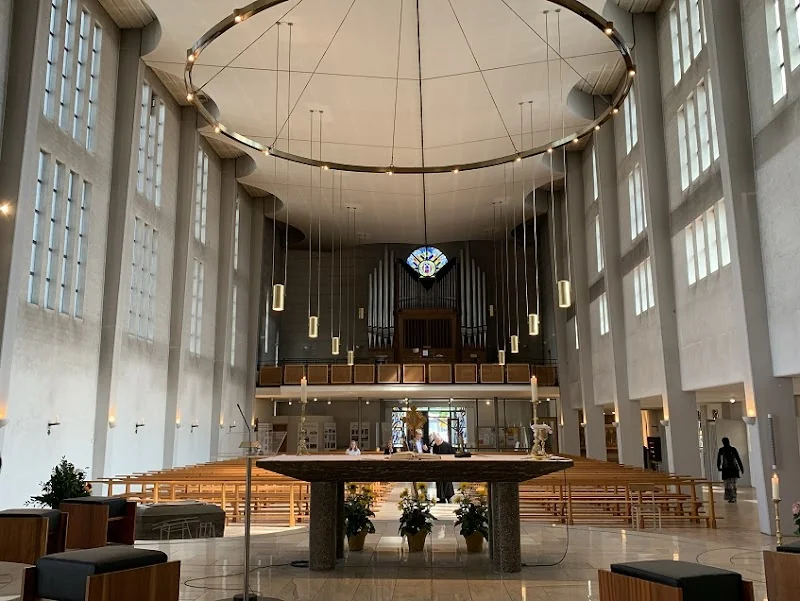
The current form of St. Michael to the Wengen is the result of a tumultuous construction and reconstruction history. The official history page describes that the church was rebuilt in a new form after its destruction in the war in 1953/54 and underwent a final interior renovation in 1996/97, which gave it its current character. As early as the 17th and 18th centuries, the house of worship had been characterized by Baroque and later Rococo styles; the sides and the interior were repeatedly stylistically adjusted. Particularly noteworthy is the reference to the magnificent frescoes by Franz Martin Kuen, which were created starting in 1743. Although the current interior has a different character after the war destruction and reconstruction than the earlier Baroque furnishings, Wengen Church remains a place where historical depth and modern form come together palpably. Those interested in architecture in Ulm will find here not a sleek new building but a space where several layers of time have become visible. ([katholische-kirche-ulm-mitte-ost.de](https://katholische-kirche-ulm-mitte-ost.de/geschichte/))
For anyone searching for photos or images of St. Michael to the Wengen, not only current images are interesting but also historical views. The city archive of Ulm has its own gallery titled Wengen Church and Monastery, which refers to views from the 17th to the 19th century. This is particularly valuable for visual research, as these images allow for the development of the place to be traced over long periods. Additionally, current motifs from the church's present, such as the installation 14 Cloths for Lent, are presented on the official pages of the parish. It is also explained there that the new installation by Marianne Hollenstein references the tradition of hunger cloths and with its 14 cloths refers to the stations of the cross. For search queries like St. Michael to the Wengen photos or images of St. Michael to the Wengen Ulm, this is important: the church is not only historically photogenic but is also repeatedly a stage for art in the church space. ([stadtarchiv.ulm.de](https://stadtarchiv.ulm.de/sonderseiten/galerieseite?sc_galleryId=e94e0b2e-81e3-4f58-8249-944be00fa378))
This connection of architecture, art, and liturgy makes Wengen Church particularly attractive for photographs. Historical images tell of the monastery, the city, and change; current pictures show the place as a vibrant city church with contemporary installations, services, and cultural events. When thinking of photographs, one should therefore not only consider the external appearance but also the atmosphere inside: the interplay between sacred calm and open urban culture, between old history and new use. This is a key reason why search queries for photos, images, and reviews of this church often come together. Wengen Church provides visual impressions that go beyond mere architectural details: it shows a church that stands in the city but does not live at a distance from it. The images tell of a place that gains its character precisely through its complexity. ([stadtarchiv.ulm.de](https://stadtarchiv.ulm.de/sonderseiten/galerieseite?sc_galleryId=e94e0b2e-81e3-4f58-8249-944be00fa378))
Services, Concerts, and Cultural Events
St. Michael to the Wengen is today not only a parish church but also a versatile event venue. The official community page lists current offerings including services, the 2026 program, the rosary prayer of the Philippine community in the Small Wengen Church, and a theater service on Mephisto. The page for the Lent installation 14 Cloths also shows how closely art, spirituality, and conversation formats are thought together here: vernissages, finissages, tours, music, dance, and impulses are explicitly part of the concept. The opportunity for conversation with a pastor at the WengenPortal on Mondays and Fridays also shows that Wengen Church is not only there for significant liturgical moments but also for personal concerns, prayer, and support. For people searching for Wengen Church Ulm events or services Wengen Church Ulm, this is an important insight: the place thrives on its mix of classical pastoral care, cultural work, and open city church. ([katholische-kirche-ulm.de](https://katholische-kirche-ulm.de/kirchengemeinden/st-michael-zu-den-wengen/))
The musical dimension has a particularly long tradition at St. Michael to the Wengen. The history page emphasizes that the canons, through the cultivation of science and music, generated diverse religious impulses. Even in earlier centuries, the church was not only a place of prayer but also a musical and cultural resonance space. This tradition continues to the present day: the official and municipal event calendars repeatedly feature concerts in Wengen Church, including the series Sperrstunde - Hip Hop in Wengen Church, where local and regional acts perform live in the church. Additional concert formats appear in the church and municipal event overview. This shows that Wengen Church in Ulm has become an open sound space where spiritual music, experimental formats, and concerts can coexist. Therefore, those searching for events in Wengen Church will find not only classical church music but a surprisingly wide range from spiritual to urban, from meditative to energetic. ([katholische-kirche-ulm-mitte-ost.de](https://katholische-kirche-ulm-mitte-ost.de/geschichte/))
It is particularly interesting that Wengen Church is also used as a place for special liturgical and ecumenical moments. The official pages mention, among other things, the Good Friday liturgy for the pastoral care unit St. Georg and St. Michael to the Wengen, as well as other services that throughout the year make the connection between the communities visible. There is thus no rigid separation between community life and culture, but a lively transition: devotion, concert, conversation, exhibition, and pastoral care do not stand alongside each other as competition but complement each other. This is exactly what makes Wengen Church so attractive for visitors. Those who do not know the church may expect primarily a sacred space; those who visit often discover a place where faith is presented in an urban form. For Ulm, this is an important cultural added value because the church remains visible far beyond its local community. ([katholische-kirche-ulm.de](https://katholische-kirche-ulm.de/kirchengemeinden/st-michael-zu-den-wengen/))
Directions by Bus and Train to Wengen Church
Getting to St. Michael to the Wengen is uncomplicated because the church is centrally located in the city center and close to the main train station. The Ulm Theater lists the address Wengengasse 6, 89073 Ulm, explicitly describes the location as city center, near the main train station, and recommends traveling by bus to the main train station. Bus lines 1, 2, 5, 6, 7, and 10 are mentioned; from there, it is about a five-minute walk to the church. For anyone arriving by train, this is a significant advantage, as Wengen Church can be easily reached with a short walk from the station. This is ideal for concert visits, services, or exhibitions, as one arrives directly in the city center without long distances or complicated transfers. Therefore, for search queries like directions Wengen Church Ulm or St. Michael to the Wengen Ulm, the proximity to the main train station is one of the most important practical features. ([theater-ulm.de](https://www.theater-ulm.de/orte/katholische-kirche-st-michael-zu-den-wengen))
Anyone coming from outside Ulm also benefits from the city's good regional accessibility. The city visitor information points out that Ulm is located on the A8 and A7 highways and is also easily accessible by ICE, IC, EC, or regional trains. This is relevant for visitors to Wengen Church because the church is located in a city where long-distance and local transport intersect. Practically, this means: those traveling from Stuttgart, Munich, the Allgäu, or from Bavarian Swabia can choose relatively flexibly between car and train. For a church or cultural visit, the train is often particularly comfortable because one lands directly in the urban area and can switch to the city center with little effort. Thus, Wengen Church becomes not only a destination within Ulm but also a place that is very well suited for day visitors from the region. ([ulm.de](https://www.ulm.de/tourismus/besucherinfos/anreise-und-parken))
The practical location also includes the surroundings of Wengengasse. The city of Ulm has gradually redesigned the Wengen district in recent years; according to the city page, the southern Wengengasse was converted into a pedestrian zone in 2022, with more trees, benches, and bicycle racks. At the same time, a mobility station was planned, and the quality of stay in the district was explicitly improved. For visitors, this means: around Wengen Church, the surroundings have developed into a significantly more pedestrian-friendly and urban space. This is particularly pleasant if one wants to experience the church not only as a destination but as part of a city walk. Wengen Church is thus located in a district that consciously focuses on quality of stay, greening, and modern urban design. ([ulm.de](https://www.ulm.de/aktuelle-meldungen/z%C3%B6a/dezember-2022/wengengasse_suedlich_saniert_2022_12?utm_source=openai))
Parking Around St. Michael to the Wengen
When it comes to parking, it is important to know that Wengen Church is located in a dense city center area. The Ulm Theater recommends the main train station parking lot as a direct parking option, from which the church is within walking distance. This is the simplest solution for many guests, as one can park the car near the station and then walk to the church. In addition, the Ulm parking management company lists several central parking garages, including Am Bahnhof, Am Rathaus, Deutschhaus, Fischerviertel, Salzstadel, Frauenstraße, Congress Centrum Nord / Basteicenter, Congress Centrum Süd / Maritim Hotel, Kornhaus, and Theater. For a visit to the city center, this is a large selection, and depending on the arrival time or type of event, a suitable option can usually be found. Therefore, those searching for parking Wengen Church Ulm should plan more for a central parking garage than for direct parking in front of the church. ([theater-ulm.de](https://www.theater-ulm.de/orte/katholische-kirche-st-michael-zu-den-wengen))
Additionally, one should consider the transformation of the Wengen district. The city has redesigned traffic areas in recent years; as part of the Green Parking Day 2025, it was pointed out that action areas were created between Wengen Church and Robert-Scholl-Platz and around 15 parking spaces in Walfisch- and Ulmer Gasse were repurposed. Together with the southern Wengengasse, which was already completed in 2022, this shows that the area around Wengen Church is now more focused on pedestrians, cycling, and quality of stay. For guests, this is generally positive because the district appears more pleasant and greener, but it also means that one should not automatically count on many parking spaces directly on site. Therefore, those who want to arrive relaxed should best plan some time for the short walk from the parking garage or train station. This is especially sensible for concerts, exhibitions, and festive services. ([ulm.de](https://www.ulm.de/aktuelle-meldungen/z%C3%B6a/september-2025/green-parking-day-2025_09?utm_source=openai))
From an SEO perspective, the topics of directions and parking are important because many visitors only plan their visit concretely afterward. For Wengen Church, it applies: central, walkable, well-connected to the main train station, and located in an increasingly traffic-calmed neighborhood. This is not a place for convenient direct parking right at the door, but a very good place for a combined visit of church, city center, and cultural walk. Those coming by car use one of the central parking garages; those arriving by bus or train benefit from the short remaining distance. This combination is particularly strong for an inner-city church because it allows for spontaneous, flexible visits without complicated logistics. ([theater-ulm.de](https://www.theater-ulm.de/orte/katholische-kirche-st-michael-zu-den-wengen))
Contact, Opening Hours, and Helpful Tips for Visitors
For practical planning, the official contact details of the parish are particularly helpful. The community page lists St. Michael to the Wengen, Wengengasse 6, 89073 Ulm, the phone number 0731 / 63583, and the email address StMichael-Wengen.Ulm@drs.de. According to the page, the parish offices are open on Mondays and Fridays from 10:00 to 12:00 and from 15:00 to 17:00. This is useful if you have questions in advance about services, pastoral care, events, or a visit. The page also emphasizes that the parish belongs to the pastoral care unit Ulm Mitte-Ost. Therefore, those seeking specific information will find not only a church here but a well-organized urban parish with clear points of contact. ([katholische-kirche-ulm.de](https://katholische-kirche-ulm.de/kirchengemeinden/st-michael-zu-den-wengen/))
For the search behavior regarding reviews, it is interesting that the location data you provided shows a rating of 4.6 stars based on 73 reviews. This indicates an overall very positive perception. Combined with the central location, long history, and wide range of events, this is not surprising: many people likely appreciate the special atmosphere, the connection of spirituality and culture, and the good integration into Ulm's urban life. Therefore, those visiting Wengen Church should not only think of a classic visit but also be open to a place that shows very different sides depending on the time of day: quiet devotion, musical intensity, artistic impulses, or simply a short stop in the middle of the city. This versatility makes Wengen Church a strong search term for photos, impressions, and reviews.
If you are looking for images, historical views, or current impressions, it is worth taking a targeted look at three levels: first, the historical gallery of the city archive Ulm with Wengen Church and Monastery, second, the official community page with its current information, and third, the event announcements for art and cultural formats like 14 Cloths. Together, these sources provide a very complete picture of this place. Wengen Church is a church with history, but not a museum backdrop: it is a place where Ulm continues to visibly unite faith, culture, and urban identity. That is precisely why it fits so well with search queries for photos, reviews, history, directions, and events. ([stadtarchiv.ulm.de](https://stadtarchiv.ulm.de/sonderseiten/galerieseite?sc_galleryId=e94e0b2e-81e3-4f58-8249-944be00fa378))
Sources:
Show moreShow less
St. Michael to the Wengen | Photos & Reviews
St. Michael to the Wengen, also known as Wengen Church, is a Catholic parish church located in the heart of Ulm and belongs to the pastoral care unit Ulm Mitte-Ost. The address at Wengengasse 6 immediately clarifies why this church is perceived as a spiritual center in the heart of the city by many people: It is not on the outskirts, but in the vibrant old town and city center, where faith, history, music, and urban life are closely intertwined. Those looking for photos, reviews, or the unique character of Wengen Church quickly encounter a place that plays a significant role not only religiously but also culturally and historically. The available location data also shows a very good rating of 4.6 stars based on 73 reviews, highlighting the high attention and positive perception of the place. Thus, Wengen Church is much more than just an address on the map: it is a place of strong identity for worship, encounter, and culture in Ulm. ([katholische-kirche-ulm.de](https://katholische-kirche-ulm.de/kirchengemeinden/st-michael-zu-den-wengen/))
History and Spiritual Significance of Wengen Church
The history of St. Michael to the Wengen is exceptionally long and moving. The official history page of the pastoral care unit Ulm Mitte-Ost reports that the first church was built on today's Michelsberg as early as 1183, which was cared for by Augustinian canons. In 1215, they moved their seat to the Blauinseln and built the second St. Michael Church there, which was named St. Michael to the Wengen. Following a municipal resolution, the church and monastery had to be demolished again in 1377, but in 1399, the foundation stone for a new monastery with a new church could be laid at today's location. This sequence makes it clear that Wengen Church is not a static building but the result of several historical upheavals, relocations, and new beginnings. The current church thus carries not only a name but also the memory of many centuries of Ulm's city and church history in its substance. ([katholische-kirche-ulm-mitte-ost.de](https://katholische-kirche-ulm-mitte-ost.de/geschichte/))
Particularly exciting is the development after the Reformation and after secularization. The official history page describes that during the Reformation, despite difficult conditions, the Wengen Monastery became the church center for the few Catholics remaining in Ulm. It remained a place where Eucharist could be celebrated and where pastoral care, education, and music mutually reinforced each other. The canons pursued scientific studies and cared for the Lukas Brotherhood of artists, showing how closely religious and cultural education were intertwined in this milieu. After secularization in 1802/03, St. Michael became the first Catholic parish church in Ulm, and with the reconstruction after World War II, the community once again gained a strong center in the midst of the city. This explains why Wengen Church is still perceived as a church in the heart of Ulm today: it stands for continuity despite breaks, for new beginnings despite loss, and for a long Catholic presence in a city whose religious history has been reshaped multiple times. ([katholische-kirche-ulm-mitte-ost.de](https://katholische-kirche-ulm-mitte-ost.de/geschichte/))
Another key to the significance of the church lies in its role as a spiritual and pastoral center. The official community page explicitly invites people to take advantage of the diverse offerings of the parish and to attend services and events. This aligns with the historical line of the history page, which describes St. Michael as a place where the small Catholic community could gather in the predominantly Protestant Ulm. Today, this function continues, but in a modern form: as a city church, as a place for conversations, as a space for cultural formats, and as a spiritual anchor in the city center. Therefore, those searching for Wengen Church Ulm or St. Michael to the Wengen Ulm are often looking not just for a building but for a place with identity, history, and lived presence. This is precisely the special appeal of this church: it is historically significant and at the same time embedded in the everyday life of the city. ([katholische-kirche-ulm.de](https://katholische-kirche-ulm.de/kirchengemeinden/st-michael-zu-den-wengen/))
Architecture, Interior, and Photos of Wengen Church
The current form of St. Michael to the Wengen is the result of a tumultuous construction and reconstruction history. The official history page describes that the church was rebuilt in a new form after its destruction in the war in 1953/54 and underwent a final interior renovation in 1996/97, which gave it its current character. As early as the 17th and 18th centuries, the house of worship had been characterized by Baroque and later Rococo styles; the sides and the interior were repeatedly stylistically adjusted. Particularly noteworthy is the reference to the magnificent frescoes by Franz Martin Kuen, which were created starting in 1743. Although the current interior has a different character after the war destruction and reconstruction than the earlier Baroque furnishings, Wengen Church remains a place where historical depth and modern form come together palpably. Those interested in architecture in Ulm will find here not a sleek new building but a space where several layers of time have become visible. ([katholische-kirche-ulm-mitte-ost.de](https://katholische-kirche-ulm-mitte-ost.de/geschichte/))
For anyone searching for photos or images of St. Michael to the Wengen, not only current images are interesting but also historical views. The city archive of Ulm has its own gallery titled Wengen Church and Monastery, which refers to views from the 17th to the 19th century. This is particularly valuable for visual research, as these images allow for the development of the place to be traced over long periods. Additionally, current motifs from the church's present, such as the installation 14 Cloths for Lent, are presented on the official pages of the parish. It is also explained there that the new installation by Marianne Hollenstein references the tradition of hunger cloths and with its 14 cloths refers to the stations of the cross. For search queries like St. Michael to the Wengen photos or images of St. Michael to the Wengen Ulm, this is important: the church is not only historically photogenic but is also repeatedly a stage for art in the church space. ([stadtarchiv.ulm.de](https://stadtarchiv.ulm.de/sonderseiten/galerieseite?sc_galleryId=e94e0b2e-81e3-4f58-8249-944be00fa378))
This connection of architecture, art, and liturgy makes Wengen Church particularly attractive for photographs. Historical images tell of the monastery, the city, and change; current pictures show the place as a vibrant city church with contemporary installations, services, and cultural events. When thinking of photographs, one should therefore not only consider the external appearance but also the atmosphere inside: the interplay between sacred calm and open urban culture, between old history and new use. This is a key reason why search queries for photos, images, and reviews of this church often come together. Wengen Church provides visual impressions that go beyond mere architectural details: it shows a church that stands in the city but does not live at a distance from it. The images tell of a place that gains its character precisely through its complexity. ([stadtarchiv.ulm.de](https://stadtarchiv.ulm.de/sonderseiten/galerieseite?sc_galleryId=e94e0b2e-81e3-4f58-8249-944be00fa378))
Services, Concerts, and Cultural Events
St. Michael to the Wengen is today not only a parish church but also a versatile event venue. The official community page lists current offerings including services, the 2026 program, the rosary prayer of the Philippine community in the Small Wengen Church, and a theater service on Mephisto. The page for the Lent installation 14 Cloths also shows how closely art, spirituality, and conversation formats are thought together here: vernissages, finissages, tours, music, dance, and impulses are explicitly part of the concept. The opportunity for conversation with a pastor at the WengenPortal on Mondays and Fridays also shows that Wengen Church is not only there for significant liturgical moments but also for personal concerns, prayer, and support. For people searching for Wengen Church Ulm events or services Wengen Church Ulm, this is an important insight: the place thrives on its mix of classical pastoral care, cultural work, and open city church. ([katholische-kirche-ulm.de](https://katholische-kirche-ulm.de/kirchengemeinden/st-michael-zu-den-wengen/))
The musical dimension has a particularly long tradition at St. Michael to the Wengen. The history page emphasizes that the canons, through the cultivation of science and music, generated diverse religious impulses. Even in earlier centuries, the church was not only a place of prayer but also a musical and cultural resonance space. This tradition continues to the present day: the official and municipal event calendars repeatedly feature concerts in Wengen Church, including the series Sperrstunde - Hip Hop in Wengen Church, where local and regional acts perform live in the church. Additional concert formats appear in the church and municipal event overview. This shows that Wengen Church in Ulm has become an open sound space where spiritual music, experimental formats, and concerts can coexist. Therefore, those searching for events in Wengen Church will find not only classical church music but a surprisingly wide range from spiritual to urban, from meditative to energetic. ([katholische-kirche-ulm-mitte-ost.de](https://katholische-kirche-ulm-mitte-ost.de/geschichte/))
It is particularly interesting that Wengen Church is also used as a place for special liturgical and ecumenical moments. The official pages mention, among other things, the Good Friday liturgy for the pastoral care unit St. Georg and St. Michael to the Wengen, as well as other services that throughout the year make the connection between the communities visible. There is thus no rigid separation between community life and culture, but a lively transition: devotion, concert, conversation, exhibition, and pastoral care do not stand alongside each other as competition but complement each other. This is exactly what makes Wengen Church so attractive for visitors. Those who do not know the church may expect primarily a sacred space; those who visit often discover a place where faith is presented in an urban form. For Ulm, this is an important cultural added value because the church remains visible far beyond its local community. ([katholische-kirche-ulm.de](https://katholische-kirche-ulm.de/kirchengemeinden/st-michael-zu-den-wengen/))
Directions by Bus and Train to Wengen Church
Getting to St. Michael to the Wengen is uncomplicated because the church is centrally located in the city center and close to the main train station. The Ulm Theater lists the address Wengengasse 6, 89073 Ulm, explicitly describes the location as city center, near the main train station, and recommends traveling by bus to the main train station. Bus lines 1, 2, 5, 6, 7, and 10 are mentioned; from there, it is about a five-minute walk to the church. For anyone arriving by train, this is a significant advantage, as Wengen Church can be easily reached with a short walk from the station. This is ideal for concert visits, services, or exhibitions, as one arrives directly in the city center without long distances or complicated transfers. Therefore, for search queries like directions Wengen Church Ulm or St. Michael to the Wengen Ulm, the proximity to the main train station is one of the most important practical features. ([theater-ulm.de](https://www.theater-ulm.de/orte/katholische-kirche-st-michael-zu-den-wengen))
Anyone coming from outside Ulm also benefits from the city's good regional accessibility. The city visitor information points out that Ulm is located on the A8 and A7 highways and is also easily accessible by ICE, IC, EC, or regional trains. This is relevant for visitors to Wengen Church because the church is located in a city where long-distance and local transport intersect. Practically, this means: those traveling from Stuttgart, Munich, the Allgäu, or from Bavarian Swabia can choose relatively flexibly between car and train. For a church or cultural visit, the train is often particularly comfortable because one lands directly in the urban area and can switch to the city center with little effort. Thus, Wengen Church becomes not only a destination within Ulm but also a place that is very well suited for day visitors from the region. ([ulm.de](https://www.ulm.de/tourismus/besucherinfos/anreise-und-parken))
The practical location also includes the surroundings of Wengengasse. The city of Ulm has gradually redesigned the Wengen district in recent years; according to the city page, the southern Wengengasse was converted into a pedestrian zone in 2022, with more trees, benches, and bicycle racks. At the same time, a mobility station was planned, and the quality of stay in the district was explicitly improved. For visitors, this means: around Wengen Church, the surroundings have developed into a significantly more pedestrian-friendly and urban space. This is particularly pleasant if one wants to experience the church not only as a destination but as part of a city walk. Wengen Church is thus located in a district that consciously focuses on quality of stay, greening, and modern urban design. ([ulm.de](https://www.ulm.de/aktuelle-meldungen/z%C3%B6a/dezember-2022/wengengasse_suedlich_saniert_2022_12?utm_source=openai))
Parking Around St. Michael to the Wengen
When it comes to parking, it is important to know that Wengen Church is located in a dense city center area. The Ulm Theater recommends the main train station parking lot as a direct parking option, from which the church is within walking distance. This is the simplest solution for many guests, as one can park the car near the station and then walk to the church. In addition, the Ulm parking management company lists several central parking garages, including Am Bahnhof, Am Rathaus, Deutschhaus, Fischerviertel, Salzstadel, Frauenstraße, Congress Centrum Nord / Basteicenter, Congress Centrum Süd / Maritim Hotel, Kornhaus, and Theater. For a visit to the city center, this is a large selection, and depending on the arrival time or type of event, a suitable option can usually be found. Therefore, those searching for parking Wengen Church Ulm should plan more for a central parking garage than for direct parking in front of the church. ([theater-ulm.de](https://www.theater-ulm.de/orte/katholische-kirche-st-michael-zu-den-wengen))
Additionally, one should consider the transformation of the Wengen district. The city has redesigned traffic areas in recent years; as part of the Green Parking Day 2025, it was pointed out that action areas were created between Wengen Church and Robert-Scholl-Platz and around 15 parking spaces in Walfisch- and Ulmer Gasse were repurposed. Together with the southern Wengengasse, which was already completed in 2022, this shows that the area around Wengen Church is now more focused on pedestrians, cycling, and quality of stay. For guests, this is generally positive because the district appears more pleasant and greener, but it also means that one should not automatically count on many parking spaces directly on site. Therefore, those who want to arrive relaxed should best plan some time for the short walk from the parking garage or train station. This is especially sensible for concerts, exhibitions, and festive services. ([ulm.de](https://www.ulm.de/aktuelle-meldungen/z%C3%B6a/september-2025/green-parking-day-2025_09?utm_source=openai))
From an SEO perspective, the topics of directions and parking are important because many visitors only plan their visit concretely afterward. For Wengen Church, it applies: central, walkable, well-connected to the main train station, and located in an increasingly traffic-calmed neighborhood. This is not a place for convenient direct parking right at the door, but a very good place for a combined visit of church, city center, and cultural walk. Those coming by car use one of the central parking garages; those arriving by bus or train benefit from the short remaining distance. This combination is particularly strong for an inner-city church because it allows for spontaneous, flexible visits without complicated logistics. ([theater-ulm.de](https://www.theater-ulm.de/orte/katholische-kirche-st-michael-zu-den-wengen))
Contact, Opening Hours, and Helpful Tips for Visitors
For practical planning, the official contact details of the parish are particularly helpful. The community page lists St. Michael to the Wengen, Wengengasse 6, 89073 Ulm, the phone number 0731 / 63583, and the email address StMichael-Wengen.Ulm@drs.de. According to the page, the parish offices are open on Mondays and Fridays from 10:00 to 12:00 and from 15:00 to 17:00. This is useful if you have questions in advance about services, pastoral care, events, or a visit. The page also emphasizes that the parish belongs to the pastoral care unit Ulm Mitte-Ost. Therefore, those seeking specific information will find not only a church here but a well-organized urban parish with clear points of contact. ([katholische-kirche-ulm.de](https://katholische-kirche-ulm.de/kirchengemeinden/st-michael-zu-den-wengen/))
For the search behavior regarding reviews, it is interesting that the location data you provided shows a rating of 4.6 stars based on 73 reviews. This indicates an overall very positive perception. Combined with the central location, long history, and wide range of events, this is not surprising: many people likely appreciate the special atmosphere, the connection of spirituality and culture, and the good integration into Ulm's urban life. Therefore, those visiting Wengen Church should not only think of a classic visit but also be open to a place that shows very different sides depending on the time of day: quiet devotion, musical intensity, artistic impulses, or simply a short stop in the middle of the city. This versatility makes Wengen Church a strong search term for photos, impressions, and reviews.
If you are looking for images, historical views, or current impressions, it is worth taking a targeted look at three levels: first, the historical gallery of the city archive Ulm with Wengen Church and Monastery, second, the official community page with its current information, and third, the event announcements for art and cultural formats like 14 Cloths. Together, these sources provide a very complete picture of this place. Wengen Church is a church with history, but not a museum backdrop: it is a place where Ulm continues to visibly unite faith, culture, and urban identity. That is precisely why it fits so well with search queries for photos, reviews, history, directions, and events. ([stadtarchiv.ulm.de](https://stadtarchiv.ulm.de/sonderseiten/galerieseite?sc_galleryId=e94e0b2e-81e3-4f58-8249-944be00fa378))
Sources:
St. Michael to the Wengen | Photos & Reviews
St. Michael to the Wengen, also known as Wengen Church, is a Catholic parish church located in the heart of Ulm and belongs to the pastoral care unit Ulm Mitte-Ost. The address at Wengengasse 6 immediately clarifies why this church is perceived as a spiritual center in the heart of the city by many people: It is not on the outskirts, but in the vibrant old town and city center, where faith, history, music, and urban life are closely intertwined. Those looking for photos, reviews, or the unique character of Wengen Church quickly encounter a place that plays a significant role not only religiously but also culturally and historically. The available location data also shows a very good rating of 4.6 stars based on 73 reviews, highlighting the high attention and positive perception of the place. Thus, Wengen Church is much more than just an address on the map: it is a place of strong identity for worship, encounter, and culture in Ulm. ([katholische-kirche-ulm.de](https://katholische-kirche-ulm.de/kirchengemeinden/st-michael-zu-den-wengen/))
History and Spiritual Significance of Wengen Church
The history of St. Michael to the Wengen is exceptionally long and moving. The official history page of the pastoral care unit Ulm Mitte-Ost reports that the first church was built on today's Michelsberg as early as 1183, which was cared for by Augustinian canons. In 1215, they moved their seat to the Blauinseln and built the second St. Michael Church there, which was named St. Michael to the Wengen. Following a municipal resolution, the church and monastery had to be demolished again in 1377, but in 1399, the foundation stone for a new monastery with a new church could be laid at today's location. This sequence makes it clear that Wengen Church is not a static building but the result of several historical upheavals, relocations, and new beginnings. The current church thus carries not only a name but also the memory of many centuries of Ulm's city and church history in its substance. ([katholische-kirche-ulm-mitte-ost.de](https://katholische-kirche-ulm-mitte-ost.de/geschichte/))
Particularly exciting is the development after the Reformation and after secularization. The official history page describes that during the Reformation, despite difficult conditions, the Wengen Monastery became the church center for the few Catholics remaining in Ulm. It remained a place where Eucharist could be celebrated and where pastoral care, education, and music mutually reinforced each other. The canons pursued scientific studies and cared for the Lukas Brotherhood of artists, showing how closely religious and cultural education were intertwined in this milieu. After secularization in 1802/03, St. Michael became the first Catholic parish church in Ulm, and with the reconstruction after World War II, the community once again gained a strong center in the midst of the city. This explains why Wengen Church is still perceived as a church in the heart of Ulm today: it stands for continuity despite breaks, for new beginnings despite loss, and for a long Catholic presence in a city whose religious history has been reshaped multiple times. ([katholische-kirche-ulm-mitte-ost.de](https://katholische-kirche-ulm-mitte-ost.de/geschichte/))
Another key to the significance of the church lies in its role as a spiritual and pastoral center. The official community page explicitly invites people to take advantage of the diverse offerings of the parish and to attend services and events. This aligns with the historical line of the history page, which describes St. Michael as a place where the small Catholic community could gather in the predominantly Protestant Ulm. Today, this function continues, but in a modern form: as a city church, as a place for conversations, as a space for cultural formats, and as a spiritual anchor in the city center. Therefore, those searching for Wengen Church Ulm or St. Michael to the Wengen Ulm are often looking not just for a building but for a place with identity, history, and lived presence. This is precisely the special appeal of this church: it is historically significant and at the same time embedded in the everyday life of the city. ([katholische-kirche-ulm.de](https://katholische-kirche-ulm.de/kirchengemeinden/st-michael-zu-den-wengen/))
Architecture, Interior, and Photos of Wengen Church
The current form of St. Michael to the Wengen is the result of a tumultuous construction and reconstruction history. The official history page describes that the church was rebuilt in a new form after its destruction in the war in 1953/54 and underwent a final interior renovation in 1996/97, which gave it its current character. As early as the 17th and 18th centuries, the house of worship had been characterized by Baroque and later Rococo styles; the sides and the interior were repeatedly stylistically adjusted. Particularly noteworthy is the reference to the magnificent frescoes by Franz Martin Kuen, which were created starting in 1743. Although the current interior has a different character after the war destruction and reconstruction than the earlier Baroque furnishings, Wengen Church remains a place where historical depth and modern form come together palpably. Those interested in architecture in Ulm will find here not a sleek new building but a space where several layers of time have become visible. ([katholische-kirche-ulm-mitte-ost.de](https://katholische-kirche-ulm-mitte-ost.de/geschichte/))
For anyone searching for photos or images of St. Michael to the Wengen, not only current images are interesting but also historical views. The city archive of Ulm has its own gallery titled Wengen Church and Monastery, which refers to views from the 17th to the 19th century. This is particularly valuable for visual research, as these images allow for the development of the place to be traced over long periods. Additionally, current motifs from the church's present, such as the installation 14 Cloths for Lent, are presented on the official pages of the parish. It is also explained there that the new installation by Marianne Hollenstein references the tradition of hunger cloths and with its 14 cloths refers to the stations of the cross. For search queries like St. Michael to the Wengen photos or images of St. Michael to the Wengen Ulm, this is important: the church is not only historically photogenic but is also repeatedly a stage for art in the church space. ([stadtarchiv.ulm.de](https://stadtarchiv.ulm.de/sonderseiten/galerieseite?sc_galleryId=e94e0b2e-81e3-4f58-8249-944be00fa378))
This connection of architecture, art, and liturgy makes Wengen Church particularly attractive for photographs. Historical images tell of the monastery, the city, and change; current pictures show the place as a vibrant city church with contemporary installations, services, and cultural events. When thinking of photographs, one should therefore not only consider the external appearance but also the atmosphere inside: the interplay between sacred calm and open urban culture, between old history and new use. This is a key reason why search queries for photos, images, and reviews of this church often come together. Wengen Church provides visual impressions that go beyond mere architectural details: it shows a church that stands in the city but does not live at a distance from it. The images tell of a place that gains its character precisely through its complexity. ([stadtarchiv.ulm.de](https://stadtarchiv.ulm.de/sonderseiten/galerieseite?sc_galleryId=e94e0b2e-81e3-4f58-8249-944be00fa378))
Services, Concerts, and Cultural Events
St. Michael to the Wengen is today not only a parish church but also a versatile event venue. The official community page lists current offerings including services, the 2026 program, the rosary prayer of the Philippine community in the Small Wengen Church, and a theater service on Mephisto. The page for the Lent installation 14 Cloths also shows how closely art, spirituality, and conversation formats are thought together here: vernissages, finissages, tours, music, dance, and impulses are explicitly part of the concept. The opportunity for conversation with a pastor at the WengenPortal on Mondays and Fridays also shows that Wengen Church is not only there for significant liturgical moments but also for personal concerns, prayer, and support. For people searching for Wengen Church Ulm events or services Wengen Church Ulm, this is an important insight: the place thrives on its mix of classical pastoral care, cultural work, and open city church. ([katholische-kirche-ulm.de](https://katholische-kirche-ulm.de/kirchengemeinden/st-michael-zu-den-wengen/))
The musical dimension has a particularly long tradition at St. Michael to the Wengen. The history page emphasizes that the canons, through the cultivation of science and music, generated diverse religious impulses. Even in earlier centuries, the church was not only a place of prayer but also a musical and cultural resonance space. This tradition continues to the present day: the official and municipal event calendars repeatedly feature concerts in Wengen Church, including the series Sperrstunde - Hip Hop in Wengen Church, where local and regional acts perform live in the church. Additional concert formats appear in the church and municipal event overview. This shows that Wengen Church in Ulm has become an open sound space where spiritual music, experimental formats, and concerts can coexist. Therefore, those searching for events in Wengen Church will find not only classical church music but a surprisingly wide range from spiritual to urban, from meditative to energetic. ([katholische-kirche-ulm-mitte-ost.de](https://katholische-kirche-ulm-mitte-ost.de/geschichte/))
It is particularly interesting that Wengen Church is also used as a place for special liturgical and ecumenical moments. The official pages mention, among other things, the Good Friday liturgy for the pastoral care unit St. Georg and St. Michael to the Wengen, as well as other services that throughout the year make the connection between the communities visible. There is thus no rigid separation between community life and culture, but a lively transition: devotion, concert, conversation, exhibition, and pastoral care do not stand alongside each other as competition but complement each other. This is exactly what makes Wengen Church so attractive for visitors. Those who do not know the church may expect primarily a sacred space; those who visit often discover a place where faith is presented in an urban form. For Ulm, this is an important cultural added value because the church remains visible far beyond its local community. ([katholische-kirche-ulm.de](https://katholische-kirche-ulm.de/kirchengemeinden/st-michael-zu-den-wengen/))
Directions by Bus and Train to Wengen Church
Getting to St. Michael to the Wengen is uncomplicated because the church is centrally located in the city center and close to the main train station. The Ulm Theater lists the address Wengengasse 6, 89073 Ulm, explicitly describes the location as city center, near the main train station, and recommends traveling by bus to the main train station. Bus lines 1, 2, 5, 6, 7, and 10 are mentioned; from there, it is about a five-minute walk to the church. For anyone arriving by train, this is a significant advantage, as Wengen Church can be easily reached with a short walk from the station. This is ideal for concert visits, services, or exhibitions, as one arrives directly in the city center without long distances or complicated transfers. Therefore, for search queries like directions Wengen Church Ulm or St. Michael to the Wengen Ulm, the proximity to the main train station is one of the most important practical features. ([theater-ulm.de](https://www.theater-ulm.de/orte/katholische-kirche-st-michael-zu-den-wengen))
Anyone coming from outside Ulm also benefits from the city's good regional accessibility. The city visitor information points out that Ulm is located on the A8 and A7 highways and is also easily accessible by ICE, IC, EC, or regional trains. This is relevant for visitors to Wengen Church because the church is located in a city where long-distance and local transport intersect. Practically, this means: those traveling from Stuttgart, Munich, the Allgäu, or from Bavarian Swabia can choose relatively flexibly between car and train. For a church or cultural visit, the train is often particularly comfortable because one lands directly in the urban area and can switch to the city center with little effort. Thus, Wengen Church becomes not only a destination within Ulm but also a place that is very well suited for day visitors from the region. ([ulm.de](https://www.ulm.de/tourismus/besucherinfos/anreise-und-parken))
The practical location also includes the surroundings of Wengengasse. The city of Ulm has gradually redesigned the Wengen district in recent years; according to the city page, the southern Wengengasse was converted into a pedestrian zone in 2022, with more trees, benches, and bicycle racks. At the same time, a mobility station was planned, and the quality of stay in the district was explicitly improved. For visitors, this means: around Wengen Church, the surroundings have developed into a significantly more pedestrian-friendly and urban space. This is particularly pleasant if one wants to experience the church not only as a destination but as part of a city walk. Wengen Church is thus located in a district that consciously focuses on quality of stay, greening, and modern urban design. ([ulm.de](https://www.ulm.de/aktuelle-meldungen/z%C3%B6a/dezember-2022/wengengasse_suedlich_saniert_2022_12?utm_source=openai))
Parking Around St. Michael to the Wengen
When it comes to parking, it is important to know that Wengen Church is located in a dense city center area. The Ulm Theater recommends the main train station parking lot as a direct parking option, from which the church is within walking distance. This is the simplest solution for many guests, as one can park the car near the station and then walk to the church. In addition, the Ulm parking management company lists several central parking garages, including Am Bahnhof, Am Rathaus, Deutschhaus, Fischerviertel, Salzstadel, Frauenstraße, Congress Centrum Nord / Basteicenter, Congress Centrum Süd / Maritim Hotel, Kornhaus, and Theater. For a visit to the city center, this is a large selection, and depending on the arrival time or type of event, a suitable option can usually be found. Therefore, those searching for parking Wengen Church Ulm should plan more for a central parking garage than for direct parking in front of the church. ([theater-ulm.de](https://www.theater-ulm.de/orte/katholische-kirche-st-michael-zu-den-wengen))
Additionally, one should consider the transformation of the Wengen district. The city has redesigned traffic areas in recent years; as part of the Green Parking Day 2025, it was pointed out that action areas were created between Wengen Church and Robert-Scholl-Platz and around 15 parking spaces in Walfisch- and Ulmer Gasse were repurposed. Together with the southern Wengengasse, which was already completed in 2022, this shows that the area around Wengen Church is now more focused on pedestrians, cycling, and quality of stay. For guests, this is generally positive because the district appears more pleasant and greener, but it also means that one should not automatically count on many parking spaces directly on site. Therefore, those who want to arrive relaxed should best plan some time for the short walk from the parking garage or train station. This is especially sensible for concerts, exhibitions, and festive services. ([ulm.de](https://www.ulm.de/aktuelle-meldungen/z%C3%B6a/september-2025/green-parking-day-2025_09?utm_source=openai))
From an SEO perspective, the topics of directions and parking are important because many visitors only plan their visit concretely afterward. For Wengen Church, it applies: central, walkable, well-connected to the main train station, and located in an increasingly traffic-calmed neighborhood. This is not a place for convenient direct parking right at the door, but a very good place for a combined visit of church, city center, and cultural walk. Those coming by car use one of the central parking garages; those arriving by bus or train benefit from the short remaining distance. This combination is particularly strong for an inner-city church because it allows for spontaneous, flexible visits without complicated logistics. ([theater-ulm.de](https://www.theater-ulm.de/orte/katholische-kirche-st-michael-zu-den-wengen))
Contact, Opening Hours, and Helpful Tips for Visitors
For practical planning, the official contact details of the parish are particularly helpful. The community page lists St. Michael to the Wengen, Wengengasse 6, 89073 Ulm, the phone number 0731 / 63583, and the email address StMichael-Wengen.Ulm@drs.de. According to the page, the parish offices are open on Mondays and Fridays from 10:00 to 12:00 and from 15:00 to 17:00. This is useful if you have questions in advance about services, pastoral care, events, or a visit. The page also emphasizes that the parish belongs to the pastoral care unit Ulm Mitte-Ost. Therefore, those seeking specific information will find not only a church here but a well-organized urban parish with clear points of contact. ([katholische-kirche-ulm.de](https://katholische-kirche-ulm.de/kirchengemeinden/st-michael-zu-den-wengen/))
For the search behavior regarding reviews, it is interesting that the location data you provided shows a rating of 4.6 stars based on 73 reviews. This indicates an overall very positive perception. Combined with the central location, long history, and wide range of events, this is not surprising: many people likely appreciate the special atmosphere, the connection of spirituality and culture, and the good integration into Ulm's urban life. Therefore, those visiting Wengen Church should not only think of a classic visit but also be open to a place that shows very different sides depending on the time of day: quiet devotion, musical intensity, artistic impulses, or simply a short stop in the middle of the city. This versatility makes Wengen Church a strong search term for photos, impressions, and reviews.
If you are looking for images, historical views, or current impressions, it is worth taking a targeted look at three levels: first, the historical gallery of the city archive Ulm with Wengen Church and Monastery, second, the official community page with its current information, and third, the event announcements for art and cultural formats like 14 Cloths. Together, these sources provide a very complete picture of this place. Wengen Church is a church with history, but not a museum backdrop: it is a place where Ulm continues to visibly unite faith, culture, and urban identity. That is precisely why it fits so well with search queries for photos, reviews, history, directions, and events. ([stadtarchiv.ulm.de](https://stadtarchiv.ulm.de/sonderseiten/galerieseite?sc_galleryId=e94e0b2e-81e3-4f58-8249-944be00fa378))
Sources:
Upcoming Events
No events found
Frequently Asked Questions
Reviews
Виктория Зайцева
3. May 2023
Judging by the rest of the church, it was a beautiful building. It's a pity it was destroyed in 1944. What I saw in the 1944 photo reminded me of Mariupol in 2022. The Church of St. Olga, where I baptized my daughter, was also destroyed during the bombing.
James Dondlinger
24. September 2017
Beautiful church. St. Michael and Georgskirche are sister parishes and coordinate mass times between the two. See photo. Helpful but you just about have to go to the parish to get accurate mass times.
Lisa Bethe
13. June 2022
What surprises you upon entering is the modern design and furnishings of the church. Very clear and without frills.
Magdalene Wiedenmann
3. August 2023
Catholic church in the center of Ulm with historical roots in the Middle Ages. Martin Luther probably stayed there in 1511, as it was an Augustinian monastery back then. Bombed in December 1944, but today it’s in good shape again. Large and small organ available. Garden with old roses in the former cloister.
Andreas P
12. December 2025
Beautiful church in the center of Ulm that invites peace and reflection.