
Ulm
Schloßstraße 38, 89079 Ulm-Wiblingen, Deutschland
Wiblingen Monastery | Opening Hours & Tours
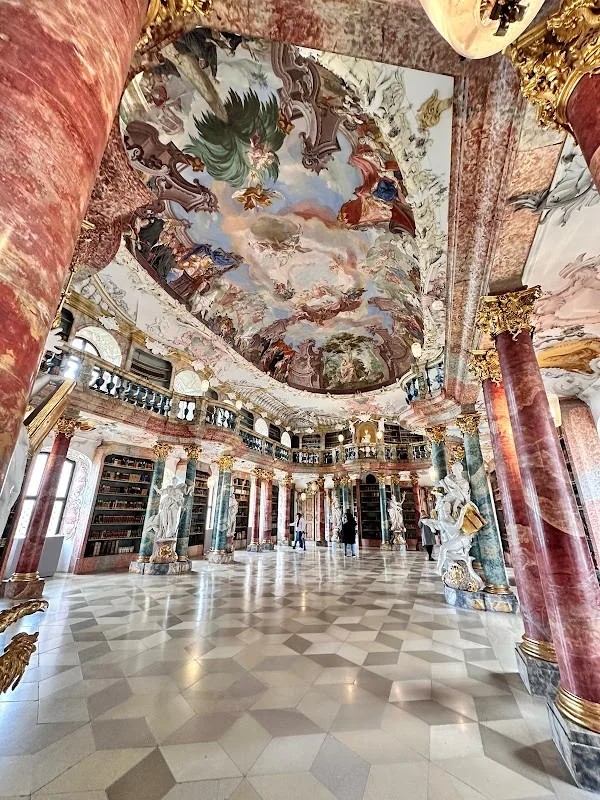
Wiblingen Monastery is one of the most impressive Baroque monasteries in southern Germany, uniquely combining architecture, history, and visitor experience. The complex is located in the Ulm district of Wiblingen and is particularly known for its magnificent library hall, the monumental monastery church, and the museum in the convent building. At first glance, it becomes clear why this place is considered the highlight of Baroque church architecture in Upper Swabia. The library hall is described as one of the most successful spatial creations of the Rococo, while the monastery church is one of the most significant testimonies at the transition from Rococo to Classicism. Today, the monastery is not only a cultural monument but also a vibrant place for tours, concerts, exhibitions, weddings, and special events. Those planning a visit will find a destination that excellently combines historical ambiance with practical visitor information. ([kloster-wiblingen.de](https://www.kloster-wiblingen.de/?utm_source=openai))
Opening Hours, Admission, and Visit Planning
For planning your visit, it is worthwhile to take a look at the seasonal opening hours. The library hall, the museum in the convent building, and the ticket office have different time slots depending on the season, which are oriented towards holiday periods and tourist demand. In spring and summer, it is generally open from Tuesday to Sunday, and in late summer and autumn months, it is also open on several weekdays, while winter hours are significantly reduced. Additionally, the official site points out a temporary closure of the library hall and the museum from October 6 to 11, 2026, due to film shoots. Equally important for visitors is the current note that the Basilica of St. Martin will undergo extensive renovations until approximately 2028 and can therefore only be visited to a limited extent. This shifts the focus of the visit even more towards the library hall, the museum, and the outdoor facilities. This combination of changing opening hours and construction restrictions makes it sensible to check the visit in advance rather than arriving spontaneously. ([kloster-wiblingen.de](https://www.kloster-wiblingen.de/besuchsinformation/oeffnungszeiten/?utm_source=openai))
The admission prices are also clearly regulated and assist in concrete planning. For the library hall with the museum in the convent building, adults pay 6 euros, reduced rates are 3 euros, and families pay 15 euros. Special tours are priced higher and provide in-depth insights into the history and rooms of the monastery. Group rates are also available for both the library hall with the museum and combined offers with the basilica. The basilica itself is free of charge, making the place attractive for guests who only want to get a first impression. Those who regularly visit cultural destinations in Baden-Württemberg also benefit from discounts such as the Schlosscard or, with appropriate eligibility, the state family pass. Thus, Wiblingen Monastery becomes a destination suitable for both a short cultural stop and a longer visit with a guided tour and walk. ([kloster-wiblingen.de](https://www.kloster-wiblingen.de/besuchsinformation/preise/?utm_source=openai))
Access, Public Transport, and Parking
The location of the monastery is convenient for day-trippers, as it is easily accessible by both car and public transport. The official address is Schlossstraße 38 in 89079 Ulm-Wiblingen. Those arriving by bus can take line 4 from Ehinger Tor to the Kloster Wiblingen stop. The city of Ulm describes the route from the city center as also being well reachable by bus. The rental documents additionally clarify that the distance to public transport is only about 100 meters. For drivers, it is particularly relevant that within walking distance there are 100 public, free parking spaces for cars as well as three public, free parking spaces for coaches or motorhomes. This makes the monastery practically organized for group trips, family outings, and day trips. Especially for a historical monument located in a district and not right in the center, this accessibility is a real advantage. ([kloster-wiblingen.de](https://www.kloster-wiblingen.de/besuchsinformation/anfahrt))
The official rental and visitor information further enhances the picture with additional useful orientation points. The complex is located about 3 kilometers from the highway, approximately 5 kilometers from the train station, and about 6 kilometers from the city center. These details show that while the monastery is outside the densest city center area, it is still situated in a well-connected part of Ulm-Wiblingen. For visitors, this means: Those who want to combine their trip with a city visit, a restaurant stop in Ulm, or another destination along the Danube can easily plan their arrival. Especially for events in the monastery courtyard or concerts, the mix of parking spaces, short public transport distance, and clearly marked address is helpful. Thus, Wiblingen Monastery is not only culturally and historically interesting but also logistically easy to visit. ([kloster-wiblingen.de](https://www.kloster-wiblingen.de/fileadmin/Raum/Pdf/42_ulm-wiblingen/ssg_kloster-wiblingen_vermietung_gesamt.pdf))
History of the Monastery and Its Baroque Significance
The history of Wiblingen Monastery begins in 1093 when Counts Hartmann and Otto of Kirchberg established the foundation. At the end of the 11th century, monks from the Benedictine monastery of St. Blasien in the Black Forest came to establish monastic life. Little is known about the very first complex, but soon after its founding, the Bishop of Constance was able to consecrate the first monastery church. Over the centuries, the importance of the monastery grew continuously, even though it never quite reached the size or wealth of some neighboring abbeys. The major expansion in the 18th century, which from 1714 shaped the complex into a Baroque ensemble, was particularly formative. The official description and visitor documents emphasize that Wiblingen is now considered the highlight of the Upper Swabian Baroque Road and the last bloom of Baroque church architecture in Upper Swabia. ([kloster-wiblingen.de](https://www.kloster-wiblingen.de/erlebnis-kloster-garten/kloster-garten))
The end of the monastic era came with secularization. The city of Ulm states that the monks were expelled and the books went to other libraries or were auctioned off. In 1805, after about 700 years, the time of the monastery ended; shortly thereafter, the use changed several times, including as a residence and later as a barracks. It was not until between 1915 and 1917 that the missing south wing was added, completing the Baroque four-wing plan. Today, the complex belongs to the state of Baden-Württemberg, and especially the library and the monumental church allow us to trace the historical power and spiritual claim of the former Benedictine monastery to this day. The fact that not only art history but also European upheaval history can be read in Wiblingen makes the place so exciting for culture-interested visitors. ([ulm.de](https://www.ulm.de/tourismus/stadtgeschichte/schicksalstage-und-orte/kloster-wiblingen))
Library Hall, Monastery Church, and Baroque Architecture
The library hall is the centerpiece of many visits to Wiblingen Monastery. The official description states that all treasures of wisdom and science are available here, and this claim shapes the spatial effect. At its peak, the library comprised about 15,000 volumes, a collection that was extraordinarily large for its time. Particularly remarkable is the design of the books themselves: The spines were painted white or covered with light paper so that they harmoniously fit into the spatial concept. The hall thus served not only for the storage of books but also as a representative reception room for distinguished guests. This shows in the library hall the self-understanding of a monastery that wanted to bring together knowledge, representation, and religious order. Therefore, those entering the room experience not just a museum but an artistically and intellectually programmatic staging of the Baroque. ([kloster-wiblingen.de](https://www.kloster-wiblingen.de/erlebnis-kloster-garten/kloster-garten/gebaeude/bibliothekssaal))
The monastery church also significantly contributes to the overall impression of the complex. The official website describes it as the last highlight of Baroque church architecture in Upper Swabia; at the same time, it is one of the most significant testimonies of architecture at the transition from Rococo to Classicism. Particularly impressive are the spatial effect, the furnishings, and the artistic details, which can be experienced both virtually and on-site. Additionally, the rental documents describe the library hall as having 245 square meters, the room is partially barrier-free, has an elevator, and is usable outside the heating period from March to November. It is clear: Wiblingen Monastery is not just a monument to look at but an architecturally versatile place where different uses and experiences overlap. The combination of church, hall, and convent building gives the complex the representative size that makes the visit so impressive. ([kloster-wiblingen.de](https://www.kloster-wiblingen.de/?utm_source=openai))
Guided Tours, Special Tours, and Museum in the Convent Building
Those who really want to understand Wiblingen Monastery should plan a guided tour. The official site consolidates the offerings in a calendar, where tours, special tours, and events are sorted by date. There are special offers for groups, and individual visitors should also take a look at the calendar, as regularly changing themes appear there. The museum in the convent building complements the visit with a presentation of the monastery's history and provides insights into the daily lives of the people who lived under monastic rule. This creates a tour that not only shows the art of the rooms but also explains their social and historical function. Particularly attractive is that the city and the official monastery site offer visitors not only information but a real selection of formats: from classic tours to special tours to digital tours. Thus, one can deepen the visit historically, architecturally, or thematically depending on interest. ([kloster-wiblingen.de](https://www.kloster-wiblingen.de/besuchsinformation/fuehrungen-veranstaltungen))
Also practical is the clear contact structure. For guided tours, special tours, and information, the visitor center is responsible, and the official contact page lists a central phone number as well as the email address info@kloster-wiblingen.de. This is helpful when groups want to coordinate a date or inquire about special formats. The rental documents also show that rooms and outdoor areas are partially barrier-free and allow for different uses. For visitors with special interests, this is important because the complex does not reduce itself to a single standard experience. Instead, there is a historically rich place with museum education, tour offerings, and diverse event spaces. Thus, those who do not just want to see the library hall or the monastery church briefly but really want to contextualize them will find here a professionally organized cultural offering with clear contacts and a well-structured program. ([kloster-wiblingen.de](https://www.kloster-wiblingen.de/besuchsinformation/kontakt))
Concerts, Open Airs, Weddings, Meetings, and Celebrations at Wiblingen Monastery
Wiblingen Monastery is not only a place of history in 2026 but also a very active event venue. The official schedule lists several Wiblingen monastery music events in July 2026, each as organ concerts in the Baroque monastery church with free admission. Additionally, the event calendar for late June 2026 lists large open-air concerts in the monastery courtyard, including Wincent Weiss, Montez, and Deep Purple. The official website describes these open airs as concerts in a historical setting, and that is exactly what makes the appeal: The monastery courtyard combines open air, monumental architecture, and cultural large events into a very special experience. For inquiries regarding concerts, open airs, and events at Wiblingen Monastery, this is particularly relevant because it showcases a cultural place with a current program, not just a pure monument. A medieval spectacle is also listed in the annual program for 2026, further emphasizing the range of offerings. ([kloster-wiblingen.de](https://www.kloster-wiblingen.de/besuchsinformation/fuehrungen-veranstaltungen))
For private and business occasions, the complex is also well prepared. The rental documents mention the library hall as a venue for meetings, lectures, presentations, readings, chamber music, and exhibitions. At the same time, civil and free weddings are possible. The hall has an area of 245 square meters and can accommodate 160 people in row seating and 168 for standing receptions. The monastery courtyard is even larger: 4,900 square meters, accommodating up to 5,000 people for standing receptions and suitable for wedding celebrations, company anniversaries, operas, theater, concerts, and markets. This makes Wiblingen Monastery an extraordinarily versatile event location, ranging from intimate weddings to large open-air events. So, if you are looking for a historical wedding venue or a representative place for celebrations and events, you will find an offering here that convincingly combines architectural impact and practical usability. ([kloster-wiblingen.de](https://www.kloster-wiblingen.de/fileadmin/Raum/Pdf/42_ulm-wiblingen/ssg_kloster-wiblingen_vermietung_bibliothekssaal_01-2021.pdf))
Sources:
- Wiblingen Monastery - Official Website
- Wiblingen Monastery - Opening Hours
- Wiblingen Monastery - Access and Parking
- Wiblingen Monastery - Library Hall
- Wiblingen Monastery - Tours and Events
- Wiblingen Monastery - Event Calendar 2026
- Wiblingen Monastery - Library Hall Rental
- Wiblingen Monastery - Courtyard Rental
- City of Ulm - Wiblingen Monastery
Show moreShow less
Wiblingen Monastery | Opening Hours & Tours
Wiblingen Monastery is one of the most impressive Baroque monasteries in southern Germany, uniquely combining architecture, history, and visitor experience. The complex is located in the Ulm district of Wiblingen and is particularly known for its magnificent library hall, the monumental monastery church, and the museum in the convent building. At first glance, it becomes clear why this place is considered the highlight of Baroque church architecture in Upper Swabia. The library hall is described as one of the most successful spatial creations of the Rococo, while the monastery church is one of the most significant testimonies at the transition from Rococo to Classicism. Today, the monastery is not only a cultural monument but also a vibrant place for tours, concerts, exhibitions, weddings, and special events. Those planning a visit will find a destination that excellently combines historical ambiance with practical visitor information. ([kloster-wiblingen.de](https://www.kloster-wiblingen.de/?utm_source=openai))
Opening Hours, Admission, and Visit Planning
For planning your visit, it is worthwhile to take a look at the seasonal opening hours. The library hall, the museum in the convent building, and the ticket office have different time slots depending on the season, which are oriented towards holiday periods and tourist demand. In spring and summer, it is generally open from Tuesday to Sunday, and in late summer and autumn months, it is also open on several weekdays, while winter hours are significantly reduced. Additionally, the official site points out a temporary closure of the library hall and the museum from October 6 to 11, 2026, due to film shoots. Equally important for visitors is the current note that the Basilica of St. Martin will undergo extensive renovations until approximately 2028 and can therefore only be visited to a limited extent. This shifts the focus of the visit even more towards the library hall, the museum, and the outdoor facilities. This combination of changing opening hours and construction restrictions makes it sensible to check the visit in advance rather than arriving spontaneously. ([kloster-wiblingen.de](https://www.kloster-wiblingen.de/besuchsinformation/oeffnungszeiten/?utm_source=openai))
The admission prices are also clearly regulated and assist in concrete planning. For the library hall with the museum in the convent building, adults pay 6 euros, reduced rates are 3 euros, and families pay 15 euros. Special tours are priced higher and provide in-depth insights into the history and rooms of the monastery. Group rates are also available for both the library hall with the museum and combined offers with the basilica. The basilica itself is free of charge, making the place attractive for guests who only want to get a first impression. Those who regularly visit cultural destinations in Baden-Württemberg also benefit from discounts such as the Schlosscard or, with appropriate eligibility, the state family pass. Thus, Wiblingen Monastery becomes a destination suitable for both a short cultural stop and a longer visit with a guided tour and walk. ([kloster-wiblingen.de](https://www.kloster-wiblingen.de/besuchsinformation/preise/?utm_source=openai))
Access, Public Transport, and Parking
The location of the monastery is convenient for day-trippers, as it is easily accessible by both car and public transport. The official address is Schlossstraße 38 in 89079 Ulm-Wiblingen. Those arriving by bus can take line 4 from Ehinger Tor to the Kloster Wiblingen stop. The city of Ulm describes the route from the city center as also being well reachable by bus. The rental documents additionally clarify that the distance to public transport is only about 100 meters. For drivers, it is particularly relevant that within walking distance there are 100 public, free parking spaces for cars as well as three public, free parking spaces for coaches or motorhomes. This makes the monastery practically organized for group trips, family outings, and day trips. Especially for a historical monument located in a district and not right in the center, this accessibility is a real advantage. ([kloster-wiblingen.de](https://www.kloster-wiblingen.de/besuchsinformation/anfahrt))
The official rental and visitor information further enhances the picture with additional useful orientation points. The complex is located about 3 kilometers from the highway, approximately 5 kilometers from the train station, and about 6 kilometers from the city center. These details show that while the monastery is outside the densest city center area, it is still situated in a well-connected part of Ulm-Wiblingen. For visitors, this means: Those who want to combine their trip with a city visit, a restaurant stop in Ulm, or another destination along the Danube can easily plan their arrival. Especially for events in the monastery courtyard or concerts, the mix of parking spaces, short public transport distance, and clearly marked address is helpful. Thus, Wiblingen Monastery is not only culturally and historically interesting but also logistically easy to visit. ([kloster-wiblingen.de](https://www.kloster-wiblingen.de/fileadmin/Raum/Pdf/42_ulm-wiblingen/ssg_kloster-wiblingen_vermietung_gesamt.pdf))
History of the Monastery and Its Baroque Significance
The history of Wiblingen Monastery begins in 1093 when Counts Hartmann and Otto of Kirchberg established the foundation. At the end of the 11th century, monks from the Benedictine monastery of St. Blasien in the Black Forest came to establish monastic life. Little is known about the very first complex, but soon after its founding, the Bishop of Constance was able to consecrate the first monastery church. Over the centuries, the importance of the monastery grew continuously, even though it never quite reached the size or wealth of some neighboring abbeys. The major expansion in the 18th century, which from 1714 shaped the complex into a Baroque ensemble, was particularly formative. The official description and visitor documents emphasize that Wiblingen is now considered the highlight of the Upper Swabian Baroque Road and the last bloom of Baroque church architecture in Upper Swabia. ([kloster-wiblingen.de](https://www.kloster-wiblingen.de/erlebnis-kloster-garten/kloster-garten))
The end of the monastic era came with secularization. The city of Ulm states that the monks were expelled and the books went to other libraries or were auctioned off. In 1805, after about 700 years, the time of the monastery ended; shortly thereafter, the use changed several times, including as a residence and later as a barracks. It was not until between 1915 and 1917 that the missing south wing was added, completing the Baroque four-wing plan. Today, the complex belongs to the state of Baden-Württemberg, and especially the library and the monumental church allow us to trace the historical power and spiritual claim of the former Benedictine monastery to this day. The fact that not only art history but also European upheaval history can be read in Wiblingen makes the place so exciting for culture-interested visitors. ([ulm.de](https://www.ulm.de/tourismus/stadtgeschichte/schicksalstage-und-orte/kloster-wiblingen))
Library Hall, Monastery Church, and Baroque Architecture
The library hall is the centerpiece of many visits to Wiblingen Monastery. The official description states that all treasures of wisdom and science are available here, and this claim shapes the spatial effect. At its peak, the library comprised about 15,000 volumes, a collection that was extraordinarily large for its time. Particularly remarkable is the design of the books themselves: The spines were painted white or covered with light paper so that they harmoniously fit into the spatial concept. The hall thus served not only for the storage of books but also as a representative reception room for distinguished guests. This shows in the library hall the self-understanding of a monastery that wanted to bring together knowledge, representation, and religious order. Therefore, those entering the room experience not just a museum but an artistically and intellectually programmatic staging of the Baroque. ([kloster-wiblingen.de](https://www.kloster-wiblingen.de/erlebnis-kloster-garten/kloster-garten/gebaeude/bibliothekssaal))
The monastery church also significantly contributes to the overall impression of the complex. The official website describes it as the last highlight of Baroque church architecture in Upper Swabia; at the same time, it is one of the most significant testimonies of architecture at the transition from Rococo to Classicism. Particularly impressive are the spatial effect, the furnishings, and the artistic details, which can be experienced both virtually and on-site. Additionally, the rental documents describe the library hall as having 245 square meters, the room is partially barrier-free, has an elevator, and is usable outside the heating period from March to November. It is clear: Wiblingen Monastery is not just a monument to look at but an architecturally versatile place where different uses and experiences overlap. The combination of church, hall, and convent building gives the complex the representative size that makes the visit so impressive. ([kloster-wiblingen.de](https://www.kloster-wiblingen.de/?utm_source=openai))
Guided Tours, Special Tours, and Museum in the Convent Building
Those who really want to understand Wiblingen Monastery should plan a guided tour. The official site consolidates the offerings in a calendar, where tours, special tours, and events are sorted by date. There are special offers for groups, and individual visitors should also take a look at the calendar, as regularly changing themes appear there. The museum in the convent building complements the visit with a presentation of the monastery's history and provides insights into the daily lives of the people who lived under monastic rule. This creates a tour that not only shows the art of the rooms but also explains their social and historical function. Particularly attractive is that the city and the official monastery site offer visitors not only information but a real selection of formats: from classic tours to special tours to digital tours. Thus, one can deepen the visit historically, architecturally, or thematically depending on interest. ([kloster-wiblingen.de](https://www.kloster-wiblingen.de/besuchsinformation/fuehrungen-veranstaltungen))
Also practical is the clear contact structure. For guided tours, special tours, and information, the visitor center is responsible, and the official contact page lists a central phone number as well as the email address info@kloster-wiblingen.de. This is helpful when groups want to coordinate a date or inquire about special formats. The rental documents also show that rooms and outdoor areas are partially barrier-free and allow for different uses. For visitors with special interests, this is important because the complex does not reduce itself to a single standard experience. Instead, there is a historically rich place with museum education, tour offerings, and diverse event spaces. Thus, those who do not just want to see the library hall or the monastery church briefly but really want to contextualize them will find here a professionally organized cultural offering with clear contacts and a well-structured program. ([kloster-wiblingen.de](https://www.kloster-wiblingen.de/besuchsinformation/kontakt))
Concerts, Open Airs, Weddings, Meetings, and Celebrations at Wiblingen Monastery
Wiblingen Monastery is not only a place of history in 2026 but also a very active event venue. The official schedule lists several Wiblingen monastery music events in July 2026, each as organ concerts in the Baroque monastery church with free admission. Additionally, the event calendar for late June 2026 lists large open-air concerts in the monastery courtyard, including Wincent Weiss, Montez, and Deep Purple. The official website describes these open airs as concerts in a historical setting, and that is exactly what makes the appeal: The monastery courtyard combines open air, monumental architecture, and cultural large events into a very special experience. For inquiries regarding concerts, open airs, and events at Wiblingen Monastery, this is particularly relevant because it showcases a cultural place with a current program, not just a pure monument. A medieval spectacle is also listed in the annual program for 2026, further emphasizing the range of offerings. ([kloster-wiblingen.de](https://www.kloster-wiblingen.de/besuchsinformation/fuehrungen-veranstaltungen))
For private and business occasions, the complex is also well prepared. The rental documents mention the library hall as a venue for meetings, lectures, presentations, readings, chamber music, and exhibitions. At the same time, civil and free weddings are possible. The hall has an area of 245 square meters and can accommodate 160 people in row seating and 168 for standing receptions. The monastery courtyard is even larger: 4,900 square meters, accommodating up to 5,000 people for standing receptions and suitable for wedding celebrations, company anniversaries, operas, theater, concerts, and markets. This makes Wiblingen Monastery an extraordinarily versatile event location, ranging from intimate weddings to large open-air events. So, if you are looking for a historical wedding venue or a representative place for celebrations and events, you will find an offering here that convincingly combines architectural impact and practical usability. ([kloster-wiblingen.de](https://www.kloster-wiblingen.de/fileadmin/Raum/Pdf/42_ulm-wiblingen/ssg_kloster-wiblingen_vermietung_bibliothekssaal_01-2021.pdf))
Sources:
- Wiblingen Monastery - Official Website
- Wiblingen Monastery - Opening Hours
- Wiblingen Monastery - Access and Parking
- Wiblingen Monastery - Library Hall
- Wiblingen Monastery - Tours and Events
- Wiblingen Monastery - Event Calendar 2026
- Wiblingen Monastery - Library Hall Rental
- Wiblingen Monastery - Courtyard Rental
- City of Ulm - Wiblingen Monastery
Wiblingen Monastery | Opening Hours & Tours
Wiblingen Monastery is one of the most impressive Baroque monasteries in southern Germany, uniquely combining architecture, history, and visitor experience. The complex is located in the Ulm district of Wiblingen and is particularly known for its magnificent library hall, the monumental monastery church, and the museum in the convent building. At first glance, it becomes clear why this place is considered the highlight of Baroque church architecture in Upper Swabia. The library hall is described as one of the most successful spatial creations of the Rococo, while the monastery church is one of the most significant testimonies at the transition from Rococo to Classicism. Today, the monastery is not only a cultural monument but also a vibrant place for tours, concerts, exhibitions, weddings, and special events. Those planning a visit will find a destination that excellently combines historical ambiance with practical visitor information. ([kloster-wiblingen.de](https://www.kloster-wiblingen.de/?utm_source=openai))
Opening Hours, Admission, and Visit Planning
For planning your visit, it is worthwhile to take a look at the seasonal opening hours. The library hall, the museum in the convent building, and the ticket office have different time slots depending on the season, which are oriented towards holiday periods and tourist demand. In spring and summer, it is generally open from Tuesday to Sunday, and in late summer and autumn months, it is also open on several weekdays, while winter hours are significantly reduced. Additionally, the official site points out a temporary closure of the library hall and the museum from October 6 to 11, 2026, due to film shoots. Equally important for visitors is the current note that the Basilica of St. Martin will undergo extensive renovations until approximately 2028 and can therefore only be visited to a limited extent. This shifts the focus of the visit even more towards the library hall, the museum, and the outdoor facilities. This combination of changing opening hours and construction restrictions makes it sensible to check the visit in advance rather than arriving spontaneously. ([kloster-wiblingen.de](https://www.kloster-wiblingen.de/besuchsinformation/oeffnungszeiten/?utm_source=openai))
The admission prices are also clearly regulated and assist in concrete planning. For the library hall with the museum in the convent building, adults pay 6 euros, reduced rates are 3 euros, and families pay 15 euros. Special tours are priced higher and provide in-depth insights into the history and rooms of the monastery. Group rates are also available for both the library hall with the museum and combined offers with the basilica. The basilica itself is free of charge, making the place attractive for guests who only want to get a first impression. Those who regularly visit cultural destinations in Baden-Württemberg also benefit from discounts such as the Schlosscard or, with appropriate eligibility, the state family pass. Thus, Wiblingen Monastery becomes a destination suitable for both a short cultural stop and a longer visit with a guided tour and walk. ([kloster-wiblingen.de](https://www.kloster-wiblingen.de/besuchsinformation/preise/?utm_source=openai))
Access, Public Transport, and Parking
The location of the monastery is convenient for day-trippers, as it is easily accessible by both car and public transport. The official address is Schlossstraße 38 in 89079 Ulm-Wiblingen. Those arriving by bus can take line 4 from Ehinger Tor to the Kloster Wiblingen stop. The city of Ulm describes the route from the city center as also being well reachable by bus. The rental documents additionally clarify that the distance to public transport is only about 100 meters. For drivers, it is particularly relevant that within walking distance there are 100 public, free parking spaces for cars as well as three public, free parking spaces for coaches or motorhomes. This makes the monastery practically organized for group trips, family outings, and day trips. Especially for a historical monument located in a district and not right in the center, this accessibility is a real advantage. ([kloster-wiblingen.de](https://www.kloster-wiblingen.de/besuchsinformation/anfahrt))
The official rental and visitor information further enhances the picture with additional useful orientation points. The complex is located about 3 kilometers from the highway, approximately 5 kilometers from the train station, and about 6 kilometers from the city center. These details show that while the monastery is outside the densest city center area, it is still situated in a well-connected part of Ulm-Wiblingen. For visitors, this means: Those who want to combine their trip with a city visit, a restaurant stop in Ulm, or another destination along the Danube can easily plan their arrival. Especially for events in the monastery courtyard or concerts, the mix of parking spaces, short public transport distance, and clearly marked address is helpful. Thus, Wiblingen Monastery is not only culturally and historically interesting but also logistically easy to visit. ([kloster-wiblingen.de](https://www.kloster-wiblingen.de/fileadmin/Raum/Pdf/42_ulm-wiblingen/ssg_kloster-wiblingen_vermietung_gesamt.pdf))
History of the Monastery and Its Baroque Significance
The history of Wiblingen Monastery begins in 1093 when Counts Hartmann and Otto of Kirchberg established the foundation. At the end of the 11th century, monks from the Benedictine monastery of St. Blasien in the Black Forest came to establish monastic life. Little is known about the very first complex, but soon after its founding, the Bishop of Constance was able to consecrate the first monastery church. Over the centuries, the importance of the monastery grew continuously, even though it never quite reached the size or wealth of some neighboring abbeys. The major expansion in the 18th century, which from 1714 shaped the complex into a Baroque ensemble, was particularly formative. The official description and visitor documents emphasize that Wiblingen is now considered the highlight of the Upper Swabian Baroque Road and the last bloom of Baroque church architecture in Upper Swabia. ([kloster-wiblingen.de](https://www.kloster-wiblingen.de/erlebnis-kloster-garten/kloster-garten))
The end of the monastic era came with secularization. The city of Ulm states that the monks were expelled and the books went to other libraries or were auctioned off. In 1805, after about 700 years, the time of the monastery ended; shortly thereafter, the use changed several times, including as a residence and later as a barracks. It was not until between 1915 and 1917 that the missing south wing was added, completing the Baroque four-wing plan. Today, the complex belongs to the state of Baden-Württemberg, and especially the library and the monumental church allow us to trace the historical power and spiritual claim of the former Benedictine monastery to this day. The fact that not only art history but also European upheaval history can be read in Wiblingen makes the place so exciting for culture-interested visitors. ([ulm.de](https://www.ulm.de/tourismus/stadtgeschichte/schicksalstage-und-orte/kloster-wiblingen))
Library Hall, Monastery Church, and Baroque Architecture
The library hall is the centerpiece of many visits to Wiblingen Monastery. The official description states that all treasures of wisdom and science are available here, and this claim shapes the spatial effect. At its peak, the library comprised about 15,000 volumes, a collection that was extraordinarily large for its time. Particularly remarkable is the design of the books themselves: The spines were painted white or covered with light paper so that they harmoniously fit into the spatial concept. The hall thus served not only for the storage of books but also as a representative reception room for distinguished guests. This shows in the library hall the self-understanding of a monastery that wanted to bring together knowledge, representation, and religious order. Therefore, those entering the room experience not just a museum but an artistically and intellectually programmatic staging of the Baroque. ([kloster-wiblingen.de](https://www.kloster-wiblingen.de/erlebnis-kloster-garten/kloster-garten/gebaeude/bibliothekssaal))
The monastery church also significantly contributes to the overall impression of the complex. The official website describes it as the last highlight of Baroque church architecture in Upper Swabia; at the same time, it is one of the most significant testimonies of architecture at the transition from Rococo to Classicism. Particularly impressive are the spatial effect, the furnishings, and the artistic details, which can be experienced both virtually and on-site. Additionally, the rental documents describe the library hall as having 245 square meters, the room is partially barrier-free, has an elevator, and is usable outside the heating period from March to November. It is clear: Wiblingen Monastery is not just a monument to look at but an architecturally versatile place where different uses and experiences overlap. The combination of church, hall, and convent building gives the complex the representative size that makes the visit so impressive. ([kloster-wiblingen.de](https://www.kloster-wiblingen.de/?utm_source=openai))
Guided Tours, Special Tours, and Museum in the Convent Building
Those who really want to understand Wiblingen Monastery should plan a guided tour. The official site consolidates the offerings in a calendar, where tours, special tours, and events are sorted by date. There are special offers for groups, and individual visitors should also take a look at the calendar, as regularly changing themes appear there. The museum in the convent building complements the visit with a presentation of the monastery's history and provides insights into the daily lives of the people who lived under monastic rule. This creates a tour that not only shows the art of the rooms but also explains their social and historical function. Particularly attractive is that the city and the official monastery site offer visitors not only information but a real selection of formats: from classic tours to special tours to digital tours. Thus, one can deepen the visit historically, architecturally, or thematically depending on interest. ([kloster-wiblingen.de](https://www.kloster-wiblingen.de/besuchsinformation/fuehrungen-veranstaltungen))
Also practical is the clear contact structure. For guided tours, special tours, and information, the visitor center is responsible, and the official contact page lists a central phone number as well as the email address info@kloster-wiblingen.de. This is helpful when groups want to coordinate a date or inquire about special formats. The rental documents also show that rooms and outdoor areas are partially barrier-free and allow for different uses. For visitors with special interests, this is important because the complex does not reduce itself to a single standard experience. Instead, there is a historically rich place with museum education, tour offerings, and diverse event spaces. Thus, those who do not just want to see the library hall or the monastery church briefly but really want to contextualize them will find here a professionally organized cultural offering with clear contacts and a well-structured program. ([kloster-wiblingen.de](https://www.kloster-wiblingen.de/besuchsinformation/kontakt))
Concerts, Open Airs, Weddings, Meetings, and Celebrations at Wiblingen Monastery
Wiblingen Monastery is not only a place of history in 2026 but also a very active event venue. The official schedule lists several Wiblingen monastery music events in July 2026, each as organ concerts in the Baroque monastery church with free admission. Additionally, the event calendar for late June 2026 lists large open-air concerts in the monastery courtyard, including Wincent Weiss, Montez, and Deep Purple. The official website describes these open airs as concerts in a historical setting, and that is exactly what makes the appeal: The monastery courtyard combines open air, monumental architecture, and cultural large events into a very special experience. For inquiries regarding concerts, open airs, and events at Wiblingen Monastery, this is particularly relevant because it showcases a cultural place with a current program, not just a pure monument. A medieval spectacle is also listed in the annual program for 2026, further emphasizing the range of offerings. ([kloster-wiblingen.de](https://www.kloster-wiblingen.de/besuchsinformation/fuehrungen-veranstaltungen))
For private and business occasions, the complex is also well prepared. The rental documents mention the library hall as a venue for meetings, lectures, presentations, readings, chamber music, and exhibitions. At the same time, civil and free weddings are possible. The hall has an area of 245 square meters and can accommodate 160 people in row seating and 168 for standing receptions. The monastery courtyard is even larger: 4,900 square meters, accommodating up to 5,000 people for standing receptions and suitable for wedding celebrations, company anniversaries, operas, theater, concerts, and markets. This makes Wiblingen Monastery an extraordinarily versatile event location, ranging from intimate weddings to large open-air events. So, if you are looking for a historical wedding venue or a representative place for celebrations and events, you will find an offering here that convincingly combines architectural impact and practical usability. ([kloster-wiblingen.de](https://www.kloster-wiblingen.de/fileadmin/Raum/Pdf/42_ulm-wiblingen/ssg_kloster-wiblingen_vermietung_bibliothekssaal_01-2021.pdf))
Sources:
- Wiblingen Monastery - Official Website
- Wiblingen Monastery - Opening Hours
- Wiblingen Monastery - Access and Parking
- Wiblingen Monastery - Library Hall
- Wiblingen Monastery - Tours and Events
- Wiblingen Monastery - Event Calendar 2026
- Wiblingen Monastery - Library Hall Rental
- Wiblingen Monastery - Courtyard Rental
- City of Ulm - Wiblingen Monastery

Frequently Asked Questions
Reviews
No reviews found