
Blaubeuren
Klosterhof 2, 89143 Blaubeuren, Deutschland
Blaubeuren Monastery | Tours & Opening Hours
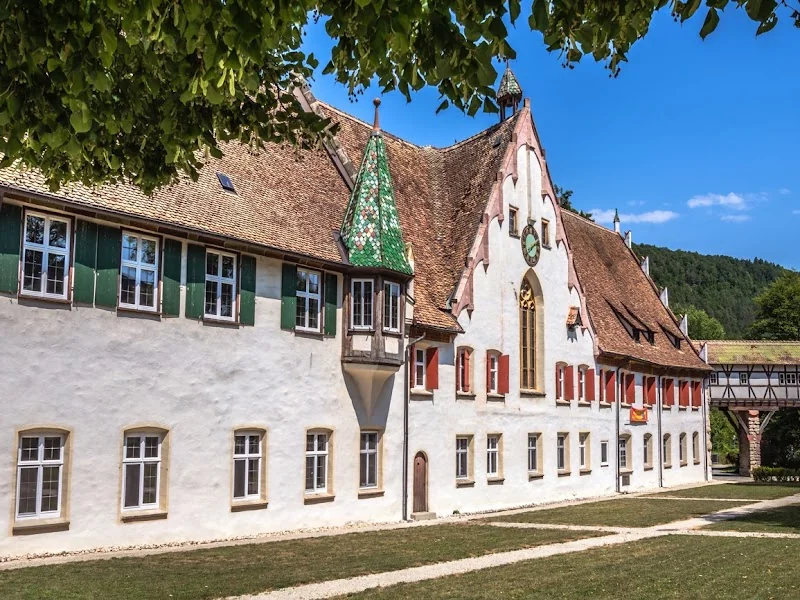
Blaubeuren Monastery is one of the most impressive monastery complexes in the Swabian Jura. Located directly at the Blautopf, the site combines medieval architecture, ecclesiastical education, and vibrant culture in a compact space. The former Benedictine monastery has been home to the Protestant Seminar Blaubeuren, a public high school with boarding facilities, since the Reformation. Visitors experience a largely preserved late Gothic complex with cloister, choir room, high altar, and the historic bathhouse. Those who visit Blaubeuren do not encounter a static museum, but a place where history, education, and events come together to this day. ([seminar-blaubeuren.de](https://seminar-blaubeuren.de/index.php/kloster/))
Tours and Opening Hours at Blaubeuren Monastery
If you want to see the monastery not just from the outside but understand it in its entirety, you should plan a guided tour. The visitor information of the Protestant Seminar states that tours are only available by prior arrangement. Bookings are made through the Tourist Information Blaubeuren, either via their website, by email, or by phone. This is convenient because various tour formats are available, differing in duration, group size, and thematic focus. The classic monastery tour lasts one hour and takes you through the rib-vaulted cloister, to the fountain chapel, to the chapter house, to the Peter chapel, Urban chapel, and sacristy, ending in the choir room with the famous high altar. For greater thematic depth, there is the longer tour Monastery plus Monk's Bathhouse and costume tours with Brother Gregorius or Sister Fides. ([seminar-blaubeuren.de](https://seminar-blaubeuren.de/index.php/kloster/besucherinformationen/))
The opening hours are also clearly regulated for planning: From March 1 to November 1, the monastery is open daily from 10 AM to 5 PM. Outside of these hours, tours are only possible by arrangement and for a special opening fee. This is an important note for visitors, as Blaubeuren Monastery is not an arbitrarily accessible excursion destination but a historical site with active educational use and therefore regulated visiting hours. Those who come on a sunny spring day or in the golden autumn experience the cloister, the monastery courtyard, and the choir room particularly impressively, as the light emphasizes the Gothic forms even more. Especially for groups, families, and school classes, early inquiries are worthwhile, as the maximum number of participants is limited for standard tours. This keeps the tour personal, calm, and content-rich. ([seminar-blaubeuren.de](https://seminar-blaubeuren.de/index.php/kloster/besucherinformationen/))
High Altar, Choir Room, and Cloister as the Heart of the Complex
The most famous artwork in Blaubeuren Monastery is the late Gothic high altar in the choir room. It dates from 1493 and was created together with the choir stalls by the Ulm school. This connection makes the site art-historically valuable: Here, sculpture, painting, and sacred space meet in an unusually cohesive form. The choir room itself is the heart of the monastery complex. It directs the gaze entirely to the sanctuarium, that is, the area of the altar, making visible how closely architecture and liturgical use are connected here. Anyone walking through the church quickly realizes that the monastery was not decorated later, but that space, furnishings, and function are coordinated. ([seminar-blaubeuren.de](https://seminar-blaubeuren.de/index.php/kloster/))
The cloister, chapter house, and adjacent rooms are also remarkably well preserved. The chapter house is a two-aisled room with ribbed vaulting, where the monks once held their daily meetings. Today, among other things, there are Gothic tomb slabs of the Counts of Helfenstein, who once held the bailiwick. The tours also mention the fountain chapel, Peter chapel, Urban chapel, and the sacristy, whose floral ceiling paintings contribute to the quiet beauty of the complex. These rooms make it understandable how a medieval monastery functioned: as a place of prayer, order, and communal life. Additionally, there is the Johannes fountain in the monastery courtyard, whose fountain figure shows John the Baptist, the patron saint of the monastery. This mixture of art, symbolism, and everyday space makes the complex so powerful. ([seminar-blaubeuren.de](https://seminar-blaubeuren.de/index.php/kloster/besucherinformationen/))
History of Blaubeuren Monastery from Foundation to Seminar Time
The history of the monastery dates back a long way. According to historical records, it begins with a St. John's Church at the Blautopf in the 7th century. The actual foundation of the monastery took place in 1085 by the Counts of Ruck and Tübingen, who ultimately chose the site by the Blautopf because the water supply was secure there. In 1090, the first monks from Hirsau under Abbot Azelinus arrived, and in 1099 Countess Adelheid of Tübingen placed the monastery under the protection of the apostolic see. The monastery church was consecrated in 1124. Even these early dates show that Blaubeuren was established from the beginning at a location where spiritual foundation, power politics, and water supply were closely linked. The monastery was never here by chance but was deliberately located at a prominent spring. ([seminar-blaubeuren.de](https://seminar-blaubeuren.de/index.php/kloster/))
In the 14th and 15th centuries, there was initially economic decline, but from 1451, the actual flourishing began with the reform of the monastery. The new construction started in 1466 under Abbot Ulrich Kundig and was continued under Heinrich III. Fabri and Gregor Rösch. The high altar and choir stalls were created in 1493, and the new construction phase ended in 1510. With the Reformation in Württemberg in 1534, the monks were expelled, returned temporarily later, and in 1556 the Protestant monastery school was established. In 1777, the poet Christian Friedrich Daniel Schubart was arrested in the monastery bailiwick, the monastery school was dissolved in 1810, and in 1817 the Protestant Theological Seminar was founded. Restorations of the choir room and high altar in the 1970s, as well as later anniversaries, show how closely monument preservation and use are still connected here today. ([seminar-blaubeuren.de](https://seminar-blaubeuren.de/index.php/kloster/geschichte-des-klosters/))
School, Boarding School, and Seminar Life in the Historic Monastery
Blaubeuren Monastery is not only a monument but also a place of education. The Ministry of Culture of Baden-Württemberg describes the Protestant theological seminars in Maulbronn and Blaubeuren as public high schools with boarding facilities. In Blaubeuren, seminar students live together with teachers, staff, and their families within the historic monastery complex. This gives the place a special atmosphere: Behind the old walls, there is no idle museum operation, but a lively school routine. The Seminar Blaubeuren sees itself as a classical language high school with a church boarding school; additionally, according to the official description, courses with modern language and mathematical-scientific profiles can also be chosen. The path to the Abitur begins there in grade 9. ([km.baden-wuerttemberg.de](https://km.baden-wuerttemberg.de/de/schule/gymnasium/evangelisch-theologische-seminare))
The school stands in the tradition of the Protestant monastery schools in Württemberg and promotes gifted and interested Protestant students. Particularly important is the so-called Landexamen, an entrance examination, after which the seminar students become scholarship holders of the Protestant Seminar Foundation. This is intended to make the attendance of school and boarding school fundamentally possible for all interested Protestant youths. For visitors, this means: The complex is open during the day, but it remains a working and living place with rules, consideration, and clear responsibilities. This mixture gives the monastery a special liveliness. One not only feels the past but also a present educational and faith practice that has continued at this place for centuries. This is exactly what distinguishes Blaubeuren from many other historical sites. ([km.baden-wuerttemberg.de](https://km.baden-wuerttemberg.de/de/schule/gymnasium/evangelisch-theologische-seminare))
Bathhouse, Museum, and Other Attractions Around the Monastery
A special highlight of the tour is the completely preserved bathhouse of the monks. According to ADAC Maps, it is the only one of its kind in Germany and now houses the local museum of Blaubeuren. This makes the visit doubly interesting: On the one hand, you see a rare medieval functional building, and on the other hand, you gain an impression of how much monastery life also consisted of practical routines. The bathhouse reminds us that monasteries were not only places of prayer but also places of personal care, provision, and daily life. Together with the cloister, church, and choir room, it forms an ensemble that is remarkable in its cohesion. The fact that the Johannes fountain and the chapter house are also preserved in the monastery courtyard gives the complex a special density of authentic spaces and objects. ([maps.adac.de](https://maps.adac.de/poi/kloster-blaubeuren-blaubeuren?utm_source=openai))
Those who broaden their view will also recognize the interplay between the monastery, Blautopf, and old town. The founding history of the monastery already shows how important the Blautopf was as a water source. Today, the location remains one of the strongest arguments for a visit: The monastery is located in close proximity to one of the most famous natural monuments of the Swabian Jura and shapes the image of Blaubeuren along with it. For this reason, the site is often perceived as a connection of nature, history, and education. The historic town center, the Blautopf, and the monastery complex can be easily combined in one excursion. Those who visit the Blautopf, the monastery, and the museum in succession get a very compact but content-rich impression of Blaubeuren as a cultural and memorial site. This juxtaposition of nature and monument is one of the strongest attractions of the location. ([seminar-blaubeuren.de](https://seminar-blaubeuren.de/index.php/kloster/))
Events in the Dormitory and Practical Information on Arrival and Parking
Blaubeuren Monastery is also a cultural site. The official page of the seminar community documents a concert series in the dormitory that spans several years and includes formats such as jazz, a cappella, house music evenings, seminar concerts, and baroque cello. Admission to all concerts is free, but donations for financing are requested. This is exciting for visitors because the historic space can not only be viewed but actually experienced acoustically. Especially the medieval ambiance of the dormitory is described as formative in the event announcements. This creates a real added value beyond mere monument viewing: The monastery becomes a place of listening, encounter, and contemporary culture. Anyone planning a visit should therefore also take a look at the event calendar. ([seminar-blaubeuren.de](https://seminar-blaubeuren.de/index.php/aktuelles/konzerte/?utm_source=openai))
For travel by car, the city parking information is important. The city of Blaubeuren offers parking fee zones 1 and 2 as well as the Krone underground garage; annual parking tickets can be purchased online. The city also states that the rates and conditions can be viewed in advance and that the Krone underground garage is also included in zone 1. Therefore, anyone combining a monastery visit with a stroll through the old town should check the parking zones in advance and choose the appropriate zone. The address of the monastery is Klosterhof 2 in 89143 Blaubeuren. For a stress-free arrival, it is advisable to combine public transport travel, walking through the old town, or using the city's parking offers. This way, the visit can be well combined with the Blautopf, old town, and museum without losing focus on the actual monastery complex. ([shopparken.blaubeuren.de](https://shopparken.blaubeuren.de/))
Sources:
Mehr anzeigenWeniger anzeigen
Blaubeuren Monastery | Tours & Opening Hours
Blaubeuren Monastery is one of the most impressive monastery complexes in the Swabian Jura. Located directly at the Blautopf, the site combines medieval architecture, ecclesiastical education, and vibrant culture in a compact space. The former Benedictine monastery has been home to the Protestant Seminar Blaubeuren, a public high school with boarding facilities, since the Reformation. Visitors experience a largely preserved late Gothic complex with cloister, choir room, high altar, and the historic bathhouse. Those who visit Blaubeuren do not encounter a static museum, but a place where history, education, and events come together to this day. ([seminar-blaubeuren.de](https://seminar-blaubeuren.de/index.php/kloster/))
Tours and Opening Hours at Blaubeuren Monastery
If you want to see the monastery not just from the outside but understand it in its entirety, you should plan a guided tour. The visitor information of the Protestant Seminar states that tours are only available by prior arrangement. Bookings are made through the Tourist Information Blaubeuren, either via their website, by email, or by phone. This is convenient because various tour formats are available, differing in duration, group size, and thematic focus. The classic monastery tour lasts one hour and takes you through the rib-vaulted cloister, to the fountain chapel, to the chapter house, to the Peter chapel, Urban chapel, and sacristy, ending in the choir room with the famous high altar. For greater thematic depth, there is the longer tour Monastery plus Monk's Bathhouse and costume tours with Brother Gregorius or Sister Fides. ([seminar-blaubeuren.de](https://seminar-blaubeuren.de/index.php/kloster/besucherinformationen/))
The opening hours are also clearly regulated for planning: From March 1 to November 1, the monastery is open daily from 10 AM to 5 PM. Outside of these hours, tours are only possible by arrangement and for a special opening fee. This is an important note for visitors, as Blaubeuren Monastery is not an arbitrarily accessible excursion destination but a historical site with active educational use and therefore regulated visiting hours. Those who come on a sunny spring day or in the golden autumn experience the cloister, the monastery courtyard, and the choir room particularly impressively, as the light emphasizes the Gothic forms even more. Especially for groups, families, and school classes, early inquiries are worthwhile, as the maximum number of participants is limited for standard tours. This keeps the tour personal, calm, and content-rich. ([seminar-blaubeuren.de](https://seminar-blaubeuren.de/index.php/kloster/besucherinformationen/))
High Altar, Choir Room, and Cloister as the Heart of the Complex
The most famous artwork in Blaubeuren Monastery is the late Gothic high altar in the choir room. It dates from 1493 and was created together with the choir stalls by the Ulm school. This connection makes the site art-historically valuable: Here, sculpture, painting, and sacred space meet in an unusually cohesive form. The choir room itself is the heart of the monastery complex. It directs the gaze entirely to the sanctuarium, that is, the area of the altar, making visible how closely architecture and liturgical use are connected here. Anyone walking through the church quickly realizes that the monastery was not decorated later, but that space, furnishings, and function are coordinated. ([seminar-blaubeuren.de](https://seminar-blaubeuren.de/index.php/kloster/))
The cloister, chapter house, and adjacent rooms are also remarkably well preserved. The chapter house is a two-aisled room with ribbed vaulting, where the monks once held their daily meetings. Today, among other things, there are Gothic tomb slabs of the Counts of Helfenstein, who once held the bailiwick. The tours also mention the fountain chapel, Peter chapel, Urban chapel, and the sacristy, whose floral ceiling paintings contribute to the quiet beauty of the complex. These rooms make it understandable how a medieval monastery functioned: as a place of prayer, order, and communal life. Additionally, there is the Johannes fountain in the monastery courtyard, whose fountain figure shows John the Baptist, the patron saint of the monastery. This mixture of art, symbolism, and everyday space makes the complex so powerful. ([seminar-blaubeuren.de](https://seminar-blaubeuren.de/index.php/kloster/besucherinformationen/))
History of Blaubeuren Monastery from Foundation to Seminar Time
The history of the monastery dates back a long way. According to historical records, it begins with a St. John's Church at the Blautopf in the 7th century. The actual foundation of the monastery took place in 1085 by the Counts of Ruck and Tübingen, who ultimately chose the site by the Blautopf because the water supply was secure there. In 1090, the first monks from Hirsau under Abbot Azelinus arrived, and in 1099 Countess Adelheid of Tübingen placed the monastery under the protection of the apostolic see. The monastery church was consecrated in 1124. Even these early dates show that Blaubeuren was established from the beginning at a location where spiritual foundation, power politics, and water supply were closely linked. The monastery was never here by chance but was deliberately located at a prominent spring. ([seminar-blaubeuren.de](https://seminar-blaubeuren.de/index.php/kloster/))
In the 14th and 15th centuries, there was initially economic decline, but from 1451, the actual flourishing began with the reform of the monastery. The new construction started in 1466 under Abbot Ulrich Kundig and was continued under Heinrich III. Fabri and Gregor Rösch. The high altar and choir stalls were created in 1493, and the new construction phase ended in 1510. With the Reformation in Württemberg in 1534, the monks were expelled, returned temporarily later, and in 1556 the Protestant monastery school was established. In 1777, the poet Christian Friedrich Daniel Schubart was arrested in the monastery bailiwick, the monastery school was dissolved in 1810, and in 1817 the Protestant Theological Seminar was founded. Restorations of the choir room and high altar in the 1970s, as well as later anniversaries, show how closely monument preservation and use are still connected here today. ([seminar-blaubeuren.de](https://seminar-blaubeuren.de/index.php/kloster/geschichte-des-klosters/))
School, Boarding School, and Seminar Life in the Historic Monastery
Blaubeuren Monastery is not only a monument but also a place of education. The Ministry of Culture of Baden-Württemberg describes the Protestant theological seminars in Maulbronn and Blaubeuren as public high schools with boarding facilities. In Blaubeuren, seminar students live together with teachers, staff, and their families within the historic monastery complex. This gives the place a special atmosphere: Behind the old walls, there is no idle museum operation, but a lively school routine. The Seminar Blaubeuren sees itself as a classical language high school with a church boarding school; additionally, according to the official description, courses with modern language and mathematical-scientific profiles can also be chosen. The path to the Abitur begins there in grade 9. ([km.baden-wuerttemberg.de](https://km.baden-wuerttemberg.de/de/schule/gymnasium/evangelisch-theologische-seminare))
The school stands in the tradition of the Protestant monastery schools in Württemberg and promotes gifted and interested Protestant students. Particularly important is the so-called Landexamen, an entrance examination, after which the seminar students become scholarship holders of the Protestant Seminar Foundation. This is intended to make the attendance of school and boarding school fundamentally possible for all interested Protestant youths. For visitors, this means: The complex is open during the day, but it remains a working and living place with rules, consideration, and clear responsibilities. This mixture gives the monastery a special liveliness. One not only feels the past but also a present educational and faith practice that has continued at this place for centuries. This is exactly what distinguishes Blaubeuren from many other historical sites. ([km.baden-wuerttemberg.de](https://km.baden-wuerttemberg.de/de/schule/gymnasium/evangelisch-theologische-seminare))
Bathhouse, Museum, and Other Attractions Around the Monastery
A special highlight of the tour is the completely preserved bathhouse of the monks. According to ADAC Maps, it is the only one of its kind in Germany and now houses the local museum of Blaubeuren. This makes the visit doubly interesting: On the one hand, you see a rare medieval functional building, and on the other hand, you gain an impression of how much monastery life also consisted of practical routines. The bathhouse reminds us that monasteries were not only places of prayer but also places of personal care, provision, and daily life. Together with the cloister, church, and choir room, it forms an ensemble that is remarkable in its cohesion. The fact that the Johannes fountain and the chapter house are also preserved in the monastery courtyard gives the complex a special density of authentic spaces and objects. ([maps.adac.de](https://maps.adac.de/poi/kloster-blaubeuren-blaubeuren?utm_source=openai))
Those who broaden their view will also recognize the interplay between the monastery, Blautopf, and old town. The founding history of the monastery already shows how important the Blautopf was as a water source. Today, the location remains one of the strongest arguments for a visit: The monastery is located in close proximity to one of the most famous natural monuments of the Swabian Jura and shapes the image of Blaubeuren along with it. For this reason, the site is often perceived as a connection of nature, history, and education. The historic town center, the Blautopf, and the monastery complex can be easily combined in one excursion. Those who visit the Blautopf, the monastery, and the museum in succession get a very compact but content-rich impression of Blaubeuren as a cultural and memorial site. This juxtaposition of nature and monument is one of the strongest attractions of the location. ([seminar-blaubeuren.de](https://seminar-blaubeuren.de/index.php/kloster/))
Events in the Dormitory and Practical Information on Arrival and Parking
Blaubeuren Monastery is also a cultural site. The official page of the seminar community documents a concert series in the dormitory that spans several years and includes formats such as jazz, a cappella, house music evenings, seminar concerts, and baroque cello. Admission to all concerts is free, but donations for financing are requested. This is exciting for visitors because the historic space can not only be viewed but actually experienced acoustically. Especially the medieval ambiance of the dormitory is described as formative in the event announcements. This creates a real added value beyond mere monument viewing: The monastery becomes a place of listening, encounter, and contemporary culture. Anyone planning a visit should therefore also take a look at the event calendar. ([seminar-blaubeuren.de](https://seminar-blaubeuren.de/index.php/aktuelles/konzerte/?utm_source=openai))
For travel by car, the city parking information is important. The city of Blaubeuren offers parking fee zones 1 and 2 as well as the Krone underground garage; annual parking tickets can be purchased online. The city also states that the rates and conditions can be viewed in advance and that the Krone underground garage is also included in zone 1. Therefore, anyone combining a monastery visit with a stroll through the old town should check the parking zones in advance and choose the appropriate zone. The address of the monastery is Klosterhof 2 in 89143 Blaubeuren. For a stress-free arrival, it is advisable to combine public transport travel, walking through the old town, or using the city's parking offers. This way, the visit can be well combined with the Blautopf, old town, and museum without losing focus on the actual monastery complex. ([shopparken.blaubeuren.de](https://shopparken.blaubeuren.de/))
Sources:
Blaubeuren Monastery | Tours & Opening Hours
Blaubeuren Monastery is one of the most impressive monastery complexes in the Swabian Jura. Located directly at the Blautopf, the site combines medieval architecture, ecclesiastical education, and vibrant culture in a compact space. The former Benedictine monastery has been home to the Protestant Seminar Blaubeuren, a public high school with boarding facilities, since the Reformation. Visitors experience a largely preserved late Gothic complex with cloister, choir room, high altar, and the historic bathhouse. Those who visit Blaubeuren do not encounter a static museum, but a place where history, education, and events come together to this day. ([seminar-blaubeuren.de](https://seminar-blaubeuren.de/index.php/kloster/))
Tours and Opening Hours at Blaubeuren Monastery
If you want to see the monastery not just from the outside but understand it in its entirety, you should plan a guided tour. The visitor information of the Protestant Seminar states that tours are only available by prior arrangement. Bookings are made through the Tourist Information Blaubeuren, either via their website, by email, or by phone. This is convenient because various tour formats are available, differing in duration, group size, and thematic focus. The classic monastery tour lasts one hour and takes you through the rib-vaulted cloister, to the fountain chapel, to the chapter house, to the Peter chapel, Urban chapel, and sacristy, ending in the choir room with the famous high altar. For greater thematic depth, there is the longer tour Monastery plus Monk's Bathhouse and costume tours with Brother Gregorius or Sister Fides. ([seminar-blaubeuren.de](https://seminar-blaubeuren.de/index.php/kloster/besucherinformationen/))
The opening hours are also clearly regulated for planning: From March 1 to November 1, the monastery is open daily from 10 AM to 5 PM. Outside of these hours, tours are only possible by arrangement and for a special opening fee. This is an important note for visitors, as Blaubeuren Monastery is not an arbitrarily accessible excursion destination but a historical site with active educational use and therefore regulated visiting hours. Those who come on a sunny spring day or in the golden autumn experience the cloister, the monastery courtyard, and the choir room particularly impressively, as the light emphasizes the Gothic forms even more. Especially for groups, families, and school classes, early inquiries are worthwhile, as the maximum number of participants is limited for standard tours. This keeps the tour personal, calm, and content-rich. ([seminar-blaubeuren.de](https://seminar-blaubeuren.de/index.php/kloster/besucherinformationen/))
High Altar, Choir Room, and Cloister as the Heart of the Complex
The most famous artwork in Blaubeuren Monastery is the late Gothic high altar in the choir room. It dates from 1493 and was created together with the choir stalls by the Ulm school. This connection makes the site art-historically valuable: Here, sculpture, painting, and sacred space meet in an unusually cohesive form. The choir room itself is the heart of the monastery complex. It directs the gaze entirely to the sanctuarium, that is, the area of the altar, making visible how closely architecture and liturgical use are connected here. Anyone walking through the church quickly realizes that the monastery was not decorated later, but that space, furnishings, and function are coordinated. ([seminar-blaubeuren.de](https://seminar-blaubeuren.de/index.php/kloster/))
The cloister, chapter house, and adjacent rooms are also remarkably well preserved. The chapter house is a two-aisled room with ribbed vaulting, where the monks once held their daily meetings. Today, among other things, there are Gothic tomb slabs of the Counts of Helfenstein, who once held the bailiwick. The tours also mention the fountain chapel, Peter chapel, Urban chapel, and the sacristy, whose floral ceiling paintings contribute to the quiet beauty of the complex. These rooms make it understandable how a medieval monastery functioned: as a place of prayer, order, and communal life. Additionally, there is the Johannes fountain in the monastery courtyard, whose fountain figure shows John the Baptist, the patron saint of the monastery. This mixture of art, symbolism, and everyday space makes the complex so powerful. ([seminar-blaubeuren.de](https://seminar-blaubeuren.de/index.php/kloster/besucherinformationen/))
History of Blaubeuren Monastery from Foundation to Seminar Time
The history of the monastery dates back a long way. According to historical records, it begins with a St. John's Church at the Blautopf in the 7th century. The actual foundation of the monastery took place in 1085 by the Counts of Ruck and Tübingen, who ultimately chose the site by the Blautopf because the water supply was secure there. In 1090, the first monks from Hirsau under Abbot Azelinus arrived, and in 1099 Countess Adelheid of Tübingen placed the monastery under the protection of the apostolic see. The monastery church was consecrated in 1124. Even these early dates show that Blaubeuren was established from the beginning at a location where spiritual foundation, power politics, and water supply were closely linked. The monastery was never here by chance but was deliberately located at a prominent spring. ([seminar-blaubeuren.de](https://seminar-blaubeuren.de/index.php/kloster/))
In the 14th and 15th centuries, there was initially economic decline, but from 1451, the actual flourishing began with the reform of the monastery. The new construction started in 1466 under Abbot Ulrich Kundig and was continued under Heinrich III. Fabri and Gregor Rösch. The high altar and choir stalls were created in 1493, and the new construction phase ended in 1510. With the Reformation in Württemberg in 1534, the monks were expelled, returned temporarily later, and in 1556 the Protestant monastery school was established. In 1777, the poet Christian Friedrich Daniel Schubart was arrested in the monastery bailiwick, the monastery school was dissolved in 1810, and in 1817 the Protestant Theological Seminar was founded. Restorations of the choir room and high altar in the 1970s, as well as later anniversaries, show how closely monument preservation and use are still connected here today. ([seminar-blaubeuren.de](https://seminar-blaubeuren.de/index.php/kloster/geschichte-des-klosters/))
School, Boarding School, and Seminar Life in the Historic Monastery
Blaubeuren Monastery is not only a monument but also a place of education. The Ministry of Culture of Baden-Württemberg describes the Protestant theological seminars in Maulbronn and Blaubeuren as public high schools with boarding facilities. In Blaubeuren, seminar students live together with teachers, staff, and their families within the historic monastery complex. This gives the place a special atmosphere: Behind the old walls, there is no idle museum operation, but a lively school routine. The Seminar Blaubeuren sees itself as a classical language high school with a church boarding school; additionally, according to the official description, courses with modern language and mathematical-scientific profiles can also be chosen. The path to the Abitur begins there in grade 9. ([km.baden-wuerttemberg.de](https://km.baden-wuerttemberg.de/de/schule/gymnasium/evangelisch-theologische-seminare))
The school stands in the tradition of the Protestant monastery schools in Württemberg and promotes gifted and interested Protestant students. Particularly important is the so-called Landexamen, an entrance examination, after which the seminar students become scholarship holders of the Protestant Seminar Foundation. This is intended to make the attendance of school and boarding school fundamentally possible for all interested Protestant youths. For visitors, this means: The complex is open during the day, but it remains a working and living place with rules, consideration, and clear responsibilities. This mixture gives the monastery a special liveliness. One not only feels the past but also a present educational and faith practice that has continued at this place for centuries. This is exactly what distinguishes Blaubeuren from many other historical sites. ([km.baden-wuerttemberg.de](https://km.baden-wuerttemberg.de/de/schule/gymnasium/evangelisch-theologische-seminare))
Bathhouse, Museum, and Other Attractions Around the Monastery
A special highlight of the tour is the completely preserved bathhouse of the monks. According to ADAC Maps, it is the only one of its kind in Germany and now houses the local museum of Blaubeuren. This makes the visit doubly interesting: On the one hand, you see a rare medieval functional building, and on the other hand, you gain an impression of how much monastery life also consisted of practical routines. The bathhouse reminds us that monasteries were not only places of prayer but also places of personal care, provision, and daily life. Together with the cloister, church, and choir room, it forms an ensemble that is remarkable in its cohesion. The fact that the Johannes fountain and the chapter house are also preserved in the monastery courtyard gives the complex a special density of authentic spaces and objects. ([maps.adac.de](https://maps.adac.de/poi/kloster-blaubeuren-blaubeuren?utm_source=openai))
Those who broaden their view will also recognize the interplay between the monastery, Blautopf, and old town. The founding history of the monastery already shows how important the Blautopf was as a water source. Today, the location remains one of the strongest arguments for a visit: The monastery is located in close proximity to one of the most famous natural monuments of the Swabian Jura and shapes the image of Blaubeuren along with it. For this reason, the site is often perceived as a connection of nature, history, and education. The historic town center, the Blautopf, and the monastery complex can be easily combined in one excursion. Those who visit the Blautopf, the monastery, and the museum in succession get a very compact but content-rich impression of Blaubeuren as a cultural and memorial site. This juxtaposition of nature and monument is one of the strongest attractions of the location. ([seminar-blaubeuren.de](https://seminar-blaubeuren.de/index.php/kloster/))
Events in the Dormitory and Practical Information on Arrival and Parking
Blaubeuren Monastery is also a cultural site. The official page of the seminar community documents a concert series in the dormitory that spans several years and includes formats such as jazz, a cappella, house music evenings, seminar concerts, and baroque cello. Admission to all concerts is free, but donations for financing are requested. This is exciting for visitors because the historic space can not only be viewed but actually experienced acoustically. Especially the medieval ambiance of the dormitory is described as formative in the event announcements. This creates a real added value beyond mere monument viewing: The monastery becomes a place of listening, encounter, and contemporary culture. Anyone planning a visit should therefore also take a look at the event calendar. ([seminar-blaubeuren.de](https://seminar-blaubeuren.de/index.php/aktuelles/konzerte/?utm_source=openai))
For travel by car, the city parking information is important. The city of Blaubeuren offers parking fee zones 1 and 2 as well as the Krone underground garage; annual parking tickets can be purchased online. The city also states that the rates and conditions can be viewed in advance and that the Krone underground garage is also included in zone 1. Therefore, anyone combining a monastery visit with a stroll through the old town should check the parking zones in advance and choose the appropriate zone. The address of the monastery is Klosterhof 2 in 89143 Blaubeuren. For a stress-free arrival, it is advisable to combine public transport travel, walking through the old town, or using the city's parking offers. This way, the visit can be well combined with the Blautopf, old town, and museum without losing focus on the actual monastery complex. ([shopparken.blaubeuren.de](https://shopparken.blaubeuren.de/))
Sources:
Upcoming Events
Salon Orchestra of the Music School B-L-S – From Vienna to New York
A stylish concert morning in Blaubeuren: The Salon Orchestra of the Music School B-L-S travels from Vienna to New York. Salon music, Broadway sound, and special acoustics. 19.07.2026, from 15 Euros. #Blaubeuren #Concert

Tan Caglar - The Devil Wears Wheelchair
Tan Çağlar brings fine observations, clear punchlines, and strong stage energy to the summer stage in Blaubeuren. #ComedyLive
Frequently Asked Questions
Reviews
No reviews found