
Leipheim
Weidlenweg, 89340 Leipheim, Deutschland
Children's Festival Site Leipheim | History & Directions
The Children's Festival Site in Leipheim is much more than just a simple event area. It represents a festival that has been creating identity in the city for generations, and whose name is still immediately associated with tradition, children's voices, music, and summer vibes. When someone searches for the Children's Festival Site, they almost always mean the place where the Leipheim Children's Festival has its center at Weidlenweg. The city describes the festival as a tradition with a modern presence, and the historical Children's Festival currently takes place every year on the second weekend of July; for 2026, the city mentions the days from July 11 to 13. Even these framework dates show how strongly the site is intertwined with public life in Leipheim. At the same time, the place is closely connected with school children, dances, festival sayings, and the festival operations that continue to shape the event today. ([leipheim.de](https://www.leipheim.de/de/stadtinfo/kinderfest))
For visitors, the Children's Festival Site is primarily a place of vivid memories. The official pages of the city and the entries in the Bavarian State Directory of Intangible Cultural Heritage make it clear that the Leipheim Children's Festival did not arise as just any folk festival, but emerged from a historical exceptional situation. From the memory of hunger, cold, and poor harvests, a festival developed starting in 1817 that continues to place the children of the city at its center. This connection between history and the present explains why the Children's Festival Site is perceived today not only as a stage for entertainment but also as a historical memorial site. ([leipheim.de](https://www.leipheim.de/de/stadtinfo/kinderfest/hintergrund))
Historical Children's Festival and Significance of the Festival Site
The history of the Leipheim Children's Festival begins with a crisis. In April 1815, the Tambora volcano erupted on the Indonesian island of Sumbawa, and the global consequences led to extreme climate changes in Europe. The year 1816 went down in history as the year without summer. Cold, flooding, poor harvests, high mortality among livestock, and sharply rising grain prices also hit Leipheim hard. When the situation improved in 1817, the first Children's Festival was established. The official account describes it as a thank you for surviving the years of hunger, as a sign of hope for the future, and as a celebration for the children who had particularly suffered from hunger. This origin explains why the Children's Festival Site is perceived today not only as a stage for entertainment but also as a historical memorial site. ([leipheim.de](https://www.leipheim.de/de/stadtinfo/kinderfest/hintergrund))
The development of the festival shows how strongly tradition and change belong together here. Until 1893, the festival was celebrated under and around the Alber, a tree that is about 600 years old. Later, the festival activities shifted to the current festival site area. In the 1870s, the Alber fell victim to children, and in 1893 it was cut down. There were war-related interruptions, such as between 1940 and 1948, before the first post-war Children's Festival was celebrated in 1949. Since then, the festival has renewed itself without losing its core. The Bavarian cultural and heritage pages emphasize that the festival has taken place annually on the second weekend of July since 1817 and is now understood as a cultural form, custom, and firmly established tradition in Swabia. Thus, the Children's Festival Site in Leipheim is an example of how a local place retains social significance over two centuries. ([leipheim.de](https://www.leipheim.de/de/stadtinfo/kinderfest/hintergrund))
Particularly enlightening is the classification as intangible cultural heritage. The Bavarian State Ministry of Finance and for Home has included the Leipheim Children's Festival in the State Directory of Intangible Cultural Heritage since 2020. It is also mentioned that around 400 students from the primary and secondary school in Leipheim are at the center of the festival. Bavarikon adds that there are about 450 school children who create dances, festival sayings, and parades. This makes it clear that the Children's Festival Site is not an interchangeable event location but a place for the transmission of knowledge, rituals, and community. The official city page rightly speaks of tradition meets modernity. For SEO and visitor inquiries, this combination of history, cultural value, and living practice is crucial. ([ike.bayern.de](https://www.ike.bayern.de/verzeichnis/000340/index.html))
Program, Dances, and Festival Sayings at the Children's Festival Site
Those searching for Children's Festival program, Children's Festival photos, or Children's Festival Site generally want to know what actually happens at the festival. The official and cultural-historical sources provide a clear picture: The focus is on the children of the Leipheim primary and secondary school, who practice dances together with teachers months before the event. Highlights include various dances, presentations of festival sayings, parades, and games. Particularly well-known is the Schnitterreigen, a simple walking dance reserved for seventh and eighth-grade students, which is performed on festival Sunday and Monday. The festival sayings are presented in High German or in the Swabian dialect at noon and in the evening and reflect the respective zeitgeist. This mixture of lived tradition, youth work, and public performance makes the program at the Children's Festival Site so unique. ([ike.bayern.de](https://www.ike.bayern.de/verzeichnis/000340/index.html))
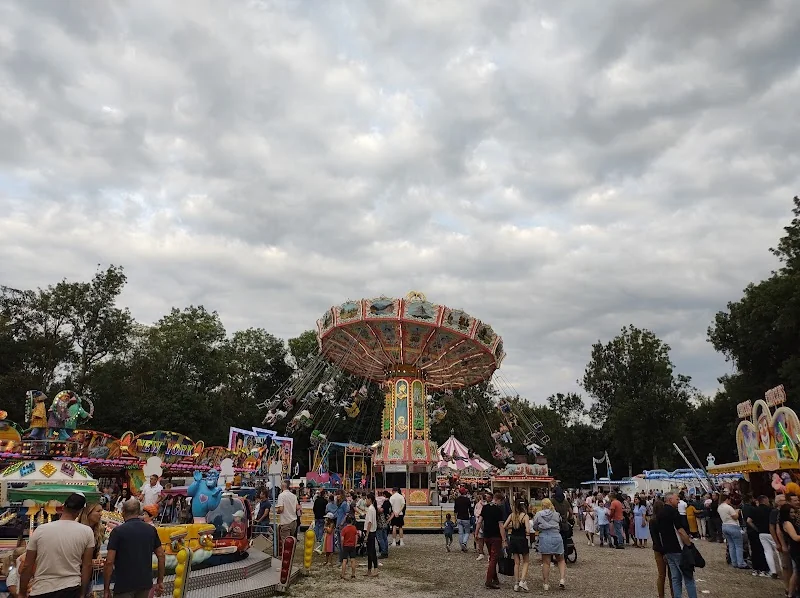
The environment of the festival is also an inseparable part of the experience. Descriptive sources mention rides, food stalls, and beer stands as part of the weekend. At the same time, the official background page emphasizes that the Children's Festival is still not a normal folk festival, even though the fairground and beer stands are part of it. This formulation captures the character of the festival site very well: it is festive and yet down-to-earth, a place for families, locals, and guests. A historical peculiarity is that the festival long revolved around children, gratitude, and local community, and only later took on more folk festival-like features. The impression of continuity arises precisely because modern elements come together with traditional forms. Therefore, for inquiries about the program, schedule, and images, not only the city's date page is interesting, but also the cultural-historical perspective that explains why the backdrop at the Children's Festival Site has such recognizable value. ([leipheim.de](https://www.leipheim.de/de/stadtinfo/kinderfest/hintergrund))
The musical accompaniment also plays an important role. The city band of Leipheim describes that the brass music contributes to the atmosphere of the Children's Festival and, together with the indispensable rides, food stalls, and beer stands, shapes the festival events. The city band also refers to the festival weekend, making it clear how strongly clubs are integrated into the local festival culture. For search intents like Children's Festival photos or Children's Festival program, this is important because such elements constitute the visual and emotional identity of the festival. The audience does not experience an anonymous event space but a weekend characterized by music, traditional costumes, children's groups, and the typical movements of a city festival. The Children's Festival Site is thus a place where not only is there celebration, but also tradition is made visible. ([stadtkapelle-leipheim.de](https://stadtkapelle-leipheim.de/cevent/kinderfest?utm_source=openai))
Directions, Weidlenweg, and Parking around the Festival Site
For practical searches for Children's Festival directions or Children's Festival parking, one piece of information is crucial: For navigation devices, the fire department of Leipheim explicitly mentions Weidlenweg, 89340 Leipheim, at the festival site. The official city map also marks Weidlenweg and the festival site or Children's Festival in the city area. Those who orient themselves to this data will find themselves in close proximity to the event location. The city map also shows several parking options marked with P in the vicinity of the center and the festival site. This is important for visitors because it shows that the site is well integrated into the local infrastructure without relying on a huge external parking lot. ([ff-leipheim.de](https://ff-leipheim.de/flohmarkt/))
Another useful detail is provided by the hiking description of the city of Leipheim. It states that the path downstream along the Weidlenweg passes by the Children's Festival Site. In the same description, a parking lot in Leipheim is mentioned, from which one goes over the Danube bridge and immediately turns right. Although this information comes from a hiking route, it confirms the spatial relationship of the festival site to Weidlenweg and the Danube. For visitors, this means in practice: Orientation is easy if one takes Weidlenweg as a guideline and uses the official city map or the known access routes. Those who arrive early usually benefit from the fact that the surroundings are designed not only for the festival but also for normal city traffic. ([ff-leipheim.de](https://ff-leipheim.de/flohmarkt/))
Because the Children's Festival Site is located in the urban area and not in an isolated outskirt, the journey is part of the experience. The official city map shows nearby points such as the Danube, the cycling path, the shooting house, the Güssen hall, and other central points in the Leipheim city area. This embedding helps especially visitors who are coming for the first time. For a search query like Children's Festival Site Leipzig? a different destination would of course be meant, but in Leipheim, it is very clear that the place is well anchored locally. The combination of address, city map, and the city's event page is particularly helpful because it makes the search for the site precise. Those looking for parking, directions, and route descriptions thus find a reliable basis. ([leipheim.de](https://www.leipheim.de/de/stadtinfo/kinderfest))
Children's Festival Poster, Photos, and Current Information from the City
Many search queries revolve not only around the location but also around the appearance of the festival. This is exactly where Children's Festival poster and Children's Festival photos are particularly relevant. The city of Leipheim has a dedicated section for the Children's Festival poster on its Children's Festival page and directly refers to current information and the background of the festival. This is important for digital visibility because posters and image motifs convey the festival externally. Those searching for the event in the calendar thus receive not only dates but also a visual orientation. The official page links the poster with the festival events and shows that the city not only manages the Children's Festival but also actively communicates and shapes it. ([leipheim.de](https://www.leipheim.de/de/stadtinfo/kinderfest))
For photos, it is worth taking a look at the cultural-historical pages. Bavarikon shows motifs such as the children's dance and refers to image material from the city of Leipheim. The Bavarian State Directory and the city page emphasize that the festival has been a tradition since 1817 and is now seen as cultural heritage. Such historical images are interesting for visitors because they make the development of the festival visually comprehensible. Those searching for photos often look for clothing styles, dance formations, floral arches, or the atmosphere at the festival site. Exactly these elements are embedded in the descriptions of the sources: magnificently decorated floral arches, traditional costumes, parades, music, and the central role of school children. Thus, a simple image search becomes a gateway to the tradition of the place. ([bavarikon.de](https://www.bavarikon.de/object/bav%3ABSB-CMS-0000000000008866))
Current information is also easily accessible. The city of Leipheim lists the current dates on its Children's Festival page, refers to the Children's Festival poster, and offers additional hints through other subpages. This includes the background of the festival, which explains the historical foundation. For user experience, this is ideal: Those searching for program, date, or poster land on an official page that offers both historical depth and current orientation. The search terms Children's Festival program 2026, Children's Festival poster, or Children's Festival photos are thus directly linked to a credible information base. For a location page, this is invaluable because such content increases trust, relevance, and local visibility at the same time. ([leipheim.de](https://www.leipheim.de/de/stadtinfo/kinderfest))
Surroundings at the Danube River and What Visitors Can Expect On-Site
The Children's Festival Site is described in the sources as a festival site on the banks of the Danube, and this location shapes its character. The place is situated in an environment where city, river, floodplain forest, and historical core meet. The hiking description of the city refers to the Weidlenweg passing by the Children's Festival Site and mentions the Güssen shooting house as the first place to stop. This creates a quite clear picture: The Children's Festival Site is not a closed event complex but part of a developed urban and landscape structure. For visitors, this means short distances, familiar landmarks, and a festive feeling that remains closely linked to the place. ([ff-leipheim.de](https://ff-leipheim.de/flohmarkt/))
Especially because the site has grown historically, it does not seem arbitrary. The official background page explicitly states that the Children's Festival is still not a normal folk festival with a fairground and beer stands, even though these elements are included. This formulation explains very well what visitors can expect: a mix of festive atmosphere, family program, and historical identity. Therefore, those searching for Children's Festival Site Leipheim are not just looking for a point on the map but a living piece of city history. This makes the location interesting for families, culture enthusiasts, and guests from the region alike. Furthermore, the embedding in the urban calendar shows that the Children's Festival is a fixed date in the annual cycle and not just a one-time event. ([leipheim.de](https://www.leipheim.de/de/stadtinfo/kinderfest/hintergrund))
In the end, the Children's Festival Site can best be described as a historical event location with a strong emotional recognition value. The connection between a traditional festival, participating school children, music, dances, festival sayings, and the location at Weidlenweg makes it unique for the city of Leipheim. The site serves as a stage, a memorial site, and a meeting point. For visitors seeking information about directions, parking, program, poster, or photos, the official city page is the most reliable starting point. For everyone else, the impression remains of a place where history is not exhibited but lived anew every year. This is the special strength of the Children's Festival Site Leipheim. ([leipheim.de](https://www.leipheim.de/de/stadtinfo/kinderfest))
Sources:
- City of Leipheim – Children's Festival
- City of Leipheim – Background on the Children's Festival
- City of Leipheim – Children's Festival Poster
- Bavarian State Ministry of Finance and for Home – Leipheim Children's Festival
- bavarikon – Cultural Heritage. Leipheim Children's Festival
- Fire Department Leipheim – Flea Market at the Leipheim Festival Site
- City Band Leipheim – Children's Festival
- City of Leipheim – City Map
Show moreShow less
Children's Festival Site Leipheim | History & Directions
The Children's Festival Site in Leipheim is much more than just a simple event area. It represents a festival that has been creating identity in the city for generations, and whose name is still immediately associated with tradition, children's voices, music, and summer vibes. When someone searches for the Children's Festival Site, they almost always mean the place where the Leipheim Children's Festival has its center at Weidlenweg. The city describes the festival as a tradition with a modern presence, and the historical Children's Festival currently takes place every year on the second weekend of July; for 2026, the city mentions the days from July 11 to 13. Even these framework dates show how strongly the site is intertwined with public life in Leipheim. At the same time, the place is closely connected with school children, dances, festival sayings, and the festival operations that continue to shape the event today. ([leipheim.de](https://www.leipheim.de/de/stadtinfo/kinderfest))
For visitors, the Children's Festival Site is primarily a place of vivid memories. The official pages of the city and the entries in the Bavarian State Directory of Intangible Cultural Heritage make it clear that the Leipheim Children's Festival did not arise as just any folk festival, but emerged from a historical exceptional situation. From the memory of hunger, cold, and poor harvests, a festival developed starting in 1817 that continues to place the children of the city at its center. This connection between history and the present explains why the Children's Festival Site is perceived today not only as a stage for entertainment but also as a historical memorial site. ([leipheim.de](https://www.leipheim.de/de/stadtinfo/kinderfest/hintergrund))
Historical Children's Festival and Significance of the Festival Site
The history of the Leipheim Children's Festival begins with a crisis. In April 1815, the Tambora volcano erupted on the Indonesian island of Sumbawa, and the global consequences led to extreme climate changes in Europe. The year 1816 went down in history as the year without summer. Cold, flooding, poor harvests, high mortality among livestock, and sharply rising grain prices also hit Leipheim hard. When the situation improved in 1817, the first Children's Festival was established. The official account describes it as a thank you for surviving the years of hunger, as a sign of hope for the future, and as a celebration for the children who had particularly suffered from hunger. This origin explains why the Children's Festival Site is perceived today not only as a stage for entertainment but also as a historical memorial site. ([leipheim.de](https://www.leipheim.de/de/stadtinfo/kinderfest/hintergrund))
The development of the festival shows how strongly tradition and change belong together here. Until 1893, the festival was celebrated under and around the Alber, a tree that is about 600 years old. Later, the festival activities shifted to the current festival site area. In the 1870s, the Alber fell victim to children, and in 1893 it was cut down. There were war-related interruptions, such as between 1940 and 1948, before the first post-war Children's Festival was celebrated in 1949. Since then, the festival has renewed itself without losing its core. The Bavarian cultural and heritage pages emphasize that the festival has taken place annually on the second weekend of July since 1817 and is now understood as a cultural form, custom, and firmly established tradition in Swabia. Thus, the Children's Festival Site in Leipheim is an example of how a local place retains social significance over two centuries. ([leipheim.de](https://www.leipheim.de/de/stadtinfo/kinderfest/hintergrund))
Particularly enlightening is the classification as intangible cultural heritage. The Bavarian State Ministry of Finance and for Home has included the Leipheim Children's Festival in the State Directory of Intangible Cultural Heritage since 2020. It is also mentioned that around 400 students from the primary and secondary school in Leipheim are at the center of the festival. Bavarikon adds that there are about 450 school children who create dances, festival sayings, and parades. This makes it clear that the Children's Festival Site is not an interchangeable event location but a place for the transmission of knowledge, rituals, and community. The official city page rightly speaks of tradition meets modernity. For SEO and visitor inquiries, this combination of history, cultural value, and living practice is crucial. ([ike.bayern.de](https://www.ike.bayern.de/verzeichnis/000340/index.html))
Program, Dances, and Festival Sayings at the Children's Festival Site
Those searching for Children's Festival program, Children's Festival photos, or Children's Festival Site generally want to know what actually happens at the festival. The official and cultural-historical sources provide a clear picture: The focus is on the children of the Leipheim primary and secondary school, who practice dances together with teachers months before the event. Highlights include various dances, presentations of festival sayings, parades, and games. Particularly well-known is the Schnitterreigen, a simple walking dance reserved for seventh and eighth-grade students, which is performed on festival Sunday and Monday. The festival sayings are presented in High German or in the Swabian dialect at noon and in the evening and reflect the respective zeitgeist. This mixture of lived tradition, youth work, and public performance makes the program at the Children's Festival Site so unique. ([ike.bayern.de](https://www.ike.bayern.de/verzeichnis/000340/index.html))
The environment of the festival is also an inseparable part of the experience. Descriptive sources mention rides, food stalls, and beer stands as part of the weekend. At the same time, the official background page emphasizes that the Children's Festival is still not a normal folk festival, even though the fairground and beer stands are part of it. This formulation captures the character of the festival site very well: it is festive and yet down-to-earth, a place for families, locals, and guests. A historical peculiarity is that the festival long revolved around children, gratitude, and local community, and only later took on more folk festival-like features. The impression of continuity arises precisely because modern elements come together with traditional forms. Therefore, for inquiries about the program, schedule, and images, not only the city's date page is interesting, but also the cultural-historical perspective that explains why the backdrop at the Children's Festival Site has such recognizable value. ([leipheim.de](https://www.leipheim.de/de/stadtinfo/kinderfest/hintergrund))
The musical accompaniment also plays an important role. The city band of Leipheim describes that the brass music contributes to the atmosphere of the Children's Festival and, together with the indispensable rides, food stalls, and beer stands, shapes the festival events. The city band also refers to the festival weekend, making it clear how strongly clubs are integrated into the local festival culture. For search intents like Children's Festival photos or Children's Festival program, this is important because such elements constitute the visual and emotional identity of the festival. The audience does not experience an anonymous event space but a weekend characterized by music, traditional costumes, children's groups, and the typical movements of a city festival. The Children's Festival Site is thus a place where not only is there celebration, but also tradition is made visible. ([stadtkapelle-leipheim.de](https://stadtkapelle-leipheim.de/cevent/kinderfest?utm_source=openai))
Directions, Weidlenweg, and Parking around the Festival Site
For practical searches for Children's Festival directions or Children's Festival parking, one piece of information is crucial: For navigation devices, the fire department of Leipheim explicitly mentions Weidlenweg, 89340 Leipheim, at the festival site. The official city map also marks Weidlenweg and the festival site or Children's Festival in the city area. Those who orient themselves to this data will find themselves in close proximity to the event location. The city map also shows several parking options marked with P in the vicinity of the center and the festival site. This is important for visitors because it shows that the site is well integrated into the local infrastructure without relying on a huge external parking lot. ([ff-leipheim.de](https://ff-leipheim.de/flohmarkt/))
Another useful detail is provided by the hiking description of the city of Leipheim. It states that the path downstream along the Weidlenweg passes by the Children's Festival Site. In the same description, a parking lot in Leipheim is mentioned, from which one goes over the Danube bridge and immediately turns right. Although this information comes from a hiking route, it confirms the spatial relationship of the festival site to Weidlenweg and the Danube. For visitors, this means in practice: Orientation is easy if one takes Weidlenweg as a guideline and uses the official city map or the known access routes. Those who arrive early usually benefit from the fact that the surroundings are designed not only for the festival but also for normal city traffic. ([ff-leipheim.de](https://ff-leipheim.de/flohmarkt/))
Because the Children's Festival Site is located in the urban area and not in an isolated outskirt, the journey is part of the experience. The official city map shows nearby points such as the Danube, the cycling path, the shooting house, the Güssen hall, and other central points in the Leipheim city area. This embedding helps especially visitors who are coming for the first time. For a search query like Children's Festival Site Leipzig? a different destination would of course be meant, but in Leipheim, it is very clear that the place is well anchored locally. The combination of address, city map, and the city's event page is particularly helpful because it makes the search for the site precise. Those looking for parking, directions, and route descriptions thus find a reliable basis. ([leipheim.de](https://www.leipheim.de/de/stadtinfo/kinderfest))
Children's Festival Poster, Photos, and Current Information from the City
Many search queries revolve not only around the location but also around the appearance of the festival. This is exactly where Children's Festival poster and Children's Festival photos are particularly relevant. The city of Leipheim has a dedicated section for the Children's Festival poster on its Children's Festival page and directly refers to current information and the background of the festival. This is important for digital visibility because posters and image motifs convey the festival externally. Those searching for the event in the calendar thus receive not only dates but also a visual orientation. The official page links the poster with the festival events and shows that the city not only manages the Children's Festival but also actively communicates and shapes it. ([leipheim.de](https://www.leipheim.de/de/stadtinfo/kinderfest))
For photos, it is worth taking a look at the cultural-historical pages. Bavarikon shows motifs such as the children's dance and refers to image material from the city of Leipheim. The Bavarian State Directory and the city page emphasize that the festival has been a tradition since 1817 and is now seen as cultural heritage. Such historical images are interesting for visitors because they make the development of the festival visually comprehensible. Those searching for photos often look for clothing styles, dance formations, floral arches, or the atmosphere at the festival site. Exactly these elements are embedded in the descriptions of the sources: magnificently decorated floral arches, traditional costumes, parades, music, and the central role of school children. Thus, a simple image search becomes a gateway to the tradition of the place. ([bavarikon.de](https://www.bavarikon.de/object/bav%3ABSB-CMS-0000000000008866))
Current information is also easily accessible. The city of Leipheim lists the current dates on its Children's Festival page, refers to the Children's Festival poster, and offers additional hints through other subpages. This includes the background of the festival, which explains the historical foundation. For user experience, this is ideal: Those searching for program, date, or poster land on an official page that offers both historical depth and current orientation. The search terms Children's Festival program 2026, Children's Festival poster, or Children's Festival photos are thus directly linked to a credible information base. For a location page, this is invaluable because such content increases trust, relevance, and local visibility at the same time. ([leipheim.de](https://www.leipheim.de/de/stadtinfo/kinderfest))
Surroundings at the Danube River and What Visitors Can Expect On-Site
The Children's Festival Site is described in the sources as a festival site on the banks of the Danube, and this location shapes its character. The place is situated in an environment where city, river, floodplain forest, and historical core meet. The hiking description of the city refers to the Weidlenweg passing by the Children's Festival Site and mentions the Güssen shooting house as the first place to stop. This creates a quite clear picture: The Children's Festival Site is not a closed event complex but part of a developed urban and landscape structure. For visitors, this means short distances, familiar landmarks, and a festive feeling that remains closely linked to the place. ([ff-leipheim.de](https://ff-leipheim.de/flohmarkt/))
Especially because the site has grown historically, it does not seem arbitrary. The official background page explicitly states that the Children's Festival is still not a normal folk festival with a fairground and beer stands, even though these elements are included. This formulation explains very well what visitors can expect: a mix of festive atmosphere, family program, and historical identity. Therefore, those searching for Children's Festival Site Leipheim are not just looking for a point on the map but a living piece of city history. This makes the location interesting for families, culture enthusiasts, and guests from the region alike. Furthermore, the embedding in the urban calendar shows that the Children's Festival is a fixed date in the annual cycle and not just a one-time event. ([leipheim.de](https://www.leipheim.de/de/stadtinfo/kinderfest/hintergrund))
In the end, the Children's Festival Site can best be described as a historical event location with a strong emotional recognition value. The connection between a traditional festival, participating school children, music, dances, festival sayings, and the location at Weidlenweg makes it unique for the city of Leipheim. The site serves as a stage, a memorial site, and a meeting point. For visitors seeking information about directions, parking, program, poster, or photos, the official city page is the most reliable starting point. For everyone else, the impression remains of a place where history is not exhibited but lived anew every year. This is the special strength of the Children's Festival Site Leipheim. ([leipheim.de](https://www.leipheim.de/de/stadtinfo/kinderfest))
Sources:
- City of Leipheim – Children's Festival
- City of Leipheim – Background on the Children's Festival
- City of Leipheim – Children's Festival Poster
- Bavarian State Ministry of Finance and for Home – Leipheim Children's Festival
- bavarikon – Cultural Heritage. Leipheim Children's Festival
- Fire Department Leipheim – Flea Market at the Leipheim Festival Site
- City Band Leipheim – Children's Festival
- City of Leipheim – City Map
Children's Festival Site Leipheim | History & Directions
The Children's Festival Site in Leipheim is much more than just a simple event area. It represents a festival that has been creating identity in the city for generations, and whose name is still immediately associated with tradition, children's voices, music, and summer vibes. When someone searches for the Children's Festival Site, they almost always mean the place where the Leipheim Children's Festival has its center at Weidlenweg. The city describes the festival as a tradition with a modern presence, and the historical Children's Festival currently takes place every year on the second weekend of July; for 2026, the city mentions the days from July 11 to 13. Even these framework dates show how strongly the site is intertwined with public life in Leipheim. At the same time, the place is closely connected with school children, dances, festival sayings, and the festival operations that continue to shape the event today. ([leipheim.de](https://www.leipheim.de/de/stadtinfo/kinderfest))
For visitors, the Children's Festival Site is primarily a place of vivid memories. The official pages of the city and the entries in the Bavarian State Directory of Intangible Cultural Heritage make it clear that the Leipheim Children's Festival did not arise as just any folk festival, but emerged from a historical exceptional situation. From the memory of hunger, cold, and poor harvests, a festival developed starting in 1817 that continues to place the children of the city at its center. This connection between history and the present explains why the Children's Festival Site is perceived today not only as a stage for entertainment but also as a historical memorial site. ([leipheim.de](https://www.leipheim.de/de/stadtinfo/kinderfest/hintergrund))
Historical Children's Festival and Significance of the Festival Site
The history of the Leipheim Children's Festival begins with a crisis. In April 1815, the Tambora volcano erupted on the Indonesian island of Sumbawa, and the global consequences led to extreme climate changes in Europe. The year 1816 went down in history as the year without summer. Cold, flooding, poor harvests, high mortality among livestock, and sharply rising grain prices also hit Leipheim hard. When the situation improved in 1817, the first Children's Festival was established. The official account describes it as a thank you for surviving the years of hunger, as a sign of hope for the future, and as a celebration for the children who had particularly suffered from hunger. This origin explains why the Children's Festival Site is perceived today not only as a stage for entertainment but also as a historical memorial site. ([leipheim.de](https://www.leipheim.de/de/stadtinfo/kinderfest/hintergrund))
The development of the festival shows how strongly tradition and change belong together here. Until 1893, the festival was celebrated under and around the Alber, a tree that is about 600 years old. Later, the festival activities shifted to the current festival site area. In the 1870s, the Alber fell victim to children, and in 1893 it was cut down. There were war-related interruptions, such as between 1940 and 1948, before the first post-war Children's Festival was celebrated in 1949. Since then, the festival has renewed itself without losing its core. The Bavarian cultural and heritage pages emphasize that the festival has taken place annually on the second weekend of July since 1817 and is now understood as a cultural form, custom, and firmly established tradition in Swabia. Thus, the Children's Festival Site in Leipheim is an example of how a local place retains social significance over two centuries. ([leipheim.de](https://www.leipheim.de/de/stadtinfo/kinderfest/hintergrund))
Particularly enlightening is the classification as intangible cultural heritage. The Bavarian State Ministry of Finance and for Home has included the Leipheim Children's Festival in the State Directory of Intangible Cultural Heritage since 2020. It is also mentioned that around 400 students from the primary and secondary school in Leipheim are at the center of the festival. Bavarikon adds that there are about 450 school children who create dances, festival sayings, and parades. This makes it clear that the Children's Festival Site is not an interchangeable event location but a place for the transmission of knowledge, rituals, and community. The official city page rightly speaks of tradition meets modernity. For SEO and visitor inquiries, this combination of history, cultural value, and living practice is crucial. ([ike.bayern.de](https://www.ike.bayern.de/verzeichnis/000340/index.html))
Program, Dances, and Festival Sayings at the Children's Festival Site
Those searching for Children's Festival program, Children's Festival photos, or Children's Festival Site generally want to know what actually happens at the festival. The official and cultural-historical sources provide a clear picture: The focus is on the children of the Leipheim primary and secondary school, who practice dances together with teachers months before the event. Highlights include various dances, presentations of festival sayings, parades, and games. Particularly well-known is the Schnitterreigen, a simple walking dance reserved for seventh and eighth-grade students, which is performed on festival Sunday and Monday. The festival sayings are presented in High German or in the Swabian dialect at noon and in the evening and reflect the respective zeitgeist. This mixture of lived tradition, youth work, and public performance makes the program at the Children's Festival Site so unique. ([ike.bayern.de](https://www.ike.bayern.de/verzeichnis/000340/index.html))
The environment of the festival is also an inseparable part of the experience. Descriptive sources mention rides, food stalls, and beer stands as part of the weekend. At the same time, the official background page emphasizes that the Children's Festival is still not a normal folk festival, even though the fairground and beer stands are part of it. This formulation captures the character of the festival site very well: it is festive and yet down-to-earth, a place for families, locals, and guests. A historical peculiarity is that the festival long revolved around children, gratitude, and local community, and only later took on more folk festival-like features. The impression of continuity arises precisely because modern elements come together with traditional forms. Therefore, for inquiries about the program, schedule, and images, not only the city's date page is interesting, but also the cultural-historical perspective that explains why the backdrop at the Children's Festival Site has such recognizable value. ([leipheim.de](https://www.leipheim.de/de/stadtinfo/kinderfest/hintergrund))
The musical accompaniment also plays an important role. The city band of Leipheim describes that the brass music contributes to the atmosphere of the Children's Festival and, together with the indispensable rides, food stalls, and beer stands, shapes the festival events. The city band also refers to the festival weekend, making it clear how strongly clubs are integrated into the local festival culture. For search intents like Children's Festival photos or Children's Festival program, this is important because such elements constitute the visual and emotional identity of the festival. The audience does not experience an anonymous event space but a weekend characterized by music, traditional costumes, children's groups, and the typical movements of a city festival. The Children's Festival Site is thus a place where not only is there celebration, but also tradition is made visible. ([stadtkapelle-leipheim.de](https://stadtkapelle-leipheim.de/cevent/kinderfest?utm_source=openai))
Directions, Weidlenweg, and Parking around the Festival Site
For practical searches for Children's Festival directions or Children's Festival parking, one piece of information is crucial: For navigation devices, the fire department of Leipheim explicitly mentions Weidlenweg, 89340 Leipheim, at the festival site. The official city map also marks Weidlenweg and the festival site or Children's Festival in the city area. Those who orient themselves to this data will find themselves in close proximity to the event location. The city map also shows several parking options marked with P in the vicinity of the center and the festival site. This is important for visitors because it shows that the site is well integrated into the local infrastructure without relying on a huge external parking lot. ([ff-leipheim.de](https://ff-leipheim.de/flohmarkt/))
Another useful detail is provided by the hiking description of the city of Leipheim. It states that the path downstream along the Weidlenweg passes by the Children's Festival Site. In the same description, a parking lot in Leipheim is mentioned, from which one goes over the Danube bridge and immediately turns right. Although this information comes from a hiking route, it confirms the spatial relationship of the festival site to Weidlenweg and the Danube. For visitors, this means in practice: Orientation is easy if one takes Weidlenweg as a guideline and uses the official city map or the known access routes. Those who arrive early usually benefit from the fact that the surroundings are designed not only for the festival but also for normal city traffic. ([ff-leipheim.de](https://ff-leipheim.de/flohmarkt/))
Because the Children's Festival Site is located in the urban area and not in an isolated outskirt, the journey is part of the experience. The official city map shows nearby points such as the Danube, the cycling path, the shooting house, the Güssen hall, and other central points in the Leipheim city area. This embedding helps especially visitors who are coming for the first time. For a search query like Children's Festival Site Leipzig? a different destination would of course be meant, but in Leipheim, it is very clear that the place is well anchored locally. The combination of address, city map, and the city's event page is particularly helpful because it makes the search for the site precise. Those looking for parking, directions, and route descriptions thus find a reliable basis. ([leipheim.de](https://www.leipheim.de/de/stadtinfo/kinderfest))
Children's Festival Poster, Photos, and Current Information from the City
Many search queries revolve not only around the location but also around the appearance of the festival. This is exactly where Children's Festival poster and Children's Festival photos are particularly relevant. The city of Leipheim has a dedicated section for the Children's Festival poster on its Children's Festival page and directly refers to current information and the background of the festival. This is important for digital visibility because posters and image motifs convey the festival externally. Those searching for the event in the calendar thus receive not only dates but also a visual orientation. The official page links the poster with the festival events and shows that the city not only manages the Children's Festival but also actively communicates and shapes it. ([leipheim.de](https://www.leipheim.de/de/stadtinfo/kinderfest))
For photos, it is worth taking a look at the cultural-historical pages. Bavarikon shows motifs such as the children's dance and refers to image material from the city of Leipheim. The Bavarian State Directory and the city page emphasize that the festival has been a tradition since 1817 and is now seen as cultural heritage. Such historical images are interesting for visitors because they make the development of the festival visually comprehensible. Those searching for photos often look for clothing styles, dance formations, floral arches, or the atmosphere at the festival site. Exactly these elements are embedded in the descriptions of the sources: magnificently decorated floral arches, traditional costumes, parades, music, and the central role of school children. Thus, a simple image search becomes a gateway to the tradition of the place. ([bavarikon.de](https://www.bavarikon.de/object/bav%3ABSB-CMS-0000000000008866))
Current information is also easily accessible. The city of Leipheim lists the current dates on its Children's Festival page, refers to the Children's Festival poster, and offers additional hints through other subpages. This includes the background of the festival, which explains the historical foundation. For user experience, this is ideal: Those searching for program, date, or poster land on an official page that offers both historical depth and current orientation. The search terms Children's Festival program 2026, Children's Festival poster, or Children's Festival photos are thus directly linked to a credible information base. For a location page, this is invaluable because such content increases trust, relevance, and local visibility at the same time. ([leipheim.de](https://www.leipheim.de/de/stadtinfo/kinderfest))
Surroundings at the Danube River and What Visitors Can Expect On-Site
The Children's Festival Site is described in the sources as a festival site on the banks of the Danube, and this location shapes its character. The place is situated in an environment where city, river, floodplain forest, and historical core meet. The hiking description of the city refers to the Weidlenweg passing by the Children's Festival Site and mentions the Güssen shooting house as the first place to stop. This creates a quite clear picture: The Children's Festival Site is not a closed event complex but part of a developed urban and landscape structure. For visitors, this means short distances, familiar landmarks, and a festive feeling that remains closely linked to the place. ([ff-leipheim.de](https://ff-leipheim.de/flohmarkt/))
Especially because the site has grown historically, it does not seem arbitrary. The official background page explicitly states that the Children's Festival is still not a normal folk festival with a fairground and beer stands, even though these elements are included. This formulation explains very well what visitors can expect: a mix of festive atmosphere, family program, and historical identity. Therefore, those searching for Children's Festival Site Leipheim are not just looking for a point on the map but a living piece of city history. This makes the location interesting for families, culture enthusiasts, and guests from the region alike. Furthermore, the embedding in the urban calendar shows that the Children's Festival is a fixed date in the annual cycle and not just a one-time event. ([leipheim.de](https://www.leipheim.de/de/stadtinfo/kinderfest/hintergrund))
In the end, the Children's Festival Site can best be described as a historical event location with a strong emotional recognition value. The connection between a traditional festival, participating school children, music, dances, festival sayings, and the location at Weidlenweg makes it unique for the city of Leipheim. The site serves as a stage, a memorial site, and a meeting point. For visitors seeking information about directions, parking, program, poster, or photos, the official city page is the most reliable starting point. For everyone else, the impression remains of a place where history is not exhibited but lived anew every year. This is the special strength of the Children's Festival Site Leipheim. ([leipheim.de](https://www.leipheim.de/de/stadtinfo/kinderfest))
Sources:
- City of Leipheim – Children's Festival
- City of Leipheim – Background on the Children's Festival
- City of Leipheim – Children's Festival Poster
- Bavarian State Ministry of Finance and for Home – Leipheim Children's Festival
- bavarikon – Cultural Heritage. Leipheim Children's Festival
- Fire Department Leipheim – Flea Market at the Leipheim Festival Site
- City Band Leipheim – Children's Festival
- City of Leipheim – City Map
Upcoming Events
No events found
Frequently Asked Questions
Reviews
Steffen Heil
13. July 2025
Really sad to pay 5 euros for entry and 15 euros for a Maß just to go once, who can afford that these days? That was the last time I’m here, I’d rather go to the Langenau Children's Festival where at least there's no entry fee!!!!!
Georg Konrad
17. July 2025
It was definitely better before... 5 euros for entry, food and drinks are expensive too... and the portions are smaller...
Dolli
13. July 2025
Nice, shady festival with a great selection of food and drinks. Parking costs 3 euros.
K. V.
13. July 2025
Honestly... I find it outrageous... charging for parking and then also an entry fee per person!!
T Punkt B Punkt
17. July 2023
Great festival for young and old. There's a lot going on. Cool rides. Good selection of food. I think there's something for everyone. Musical entertainment. Paid parking nearby. I found 2 euros okay. Entry to the festival area is 4 euros per adult.