
Ulm
Am Hochsträß 8, 89081 Ulm, Deutschland
HfG Archive / Museum Ulm | Tickets & Opening Hours
The HfG Archive / Museum Ulm is not an ordinary museum, but a place where architecture, design history, and research merge directly. It is located in the former building of the Hochschule für Gestaltung on the Oberer Kuhberg and makes the history of the legendary HfG Ulm accessible to a broad audience. Those looking for a destination that not only showcases content but is itself a piece of design history will find one of the most important places for German and international design culture here. The building operates as both a museum and archive, displaying permanent and changing exhibitions, offering guided tours, and enabling scientific research. This dual function makes the location special: it is not just about beautiful objects, but about ideas, methods, and an attitude towards design that continues to resonate today. The combination of a historic site, clear architecture, and well-curated content makes the HfG Archive / Museum Ulm an address that is interesting for both first-time visitors and in-depth research. ([hfg-archiv.museumulm.de](https://hfg-archiv.museumulm.de/))
Tickets, Opening Hours, and Admission Prices
Planning a visit is pleasantly straightforward. The exhibitions are open from Tuesday to Sunday and on public holidays from 11 AM to 5 PM. The archive area for document presentation and scientific research has separate hours: it is accessible on Wednesdays from 9 AM to 5 PM, but only by prior appointment. The admission for the permanent and special exhibitions is currently 5 euros regular and 4 euros reduced. Additionally, there are several attractive free conditions: admission is free on the first Friday of each month, as well as for children and teenagers up to and including 18 years. Those with the MuseumPassMusees or the UlmCard also receive free admission. This makes the house suitable not only for spontaneous cultural stops but also for targeted day trips with clearly calculable costs. Tickets can be booked online, which is particularly useful if you want to combine your visit with a guided tour or a specific time slot. Admission is also offered as a gift. For a house of this significance, the price level is deliberately kept low, so that the history of HfG is accessible to many visitors and not just reserved for special interest groups. ([hfg-archiv.museumulm.de](https://hfg-archiv.museumulm.de/en/visit/))
Those who plan their visit strategically benefit from the special regulations, especially on weekends or during an already planned trip to Ulm. The house also responds to current conditions with additional actions: for example, there was a free admission week in August 2026, and on hot days, admission may be reduced if the weather data reaches certain values. This is helpful for visitor communication, as one not only knows the standard rate but can also keep an eye on possible discounts. For families, school classes, and groups, it is important that public tours and private group tours are offered separately. Public tours cost 3 euros per person plus admission; private tours must be booked in advance and have fixed group prices. This allows for very flexible organization of the visit depending on interest: from a short spontaneous tour to an extensive, thematically guided exploration of the history of HfG Ulm. In the context of inquiries such as tickets, admission, or opening hours, the house is clearly structured and well prepared. ([hfg-archiv.museumulm.de](https://hfg-archiv.museumulm.de/en/visit/))
Directions, Parking, and Accessibility
The HfG Archive / Museum Ulm is located at Am Hochsträß 8, 89081 Ulm, in the former building of the Hochschule für Gestaltung on the Oberer Kuhberg. The path from the main entrance through the building is signposted, making access easy to find despite the special location. For those arriving by car, the instructions are clear: public, free parking is available below the university building. For those wishing to arrive barrier-free, the upper entrance is used, which is reached via a paved road that leads left around the building and past the gatehouse. There is also a designated disabled parking space there. This is an important detail for a historically and architecturally significant building because access is described not only functionally but also understandably. Visitors do not have to improvise but can plan their orientation very concretely. Especially at a location on the Oberer Kuhberg, this clarity is a real advantage because the building is not located in a classic city center but in a historic campus context. ([hfg-archiv.museumulm.de](https://hfg-archiv.museumulm.de/besucherinfos/))
The location is also easily accessible by public transport. The official directions mention two simple options: From Ulm station, take tram line 2 to Kuhberg Schulzentrum, then transfer to bus line 8 and walk about eight minutes to Oberer Kuhberg. From the city center at Ulm Town Hall, take bus line 4 to Ehinger Tor, then transfer to tram line 2, continue to Kuhberg Schulzentrum, then take bus line 8 and walk the last meters. For a cultural site outside the narrow old town, this is remarkably clearly described. Additionally, the house refers to the timetable information from SWU and DING, which makes planning easier, especially for visitors from the region. This means in practice: even without local knowledge, the way can be well organized if you plan a few minutes of buffer time. Those who want to make the experience stress-free should check the public transport connection in advance and combine the visit with a guided tour or a coffee in the city. ([hfg-archiv.museumulm.de](https://hfg-archiv.museumulm.de/besucherinfos/))
How the HfG Ulm Made History
The most important historical foundation of the house is the Hochschule für Gestaltung Ulm, or HfG Ulm, which was founded in 1953 by Inge Scholl, Otl Aicher, and Max Bill. Max Bill also took over as the first rector in 1953. The school developed in the 1950s and 1960s into one of the most progressive institutions for design and environmental design and quickly gained international recognition. In its departments, new approaches in the fields of visual communication, industrial design, architecture, information, and later also film were tested and practically implemented. What was special about the HfG was not only the quality of individual works but a whole pedagogical model: design was understood as a scientifically based, socially relevant discipline. This attitude was closely linked to the idea of improving everyday life in a democratic society through good design. That is precisely why the HfG Archive / Museum Ulm is much more than a local memorial. It is a place where the aftereffects of a European design movement can be traced precisely. The themes range from the post-war period to the modernization of consumer goods to didactic concepts for the training of designers. ([hfg-archiv.museumulm.de](https://hfg-archiv.museumulm.de/geschichte-hfg/))
The building itself is also part of this history. The construction of the HfG was designed by Max Bill and is considered a striking example of early German reinforced concrete skeleton construction. The open location on the slope of the Oberer Kuhberg and the clear, cubic form language make the place unmistakable to this day. The school was designed to integrate work and life in one place; this campus idea reflected the self-understanding of an experimental institution. According to official information, the HfG was not only seen as a model for new establishments in other countries during its active time but also continued to influence international design education and the work of many of its graduates after its closure in 1968. This is an important point for visitors who are primarily looking for history or background: the exhibition tells not only of a former school but of a network of ideas, people, and objects that continues to resonate in companies, universities, and museums today. The place thus stands for an attitude that understands design as a cultural and societal task. ([hfg-archiv.museumulm.de](https://hfg-archiv.museumulm.de/geschichte-hfg/))
The Permanent Exhibition and Iconic Designs
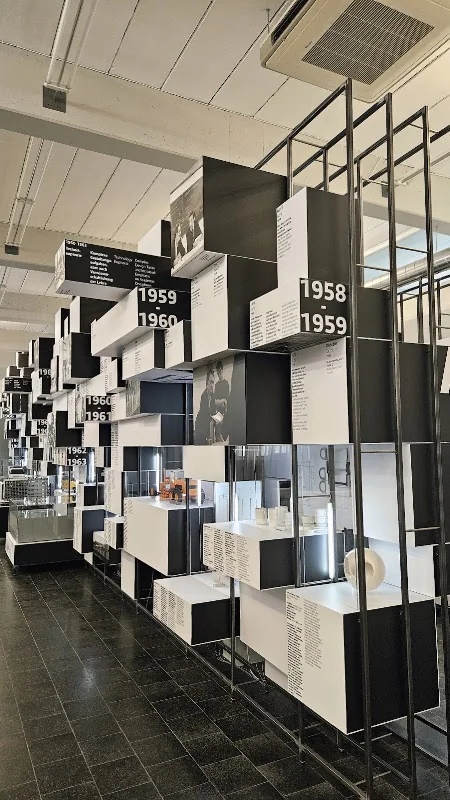
The permanent exhibition is titled From Zero Hour to 1968 and presents the history of HfG Ulm over approximately 275 square meters. More than 200 exhibits and numerous photographs make visible how the school operated, what ideas shaped it, and what products emerged from it. It is particularly important that Ulm is the only place where the history of the school can be experienced in this density because the archive is housed in the original rooms of the former HfG. The exhibition is divided into several areas: a chronological overview of the history of the school, a thematic A to Z structure, and areas for special presentations and press examples. This structure is cleverly chosen because it provides orientation for both beginners and experts. The HfG is not staged as a rigid legend but as a living school with developments, debates, and internal changes. This keeps the exhibition understandable and deep at the same time. Those interested in product design, information design, architecture, or the didactics of design will find a compact yet rich overview here. ([hfg-archiv.museumulm.de](https://hfg-archiv.museumulm.de/en/permanent-exhibition/))
Among the most famous objects are the Ulm Stool, the stackable tableware TC 100, and the Braun Radio SK 4, which also became known as Snow White's coffin. These examples illustrate how closely the HfG was connected to modern industrial design. It is not just about aesthetic form but about function, series production, material understanding, and systematic thinking. The exhibition also makes clear that a design concept was developed at the HfG that understood science and technology as the basis for good design. This so-called Ulm Model continues to resonate today. The whole is complemented by original documents, models, and photographs that illustrate the everyday work of the school. For visitors looking for photos or typical motifs, these objects are particularly interesting because they provide iconic image motifs and are also content-rich. The Ulm Stool or the Braun SK 4 are not just design classics but evidence of how consistently new solutions were worked on at the HfG. Therefore, those who walk through the exhibition attentively not only receive a historical lesson but also a very clear picture of why HfG Ulm is still considered one of the most influential design institutions today. ([hfg-archiv.museumulm.de](https://hfg-archiv.museumulm.de/en/permanent-exhibition/))
Guided Tours, Archive Use, and Special Exhibitions
The HfG Archive / Museum Ulm offers much more than a single tour through the permanent exhibition. Regular guided tours are a fixed part of the program and are aimed at both individual visitors and groups. Public tours take place through the permanent exhibition and the current special exhibitions and cost 3 euros per person plus admission. There are separate booking options for private groups; registration is done through the mediation team via email or phone. These offers are particularly helpful if you want to see the historical and design contexts not just superficially but want them explained systematically. The archive itself is also a working place: it includes original files, graphics, objects, photographs, and a special library. Since the founding of the HfG Archive in 1987, these collections have been permanently loaned to the city of Ulm; since 1993, the archive has been a department of the Ulm Museum. For research, the house is therefore a real point of contact, not just an exhibition space. This dual function as a public museum and scientifically used archive makes the place unique in Germany. ([hfg-archiv.museumulm.de](https://hfg-archiv.museumulm.de/en/visit/))
The program work is also interesting because it not only historicizes the HfG but also thinks further. The house regularly presents special exhibitions and events that address different aspects of design, history, and collection items. In addition, there is a 360-degree tour that allows the place to be explored digitally in advance. So, if you are looking for photos or a first visual impression, you can get a good picture of the rooms and the atmosphere before your visit. Additionally, there is a museum shop as well as information on discounts for certain ticket types and collaborations, such as with bwegtPlus. For many visitors, this is useful because the visit can be more easily integrated into a regional outing. The combination of research, mediation, ticket offerings, and changing programs shows that the HfG Archive / Museum Ulm is not just a place for design nostalgia but an actively working cultural institution. Especially those who land in the search for events or a current program will find a place here that does not conserve history but tells it anew time and again. ([hfg-archiv.museumulm.de](https://hfg-archiv.museumulm.de/))
Photos, Architecture, and Tips for the Visit
For the search for photos, the HfG Archive / Museum Ulm is particularly fruitful because the place itself is strongly visually shaped. The building designed by Max Bill, the open location on the slope of the Oberer Kuhberg, and the clear, reduced architecture provide motifs that are attractive for both private memory photos and social media shots. In addition, there are the historical objects inside, especially the well-known design icons of the HfG. The official image guidelines of the house show how strongly historical photographs are used and how central the interplay of space, object, and document is for the museum. So, if you are looking for images of the HfG Archive Ulm, you will find not only external architecture but also detailed interior views, exhibition scenes, and archival material. What is particularly convincing is that the house does not tell its history in a neutral white-cube environment but in the real rooms of the former school. This creates images with authenticity and atmosphere that are not found in many other museums. For visitors planning their first impression, this is important: the photogenicity of the place is not a side effect but part of its content effect. ([hfg-archiv.museumulm.de](https://hfg-archiv.museumulm.de/))
An ideal visit ideally begins with some time for the building itself. Those who choose to arrive via the upper entrance experience the campus character even before entering and get a sense of the connection between architecture, terrain, and function. Afterwards, a slow walk through the permanent exhibition is worthwhile because the many objects and photographs are designed for systematic discovery rather than quick stimuli. Those who want to dive deeper can combine the visit with a guided tour or a look at the 360-degree tour in advance. This way, questions about the course of the session, path guidance, and spatial effect can be better assessed before being on site. It is also practical that there are clear indications of opening hours, tickets, parking, and access. This reduces uncertainties and makes the visit planable even for first-time visitors. For inquiries such as photos, reviews, or admission, the most important recommendation is: first read the official house information, then select the visit according to your own expectations. Those who appreciate design history, architecture, and a quiet, very focused museum visit will discover a lot here. ([hfg-archiv.museumulm.de](https://hfg-archiv.museumulm.de/en/visit/))
Sources:
Mehr anzeigenWeniger anzeigen
HfG Archive / Museum Ulm | Tickets & Opening Hours
The HfG Archive / Museum Ulm is not an ordinary museum, but a place where architecture, design history, and research merge directly. It is located in the former building of the Hochschule für Gestaltung on the Oberer Kuhberg and makes the history of the legendary HfG Ulm accessible to a broad audience. Those looking for a destination that not only showcases content but is itself a piece of design history will find one of the most important places for German and international design culture here. The building operates as both a museum and archive, displaying permanent and changing exhibitions, offering guided tours, and enabling scientific research. This dual function makes the location special: it is not just about beautiful objects, but about ideas, methods, and an attitude towards design that continues to resonate today. The combination of a historic site, clear architecture, and well-curated content makes the HfG Archive / Museum Ulm an address that is interesting for both first-time visitors and in-depth research. ([hfg-archiv.museumulm.de](https://hfg-archiv.museumulm.de/))
Tickets, Opening Hours, and Admission Prices
Planning a visit is pleasantly straightforward. The exhibitions are open from Tuesday to Sunday and on public holidays from 11 AM to 5 PM. The archive area for document presentation and scientific research has separate hours: it is accessible on Wednesdays from 9 AM to 5 PM, but only by prior appointment. The admission for the permanent and special exhibitions is currently 5 euros regular and 4 euros reduced. Additionally, there are several attractive free conditions: admission is free on the first Friday of each month, as well as for children and teenagers up to and including 18 years. Those with the MuseumPassMusees or the UlmCard also receive free admission. This makes the house suitable not only for spontaneous cultural stops but also for targeted day trips with clearly calculable costs. Tickets can be booked online, which is particularly useful if you want to combine your visit with a guided tour or a specific time slot. Admission is also offered as a gift. For a house of this significance, the price level is deliberately kept low, so that the history of HfG is accessible to many visitors and not just reserved for special interest groups. ([hfg-archiv.museumulm.de](https://hfg-archiv.museumulm.de/en/visit/))
Those who plan their visit strategically benefit from the special regulations, especially on weekends or during an already planned trip to Ulm. The house also responds to current conditions with additional actions: for example, there was a free admission week in August 2026, and on hot days, admission may be reduced if the weather data reaches certain values. This is helpful for visitor communication, as one not only knows the standard rate but can also keep an eye on possible discounts. For families, school classes, and groups, it is important that public tours and private group tours are offered separately. Public tours cost 3 euros per person plus admission; private tours must be booked in advance and have fixed group prices. This allows for very flexible organization of the visit depending on interest: from a short spontaneous tour to an extensive, thematically guided exploration of the history of HfG Ulm. In the context of inquiries such as tickets, admission, or opening hours, the house is clearly structured and well prepared. ([hfg-archiv.museumulm.de](https://hfg-archiv.museumulm.de/en/visit/))
Directions, Parking, and Accessibility
The HfG Archive / Museum Ulm is located at Am Hochsträß 8, 89081 Ulm, in the former building of the Hochschule für Gestaltung on the Oberer Kuhberg. The path from the main entrance through the building is signposted, making access easy to find despite the special location. For those arriving by car, the instructions are clear: public, free parking is available below the university building. For those wishing to arrive barrier-free, the upper entrance is used, which is reached via a paved road that leads left around the building and past the gatehouse. There is also a designated disabled parking space there. This is an important detail for a historically and architecturally significant building because access is described not only functionally but also understandably. Visitors do not have to improvise but can plan their orientation very concretely. Especially at a location on the Oberer Kuhberg, this clarity is a real advantage because the building is not located in a classic city center but in a historic campus context. ([hfg-archiv.museumulm.de](https://hfg-archiv.museumulm.de/besucherinfos/))
The location is also easily accessible by public transport. The official directions mention two simple options: From Ulm station, take tram line 2 to Kuhberg Schulzentrum, then transfer to bus line 8 and walk about eight minutes to Oberer Kuhberg. From the city center at Ulm Town Hall, take bus line 4 to Ehinger Tor, then transfer to tram line 2, continue to Kuhberg Schulzentrum, then take bus line 8 and walk the last meters. For a cultural site outside the narrow old town, this is remarkably clearly described. Additionally, the house refers to the timetable information from SWU and DING, which makes planning easier, especially for visitors from the region. This means in practice: even without local knowledge, the way can be well organized if you plan a few minutes of buffer time. Those who want to make the experience stress-free should check the public transport connection in advance and combine the visit with a guided tour or a coffee in the city. ([hfg-archiv.museumulm.de](https://hfg-archiv.museumulm.de/besucherinfos/))
How the HfG Ulm Made History
The most important historical foundation of the house is the Hochschule für Gestaltung Ulm, or HfG Ulm, which was founded in 1953 by Inge Scholl, Otl Aicher, and Max Bill. Max Bill also took over as the first rector in 1953. The school developed in the 1950s and 1960s into one of the most progressive institutions for design and environmental design and quickly gained international recognition. In its departments, new approaches in the fields of visual communication, industrial design, architecture, information, and later also film were tested and practically implemented. What was special about the HfG was not only the quality of individual works but a whole pedagogical model: design was understood as a scientifically based, socially relevant discipline. This attitude was closely linked to the idea of improving everyday life in a democratic society through good design. That is precisely why the HfG Archive / Museum Ulm is much more than a local memorial. It is a place where the aftereffects of a European design movement can be traced precisely. The themes range from the post-war period to the modernization of consumer goods to didactic concepts for the training of designers. ([hfg-archiv.museumulm.de](https://hfg-archiv.museumulm.de/geschichte-hfg/))
The building itself is also part of this history. The construction of the HfG was designed by Max Bill and is considered a striking example of early German reinforced concrete skeleton construction. The open location on the slope of the Oberer Kuhberg and the clear, cubic form language make the place unmistakable to this day. The school was designed to integrate work and life in one place; this campus idea reflected the self-understanding of an experimental institution. According to official information, the HfG was not only seen as a model for new establishments in other countries during its active time but also continued to influence international design education and the work of many of its graduates after its closure in 1968. This is an important point for visitors who are primarily looking for history or background: the exhibition tells not only of a former school but of a network of ideas, people, and objects that continues to resonate in companies, universities, and museums today. The place thus stands for an attitude that understands design as a cultural and societal task. ([hfg-archiv.museumulm.de](https://hfg-archiv.museumulm.de/geschichte-hfg/))
The Permanent Exhibition and Iconic Designs
The permanent exhibition is titled From Zero Hour to 1968 and presents the history of HfG Ulm over approximately 275 square meters. More than 200 exhibits and numerous photographs make visible how the school operated, what ideas shaped it, and what products emerged from it. It is particularly important that Ulm is the only place where the history of the school can be experienced in this density because the archive is housed in the original rooms of the former HfG. The exhibition is divided into several areas: a chronological overview of the history of the school, a thematic A to Z structure, and areas for special presentations and press examples. This structure is cleverly chosen because it provides orientation for both beginners and experts. The HfG is not staged as a rigid legend but as a living school with developments, debates, and internal changes. This keeps the exhibition understandable and deep at the same time. Those interested in product design, information design, architecture, or the didactics of design will find a compact yet rich overview here. ([hfg-archiv.museumulm.de](https://hfg-archiv.museumulm.de/en/permanent-exhibition/))
Among the most famous objects are the Ulm Stool, the stackable tableware TC 100, and the Braun Radio SK 4, which also became known as Snow White's coffin. These examples illustrate how closely the HfG was connected to modern industrial design. It is not just about aesthetic form but about function, series production, material understanding, and systematic thinking. The exhibition also makes clear that a design concept was developed at the HfG that understood science and technology as the basis for good design. This so-called Ulm Model continues to resonate today. The whole is complemented by original documents, models, and photographs that illustrate the everyday work of the school. For visitors looking for photos or typical motifs, these objects are particularly interesting because they provide iconic image motifs and are also content-rich. The Ulm Stool or the Braun SK 4 are not just design classics but evidence of how consistently new solutions were worked on at the HfG. Therefore, those who walk through the exhibition attentively not only receive a historical lesson but also a very clear picture of why HfG Ulm is still considered one of the most influential design institutions today. ([hfg-archiv.museumulm.de](https://hfg-archiv.museumulm.de/en/permanent-exhibition/))
Guided Tours, Archive Use, and Special Exhibitions
The HfG Archive / Museum Ulm offers much more than a single tour through the permanent exhibition. Regular guided tours are a fixed part of the program and are aimed at both individual visitors and groups. Public tours take place through the permanent exhibition and the current special exhibitions and cost 3 euros per person plus admission. There are separate booking options for private groups; registration is done through the mediation team via email or phone. These offers are particularly helpful if you want to see the historical and design contexts not just superficially but want them explained systematically. The archive itself is also a working place: it includes original files, graphics, objects, photographs, and a special library. Since the founding of the HfG Archive in 1987, these collections have been permanently loaned to the city of Ulm; since 1993, the archive has been a department of the Ulm Museum. For research, the house is therefore a real point of contact, not just an exhibition space. This dual function as a public museum and scientifically used archive makes the place unique in Germany. ([hfg-archiv.museumulm.de](https://hfg-archiv.museumulm.de/en/visit/))
The program work is also interesting because it not only historicizes the HfG but also thinks further. The house regularly presents special exhibitions and events that address different aspects of design, history, and collection items. In addition, there is a 360-degree tour that allows the place to be explored digitally in advance. So, if you are looking for photos or a first visual impression, you can get a good picture of the rooms and the atmosphere before your visit. Additionally, there is a museum shop as well as information on discounts for certain ticket types and collaborations, such as with bwegtPlus. For many visitors, this is useful because the visit can be more easily integrated into a regional outing. The combination of research, mediation, ticket offerings, and changing programs shows that the HfG Archive / Museum Ulm is not just a place for design nostalgia but an actively working cultural institution. Especially those who land in the search for events or a current program will find a place here that does not conserve history but tells it anew time and again. ([hfg-archiv.museumulm.de](https://hfg-archiv.museumulm.de/))
Photos, Architecture, and Tips for the Visit
For the search for photos, the HfG Archive / Museum Ulm is particularly fruitful because the place itself is strongly visually shaped. The building designed by Max Bill, the open location on the slope of the Oberer Kuhberg, and the clear, reduced architecture provide motifs that are attractive for both private memory photos and social media shots. In addition, there are the historical objects inside, especially the well-known design icons of the HfG. The official image guidelines of the house show how strongly historical photographs are used and how central the interplay of space, object, and document is for the museum. So, if you are looking for images of the HfG Archive Ulm, you will find not only external architecture but also detailed interior views, exhibition scenes, and archival material. What is particularly convincing is that the house does not tell its history in a neutral white-cube environment but in the real rooms of the former school. This creates images with authenticity and atmosphere that are not found in many other museums. For visitors planning their first impression, this is important: the photogenicity of the place is not a side effect but part of its content effect. ([hfg-archiv.museumulm.de](https://hfg-archiv.museumulm.de/))
An ideal visit ideally begins with some time for the building itself. Those who choose to arrive via the upper entrance experience the campus character even before entering and get a sense of the connection between architecture, terrain, and function. Afterwards, a slow walk through the permanent exhibition is worthwhile because the many objects and photographs are designed for systematic discovery rather than quick stimuli. Those who want to dive deeper can combine the visit with a guided tour or a look at the 360-degree tour in advance. This way, questions about the course of the session, path guidance, and spatial effect can be better assessed before being on site. It is also practical that there are clear indications of opening hours, tickets, parking, and access. This reduces uncertainties and makes the visit planable even for first-time visitors. For inquiries such as photos, reviews, or admission, the most important recommendation is: first read the official house information, then select the visit according to your own expectations. Those who appreciate design history, architecture, and a quiet, very focused museum visit will discover a lot here. ([hfg-archiv.museumulm.de](https://hfg-archiv.museumulm.de/en/visit/))
Sources:
Upcoming Events
No events found
Frequently Asked Questions
Reviews
Marques
14. December 2024
Was planning to visit the old Ulm School of Design purely to see the architecture. Had no idea there was this museum. It’s well designed, with a fair amount in English and temporary exhibitions too. I knew a fair amount about the school’s history, but the amount of design objects on display coming from the students was very enlightening. Entry is just 5€, and there’s a small design shop. Plus friendly staff.
Jarin Chu
17. January 2025
University archive tucked on top of a hill on campus and in the center of the building. On the weekend, there are plenty of spots and small lots along the way to the building entrance to park in. Not a huge space, but some cool exhibit activities in the two or three main rooms. They even made the most out of the stairs to the basement and transformed it into a little theater. Came here for the Al dente exhibit (ends Jan 19, 2025) with 90 mins and wish we stayed for longer to try to fish out the little pasta letters to spell out one of the books! Would be great if they could include English descriptions for the exhibit, be that on the plaque or at least in a translated booklet. Would have bought their exhibit catalogue too to read more, but there weren’t English descriptions in them either. Worth a stop if the exhibit appeals to you and Ulm happens to be along the way! Never thought so much about the industrial design of food or gastrophysics until this exhibit!
Sebastian Reiz
11. August 2024
When I entered this museum/teaching institution I was completely unaware of the origin of many items to which I was exposed during my teens. Yes, even some of the pastas that I ate could be traced back to this institution. During the two hours I spent here I was the only visitor, probably because it was a beautiful summer day in the beginning of August 2024 and everybody was going to the beach/pool or wherever they could find some relief from the heat. I also envied the students that come here to learn design. In the small museum shop you can purchse objects that have been designed here. To me the most interesting part was how the perseverance of the pioneers, many from the bauhaus school, and including leading women, was the engine that built this institution after WW II.
Florence
26. October 2022
Small and interesting exhibition about the Design School and Otl Aicher. The personal is very welcoming. There's a little space with books on the topic shown. The walk in the park is nice and provides a nice view over Ulm.
Antonina Kaźmierczak
9. August 2025
The history of the school and the way of teaching are interesting, but there‘s way too much text, sometimes on the bottom of the exhibits which was hard to read. Only part of the text is in English. It was disappointing the curators didn‘t reflect on the minimal presence of women in the school, on the sexist idea behind some of the exhibits („strip-it-easy“), and that they used sexist language („aufreizende Blondine“) unreflected, without any comment.