
Ulm
Seelengraben 30, 89073 Ulm, Deutschland
Griesbadgalerie | Events & Screen Printing Workshop
The Griesbadgalerie in Ulm is a unique cultural venue because it connects history and the present in a very concentrated form. Upon entering the space, visitors experience not an anonymous event hall, but a small, consciously curated place for contemporary art, projects, and print culture. The Griesbadgalerie is located in the historic Seelhaus in the Ulm old town district Auf dem Kreuz and is supported by the Friends of Young Artists Association. Thus, the focus is not on a commercial large-scale concept, but on a place where artistic processes, exhibitions, and workshop activities intertwine. This combination makes the Griesbadgalerie interesting for visitors, artists, and also for people from the city. It is not a place for mass gatherings, but for closeness, exchange, and precise formats. At the same time, the current orientation shows that the space remains vibrant: exhibitions, dates, archive contributions, and workshop offerings are visibly bundled on the website, so that the Griesbadgalerie is perceived both as a gallery and as a production site. ([griesbadgalerie.de](https://www.griesbadgalerie.de/griesbadgalerie/historie/))
For SEO considerations, four main topics are at the forefront for this location: events and dates, screen printing workshop, history, and practical visitor information. These topics are also reflected in the search queries surrounding Griesbadgalerie Ulm, Griesbad, Griesbadbrunnen, Galerie im Griesbad, and Seelengraben 30. From these search signals, a clear interest in local orientation, cultural programming, and the special identity of the place can be derived. The Griesbadgalerie is not a place with huge capacity, but a small, highly specialized space for art and production. The city of Ulm lists the venue with about 25 square meters and 10 to 15 people, which fits well with the character of an intimate project space. For content, this means: visitors are less looking for mainstream entertainment here, but for an authentic place with substance, creativity, and a strong signature. ([ulm.de](https://www.ulm.de/-/media/ulm/ka/downloads/kreativbleibe/raumsuchende-uebersicht-veranstaltungsorte-stand-21072025.pdf?rev=0eb1d213797a44eeb0b385a99f04b843))
Events, Exhibitions, and Dates at the Griesbadgalerie
The Griesbadgalerie does not think of programming as a rigid annual grid, but as a series of exhibitions, workshop dates, and project-related formats. The homepage of the official website showcases changing exhibitions and dates, including the open screen printing workshop and workshop offerings. This aligns very well with the gallery's self-understanding, as according to its history, the place evolved from a classical exhibition practice to a dynamic project space for young contemporary art. In this logic, an appointment here is not just an appointment, but often part of a larger artistic context. Therefore, visitors find not only individual events on the website but also archive contributions that document the gallery's development and place the current program within a longer evolution. This keeps the Griesbadgalerie exciting for returning guests, as the face of the house visibly changes without losing its identity. ([griesbadgalerie.de](https://www.griesbadgalerie.de/))
Particularly striking is the focus on print, image, form, and process-oriented art. In the current realignment, which became visible in 2024 with the integration of the screen printing workshop, the program is understood even more as an interface between exhibition, production, and mediation. An article from the Augsburger Allgemeine describes the place as an art venue that continually reinvents itself and categorizes the new leadership by Adela Knajzl and Patrick Nicolas as a repositioning around print art. At the same time, the official website makes it clear that the gallery is also open to international artists who can produce and exhibit on-site. This is important for the understanding of the program: it is not only about showing finished works but also about the creation of works in the space itself. For seekers, this means that terms like events, exhibitions, dates, or programs at the Griesbadgalerie are closely linked and always consider a workshop and process character. ([griesbadgalerie.de](https://www.griesbadgalerie.de/griesbadgalerie/historie/))
The archive on the website also shows how multifaceted the house operates. There are titles like reading and exhibition, short film day, guest performance, and thematic contributions, which clearly indicate that the Griesbadgalerie is not limited to a single genre. The event level is rather open to context-related art, performance, reading, graphics, illustration, and other forms that fit the respective program. This is precisely the strength of the location: the house is small enough to feel personal, but open enough to accommodate different artistic formats. For visitors, this results in a program that feels more curated than arbitrary. Anyone looking for a cultural address in Ulm that allows not only exhibitions but also encounters and conversations will find in the Griesbadgalerie a place with a clear stance. ([griesbadgalerie.de](https://www.griesbadgalerie.de/))
Screen Printing Workshop, Workshops, and Team Events
The screen printing workshop is today one of the most important unique features of the Griesbadgalerie. According to the official website, it is open every Friday from 2 PM to 6 PM for members and guests. These opening hours are not randomly chosen but mark a regular, reliable anchor point in the weekly rhythm of the gallery. The open workshop primarily targets advanced members who already have basic experience in screen printing and can work independently. At the same time, newcomers are explicitly welcome to watch, ask questions, and gain initial insights into the technique and workshop routine. During opening hours, there is always someone on-site who provides advice, exchange, and technical assistance. This mix of openness and guidance makes the workshop so attractive: it is not a closed professional space but a learnable place where one can grow into the technique. For those who want to learn screen printing from the ground up, the gallery recommends the workshops as a structured entry. ([griesbadgalerie.de](https://www.griesbadgalerie.de/siebdruckwerkstatt/))
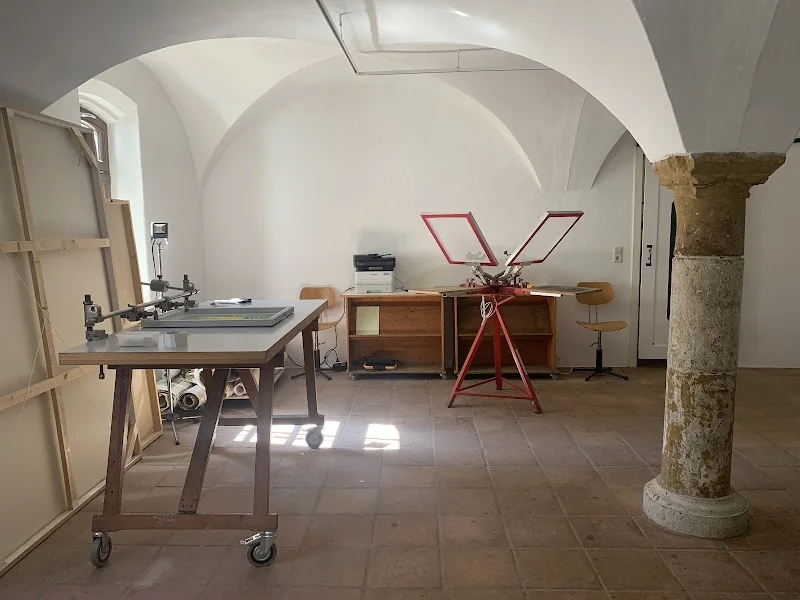
The equipment is also remarkable and shows that the Griesbadgalerie not only offers a beautiful setting but also real production conditions. Mentioned are an exposure table with 120 x 200 cm, three vacuum screen printing tables, a washing facility, screens in formats from A4 to A1+, a screen printing carousel, and an HDT1000 screen printing machine or a hand printing table. This is a very concrete and craft-serious equipment for a relatively small location. Additionally, the offerings go beyond the open workshop: the website also lists workshops, team buildings, and printing events for birthdays or bachelorette parties. There is also a note that members can pre-order screens. This makes it clear that the Griesbadgalerie functions not only as an art venue but also as a practical production site where one can realize their own projects. For SEO and user intentions, these terms are particularly strong because they address both the topic of screen printing and the experiential character of the place. ([griesbadgalerie.de](https://www.griesbadgalerie.de/siebdruckwerkstatt/))
The integration of the screen printing workshop in 2024 has significantly sharpened the content orientation of the gallery. The history of the website describes that under the leadership of Patrick Nicolas and Adela Knajzl, an open printing workshop was integrated into the Griesbadgalerie, and the works created there are exhibited in the gallery spaces. At the same time, this realignment opens up the possibility of inviting international artists who can realize and showcase their works in screen printing on-site. This is particularly exciting for visitors because the boundary between studio and exhibition space is visibly dissolved here. So anyone looking for a place where art can not only be observed but experienced in its creation is right in the Griesbadgalerie. For team events or creative group formats, the combination of craft activity, historical surroundings, and small scale is also very attractive because it creates a personal and focused atmosphere that is often lacking in large event locations. ([griesbadgalerie.de](https://www.griesbadgalerie.de/griesbadgalerie/historie/))
History of the Griesbadgalerie in the Historic Seelhaus
The history of the Griesbadgalerie does not begin with a large new building but with a grown place. According to the official history, the gallery is located in a historic building, the former Seelhaus in the Ulm old town district Auf dem Kreuz. Initially, the space was used as a storage room, which founder Reiner Bühring shortly after renting with a first exhibition. From this pragmatic beginning, the gallery in Griesbad soon developed, which Bühring led for nearly 30 years. He also founded the Friends of Young Artists Association, which still provides the organizational framework today. Initially, the focus was on painting and sculpture, preferably on reduced and minimalist works. This early phase shows that the place from the beginning did not aim for arbitrary breadth but for clear artistic positions. ([griesbadgalerie.de](https://www.griesbadgalerie.de/griesbadgalerie/historie/))
In 2009, the Ulm conceptual artist, photographer, and spatial designer Dietmar H. Herzog took over the gallery. His concept was primarily aimed at artistically active members and made the gallery more of a place for art creation. During studio phases, artists produced new works that were subsequently shown in the rooms. In 2013, there was then an almost complete change in the association's leadership and gallery management. The new director was the sculptor Frank Rändchen along with the artist and writer Florian Arnold and a team including Martin Leibinger, Tanja Andabak, and Benita Vinzelberg. With this change, the name was changed from Galerie im Griesbad to Griesbadgalerie, and the concept was realigned as a producer gallery with a focus on contemporary approaches to sculpture. This development is important for today's profile because it explains the bridge between tradition and the present. The gallery is thus not accidentally a place of production but has consciously developed in this direction over the years. ([griesbadgalerie.de](https://www.griesbadgalerie.de/griesbadgalerie/historie/))
In 2014, Martin Leibinger and Petra Schmitt took over the management, supported by Tommi Brem, Florian Arnold, and Cora Stegmann. During this phase, the gallery became a city-supported institution and was able to implement larger projects with an international orientation. The history then describes the development into a dynamic project space for young contemporary art that works at the intersections of architecture, design, or science and also engages with social and political discourses. In 2019, Petra Schmitt took over the management alone, before in 2024 the screen printing workshop was integrated under Patrick Nicolas and Adela Knajzl. This sequence shows a rare continuity in change: the space remains true to its cultural mission but changes the form in which this mission is implemented. Therefore, anyone visiting the Griesbadgalerie today experiences not only a current exhibition but also the traces of a long institutional development. This gives the place depth and credibility. ([griesbadgalerie.de](https://www.griesbadgalerie.de/griesbadgalerie/historie/))
Address, Contact, and Location in Ulm
For visitors, the practical information is quickly summarized. The Griesbadgalerie is located at Seelengraben 30, 89073 Ulm. On the contact page, the gallery also provides a mobile number, a landline number, an email address, and a note that it is also reachable via WhatsApp. Particularly clearly indicated is the open screen printing workshop with its Friday hours from 2 PM to 6 PM. Thus, the address is not just a geographical point but also a functioning contact and visit place where one can ask questions, discuss projects, or attend workshop dates. For user intentions, this is important because search queries for Griesbadgalerie Ulm, contact, or Seelengraben 30 usually seek exactly this quick orientation: Where is the place, how do I reach it, and when is it accessible? ([griesbadgalerie.de](https://www.griesbadgalerie.de/kontakt/))
The location in the Ulm old town district Auf dem Kreuz makes the venue additionally interesting. The historical embedding ensures that the visit does not take place in an arbitrary environment but in a neighborhood with urban history and small-scale structure. The Griesbadgalerie is therefore particularly attractive for people who want to experience culture not in isolation but in the urban space. This also applies to the classification by the city of Ulm: in the event overview, the place is listed as a small space of about 25 square meters, particularly suitable for print graphics, art, design, illustration, or comics, or for formats that fit the concept of the current exhibition. This description is very valuable because it clearly states the practical usefulness of the location and confirms the artistic orientation. For an SEO description, this means: The Griesbadgalerie is not a multipurpose venue but a precisely specialized address in the heart of Ulm. ([ulm.de](https://www.ulm.de/-/media/ulm/ka/downloads/kreativbleibe/raumsuchende-uebersicht-veranstaltungsorte-stand-21072025.pdf?rev=0eb1d213797a44eeb0b385a99f04b843))
Anyone visiting the Griesbadgalerie should especially consider the character of the house: small, historical, creative, and project-oriented. This leads to good expectations for the stay. It is a place where one does not disappear in a large hall but comes into direct contact with the content and people on-site. For interested parties from Ulm and the surrounding area, this is ideal when they seek culture with a personal connection. Public perception is also strengthened by the fact that the gallery makes not only offers but also archive and history transparent on its website. This facilitates orientation and builds trust. So anyone searching online for Griesbadgalerie Ulm, Galerie im Griesbad, or Seelengraben 30 will find here a clearly defined address that brings with it a special local identity through its history. ([griesbadgalerie.de](https://www.griesbadgalerie.de/kontakt/))
Capacity, Room Size, and Suitable Formats
The Griesbadgalerie is deliberately small in size, and this is precisely part of its strength. The city of Ulm lists the space with about 25 square meters and 10 to 15 people. These numbers are important because they immediately show which formats work well here: smaller presentations, workshops, readings, discussions, printing sessions, or curated exhibitions with manageable group sizes. In a time when many cultural venues focus on size and event character, the Griesbadgalerie feels pleasantly concentrated. Visitors thus experience a closeness to the content that is often lost in larger venues. For SEO, this low capacity is not a disadvantage but a clear profile feature because many seekers are specifically looking for intimate, creative, and well-overviewable places. ([ulm.de](https://www.ulm.de/-/media/ulm/ka/downloads/kreativbleibe/raumsuchende-uebersicht-veranstaltungsorte-stand-21072025.pdf?rev=0eb1d213797a44eeb0b385a99f04b843))
The city’s description of the content suitability is also revealing. The venue is explicitly mentioned for events related to print graphics, art, design, illustration, or comics, as well as for formats that fit the respective exhibition. This is a very concrete and at the same time flexible definition. It shows that the Griesbadgalerie is not conceived as a general event space but as a thematically fitting project location. The integrated screen printing workshop further reinforces this impression because actual production takes place here, not just presentation. So anyone looking for a place for a small creative team format, an artistic presentation, or a workshop-based event will find a coherent environment in the Griesbadgalerie. Particularly interesting is the combination of historical architecture, craft equipment, and contemporary orientation, as this mix creates an atmosphere that is conducive to creative processes. ([ulm.de](https://www.ulm.de/-/media/ulm/ka/downloads/kreativbleibe/raumsuchende-uebersicht-veranstaltungsorte-stand-21072025.pdf?rev=0eb1d213797a44eeb0b385a99f04b843))
For content and keyword planning, this results in a clear picture: the most important search concerns revolve not only around the name of the location but especially around events, screen printing, workshops, history, and practical information. The Griesbadgalerie meets these needs very well because it makes all these levels visible on its website. For users, this is helpful because they quickly understand whether the place fits their plans. Therefore, for an SEO description, it is sensible to present the small dimensions not as a limitation but as a quality. This interpretation makes the Griesbadgalerie a location with character: deliberately small, content-wise clear, historically anchored, and very active creatively. This is a strong profile for Ulm and a good argument for people who prefer authentic cultural venues. ([ulm.de](https://www.ulm.de/-/media/ulm/ka/downloads/kreativbleibe/raumsuchende-uebersicht-veranstaltungsorte-stand-21072025.pdf?rev=0eb1d213797a44eeb0b385a99f04b843))
Why the Griesbadgalerie in Ulm is So Special
The Griesbadgalerie is not special because it is large or loud, but because it consistently lives its own model of culture. It is a non-profit association that promotes young contemporary art, respectfully uses historical spaces, and makes production visible. The official history describes a path from the Galerie im Griesbad to the current Griesbadgalerie, from painting and sculpture to producer gallery and now to a project space with interdisciplinary and socially open references. This means: an institution has emerged here that has adapted to new conditions over decades without giving up its artistic identity. Such places are culturally valuable because they not only show finished results but also the path to them. This creates closeness, credibility, and a special form of authenticity that is very powerful in communication. ([griesbadgalerie.de](https://www.griesbadgalerie.de/griesbadgalerie/historie/))
Additionally, there is the visible connection of space, technique, and content. The screen printing workshop is not intended as a side show but as an integral part of today’s Griesbadgalerie. This distinguishes it from many other exhibition venues. Those who work or exhibit there are in a place where the act of making itself becomes part of public perception. At the same time, the house remains open to visitors, the curious, and people who simply want a good insight into contemporary culture. The combination of open workshop, changing exhibitions, small event formats, and historical surroundings makes the Griesbadgalerie a very clearly positioned address in Ulm. For content related to Griesbadgalerie Ulm, Galerie im Griesbad, Seelengraben 30, and screen printing workshop, this is the central message: this place is small but content-wise strong. ([griesbadgalerie.de](https://www.griesbadgalerie.de/siebdruckwerkstatt/))
Anyone wanting to discover the location online should therefore keep an eye on the current dates, workshop offerings, and history. These three levels together tell the whole story of the place: what it is today, how it is worked, and why it is culturally relevant in Ulm. The Griesbadgalerie is thus a good example of how a local cultural space can build a profile over many years without losing its openness. For visitors, this means a compact, honest, and inspiring experience. For seekers, it means clear orientation. And for the city of Ulm, it means a place where young art, historical ambiance, and craft production come together convincingly. ([griesbadgalerie.de](https://www.griesbadgalerie.de/griesbadgalerie/historie/))
Sources:
Show moreShow less
Griesbadgalerie | Events & Screen Printing Workshop
The Griesbadgalerie in Ulm is a unique cultural venue because it connects history and the present in a very concentrated form. Upon entering the space, visitors experience not an anonymous event hall, but a small, consciously curated place for contemporary art, projects, and print culture. The Griesbadgalerie is located in the historic Seelhaus in the Ulm old town district Auf dem Kreuz and is supported by the Friends of Young Artists Association. Thus, the focus is not on a commercial large-scale concept, but on a place where artistic processes, exhibitions, and workshop activities intertwine. This combination makes the Griesbadgalerie interesting for visitors, artists, and also for people from the city. It is not a place for mass gatherings, but for closeness, exchange, and precise formats. At the same time, the current orientation shows that the space remains vibrant: exhibitions, dates, archive contributions, and workshop offerings are visibly bundled on the website, so that the Griesbadgalerie is perceived both as a gallery and as a production site. ([griesbadgalerie.de](https://www.griesbadgalerie.de/griesbadgalerie/historie/))
For SEO considerations, four main topics are at the forefront for this location: events and dates, screen printing workshop, history, and practical visitor information. These topics are also reflected in the search queries surrounding Griesbadgalerie Ulm, Griesbad, Griesbadbrunnen, Galerie im Griesbad, and Seelengraben 30. From these search signals, a clear interest in local orientation, cultural programming, and the special identity of the place can be derived. The Griesbadgalerie is not a place with huge capacity, but a small, highly specialized space for art and production. The city of Ulm lists the venue with about 25 square meters and 10 to 15 people, which fits well with the character of an intimate project space. For content, this means: visitors are less looking for mainstream entertainment here, but for an authentic place with substance, creativity, and a strong signature. ([ulm.de](https://www.ulm.de/-/media/ulm/ka/downloads/kreativbleibe/raumsuchende-uebersicht-veranstaltungsorte-stand-21072025.pdf?rev=0eb1d213797a44eeb0b385a99f04b843))
Events, Exhibitions, and Dates at the Griesbadgalerie
The Griesbadgalerie does not think of programming as a rigid annual grid, but as a series of exhibitions, workshop dates, and project-related formats. The homepage of the official website showcases changing exhibitions and dates, including the open screen printing workshop and workshop offerings. This aligns very well with the gallery's self-understanding, as according to its history, the place evolved from a classical exhibition practice to a dynamic project space for young contemporary art. In this logic, an appointment here is not just an appointment, but often part of a larger artistic context. Therefore, visitors find not only individual events on the website but also archive contributions that document the gallery's development and place the current program within a longer evolution. This keeps the Griesbadgalerie exciting for returning guests, as the face of the house visibly changes without losing its identity. ([griesbadgalerie.de](https://www.griesbadgalerie.de/))
Particularly striking is the focus on print, image, form, and process-oriented art. In the current realignment, which became visible in 2024 with the integration of the screen printing workshop, the program is understood even more as an interface between exhibition, production, and mediation. An article from the Augsburger Allgemeine describes the place as an art venue that continually reinvents itself and categorizes the new leadership by Adela Knajzl and Patrick Nicolas as a repositioning around print art. At the same time, the official website makes it clear that the gallery is also open to international artists who can produce and exhibit on-site. This is important for the understanding of the program: it is not only about showing finished works but also about the creation of works in the space itself. For seekers, this means that terms like events, exhibitions, dates, or programs at the Griesbadgalerie are closely linked and always consider a workshop and process character. ([griesbadgalerie.de](https://www.griesbadgalerie.de/griesbadgalerie/historie/))
The archive on the website also shows how multifaceted the house operates. There are titles like reading and exhibition, short film day, guest performance, and thematic contributions, which clearly indicate that the Griesbadgalerie is not limited to a single genre. The event level is rather open to context-related art, performance, reading, graphics, illustration, and other forms that fit the respective program. This is precisely the strength of the location: the house is small enough to feel personal, but open enough to accommodate different artistic formats. For visitors, this results in a program that feels more curated than arbitrary. Anyone looking for a cultural address in Ulm that allows not only exhibitions but also encounters and conversations will find in the Griesbadgalerie a place with a clear stance. ([griesbadgalerie.de](https://www.griesbadgalerie.de/))
Screen Printing Workshop, Workshops, and Team Events
The screen printing workshop is today one of the most important unique features of the Griesbadgalerie. According to the official website, it is open every Friday from 2 PM to 6 PM for members and guests. These opening hours are not randomly chosen but mark a regular, reliable anchor point in the weekly rhythm of the gallery. The open workshop primarily targets advanced members who already have basic experience in screen printing and can work independently. At the same time, newcomers are explicitly welcome to watch, ask questions, and gain initial insights into the technique and workshop routine. During opening hours, there is always someone on-site who provides advice, exchange, and technical assistance. This mix of openness and guidance makes the workshop so attractive: it is not a closed professional space but a learnable place where one can grow into the technique. For those who want to learn screen printing from the ground up, the gallery recommends the workshops as a structured entry. ([griesbadgalerie.de](https://www.griesbadgalerie.de/siebdruckwerkstatt/))
The equipment is also remarkable and shows that the Griesbadgalerie not only offers a beautiful setting but also real production conditions. Mentioned are an exposure table with 120 x 200 cm, three vacuum screen printing tables, a washing facility, screens in formats from A4 to A1+, a screen printing carousel, and an HDT1000 screen printing machine or a hand printing table. This is a very concrete and craft-serious equipment for a relatively small location. Additionally, the offerings go beyond the open workshop: the website also lists workshops, team buildings, and printing events for birthdays or bachelorette parties. There is also a note that members can pre-order screens. This makes it clear that the Griesbadgalerie functions not only as an art venue but also as a practical production site where one can realize their own projects. For SEO and user intentions, these terms are particularly strong because they address both the topic of screen printing and the experiential character of the place. ([griesbadgalerie.de](https://www.griesbadgalerie.de/siebdruckwerkstatt/))
The integration of the screen printing workshop in 2024 has significantly sharpened the content orientation of the gallery. The history of the website describes that under the leadership of Patrick Nicolas and Adela Knajzl, an open printing workshop was integrated into the Griesbadgalerie, and the works created there are exhibited in the gallery spaces. At the same time, this realignment opens up the possibility of inviting international artists who can realize and showcase their works in screen printing on-site. This is particularly exciting for visitors because the boundary between studio and exhibition space is visibly dissolved here. So anyone looking for a place where art can not only be observed but experienced in its creation is right in the Griesbadgalerie. For team events or creative group formats, the combination of craft activity, historical surroundings, and small scale is also very attractive because it creates a personal and focused atmosphere that is often lacking in large event locations. ([griesbadgalerie.de](https://www.griesbadgalerie.de/griesbadgalerie/historie/))
History of the Griesbadgalerie in the Historic Seelhaus
The history of the Griesbadgalerie does not begin with a large new building but with a grown place. According to the official history, the gallery is located in a historic building, the former Seelhaus in the Ulm old town district Auf dem Kreuz. Initially, the space was used as a storage room, which founder Reiner Bühring shortly after renting with a first exhibition. From this pragmatic beginning, the gallery in Griesbad soon developed, which Bühring led for nearly 30 years. He also founded the Friends of Young Artists Association, which still provides the organizational framework today. Initially, the focus was on painting and sculpture, preferably on reduced and minimalist works. This early phase shows that the place from the beginning did not aim for arbitrary breadth but for clear artistic positions. ([griesbadgalerie.de](https://www.griesbadgalerie.de/griesbadgalerie/historie/))
In 2009, the Ulm conceptual artist, photographer, and spatial designer Dietmar H. Herzog took over the gallery. His concept was primarily aimed at artistically active members and made the gallery more of a place for art creation. During studio phases, artists produced new works that were subsequently shown in the rooms. In 2013, there was then an almost complete change in the association's leadership and gallery management. The new director was the sculptor Frank Rändchen along with the artist and writer Florian Arnold and a team including Martin Leibinger, Tanja Andabak, and Benita Vinzelberg. With this change, the name was changed from Galerie im Griesbad to Griesbadgalerie, and the concept was realigned as a producer gallery with a focus on contemporary approaches to sculpture. This development is important for today's profile because it explains the bridge between tradition and the present. The gallery is thus not accidentally a place of production but has consciously developed in this direction over the years. ([griesbadgalerie.de](https://www.griesbadgalerie.de/griesbadgalerie/historie/))
In 2014, Martin Leibinger and Petra Schmitt took over the management, supported by Tommi Brem, Florian Arnold, and Cora Stegmann. During this phase, the gallery became a city-supported institution and was able to implement larger projects with an international orientation. The history then describes the development into a dynamic project space for young contemporary art that works at the intersections of architecture, design, or science and also engages with social and political discourses. In 2019, Petra Schmitt took over the management alone, before in 2024 the screen printing workshop was integrated under Patrick Nicolas and Adela Knajzl. This sequence shows a rare continuity in change: the space remains true to its cultural mission but changes the form in which this mission is implemented. Therefore, anyone visiting the Griesbadgalerie today experiences not only a current exhibition but also the traces of a long institutional development. This gives the place depth and credibility. ([griesbadgalerie.de](https://www.griesbadgalerie.de/griesbadgalerie/historie/))
Address, Contact, and Location in Ulm
For visitors, the practical information is quickly summarized. The Griesbadgalerie is located at Seelengraben 30, 89073 Ulm. On the contact page, the gallery also provides a mobile number, a landline number, an email address, and a note that it is also reachable via WhatsApp. Particularly clearly indicated is the open screen printing workshop with its Friday hours from 2 PM to 6 PM. Thus, the address is not just a geographical point but also a functioning contact and visit place where one can ask questions, discuss projects, or attend workshop dates. For user intentions, this is important because search queries for Griesbadgalerie Ulm, contact, or Seelengraben 30 usually seek exactly this quick orientation: Where is the place, how do I reach it, and when is it accessible? ([griesbadgalerie.de](https://www.griesbadgalerie.de/kontakt/))
The location in the Ulm old town district Auf dem Kreuz makes the venue additionally interesting. The historical embedding ensures that the visit does not take place in an arbitrary environment but in a neighborhood with urban history and small-scale structure. The Griesbadgalerie is therefore particularly attractive for people who want to experience culture not in isolation but in the urban space. This also applies to the classification by the city of Ulm: in the event overview, the place is listed as a small space of about 25 square meters, particularly suitable for print graphics, art, design, illustration, or comics, or for formats that fit the concept of the current exhibition. This description is very valuable because it clearly states the practical usefulness of the location and confirms the artistic orientation. For an SEO description, this means: The Griesbadgalerie is not a multipurpose venue but a precisely specialized address in the heart of Ulm. ([ulm.de](https://www.ulm.de/-/media/ulm/ka/downloads/kreativbleibe/raumsuchende-uebersicht-veranstaltungsorte-stand-21072025.pdf?rev=0eb1d213797a44eeb0b385a99f04b843))
Anyone visiting the Griesbadgalerie should especially consider the character of the house: small, historical, creative, and project-oriented. This leads to good expectations for the stay. It is a place where one does not disappear in a large hall but comes into direct contact with the content and people on-site. For interested parties from Ulm and the surrounding area, this is ideal when they seek culture with a personal connection. Public perception is also strengthened by the fact that the gallery makes not only offers but also archive and history transparent on its website. This facilitates orientation and builds trust. So anyone searching online for Griesbadgalerie Ulm, Galerie im Griesbad, or Seelengraben 30 will find here a clearly defined address that brings with it a special local identity through its history. ([griesbadgalerie.de](https://www.griesbadgalerie.de/kontakt/))
Capacity, Room Size, and Suitable Formats
The Griesbadgalerie is deliberately small in size, and this is precisely part of its strength. The city of Ulm lists the space with about 25 square meters and 10 to 15 people. These numbers are important because they immediately show which formats work well here: smaller presentations, workshops, readings, discussions, printing sessions, or curated exhibitions with manageable group sizes. In a time when many cultural venues focus on size and event character, the Griesbadgalerie feels pleasantly concentrated. Visitors thus experience a closeness to the content that is often lost in larger venues. For SEO, this low capacity is not a disadvantage but a clear profile feature because many seekers are specifically looking for intimate, creative, and well-overviewable places. ([ulm.de](https://www.ulm.de/-/media/ulm/ka/downloads/kreativbleibe/raumsuchende-uebersicht-veranstaltungsorte-stand-21072025.pdf?rev=0eb1d213797a44eeb0b385a99f04b843))
The city’s description of the content suitability is also revealing. The venue is explicitly mentioned for events related to print graphics, art, design, illustration, or comics, as well as for formats that fit the respective exhibition. This is a very concrete and at the same time flexible definition. It shows that the Griesbadgalerie is not conceived as a general event space but as a thematically fitting project location. The integrated screen printing workshop further reinforces this impression because actual production takes place here, not just presentation. So anyone looking for a place for a small creative team format, an artistic presentation, or a workshop-based event will find a coherent environment in the Griesbadgalerie. Particularly interesting is the combination of historical architecture, craft equipment, and contemporary orientation, as this mix creates an atmosphere that is conducive to creative processes. ([ulm.de](https://www.ulm.de/-/media/ulm/ka/downloads/kreativbleibe/raumsuchende-uebersicht-veranstaltungsorte-stand-21072025.pdf?rev=0eb1d213797a44eeb0b385a99f04b843))
For content and keyword planning, this results in a clear picture: the most important search concerns revolve not only around the name of the location but especially around events, screen printing, workshops, history, and practical information. The Griesbadgalerie meets these needs very well because it makes all these levels visible on its website. For users, this is helpful because they quickly understand whether the place fits their plans. Therefore, for an SEO description, it is sensible to present the small dimensions not as a limitation but as a quality. This interpretation makes the Griesbadgalerie a location with character: deliberately small, content-wise clear, historically anchored, and very active creatively. This is a strong profile for Ulm and a good argument for people who prefer authentic cultural venues. ([ulm.de](https://www.ulm.de/-/media/ulm/ka/downloads/kreativbleibe/raumsuchende-uebersicht-veranstaltungsorte-stand-21072025.pdf?rev=0eb1d213797a44eeb0b385a99f04b843))
Why the Griesbadgalerie in Ulm is So Special
The Griesbadgalerie is not special because it is large or loud, but because it consistently lives its own model of culture. It is a non-profit association that promotes young contemporary art, respectfully uses historical spaces, and makes production visible. The official history describes a path from the Galerie im Griesbad to the current Griesbadgalerie, from painting and sculpture to producer gallery and now to a project space with interdisciplinary and socially open references. This means: an institution has emerged here that has adapted to new conditions over decades without giving up its artistic identity. Such places are culturally valuable because they not only show finished results but also the path to them. This creates closeness, credibility, and a special form of authenticity that is very powerful in communication. ([griesbadgalerie.de](https://www.griesbadgalerie.de/griesbadgalerie/historie/))
Additionally, there is the visible connection of space, technique, and content. The screen printing workshop is not intended as a side show but as an integral part of today’s Griesbadgalerie. This distinguishes it from many other exhibition venues. Those who work or exhibit there are in a place where the act of making itself becomes part of public perception. At the same time, the house remains open to visitors, the curious, and people who simply want a good insight into contemporary culture. The combination of open workshop, changing exhibitions, small event formats, and historical surroundings makes the Griesbadgalerie a very clearly positioned address in Ulm. For content related to Griesbadgalerie Ulm, Galerie im Griesbad, Seelengraben 30, and screen printing workshop, this is the central message: this place is small but content-wise strong. ([griesbadgalerie.de](https://www.griesbadgalerie.de/siebdruckwerkstatt/))
Anyone wanting to discover the location online should therefore keep an eye on the current dates, workshop offerings, and history. These three levels together tell the whole story of the place: what it is today, how it is worked, and why it is culturally relevant in Ulm. The Griesbadgalerie is thus a good example of how a local cultural space can build a profile over many years without losing its openness. For visitors, this means a compact, honest, and inspiring experience. For seekers, it means clear orientation. And for the city of Ulm, it means a place where young art, historical ambiance, and craft production come together convincingly. ([griesbadgalerie.de](https://www.griesbadgalerie.de/griesbadgalerie/historie/))
Sources:
Griesbadgalerie | Events & Screen Printing Workshop
The Griesbadgalerie in Ulm is a unique cultural venue because it connects history and the present in a very concentrated form. Upon entering the space, visitors experience not an anonymous event hall, but a small, consciously curated place for contemporary art, projects, and print culture. The Griesbadgalerie is located in the historic Seelhaus in the Ulm old town district Auf dem Kreuz and is supported by the Friends of Young Artists Association. Thus, the focus is not on a commercial large-scale concept, but on a place where artistic processes, exhibitions, and workshop activities intertwine. This combination makes the Griesbadgalerie interesting for visitors, artists, and also for people from the city. It is not a place for mass gatherings, but for closeness, exchange, and precise formats. At the same time, the current orientation shows that the space remains vibrant: exhibitions, dates, archive contributions, and workshop offerings are visibly bundled on the website, so that the Griesbadgalerie is perceived both as a gallery and as a production site. ([griesbadgalerie.de](https://www.griesbadgalerie.de/griesbadgalerie/historie/))
For SEO considerations, four main topics are at the forefront for this location: events and dates, screen printing workshop, history, and practical visitor information. These topics are also reflected in the search queries surrounding Griesbadgalerie Ulm, Griesbad, Griesbadbrunnen, Galerie im Griesbad, and Seelengraben 30. From these search signals, a clear interest in local orientation, cultural programming, and the special identity of the place can be derived. The Griesbadgalerie is not a place with huge capacity, but a small, highly specialized space for art and production. The city of Ulm lists the venue with about 25 square meters and 10 to 15 people, which fits well with the character of an intimate project space. For content, this means: visitors are less looking for mainstream entertainment here, but for an authentic place with substance, creativity, and a strong signature. ([ulm.de](https://www.ulm.de/-/media/ulm/ka/downloads/kreativbleibe/raumsuchende-uebersicht-veranstaltungsorte-stand-21072025.pdf?rev=0eb1d213797a44eeb0b385a99f04b843))
Events, Exhibitions, and Dates at the Griesbadgalerie
The Griesbadgalerie does not think of programming as a rigid annual grid, but as a series of exhibitions, workshop dates, and project-related formats. The homepage of the official website showcases changing exhibitions and dates, including the open screen printing workshop and workshop offerings. This aligns very well with the gallery's self-understanding, as according to its history, the place evolved from a classical exhibition practice to a dynamic project space for young contemporary art. In this logic, an appointment here is not just an appointment, but often part of a larger artistic context. Therefore, visitors find not only individual events on the website but also archive contributions that document the gallery's development and place the current program within a longer evolution. This keeps the Griesbadgalerie exciting for returning guests, as the face of the house visibly changes without losing its identity. ([griesbadgalerie.de](https://www.griesbadgalerie.de/))
Particularly striking is the focus on print, image, form, and process-oriented art. In the current realignment, which became visible in 2024 with the integration of the screen printing workshop, the program is understood even more as an interface between exhibition, production, and mediation. An article from the Augsburger Allgemeine describes the place as an art venue that continually reinvents itself and categorizes the new leadership by Adela Knajzl and Patrick Nicolas as a repositioning around print art. At the same time, the official website makes it clear that the gallery is also open to international artists who can produce and exhibit on-site. This is important for the understanding of the program: it is not only about showing finished works but also about the creation of works in the space itself. For seekers, this means that terms like events, exhibitions, dates, or programs at the Griesbadgalerie are closely linked and always consider a workshop and process character. ([griesbadgalerie.de](https://www.griesbadgalerie.de/griesbadgalerie/historie/))
The archive on the website also shows how multifaceted the house operates. There are titles like reading and exhibition, short film day, guest performance, and thematic contributions, which clearly indicate that the Griesbadgalerie is not limited to a single genre. The event level is rather open to context-related art, performance, reading, graphics, illustration, and other forms that fit the respective program. This is precisely the strength of the location: the house is small enough to feel personal, but open enough to accommodate different artistic formats. For visitors, this results in a program that feels more curated than arbitrary. Anyone looking for a cultural address in Ulm that allows not only exhibitions but also encounters and conversations will find in the Griesbadgalerie a place with a clear stance. ([griesbadgalerie.de](https://www.griesbadgalerie.de/))
Screen Printing Workshop, Workshops, and Team Events
The screen printing workshop is today one of the most important unique features of the Griesbadgalerie. According to the official website, it is open every Friday from 2 PM to 6 PM for members and guests. These opening hours are not randomly chosen but mark a regular, reliable anchor point in the weekly rhythm of the gallery. The open workshop primarily targets advanced members who already have basic experience in screen printing and can work independently. At the same time, newcomers are explicitly welcome to watch, ask questions, and gain initial insights into the technique and workshop routine. During opening hours, there is always someone on-site who provides advice, exchange, and technical assistance. This mix of openness and guidance makes the workshop so attractive: it is not a closed professional space but a learnable place where one can grow into the technique. For those who want to learn screen printing from the ground up, the gallery recommends the workshops as a structured entry. ([griesbadgalerie.de](https://www.griesbadgalerie.de/siebdruckwerkstatt/))
The equipment is also remarkable and shows that the Griesbadgalerie not only offers a beautiful setting but also real production conditions. Mentioned are an exposure table with 120 x 200 cm, three vacuum screen printing tables, a washing facility, screens in formats from A4 to A1+, a screen printing carousel, and an HDT1000 screen printing machine or a hand printing table. This is a very concrete and craft-serious equipment for a relatively small location. Additionally, the offerings go beyond the open workshop: the website also lists workshops, team buildings, and printing events for birthdays or bachelorette parties. There is also a note that members can pre-order screens. This makes it clear that the Griesbadgalerie functions not only as an art venue but also as a practical production site where one can realize their own projects. For SEO and user intentions, these terms are particularly strong because they address both the topic of screen printing and the experiential character of the place. ([griesbadgalerie.de](https://www.griesbadgalerie.de/siebdruckwerkstatt/))
The integration of the screen printing workshop in 2024 has significantly sharpened the content orientation of the gallery. The history of the website describes that under the leadership of Patrick Nicolas and Adela Knajzl, an open printing workshop was integrated into the Griesbadgalerie, and the works created there are exhibited in the gallery spaces. At the same time, this realignment opens up the possibility of inviting international artists who can realize and showcase their works in screen printing on-site. This is particularly exciting for visitors because the boundary between studio and exhibition space is visibly dissolved here. So anyone looking for a place where art can not only be observed but experienced in its creation is right in the Griesbadgalerie. For team events or creative group formats, the combination of craft activity, historical surroundings, and small scale is also very attractive because it creates a personal and focused atmosphere that is often lacking in large event locations. ([griesbadgalerie.de](https://www.griesbadgalerie.de/griesbadgalerie/historie/))
History of the Griesbadgalerie in the Historic Seelhaus
The history of the Griesbadgalerie does not begin with a large new building but with a grown place. According to the official history, the gallery is located in a historic building, the former Seelhaus in the Ulm old town district Auf dem Kreuz. Initially, the space was used as a storage room, which founder Reiner Bühring shortly after renting with a first exhibition. From this pragmatic beginning, the gallery in Griesbad soon developed, which Bühring led for nearly 30 years. He also founded the Friends of Young Artists Association, which still provides the organizational framework today. Initially, the focus was on painting and sculpture, preferably on reduced and minimalist works. This early phase shows that the place from the beginning did not aim for arbitrary breadth but for clear artistic positions. ([griesbadgalerie.de](https://www.griesbadgalerie.de/griesbadgalerie/historie/))
In 2009, the Ulm conceptual artist, photographer, and spatial designer Dietmar H. Herzog took over the gallery. His concept was primarily aimed at artistically active members and made the gallery more of a place for art creation. During studio phases, artists produced new works that were subsequently shown in the rooms. In 2013, there was then an almost complete change in the association's leadership and gallery management. The new director was the sculptor Frank Rändchen along with the artist and writer Florian Arnold and a team including Martin Leibinger, Tanja Andabak, and Benita Vinzelberg. With this change, the name was changed from Galerie im Griesbad to Griesbadgalerie, and the concept was realigned as a producer gallery with a focus on contemporary approaches to sculpture. This development is important for today's profile because it explains the bridge between tradition and the present. The gallery is thus not accidentally a place of production but has consciously developed in this direction over the years. ([griesbadgalerie.de](https://www.griesbadgalerie.de/griesbadgalerie/historie/))
In 2014, Martin Leibinger and Petra Schmitt took over the management, supported by Tommi Brem, Florian Arnold, and Cora Stegmann. During this phase, the gallery became a city-supported institution and was able to implement larger projects with an international orientation. The history then describes the development into a dynamic project space for young contemporary art that works at the intersections of architecture, design, or science and also engages with social and political discourses. In 2019, Petra Schmitt took over the management alone, before in 2024 the screen printing workshop was integrated under Patrick Nicolas and Adela Knajzl. This sequence shows a rare continuity in change: the space remains true to its cultural mission but changes the form in which this mission is implemented. Therefore, anyone visiting the Griesbadgalerie today experiences not only a current exhibition but also the traces of a long institutional development. This gives the place depth and credibility. ([griesbadgalerie.de](https://www.griesbadgalerie.de/griesbadgalerie/historie/))
Address, Contact, and Location in Ulm
For visitors, the practical information is quickly summarized. The Griesbadgalerie is located at Seelengraben 30, 89073 Ulm. On the contact page, the gallery also provides a mobile number, a landline number, an email address, and a note that it is also reachable via WhatsApp. Particularly clearly indicated is the open screen printing workshop with its Friday hours from 2 PM to 6 PM. Thus, the address is not just a geographical point but also a functioning contact and visit place where one can ask questions, discuss projects, or attend workshop dates. For user intentions, this is important because search queries for Griesbadgalerie Ulm, contact, or Seelengraben 30 usually seek exactly this quick orientation: Where is the place, how do I reach it, and when is it accessible? ([griesbadgalerie.de](https://www.griesbadgalerie.de/kontakt/))
The location in the Ulm old town district Auf dem Kreuz makes the venue additionally interesting. The historical embedding ensures that the visit does not take place in an arbitrary environment but in a neighborhood with urban history and small-scale structure. The Griesbadgalerie is therefore particularly attractive for people who want to experience culture not in isolation but in the urban space. This also applies to the classification by the city of Ulm: in the event overview, the place is listed as a small space of about 25 square meters, particularly suitable for print graphics, art, design, illustration, or comics, or for formats that fit the concept of the current exhibition. This description is very valuable because it clearly states the practical usefulness of the location and confirms the artistic orientation. For an SEO description, this means: The Griesbadgalerie is not a multipurpose venue but a precisely specialized address in the heart of Ulm. ([ulm.de](https://www.ulm.de/-/media/ulm/ka/downloads/kreativbleibe/raumsuchende-uebersicht-veranstaltungsorte-stand-21072025.pdf?rev=0eb1d213797a44eeb0b385a99f04b843))
Anyone visiting the Griesbadgalerie should especially consider the character of the house: small, historical, creative, and project-oriented. This leads to good expectations for the stay. It is a place where one does not disappear in a large hall but comes into direct contact with the content and people on-site. For interested parties from Ulm and the surrounding area, this is ideal when they seek culture with a personal connection. Public perception is also strengthened by the fact that the gallery makes not only offers but also archive and history transparent on its website. This facilitates orientation and builds trust. So anyone searching online for Griesbadgalerie Ulm, Galerie im Griesbad, or Seelengraben 30 will find here a clearly defined address that brings with it a special local identity through its history. ([griesbadgalerie.de](https://www.griesbadgalerie.de/kontakt/))
Capacity, Room Size, and Suitable Formats
The Griesbadgalerie is deliberately small in size, and this is precisely part of its strength. The city of Ulm lists the space with about 25 square meters and 10 to 15 people. These numbers are important because they immediately show which formats work well here: smaller presentations, workshops, readings, discussions, printing sessions, or curated exhibitions with manageable group sizes. In a time when many cultural venues focus on size and event character, the Griesbadgalerie feels pleasantly concentrated. Visitors thus experience a closeness to the content that is often lost in larger venues. For SEO, this low capacity is not a disadvantage but a clear profile feature because many seekers are specifically looking for intimate, creative, and well-overviewable places. ([ulm.de](https://www.ulm.de/-/media/ulm/ka/downloads/kreativbleibe/raumsuchende-uebersicht-veranstaltungsorte-stand-21072025.pdf?rev=0eb1d213797a44eeb0b385a99f04b843))
The city’s description of the content suitability is also revealing. The venue is explicitly mentioned for events related to print graphics, art, design, illustration, or comics, as well as for formats that fit the respective exhibition. This is a very concrete and at the same time flexible definition. It shows that the Griesbadgalerie is not conceived as a general event space but as a thematically fitting project location. The integrated screen printing workshop further reinforces this impression because actual production takes place here, not just presentation. So anyone looking for a place for a small creative team format, an artistic presentation, or a workshop-based event will find a coherent environment in the Griesbadgalerie. Particularly interesting is the combination of historical architecture, craft equipment, and contemporary orientation, as this mix creates an atmosphere that is conducive to creative processes. ([ulm.de](https://www.ulm.de/-/media/ulm/ka/downloads/kreativbleibe/raumsuchende-uebersicht-veranstaltungsorte-stand-21072025.pdf?rev=0eb1d213797a44eeb0b385a99f04b843))
For content and keyword planning, this results in a clear picture: the most important search concerns revolve not only around the name of the location but especially around events, screen printing, workshops, history, and practical information. The Griesbadgalerie meets these needs very well because it makes all these levels visible on its website. For users, this is helpful because they quickly understand whether the place fits their plans. Therefore, for an SEO description, it is sensible to present the small dimensions not as a limitation but as a quality. This interpretation makes the Griesbadgalerie a location with character: deliberately small, content-wise clear, historically anchored, and very active creatively. This is a strong profile for Ulm and a good argument for people who prefer authentic cultural venues. ([ulm.de](https://www.ulm.de/-/media/ulm/ka/downloads/kreativbleibe/raumsuchende-uebersicht-veranstaltungsorte-stand-21072025.pdf?rev=0eb1d213797a44eeb0b385a99f04b843))
Why the Griesbadgalerie in Ulm is So Special
The Griesbadgalerie is not special because it is large or loud, but because it consistently lives its own model of culture. It is a non-profit association that promotes young contemporary art, respectfully uses historical spaces, and makes production visible. The official history describes a path from the Galerie im Griesbad to the current Griesbadgalerie, from painting and sculpture to producer gallery and now to a project space with interdisciplinary and socially open references. This means: an institution has emerged here that has adapted to new conditions over decades without giving up its artistic identity. Such places are culturally valuable because they not only show finished results but also the path to them. This creates closeness, credibility, and a special form of authenticity that is very powerful in communication. ([griesbadgalerie.de](https://www.griesbadgalerie.de/griesbadgalerie/historie/))
Additionally, there is the visible connection of space, technique, and content. The screen printing workshop is not intended as a side show but as an integral part of today’s Griesbadgalerie. This distinguishes it from many other exhibition venues. Those who work or exhibit there are in a place where the act of making itself becomes part of public perception. At the same time, the house remains open to visitors, the curious, and people who simply want a good insight into contemporary culture. The combination of open workshop, changing exhibitions, small event formats, and historical surroundings makes the Griesbadgalerie a very clearly positioned address in Ulm. For content related to Griesbadgalerie Ulm, Galerie im Griesbad, Seelengraben 30, and screen printing workshop, this is the central message: this place is small but content-wise strong. ([griesbadgalerie.de](https://www.griesbadgalerie.de/siebdruckwerkstatt/))
Anyone wanting to discover the location online should therefore keep an eye on the current dates, workshop offerings, and history. These three levels together tell the whole story of the place: what it is today, how it is worked, and why it is culturally relevant in Ulm. The Griesbadgalerie is thus a good example of how a local cultural space can build a profile over many years without losing its openness. For visitors, this means a compact, honest, and inspiring experience. For seekers, it means clear orientation. And for the city of Ulm, it means a place where young art, historical ambiance, and craft production come together convincingly. ([griesbadgalerie.de](https://www.griesbadgalerie.de/griesbadgalerie/historie/))
Sources:
Upcoming Events
No events found
Frequently Asked Questions
Reviews
No reviews found