
Ulm
Haslacher Weg 70-72, 89075 Ulm, Deutschland
Evangelical Resurrection Church Ulm-Böfingen | Service
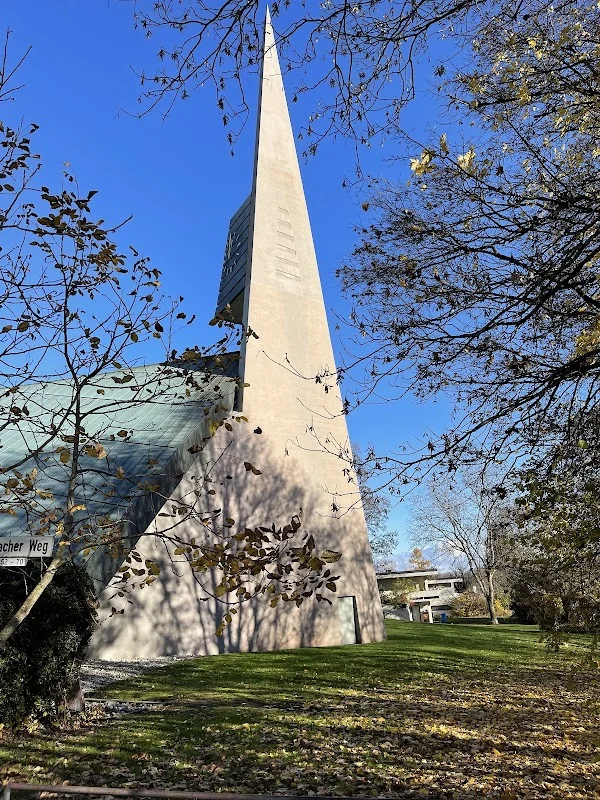
The Evangelical Resurrection Church Ulm-Böfingen is a place where architecture, community, and urban space come together. Those who enter the ensemble on Haslacher Weg experience not only a church but a prominent center of the Böfingen district. The official community and district communication describes the building as a widely visible landmark with a pointed concrete tower, a place for services, and a center of vibrant community life. The church has stood at this location since 1967; the community office is located right next door at Haslacher Weg 72. ([ulm-boefingen.de](https://www.ulm-boefingen.de/einrichtungen-detail/evangelische-auferstehungsgemeinde.html))
The search for information quickly leads to the topics that are truly important for visitors: services, events, community newsletters, contact, capacity, and the special architecture. These focal points also shape the content of this page. The church is not an isolated building but part of a larger community complex with a community center, several rooms, and offerings for children, adults, and seniors. At the same time, its history makes it clear that it was intended from the beginning as a sign of hope. ([auferstehungskirche-ulm.de](https://www.auferstehungskirche-ulm.de/gemeindeleben?utm_source=openai))
Services and vibrant community life in Böfingen
Those searching for the Resurrection Church often first look for services and events. This is no coincidence, as the community explicitly sees itself as an open place where people come together not just on Sundays. The official site states that community arises where people share their lives. In addition to the service, there are many everyday meeting places and offerings for different age groups. This openness is typical for the Resurrection Church and explains why the community has an impact far beyond the actual church space. ([auferstehungskirche-ulm.de](https://www.auferstehungskirche-ulm.de/gemeindeleben?utm_source=openai))
This is particularly evident in the church coffee, which takes place informally after services. It is more than just a drink after the service: here conversations, contacts, and a sense of neighborhood emerge. The official pages also mention the morning reflection in the Stephen Hall, which has been offered for several decades, as well as regular meetings for seniors. For music enthusiasts, the choir rehearsal of the Bö'Singers is important, meeting on Wednesdays at 7:30 PM in the community center. Thus, the community connects spiritual offerings, social closeness, and communal music-making in a remarkable way. ([auferstehungskirche-ulm.de](https://www.auferstehungskirche-ulm.de/gemeindeleben/erwachsene?utm_source=openai))
Families and children also play a significant role. Current community newsletters include references to children's and toddler services, toddler groups, and other forms of children's work. This aligns with the community's self-presentation, which highlights offerings for the youngest members from kindergarten to children's services. Additionally, there are ecumenical moments and special services that show that the Resurrection Church is not just an evangelical sacred building but a place of togetherness in the district. This creates the mix of reliability and openness that many visitors appreciate in such places. ([auferstehungskirche-ulm.de](https://www.auferstehungskirche-ulm.de/gemeindeleben?utm_source=openai))
For those looking for events, it is also important that the community regularly informs through a joint community newsletter. This is published ten times a year and consolidates events, services, church music, youth work, and offerings from the House of Encounter. This creates an overview and makes the Resurrection Church part of a larger evangelical network in Ulm. So, for those who want to keep track of not just a single date but the entire community life, this provides good orientation. ([auferstehungskirche-ulm.de](https://www.auferstehungskirche-ulm.de/aktuelles/gemeindebrief?utm_source=openai))
History, architecture, and symbolism of the Resurrection Church
The history of the Resurrection Church is closely linked to the emergence of the Böfingen district. According to available sources, the evangelical church was built between 1964 and 1966; the name was already established before construction began. This name was deliberately chosen: it was meant to express hope for displaced persons and refugees who were starting anew in Böfingen. The church space was thus planned from the beginning not only as a functional building but as a visible message of resurrection. ([auferstehungskirche-ulm.de](https://www.auferstehungskirche-ulm.de/ueber-uns/ueber-unsere-kirche?utm_source=openai))
For the architectural design, architect Heinz Rall from Stuttgart and sculptor Albrecht Kneer from Königsbronn-Zang are mentioned. The official description emphasizes that the building is a particularly successful example of church architecture from the 1960s. Concrete, glass, copper, and wood shape the impression. Additionally, there is a symbolic structure that translates the message of the name into forms: a slender, 40-meter-high tower, five bells, a wide window front, and a roof that emphasizes the altar area. These details make it understandable why the church is perceived not only as a community place but also as an architectural statement. ([auferstehungskirche-ulm.de](https://www.auferstehungskirche-ulm.de/ueber-uns/ueber-unsere-kirche?utm_source=openai))
Particularly interesting is the internal dramaturgy of the building. The floor plan is described as an equilateral pentagon, and the arrangement of the rows of chairs, the lighting, and the path from the darker anteroom to the brighter church space symbolically interlock. The church space is meant to make the experience of closeness and openness, darkness and light physically tangible. This is complemented by the wooden altar table, the bronze crucifix from 1965, the organ from the Kleuker company from 1967, and the bronze portal from 1979, which thematizes the empty tomb. Thus, architecture here becomes proclamation in material and form. ([auferstehungskirche-ulm.de](https://www.auferstehungskirche-ulm.de/ueber-uns/ueber-unsere-kirche?utm_source=openai))
The location also enhances this effect. The district page describes the pointed concrete tower as a widely visible sign around which the Böfinger Steige and the surrounding streets circle. The church is thus not at the edge but visibly in the middle of the neighborhood. In combination with the Catholic Church of the Good Shepherd and the center with shopping facilities, banks, and citizens' office, a spatial center of the district is created. The architecture is therefore not only beautiful but also consciously positioned in urban planning. ([ulm-boefingen.de](https://www.ulm-boefingen.de/einrichtungen-detail/evangelische-auferstehungsgemeinde.html))
Community center, rooms, and capacity for encounters
Those looking for spaces for events, groups, or smaller meetings will find more than just the church space at the Resurrection Church. The current Ulm overview of event venues lists several rooms: the Herterich room with 45 square meters, the Stephen Hall with 50.5 square meters, and a hall with 174 square meters. These details show that the ensemble is suitable for different formats, from meetings and group sessions to larger community gatherings. The community center is thus a true multipurpose place for the district. ([ulm.de](https://www.ulm.de/-/media/ulm/ka/downloads/kreativbleibe/raumsuchende-uebersicht-veranstaltungsorte-stand-21072025.pdf?rev=0eb1d213797a44eeb0b385a99f04b843))
The actual church is listed in the same overview with a standing capacity of 70 people. This is clear, sober information that is important for assessing the size of the space. It also explains why many events take place in the larger community center or in other rooms and not necessarily in the church nave itself. Additionally, the community context shows that the community center and the Stephen Hall are located at different addresses in the area of Haslacher Weg and Eichenhang. This is helpful for visitors as it makes the use of the entire community complex understandable. ([ulm.de](https://www.ulm.de/-/media/ulm/ka/downloads/kreativbleibe/raumsuchende-uebersicht-veranstaltungsorte-stand-21072025.pdf?rev=0eb1d213797a44eeb0b385a99f04b843))
The location also speaks for the site. The community and district page emphasize that the church, together with the Catholic neighbor and the central supply area of the district, forms a geographical center. The official community describes Böfingen with Braunland, Eichenplatz, and Eichberg as its area. This makes it clear that the Resurrection Church is not only relevant for the immediate church district but for an entire, clearly defined neighborhood. This has direct consequences for the use of the rooms: they serve not only church purposes but also neighborhood and social purposes. ([ulm-boefingen.de](https://www.ulm-boefingen.de/einrichtungen-detail/evangelische-auferstehungsgemeinde.html))
For event planners, it is also important that the community regularly informs about its offerings, showing how diverse the rooms are used. This includes public meetings, groups, music, and encounter formats as well as special dates in the church year. The rooms are therefore not just architecture but infrastructure for community life. Those looking for a location for a church event, a reading, a meeting, or a community event will find here a functional and at the same time atmospheric setting. ([auferstehungskirche-ulm.de](https://www.auferstehungskirche-ulm.de/aktuelles/gemeindebrief?utm_source=openai))
Events, music, and the joint community newsletter
The most practical access to the Resurrection Church is through its events and its community newsletter. The joint community newsletter of the evangelical Ulm parish communities is published ten times a year and informs about services, church music, youth work, and the House of Encounter. Those who want to follow the development of the community get a good overview of what happens throughout the church year. The fact that the community newsletter is also available digitally further facilitates access and shows that the community uses modern information channels. ([auferstehungskirche-ulm.de](https://www.auferstehungskirche-ulm.de/aktuelles/gemeindebrief?utm_source=openai))
Musically, the Resurrection Church is also well positioned. The page on the community's offerings explicitly refers to music in the church community as an important part of community life. It becomes particularly concrete with the Bö'Singers, who meet on Wednesday evenings for choir rehearsal in the community center. In addition, there are services and events where music plays a role, such as special community days or open church formats. This creates a profile that is as interesting for church events as it is for people looking for a lively community where music is not just an accessory. ([auferstehungskirche-ulm.de](https://www.auferstehungskirche-ulm.de/gemeindeleben?utm_source=openai))
A good example of special formats is the Open Church Day in June 2023. At that time, the Evangelical Resurrection Church Böfingen opened its doors, and information boards about the community, a stand from the Diakonie, and a video from community life provided a multifaceted impression. Such events show that the church is not just a Sunday service location but also a house that consciously opens itself outward. This is particularly relevant for inquiries about events, programs, or current insights, as this is where encounter and information come together. ([auferstehungskirche-ulm.de](https://www.auferstehungskirche-ulm.de/aktuelles/tag-der-offenen-kirche?utm_source=openai))
The younger community life is also visible in the community newsletter. There are references to children's and toddler services, toddler groups, confirmation camps, and other community topics. This is interesting for families as well as for older community members or people who are more interested in social and educational offerings. The Resurrection Church thus presents itself as a place where not only liturgy takes place but also support, education, and community. This makes it attractive for different target groups. ([auferstehungskirche-ulm.de](https://www.auferstehungskirche-ulm.de/fileadmin/mediapool/gemeinden/KG_ulmauferstehung/Gemeindebrief_Apr_2024.pdf?utm_source=openai))
Address, contact, and accessibility in the Böfingen district
For practical planning, the address and contact are the most important data. The imprint states the Evangelical Resurrection Church Ulm at Haslacher Weg 70 in 89075 Ulm. The district page adds the community office at Haslacher Weg 72. The community can be reached by phone at 0731 1763990, by email through the community office or the pastorate. This information is clear and helps with questions about services, events, or room occupancy. ([auferstehungskirche-ulm.de](https://www.auferstehungskirche-ulm.de/meta/impressum))
The contact times of the community office are also publicly stated. The district page states that it is staffed from Monday to Friday except Wednesday mornings from 9 AM to 12 PM. Additionally, the church overview mentions Tuesdays and Thursdays from 9:00 AM to 12:00 PM and Fridays from 9:00 AM to 11:00 AM. Such information is valuable as it provides direct and reliable orientation for follow-up questions. Therefore, if someone is planning an event, booking a room, or wants to learn about community life, the office is the best first contact. ([ulm-boefingen.de](https://www.ulm-boefingen.de/einrichtungen-detail/evangelische-auferstehungsgemeinde.html))
The community area itself includes Böfingen with Braunland as well as Eichenplatz and Eichberg, with certain exceptions for individual streets and residential areas, according to the district page. The community thus clearly anchors itself in a specific social space and does not only address an abstract church district. This fits with the fact that the Resurrection Church, together with the Catholic Church of the Good Shepherd and the surrounding center, provides good orientation in the district. Those moving in the quarter can easily use the church as a reference point. ([ulm-boefingen.de](https://www.ulm-boefingen.de/einrichtungen-detail/evangelische-auferstehungsgemeinde.html))
The found official pages do not mention a dedicated parking lot or a parking garage. This does not mean that there are no opportunities to park a vehicle, but it does mean that for specific parking questions, direct consultation with the community office is advisable. Especially for events with many guests, this is the safest solution, as current information on-site is always more reliable than general assumptions. Therefore, for a good arrival, it is advisable to combine address, contact, and possibly current inquiries. ([auferstehungskirche-ulm.de](https://www.auferstehungskirche-ulm.de/meta/impressum))
The significance of the church as the center of the neighborhood
The Evangelical Resurrection Church Ulm-Böfingen is not just a building but a sign in the everyday life of the district. The official community describes it as a visible center, and the district page adds that it, together with the Catholic neighbor and the center with shopping facilities, banks, and citizens' office, forms a kind of focal point. Thus, the church is spatially, socially, and symbolically anchored. Those who know Böfingen quickly recognize that this is not about an isolated monument but about a lively place in the neighborhood. ([ulm-boefingen.de](https://www.ulm-boefingen.de/einrichtungen-detail/evangelische-auferstehungsgemeinde.html))
The historical background is particularly strong. The church was created in a time of new beginnings and was meant to give hope to people who had arrived in Böfingen after loss and upheaval. This origin story explains why the architecture is so consistently related to the theme of resurrection. The path from darkness to light, the open space, the light, and the material concept are not decorative coincidences but part of a consciously designed message. This is precisely where the sustainable strength of the church lies: it connects form, function, and meaning into a coherent whole. ([auferstehungskirche-ulm.de](https://www.auferstehungskirche-ulm.de/ueber-uns/ueber-unsere-kirche?utm_source=openai))
Even today, the community continues to carry this center forward. Community newsletters, music, groups, services, senior work, children's offerings, and ecumenical impulses ensure that the church remains present in everyday life. This makes it interesting for people looking for a location for religious, communal, or cultural purposes, as well as for guests interested in church architecture or local history. The Resurrection Church is thus a good example of how a church building can be more than just a place of worship: a meeting point, a symbol, and a public space for encounters. ([auferstehungskirche-ulm.de](https://www.auferstehungskirche-ulm.de/gemeindeleben?utm_source=openai))
Sources:
- Evangelical Resurrection Church Ulm - Our Church ([auferstehungskirche-ulm.de](https://www.auferstehungskirche-ulm.de/ueber-uns/ueber-unsere-kirche?utm_source=openai))
- Evangelical Resurrection Church Ulm - Imprint ([auferstehungskirche-ulm.de](https://www.auferstehungskirche-ulm.de/meta/impressum))
- City of Ulm - Overview of Event Venues ([ulm.de](https://www.ulm.de/-/media/ulm/ka/downloads/kreativbleibe/raumsuchende-uebersicht-veranstaltungsorte-stand-21072025.pdf?rev=0eb1d213797a44eeb0b385a99f04b843))
- District Portal Böfingen - Evangelical Resurrection Community ([ulm-boefingen.de](https://www.ulm-boefingen.de/einrichtungen-detail/evangelische-auferstehungsgemeinde.html))
- Evangelical Resurrection Church Ulm - Community Newsletter ([auferstehungskirche-ulm.de](https://www.auferstehungskirche-ulm.de/aktuelles/gemeindebrief?utm_source=openai))
Show moreShow less
Evangelical Resurrection Church Ulm-Böfingen | Service
The Evangelical Resurrection Church Ulm-Böfingen is a place where architecture, community, and urban space come together. Those who enter the ensemble on Haslacher Weg experience not only a church but a prominent center of the Böfingen district. The official community and district communication describes the building as a widely visible landmark with a pointed concrete tower, a place for services, and a center of vibrant community life. The church has stood at this location since 1967; the community office is located right next door at Haslacher Weg 72. ([ulm-boefingen.de](https://www.ulm-boefingen.de/einrichtungen-detail/evangelische-auferstehungsgemeinde.html))
The search for information quickly leads to the topics that are truly important for visitors: services, events, community newsletters, contact, capacity, and the special architecture. These focal points also shape the content of this page. The church is not an isolated building but part of a larger community complex with a community center, several rooms, and offerings for children, adults, and seniors. At the same time, its history makes it clear that it was intended from the beginning as a sign of hope. ([auferstehungskirche-ulm.de](https://www.auferstehungskirche-ulm.de/gemeindeleben?utm_source=openai))
Services and vibrant community life in Böfingen
Those searching for the Resurrection Church often first look for services and events. This is no coincidence, as the community explicitly sees itself as an open place where people come together not just on Sundays. The official site states that community arises where people share their lives. In addition to the service, there are many everyday meeting places and offerings for different age groups. This openness is typical for the Resurrection Church and explains why the community has an impact far beyond the actual church space. ([auferstehungskirche-ulm.de](https://www.auferstehungskirche-ulm.de/gemeindeleben?utm_source=openai))
This is particularly evident in the church coffee, which takes place informally after services. It is more than just a drink after the service: here conversations, contacts, and a sense of neighborhood emerge. The official pages also mention the morning reflection in the Stephen Hall, which has been offered for several decades, as well as regular meetings for seniors. For music enthusiasts, the choir rehearsal of the Bö'Singers is important, meeting on Wednesdays at 7:30 PM in the community center. Thus, the community connects spiritual offerings, social closeness, and communal music-making in a remarkable way. ([auferstehungskirche-ulm.de](https://www.auferstehungskirche-ulm.de/gemeindeleben/erwachsene?utm_source=openai))
Families and children also play a significant role. Current community newsletters include references to children's and toddler services, toddler groups, and other forms of children's work. This aligns with the community's self-presentation, which highlights offerings for the youngest members from kindergarten to children's services. Additionally, there are ecumenical moments and special services that show that the Resurrection Church is not just an evangelical sacred building but a place of togetherness in the district. This creates the mix of reliability and openness that many visitors appreciate in such places. ([auferstehungskirche-ulm.de](https://www.auferstehungskirche-ulm.de/gemeindeleben?utm_source=openai))
For those looking for events, it is also important that the community regularly informs through a joint community newsletter. This is published ten times a year and consolidates events, services, church music, youth work, and offerings from the House of Encounter. This creates an overview and makes the Resurrection Church part of a larger evangelical network in Ulm. So, for those who want to keep track of not just a single date but the entire community life, this provides good orientation. ([auferstehungskirche-ulm.de](https://www.auferstehungskirche-ulm.de/aktuelles/gemeindebrief?utm_source=openai))
History, architecture, and symbolism of the Resurrection Church
The history of the Resurrection Church is closely linked to the emergence of the Böfingen district. According to available sources, the evangelical church was built between 1964 and 1966; the name was already established before construction began. This name was deliberately chosen: it was meant to express hope for displaced persons and refugees who were starting anew in Böfingen. The church space was thus planned from the beginning not only as a functional building but as a visible message of resurrection. ([auferstehungskirche-ulm.de](https://www.auferstehungskirche-ulm.de/ueber-uns/ueber-unsere-kirche?utm_source=openai))
For the architectural design, architect Heinz Rall from Stuttgart and sculptor Albrecht Kneer from Königsbronn-Zang are mentioned. The official description emphasizes that the building is a particularly successful example of church architecture from the 1960s. Concrete, glass, copper, and wood shape the impression. Additionally, there is a symbolic structure that translates the message of the name into forms: a slender, 40-meter-high tower, five bells, a wide window front, and a roof that emphasizes the altar area. These details make it understandable why the church is perceived not only as a community place but also as an architectural statement. ([auferstehungskirche-ulm.de](https://www.auferstehungskirche-ulm.de/ueber-uns/ueber-unsere-kirche?utm_source=openai))
Particularly interesting is the internal dramaturgy of the building. The floor plan is described as an equilateral pentagon, and the arrangement of the rows of chairs, the lighting, and the path from the darker anteroom to the brighter church space symbolically interlock. The church space is meant to make the experience of closeness and openness, darkness and light physically tangible. This is complemented by the wooden altar table, the bronze crucifix from 1965, the organ from the Kleuker company from 1967, and the bronze portal from 1979, which thematizes the empty tomb. Thus, architecture here becomes proclamation in material and form. ([auferstehungskirche-ulm.de](https://www.auferstehungskirche-ulm.de/ueber-uns/ueber-unsere-kirche?utm_source=openai))
The location also enhances this effect. The district page describes the pointed concrete tower as a widely visible sign around which the Böfinger Steige and the surrounding streets circle. The church is thus not at the edge but visibly in the middle of the neighborhood. In combination with the Catholic Church of the Good Shepherd and the center with shopping facilities, banks, and citizens' office, a spatial center of the district is created. The architecture is therefore not only beautiful but also consciously positioned in urban planning. ([ulm-boefingen.de](https://www.ulm-boefingen.de/einrichtungen-detail/evangelische-auferstehungsgemeinde.html))
Community center, rooms, and capacity for encounters
Those looking for spaces for events, groups, or smaller meetings will find more than just the church space at the Resurrection Church. The current Ulm overview of event venues lists several rooms: the Herterich room with 45 square meters, the Stephen Hall with 50.5 square meters, and a hall with 174 square meters. These details show that the ensemble is suitable for different formats, from meetings and group sessions to larger community gatherings. The community center is thus a true multipurpose place for the district. ([ulm.de](https://www.ulm.de/-/media/ulm/ka/downloads/kreativbleibe/raumsuchende-uebersicht-veranstaltungsorte-stand-21072025.pdf?rev=0eb1d213797a44eeb0b385a99f04b843))
The actual church is listed in the same overview with a standing capacity of 70 people. This is clear, sober information that is important for assessing the size of the space. It also explains why many events take place in the larger community center or in other rooms and not necessarily in the church nave itself. Additionally, the community context shows that the community center and the Stephen Hall are located at different addresses in the area of Haslacher Weg and Eichenhang. This is helpful for visitors as it makes the use of the entire community complex understandable. ([ulm.de](https://www.ulm.de/-/media/ulm/ka/downloads/kreativbleibe/raumsuchende-uebersicht-veranstaltungsorte-stand-21072025.pdf?rev=0eb1d213797a44eeb0b385a99f04b843))
The location also speaks for the site. The community and district page emphasize that the church, together with the Catholic neighbor and the central supply area of the district, forms a geographical center. The official community describes Böfingen with Braunland, Eichenplatz, and Eichberg as its area. This makes it clear that the Resurrection Church is not only relevant for the immediate church district but for an entire, clearly defined neighborhood. This has direct consequences for the use of the rooms: they serve not only church purposes but also neighborhood and social purposes. ([ulm-boefingen.de](https://www.ulm-boefingen.de/einrichtungen-detail/evangelische-auferstehungsgemeinde.html))
For event planners, it is also important that the community regularly informs about its offerings, showing how diverse the rooms are used. This includes public meetings, groups, music, and encounter formats as well as special dates in the church year. The rooms are therefore not just architecture but infrastructure for community life. Those looking for a location for a church event, a reading, a meeting, or a community event will find here a functional and at the same time atmospheric setting. ([auferstehungskirche-ulm.de](https://www.auferstehungskirche-ulm.de/aktuelles/gemeindebrief?utm_source=openai))
Events, music, and the joint community newsletter
The most practical access to the Resurrection Church is through its events and its community newsletter. The joint community newsletter of the evangelical Ulm parish communities is published ten times a year and informs about services, church music, youth work, and the House of Encounter. Those who want to follow the development of the community get a good overview of what happens throughout the church year. The fact that the community newsletter is also available digitally further facilitates access and shows that the community uses modern information channels. ([auferstehungskirche-ulm.de](https://www.auferstehungskirche-ulm.de/aktuelles/gemeindebrief?utm_source=openai))
Musically, the Resurrection Church is also well positioned. The page on the community's offerings explicitly refers to music in the church community as an important part of community life. It becomes particularly concrete with the Bö'Singers, who meet on Wednesday evenings for choir rehearsal in the community center. In addition, there are services and events where music plays a role, such as special community days or open church formats. This creates a profile that is as interesting for church events as it is for people looking for a lively community where music is not just an accessory. ([auferstehungskirche-ulm.de](https://www.auferstehungskirche-ulm.de/gemeindeleben?utm_source=openai))
A good example of special formats is the Open Church Day in June 2023. At that time, the Evangelical Resurrection Church Böfingen opened its doors, and information boards about the community, a stand from the Diakonie, and a video from community life provided a multifaceted impression. Such events show that the church is not just a Sunday service location but also a house that consciously opens itself outward. This is particularly relevant for inquiries about events, programs, or current insights, as this is where encounter and information come together. ([auferstehungskirche-ulm.de](https://www.auferstehungskirche-ulm.de/aktuelles/tag-der-offenen-kirche?utm_source=openai))
The younger community life is also visible in the community newsletter. There are references to children's and toddler services, toddler groups, confirmation camps, and other community topics. This is interesting for families as well as for older community members or people who are more interested in social and educational offerings. The Resurrection Church thus presents itself as a place where not only liturgy takes place but also support, education, and community. This makes it attractive for different target groups. ([auferstehungskirche-ulm.de](https://www.auferstehungskirche-ulm.de/fileadmin/mediapool/gemeinden/KG_ulmauferstehung/Gemeindebrief_Apr_2024.pdf?utm_source=openai))
Address, contact, and accessibility in the Böfingen district
For practical planning, the address and contact are the most important data. The imprint states the Evangelical Resurrection Church Ulm at Haslacher Weg 70 in 89075 Ulm. The district page adds the community office at Haslacher Weg 72. The community can be reached by phone at 0731 1763990, by email through the community office or the pastorate. This information is clear and helps with questions about services, events, or room occupancy. ([auferstehungskirche-ulm.de](https://www.auferstehungskirche-ulm.de/meta/impressum))
The contact times of the community office are also publicly stated. The district page states that it is staffed from Monday to Friday except Wednesday mornings from 9 AM to 12 PM. Additionally, the church overview mentions Tuesdays and Thursdays from 9:00 AM to 12:00 PM and Fridays from 9:00 AM to 11:00 AM. Such information is valuable as it provides direct and reliable orientation for follow-up questions. Therefore, if someone is planning an event, booking a room, or wants to learn about community life, the office is the best first contact. ([ulm-boefingen.de](https://www.ulm-boefingen.de/einrichtungen-detail/evangelische-auferstehungsgemeinde.html))
The community area itself includes Böfingen with Braunland as well as Eichenplatz and Eichberg, with certain exceptions for individual streets and residential areas, according to the district page. The community thus clearly anchors itself in a specific social space and does not only address an abstract church district. This fits with the fact that the Resurrection Church, together with the Catholic Church of the Good Shepherd and the surrounding center, provides good orientation in the district. Those moving in the quarter can easily use the church as a reference point. ([ulm-boefingen.de](https://www.ulm-boefingen.de/einrichtungen-detail/evangelische-auferstehungsgemeinde.html))
The found official pages do not mention a dedicated parking lot or a parking garage. This does not mean that there are no opportunities to park a vehicle, but it does mean that for specific parking questions, direct consultation with the community office is advisable. Especially for events with many guests, this is the safest solution, as current information on-site is always more reliable than general assumptions. Therefore, for a good arrival, it is advisable to combine address, contact, and possibly current inquiries. ([auferstehungskirche-ulm.de](https://www.auferstehungskirche-ulm.de/meta/impressum))
The significance of the church as the center of the neighborhood
The Evangelical Resurrection Church Ulm-Böfingen is not just a building but a sign in the everyday life of the district. The official community describes it as a visible center, and the district page adds that it, together with the Catholic neighbor and the center with shopping facilities, banks, and citizens' office, forms a kind of focal point. Thus, the church is spatially, socially, and symbolically anchored. Those who know Böfingen quickly recognize that this is not about an isolated monument but about a lively place in the neighborhood. ([ulm-boefingen.de](https://www.ulm-boefingen.de/einrichtungen-detail/evangelische-auferstehungsgemeinde.html))
The historical background is particularly strong. The church was created in a time of new beginnings and was meant to give hope to people who had arrived in Böfingen after loss and upheaval. This origin story explains why the architecture is so consistently related to the theme of resurrection. The path from darkness to light, the open space, the light, and the material concept are not decorative coincidences but part of a consciously designed message. This is precisely where the sustainable strength of the church lies: it connects form, function, and meaning into a coherent whole. ([auferstehungskirche-ulm.de](https://www.auferstehungskirche-ulm.de/ueber-uns/ueber-unsere-kirche?utm_source=openai))
Even today, the community continues to carry this center forward. Community newsletters, music, groups, services, senior work, children's offerings, and ecumenical impulses ensure that the church remains present in everyday life. This makes it interesting for people looking for a location for religious, communal, or cultural purposes, as well as for guests interested in church architecture or local history. The Resurrection Church is thus a good example of how a church building can be more than just a place of worship: a meeting point, a symbol, and a public space for encounters. ([auferstehungskirche-ulm.de](https://www.auferstehungskirche-ulm.de/gemeindeleben?utm_source=openai))
Sources:
- Evangelical Resurrection Church Ulm - Our Church ([auferstehungskirche-ulm.de](https://www.auferstehungskirche-ulm.de/ueber-uns/ueber-unsere-kirche?utm_source=openai))
- Evangelical Resurrection Church Ulm - Imprint ([auferstehungskirche-ulm.de](https://www.auferstehungskirche-ulm.de/meta/impressum))
- City of Ulm - Overview of Event Venues ([ulm.de](https://www.ulm.de/-/media/ulm/ka/downloads/kreativbleibe/raumsuchende-uebersicht-veranstaltungsorte-stand-21072025.pdf?rev=0eb1d213797a44eeb0b385a99f04b843))
- District Portal Böfingen - Evangelical Resurrection Community ([ulm-boefingen.de](https://www.ulm-boefingen.de/einrichtungen-detail/evangelische-auferstehungsgemeinde.html))
- Evangelical Resurrection Church Ulm - Community Newsletter ([auferstehungskirche-ulm.de](https://www.auferstehungskirche-ulm.de/aktuelles/gemeindebrief?utm_source=openai))
Evangelical Resurrection Church Ulm-Böfingen | Service
The Evangelical Resurrection Church Ulm-Böfingen is a place where architecture, community, and urban space come together. Those who enter the ensemble on Haslacher Weg experience not only a church but a prominent center of the Böfingen district. The official community and district communication describes the building as a widely visible landmark with a pointed concrete tower, a place for services, and a center of vibrant community life. The church has stood at this location since 1967; the community office is located right next door at Haslacher Weg 72. ([ulm-boefingen.de](https://www.ulm-boefingen.de/einrichtungen-detail/evangelische-auferstehungsgemeinde.html))
The search for information quickly leads to the topics that are truly important for visitors: services, events, community newsletters, contact, capacity, and the special architecture. These focal points also shape the content of this page. The church is not an isolated building but part of a larger community complex with a community center, several rooms, and offerings for children, adults, and seniors. At the same time, its history makes it clear that it was intended from the beginning as a sign of hope. ([auferstehungskirche-ulm.de](https://www.auferstehungskirche-ulm.de/gemeindeleben?utm_source=openai))
Services and vibrant community life in Böfingen
Those searching for the Resurrection Church often first look for services and events. This is no coincidence, as the community explicitly sees itself as an open place where people come together not just on Sundays. The official site states that community arises where people share their lives. In addition to the service, there are many everyday meeting places and offerings for different age groups. This openness is typical for the Resurrection Church and explains why the community has an impact far beyond the actual church space. ([auferstehungskirche-ulm.de](https://www.auferstehungskirche-ulm.de/gemeindeleben?utm_source=openai))
This is particularly evident in the church coffee, which takes place informally after services. It is more than just a drink after the service: here conversations, contacts, and a sense of neighborhood emerge. The official pages also mention the morning reflection in the Stephen Hall, which has been offered for several decades, as well as regular meetings for seniors. For music enthusiasts, the choir rehearsal of the Bö'Singers is important, meeting on Wednesdays at 7:30 PM in the community center. Thus, the community connects spiritual offerings, social closeness, and communal music-making in a remarkable way. ([auferstehungskirche-ulm.de](https://www.auferstehungskirche-ulm.de/gemeindeleben/erwachsene?utm_source=openai))
Families and children also play a significant role. Current community newsletters include references to children's and toddler services, toddler groups, and other forms of children's work. This aligns with the community's self-presentation, which highlights offerings for the youngest members from kindergarten to children's services. Additionally, there are ecumenical moments and special services that show that the Resurrection Church is not just an evangelical sacred building but a place of togetherness in the district. This creates the mix of reliability and openness that many visitors appreciate in such places. ([auferstehungskirche-ulm.de](https://www.auferstehungskirche-ulm.de/gemeindeleben?utm_source=openai))
For those looking for events, it is also important that the community regularly informs through a joint community newsletter. This is published ten times a year and consolidates events, services, church music, youth work, and offerings from the House of Encounter. This creates an overview and makes the Resurrection Church part of a larger evangelical network in Ulm. So, for those who want to keep track of not just a single date but the entire community life, this provides good orientation. ([auferstehungskirche-ulm.de](https://www.auferstehungskirche-ulm.de/aktuelles/gemeindebrief?utm_source=openai))
History, architecture, and symbolism of the Resurrection Church
The history of the Resurrection Church is closely linked to the emergence of the Böfingen district. According to available sources, the evangelical church was built between 1964 and 1966; the name was already established before construction began. This name was deliberately chosen: it was meant to express hope for displaced persons and refugees who were starting anew in Böfingen. The church space was thus planned from the beginning not only as a functional building but as a visible message of resurrection. ([auferstehungskirche-ulm.de](https://www.auferstehungskirche-ulm.de/ueber-uns/ueber-unsere-kirche?utm_source=openai))
For the architectural design, architect Heinz Rall from Stuttgart and sculptor Albrecht Kneer from Königsbronn-Zang are mentioned. The official description emphasizes that the building is a particularly successful example of church architecture from the 1960s. Concrete, glass, copper, and wood shape the impression. Additionally, there is a symbolic structure that translates the message of the name into forms: a slender, 40-meter-high tower, five bells, a wide window front, and a roof that emphasizes the altar area. These details make it understandable why the church is perceived not only as a community place but also as an architectural statement. ([auferstehungskirche-ulm.de](https://www.auferstehungskirche-ulm.de/ueber-uns/ueber-unsere-kirche?utm_source=openai))
Particularly interesting is the internal dramaturgy of the building. The floor plan is described as an equilateral pentagon, and the arrangement of the rows of chairs, the lighting, and the path from the darker anteroom to the brighter church space symbolically interlock. The church space is meant to make the experience of closeness and openness, darkness and light physically tangible. This is complemented by the wooden altar table, the bronze crucifix from 1965, the organ from the Kleuker company from 1967, and the bronze portal from 1979, which thematizes the empty tomb. Thus, architecture here becomes proclamation in material and form. ([auferstehungskirche-ulm.de](https://www.auferstehungskirche-ulm.de/ueber-uns/ueber-unsere-kirche?utm_source=openai))
The location also enhances this effect. The district page describes the pointed concrete tower as a widely visible sign around which the Böfinger Steige and the surrounding streets circle. The church is thus not at the edge but visibly in the middle of the neighborhood. In combination with the Catholic Church of the Good Shepherd and the center with shopping facilities, banks, and citizens' office, a spatial center of the district is created. The architecture is therefore not only beautiful but also consciously positioned in urban planning. ([ulm-boefingen.de](https://www.ulm-boefingen.de/einrichtungen-detail/evangelische-auferstehungsgemeinde.html))
Community center, rooms, and capacity for encounters
Those looking for spaces for events, groups, or smaller meetings will find more than just the church space at the Resurrection Church. The current Ulm overview of event venues lists several rooms: the Herterich room with 45 square meters, the Stephen Hall with 50.5 square meters, and a hall with 174 square meters. These details show that the ensemble is suitable for different formats, from meetings and group sessions to larger community gatherings. The community center is thus a true multipurpose place for the district. ([ulm.de](https://www.ulm.de/-/media/ulm/ka/downloads/kreativbleibe/raumsuchende-uebersicht-veranstaltungsorte-stand-21072025.pdf?rev=0eb1d213797a44eeb0b385a99f04b843))
The actual church is listed in the same overview with a standing capacity of 70 people. This is clear, sober information that is important for assessing the size of the space. It also explains why many events take place in the larger community center or in other rooms and not necessarily in the church nave itself. Additionally, the community context shows that the community center and the Stephen Hall are located at different addresses in the area of Haslacher Weg and Eichenhang. This is helpful for visitors as it makes the use of the entire community complex understandable. ([ulm.de](https://www.ulm.de/-/media/ulm/ka/downloads/kreativbleibe/raumsuchende-uebersicht-veranstaltungsorte-stand-21072025.pdf?rev=0eb1d213797a44eeb0b385a99f04b843))
The location also speaks for the site. The community and district page emphasize that the church, together with the Catholic neighbor and the central supply area of the district, forms a geographical center. The official community describes Böfingen with Braunland, Eichenplatz, and Eichberg as its area. This makes it clear that the Resurrection Church is not only relevant for the immediate church district but for an entire, clearly defined neighborhood. This has direct consequences for the use of the rooms: they serve not only church purposes but also neighborhood and social purposes. ([ulm-boefingen.de](https://www.ulm-boefingen.de/einrichtungen-detail/evangelische-auferstehungsgemeinde.html))
For event planners, it is also important that the community regularly informs about its offerings, showing how diverse the rooms are used. This includes public meetings, groups, music, and encounter formats as well as special dates in the church year. The rooms are therefore not just architecture but infrastructure for community life. Those looking for a location for a church event, a reading, a meeting, or a community event will find here a functional and at the same time atmospheric setting. ([auferstehungskirche-ulm.de](https://www.auferstehungskirche-ulm.de/aktuelles/gemeindebrief?utm_source=openai))
Events, music, and the joint community newsletter
The most practical access to the Resurrection Church is through its events and its community newsletter. The joint community newsletter of the evangelical Ulm parish communities is published ten times a year and informs about services, church music, youth work, and the House of Encounter. Those who want to follow the development of the community get a good overview of what happens throughout the church year. The fact that the community newsletter is also available digitally further facilitates access and shows that the community uses modern information channels. ([auferstehungskirche-ulm.de](https://www.auferstehungskirche-ulm.de/aktuelles/gemeindebrief?utm_source=openai))
Musically, the Resurrection Church is also well positioned. The page on the community's offerings explicitly refers to music in the church community as an important part of community life. It becomes particularly concrete with the Bö'Singers, who meet on Wednesday evenings for choir rehearsal in the community center. In addition, there are services and events where music plays a role, such as special community days or open church formats. This creates a profile that is as interesting for church events as it is for people looking for a lively community where music is not just an accessory. ([auferstehungskirche-ulm.de](https://www.auferstehungskirche-ulm.de/gemeindeleben?utm_source=openai))
A good example of special formats is the Open Church Day in June 2023. At that time, the Evangelical Resurrection Church Böfingen opened its doors, and information boards about the community, a stand from the Diakonie, and a video from community life provided a multifaceted impression. Such events show that the church is not just a Sunday service location but also a house that consciously opens itself outward. This is particularly relevant for inquiries about events, programs, or current insights, as this is where encounter and information come together. ([auferstehungskirche-ulm.de](https://www.auferstehungskirche-ulm.de/aktuelles/tag-der-offenen-kirche?utm_source=openai))
The younger community life is also visible in the community newsletter. There are references to children's and toddler services, toddler groups, confirmation camps, and other community topics. This is interesting for families as well as for older community members or people who are more interested in social and educational offerings. The Resurrection Church thus presents itself as a place where not only liturgy takes place but also support, education, and community. This makes it attractive for different target groups. ([auferstehungskirche-ulm.de](https://www.auferstehungskirche-ulm.de/fileadmin/mediapool/gemeinden/KG_ulmauferstehung/Gemeindebrief_Apr_2024.pdf?utm_source=openai))
Address, contact, and accessibility in the Böfingen district
For practical planning, the address and contact are the most important data. The imprint states the Evangelical Resurrection Church Ulm at Haslacher Weg 70 in 89075 Ulm. The district page adds the community office at Haslacher Weg 72. The community can be reached by phone at 0731 1763990, by email through the community office or the pastorate. This information is clear and helps with questions about services, events, or room occupancy. ([auferstehungskirche-ulm.de](https://www.auferstehungskirche-ulm.de/meta/impressum))
The contact times of the community office are also publicly stated. The district page states that it is staffed from Monday to Friday except Wednesday mornings from 9 AM to 12 PM. Additionally, the church overview mentions Tuesdays and Thursdays from 9:00 AM to 12:00 PM and Fridays from 9:00 AM to 11:00 AM. Such information is valuable as it provides direct and reliable orientation for follow-up questions. Therefore, if someone is planning an event, booking a room, or wants to learn about community life, the office is the best first contact. ([ulm-boefingen.de](https://www.ulm-boefingen.de/einrichtungen-detail/evangelische-auferstehungsgemeinde.html))
The community area itself includes Böfingen with Braunland as well as Eichenplatz and Eichberg, with certain exceptions for individual streets and residential areas, according to the district page. The community thus clearly anchors itself in a specific social space and does not only address an abstract church district. This fits with the fact that the Resurrection Church, together with the Catholic Church of the Good Shepherd and the surrounding center, provides good orientation in the district. Those moving in the quarter can easily use the church as a reference point. ([ulm-boefingen.de](https://www.ulm-boefingen.de/einrichtungen-detail/evangelische-auferstehungsgemeinde.html))
The found official pages do not mention a dedicated parking lot or a parking garage. This does not mean that there are no opportunities to park a vehicle, but it does mean that for specific parking questions, direct consultation with the community office is advisable. Especially for events with many guests, this is the safest solution, as current information on-site is always more reliable than general assumptions. Therefore, for a good arrival, it is advisable to combine address, contact, and possibly current inquiries. ([auferstehungskirche-ulm.de](https://www.auferstehungskirche-ulm.de/meta/impressum))
The significance of the church as the center of the neighborhood
The Evangelical Resurrection Church Ulm-Böfingen is not just a building but a sign in the everyday life of the district. The official community describes it as a visible center, and the district page adds that it, together with the Catholic neighbor and the center with shopping facilities, banks, and citizens' office, forms a kind of focal point. Thus, the church is spatially, socially, and symbolically anchored. Those who know Böfingen quickly recognize that this is not about an isolated monument but about a lively place in the neighborhood. ([ulm-boefingen.de](https://www.ulm-boefingen.de/einrichtungen-detail/evangelische-auferstehungsgemeinde.html))
The historical background is particularly strong. The church was created in a time of new beginnings and was meant to give hope to people who had arrived in Böfingen after loss and upheaval. This origin story explains why the architecture is so consistently related to the theme of resurrection. The path from darkness to light, the open space, the light, and the material concept are not decorative coincidences but part of a consciously designed message. This is precisely where the sustainable strength of the church lies: it connects form, function, and meaning into a coherent whole. ([auferstehungskirche-ulm.de](https://www.auferstehungskirche-ulm.de/ueber-uns/ueber-unsere-kirche?utm_source=openai))
Even today, the community continues to carry this center forward. Community newsletters, music, groups, services, senior work, children's offerings, and ecumenical impulses ensure that the church remains present in everyday life. This makes it interesting for people looking for a location for religious, communal, or cultural purposes, as well as for guests interested in church architecture or local history. The Resurrection Church is thus a good example of how a church building can be more than just a place of worship: a meeting point, a symbol, and a public space for encounters. ([auferstehungskirche-ulm.de](https://www.auferstehungskirche-ulm.de/gemeindeleben?utm_source=openai))
Sources:
- Evangelical Resurrection Church Ulm - Our Church ([auferstehungskirche-ulm.de](https://www.auferstehungskirche-ulm.de/ueber-uns/ueber-unsere-kirche?utm_source=openai))
- Evangelical Resurrection Church Ulm - Imprint ([auferstehungskirche-ulm.de](https://www.auferstehungskirche-ulm.de/meta/impressum))
- City of Ulm - Overview of Event Venues ([ulm.de](https://www.ulm.de/-/media/ulm/ka/downloads/kreativbleibe/raumsuchende-uebersicht-veranstaltungsorte-stand-21072025.pdf?rev=0eb1d213797a44eeb0b385a99f04b843))
- District Portal Böfingen - Evangelical Resurrection Community ([ulm-boefingen.de](https://www.ulm-boefingen.de/einrichtungen-detail/evangelische-auferstehungsgemeinde.html))
- Evangelical Resurrection Church Ulm - Community Newsletter ([auferstehungskirche-ulm.de](https://www.auferstehungskirche-ulm.de/aktuelles/gemeindebrief?utm_source=openai))
Upcoming Events
No events found
Frequently Asked Questions
Reviews
No reviews found