
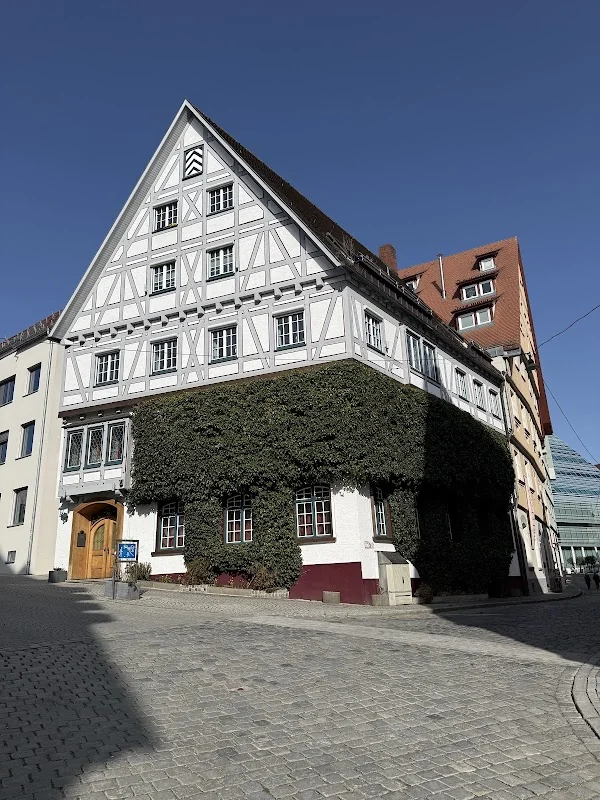
Ulm
Weinhof 19, 89073 Ulm, Deutschland
The Einsteins - Museum of a Family from Ulm | Tickets
The museum The Einsteins - Museum of a Family from Ulm has been open in Ulm since July 5, 2024, and brings visitors to a place where family history, city history, and memory culture come together in a special way. Housed in the historic Engländer at Weinhof 19, the exhibition not only tells the story of Albert Einstein but also of the people who shaped his Ulm roots. This perspective makes the place so exciting: it is not just about a pure hero portrayal, but about origins, networks, breaks, and the question of how history remains visible in a city. The museum is located in an authentic place, as members of the Einstein family lived in the building, and the Israel & Levi feather factory, in which family members were also involved, was located on the ground floor. ([ulm.de](https://www.ulm.de/kultur/st%C3%A4dtische-kultureinrichtungen/dieeinsteins))
Anyone looking for a museum in Ulm that combines biographical depth with local significance will find an unusually dense offering here. The Einsteins is not a classic technology museum nor a pure Einstein memorial, but an exhibition about family, Jewish life, and the historical developments that shaped Ulm in the 19th and 20th centuries. Albert Einstein was born in Ulm in 1879 and lived there only as an infant and toddler for about 15 months before the family moved to Munich. Nevertheless, Ulm remained an important reference point for him and his relatives. This connection forms the content backbone of the museum and explains why the exhibition goes far beyond a single life portrait. ([ulm.de](https://www.ulm.de/kultur/st%C3%A4dtische-kultureinrichtungen/dieeinsteins))
What makes The Einsteins special in Ulm?
The special feature of this museum is the focus on the family environment rather than on the individual alone. The official description emphasizes that the city of Ulm has established a museum for its most famous son and his family at an authentic location. The connections between Albert Einstein, his relatives, the Jewish community of Ulm, and the historical circumstances that influenced the life of this family are at the center. This makes the exhibition both personal and historically relevant. The life paths of individual family members not only show proximity to Einstein but also the reality of Jewish life in the 19th and 20th centuries, with integration, belonging, and painful breaks during the Nazi era. This gives the museum a depth of content that goes beyond a conventional biography. ([ulm.de](https://www.ulm.de/kultur/st%C3%A4dtische-kultureinrichtungen/dieeinsteins))
The location itself also carries the history. The house at Weinhof dates back to the 15th century and played a significant role for the Einstein family. Since the mid-19th century, there was a feather factory there, in which Einstein's grandparents and father were involved. Thus, the museum is not simply housed in a building but in a house that is directly connected to the family history. The tourist presentation also highlights that the exhibition has been set up very detail-oriented in the historical vaults, and the furniture has been precisely fitted into the space. This creates an atmospheric place that convincingly combines historical substance with modern communication. ([tourismus.ulm.de](https://tourismus.ulm.de/en/discover/ulm-and-neu-ulm/arts-and-culture/museums-and-co/die-einsteins-ulm))
In terms of content, the museum is also special because it places local history in a larger context. It tells of the Jewish community in Ulm, its development in the 19th century, and its destruction in the 20th century. At the same time, it becomes visible how deeply the Einstein family remained rooted in Ulm despite their early departure. The exhibition addresses not only origins but also memory, loss, and the question of how cities responsibly tell their history. For many visitors, this is precisely the appeal: one comes for Einstein, stays for the family history, and leaves the place with a deeper understanding of Ulm and its past. ([landesstelle.de](https://www.landesstelle.de/museen-in-baden-wuerttemberg/museum/die-einsteins-museum-einer-ulmer-familie/))
Opening hours and tickets for the visit
The Einsteins has clear and well-planned opening hours, making the visit particularly uncomplicated. It is open on Tuesdays and Wednesdays from 11 am to 5 pm, Thursdays from 11 am to 7 pm, Fridays from 11 am to 5 pm, and Saturdays and Sundays from 11 am to 6 pm. On public holidays, the opening hours are also from 11 am to 6 pm. Additionally, groups and school classes can come by arrangement outside of regular hours. This makes the museum suitable for both a spontaneous city visit and a planned outing or school group. ([einstein.ulm.de](https://einstein.ulm.de/global/datenpool/organisationseinheiten/stadt-ulm/kultur/haus-der-stadtgeschichte-stadtarchiv/%E2%80%9Edie-einsteins-museum-einer-ulmer-familie))
The admission prices are also transparent and family-friendly. Adults pay 8 euros, and the reduced admission costs 6 euros. Children up to 6 years have free admission. For children aged 6 to 12, 4 euros are charged, and for those aged 12 to 18, 6 euros. Groups of 15 or more pay 6 euros per person. Additionally, there is an annual pass for 20 euros, reduced to 16 euros. This structure shows that the museum is designed to be attractive not only for individual visits but also for repeated visits, families, and educational institutions. ([tourismus.ulm.de](https://tourismus.ulm.de/en/discover/ulm-and-neu-ulm/arts-and-culture/museums-and-co/die-einsteins-ulm))
For planning the visit, it is worthwhile to consider the focus of the stay. The exhibition works with seven chapters, media guides, and explanatory films, so one should plan enough time for a concentrated tour. Those particularly interested in history, Jewish life, or Albert Einstein will benefit from not scheduling too tightly. The Thursday opening hours until 7 pm can be practical for working people or city visits in the evening. Families with children and school groups will find good access in the multimedia elements and the illustrative explanatory films. The official structure is thus clearly aimed at different target groups. ([tourismus.ulm.de](https://tourismus.ulm.de/en/discover/ulm-and-neu-ulm/arts-and-culture/museums-and-co/die-einsteins-ulm))
Directions, parking & public transport at Weinhof 19
Getting to the museum is easy, even though there is no parking directly at the house. The official museum website lists the nearest paid parking garage as the underground garage Am Rathaus. In the immediate vicinity are also the parking garage Fischerviertel, the underground garage Kornhaus, and the parking garage Frauenstraße. Therefore, those arriving by car should expect a short walk to the old town. This is typical for a central location in Ulm and can be well combined with a stroll through the city center. ([einstein.ulm.de](https://einstein.ulm.de/global/datenpool/organisationseinheiten/stadt-ulm/kultur/haus-der-stadtgeschichte-stadtarchiv/%E2%80%9Edie-einsteins-museum-einer-ulmer-familie))
For public transport, the Rathaus stop is the nearest orientation. This places the museum in an area that is easily accessible on foot and is also connected to the city's transport network. This is particularly pleasant for visitors who arrive without a car or who want to walk just a few minutes to the museum after a city visit. The location at Weinhof 19 makes the museum part of the historic center of Ulm, so the visit can also be well combined with other stops in the old town. ([einstein.ulm.de](https://einstein.ulm.de/global/datenpool/organisationseinheiten/stadt-ulm/kultur/haus-der-stadtgeschichte-stadtarchiv/%E2%80%9Edie-einsteins-museum-einer-ulmer-familie))
Another practical advantage is the official accessibility of the museum. The museum's website explicitly states accessibility with a yes. This makes it clear that the visit is not only historically interesting but also fundamentally accessible to people with different mobility needs. Combined with the central location and the neighboring parking garages, a practical visit profile emerges. Those who plan the appointment carefully can combine the museum visit with a walk through the Ulm city center, a café stop, or a visit to other cultural places nearby. ([einstein.ulm.de](https://einstein.ulm.de/global/datenpool/organisationseinheiten/stadt-ulm/kultur/haus-der-stadtgeschichte-stadtarchiv/%E2%80%9Edie-einsteins-museum-einer-ulmer-familie))
Seven chapters, media guide & graphic novels
The exhibition works with a total of seven chapters and connects the analog tour with multimedia offerings. Visitors can enhance the tour through media stations, media guides, and explanatory films. Particularly striking is that Tobias Krell introduces the individual exhibition chapters in short, illustrative sequences. This makes historical content accessible in a low-threshold and careful manner. This is a very fitting approach for a house that brings together family, city history, and memory culture. The multimedia communication opens access for different age groups and makes the visit tangible for younger guests as well. ([tourismus.ulm.de](https://tourismus.ulm.de/en/discover/ulm-and-neu-ulm/arts-and-culture/museums-and-co/die-einsteins-ulm))
Another centerpiece is the seven graphic novels that can be accessed via the media guides. They tell the true life stories and fates of individual members of the Einstein family in comic form. This is not just a decorative additional offering but a conscious form of historical storytelling. Complex family biographies are made emotionally, visually, and understandably accessible without diluting the historical facts. Especially for visitors who may otherwise find biographical history difficult, a more direct access is created here. The graphic novels strengthen the impression that the museum not only informs but also touches and encourages further thinking. ([tourismus.ulm.de](https://tourismus.ulm.de/en/discover/ulm-and-neu-ulm/arts-and-culture/museums-and-co/die-einsteins-ulm))
Additionally, there is the so-called media station as a window into the past. The tourism site describes that photographs from the Ulm that Einstein knew interact with the present city landscape. This idea makes the exhibition particularly vivid, as past and present visually intertwine. At the same time, it becomes clear that the museum has been set up with great precision and that the furniture has been precisely fitted into the historical vaults. Thus, it is not an arbitrary exhibition space but a carefully composed environment in which architecture and content respond to each other. Those interested in museum communication will find here a particularly modern yet place-bound example. ([tourismus.ulm.de](https://tourismus.ulm.de/en/discover/ulm-and-neu-ulm/arts-and-culture/museums-and-co/die-einsteins-ulm))
Jewish community, memory culture & family history
In terms of content, the museum is closely connected to the history of the Jewish community in Ulm. The State Office for Museums in Baden-Württemberg describes that the focus is on the family network of the Einsteins while also considering the historical context in which this network was anchored. The history of the Jewish community in the 19th and 20th centuries is at the center, including its development, its rooting in the city, and its destruction during the Nazi era. The exhibition addresses integration, assimilation, exclusion, expulsion, and murder. Thus, it is not only a place of information but also a place of remembrance. ([landesstelle.de](https://www.landesstelle.de/museen-in-baden-wuerttemberg/museum/die-einsteins-museum-einer-ulmer-familie/))
Particularly strong is the connection to the life stories of individual relatives of Albert Einstein. The museum shows that Einstein maintained contact with his large family, which remained in Ulm, throughout his life despite his early departure. The exhibition makes visible how family history and the physicist's biography illuminate each other. The tourist presentation also emphasizes that Einstein helped family members who were affected by Nazi terror and that the museum also addresses the attempts to establish a new foundation between family and the city of Ulm. This connection of personal closeness and historical responsibility gives the house great emotional depth. ([landesstelle.de](https://www.landesstelle.de/museen-in-baden-wuerttemberg/museum/die-einsteins-museum-einer-ulmer-familie/))
For Ulm itself, the museum is an important building block of cultural identity. The tourism site sees it not only as a tourist showcase but also as an attraction for the people of Ulm, especially for school classes. At the same time, the museum is organizationally assigned to the House of City History - City Archive, which underscores its documentary claim. Thus, those who visit The Einsteins experience not only an exhibition about a famous family but also a place where Ulm's city history, Jewish life, memory culture, and modern communication come together. This is precisely where the lasting appeal of this location lies. ([einstein.ulm.de](https://einstein.ulm.de/global/datenpool/organisationseinheiten/stadt-ulm/kultur/haus-der-stadtgeschichte-stadtarchiv/%E2%80%9Edie-einsteins-museum-einer-ulmer-familie))
Sources:
Mehr anzeigenWeniger anzeigen
The Einsteins - Museum of a Family from Ulm | Tickets
The museum The Einsteins - Museum of a Family from Ulm has been open in Ulm since July 5, 2024, and brings visitors to a place where family history, city history, and memory culture come together in a special way. Housed in the historic Engländer at Weinhof 19, the exhibition not only tells the story of Albert Einstein but also of the people who shaped his Ulm roots. This perspective makes the place so exciting: it is not just about a pure hero portrayal, but about origins, networks, breaks, and the question of how history remains visible in a city. The museum is located in an authentic place, as members of the Einstein family lived in the building, and the Israel & Levi feather factory, in which family members were also involved, was located on the ground floor. ([ulm.de](https://www.ulm.de/kultur/st%C3%A4dtische-kultureinrichtungen/dieeinsteins))
Anyone looking for a museum in Ulm that combines biographical depth with local significance will find an unusually dense offering here. The Einsteins is not a classic technology museum nor a pure Einstein memorial, but an exhibition about family, Jewish life, and the historical developments that shaped Ulm in the 19th and 20th centuries. Albert Einstein was born in Ulm in 1879 and lived there only as an infant and toddler for about 15 months before the family moved to Munich. Nevertheless, Ulm remained an important reference point for him and his relatives. This connection forms the content backbone of the museum and explains why the exhibition goes far beyond a single life portrait. ([ulm.de](https://www.ulm.de/kultur/st%C3%A4dtische-kultureinrichtungen/dieeinsteins))
What makes The Einsteins special in Ulm?
The special feature of this museum is the focus on the family environment rather than on the individual alone. The official description emphasizes that the city of Ulm has established a museum for its most famous son and his family at an authentic location. The connections between Albert Einstein, his relatives, the Jewish community of Ulm, and the historical circumstances that influenced the life of this family are at the center. This makes the exhibition both personal and historically relevant. The life paths of individual family members not only show proximity to Einstein but also the reality of Jewish life in the 19th and 20th centuries, with integration, belonging, and painful breaks during the Nazi era. This gives the museum a depth of content that goes beyond a conventional biography. ([ulm.de](https://www.ulm.de/kultur/st%C3%A4dtische-kultureinrichtungen/dieeinsteins))
The location itself also carries the history. The house at Weinhof dates back to the 15th century and played a significant role for the Einstein family. Since the mid-19th century, there was a feather factory there, in which Einstein's grandparents and father were involved. Thus, the museum is not simply housed in a building but in a house that is directly connected to the family history. The tourist presentation also highlights that the exhibition has been set up very detail-oriented in the historical vaults, and the furniture has been precisely fitted into the space. This creates an atmospheric place that convincingly combines historical substance with modern communication. ([tourismus.ulm.de](https://tourismus.ulm.de/en/discover/ulm-and-neu-ulm/arts-and-culture/museums-and-co/die-einsteins-ulm))
In terms of content, the museum is also special because it places local history in a larger context. It tells of the Jewish community in Ulm, its development in the 19th century, and its destruction in the 20th century. At the same time, it becomes visible how deeply the Einstein family remained rooted in Ulm despite their early departure. The exhibition addresses not only origins but also memory, loss, and the question of how cities responsibly tell their history. For many visitors, this is precisely the appeal: one comes for Einstein, stays for the family history, and leaves the place with a deeper understanding of Ulm and its past. ([landesstelle.de](https://www.landesstelle.de/museen-in-baden-wuerttemberg/museum/die-einsteins-museum-einer-ulmer-familie/))
Opening hours and tickets for the visit
The Einsteins has clear and well-planned opening hours, making the visit particularly uncomplicated. It is open on Tuesdays and Wednesdays from 11 am to 5 pm, Thursdays from 11 am to 7 pm, Fridays from 11 am to 5 pm, and Saturdays and Sundays from 11 am to 6 pm. On public holidays, the opening hours are also from 11 am to 6 pm. Additionally, groups and school classes can come by arrangement outside of regular hours. This makes the museum suitable for both a spontaneous city visit and a planned outing or school group. ([einstein.ulm.de](https://einstein.ulm.de/global/datenpool/organisationseinheiten/stadt-ulm/kultur/haus-der-stadtgeschichte-stadtarchiv/%E2%80%9Edie-einsteins-museum-einer-ulmer-familie))
The admission prices are also transparent and family-friendly. Adults pay 8 euros, and the reduced admission costs 6 euros. Children up to 6 years have free admission. For children aged 6 to 12, 4 euros are charged, and for those aged 12 to 18, 6 euros. Groups of 15 or more pay 6 euros per person. Additionally, there is an annual pass for 20 euros, reduced to 16 euros. This structure shows that the museum is designed to be attractive not only for individual visits but also for repeated visits, families, and educational institutions. ([tourismus.ulm.de](https://tourismus.ulm.de/en/discover/ulm-and-neu-ulm/arts-and-culture/museums-and-co/die-einsteins-ulm))
For planning the visit, it is worthwhile to consider the focus of the stay. The exhibition works with seven chapters, media guides, and explanatory films, so one should plan enough time for a concentrated tour. Those particularly interested in history, Jewish life, or Albert Einstein will benefit from not scheduling too tightly. The Thursday opening hours until 7 pm can be practical for working people or city visits in the evening. Families with children and school groups will find good access in the multimedia elements and the illustrative explanatory films. The official structure is thus clearly aimed at different target groups. ([tourismus.ulm.de](https://tourismus.ulm.de/en/discover/ulm-and-neu-ulm/arts-and-culture/museums-and-co/die-einsteins-ulm))
Directions, parking & public transport at Weinhof 19
Getting to the museum is easy, even though there is no parking directly at the house. The official museum website lists the nearest paid parking garage as the underground garage Am Rathaus. In the immediate vicinity are also the parking garage Fischerviertel, the underground garage Kornhaus, and the parking garage Frauenstraße. Therefore, those arriving by car should expect a short walk to the old town. This is typical for a central location in Ulm and can be well combined with a stroll through the city center. ([einstein.ulm.de](https://einstein.ulm.de/global/datenpool/organisationseinheiten/stadt-ulm/kultur/haus-der-stadtgeschichte-stadtarchiv/%E2%80%9Edie-einsteins-museum-einer-ulmer-familie))
For public transport, the Rathaus stop is the nearest orientation. This places the museum in an area that is easily accessible on foot and is also connected to the city's transport network. This is particularly pleasant for visitors who arrive without a car or who want to walk just a few minutes to the museum after a city visit. The location at Weinhof 19 makes the museum part of the historic center of Ulm, so the visit can also be well combined with other stops in the old town. ([einstein.ulm.de](https://einstein.ulm.de/global/datenpool/organisationseinheiten/stadt-ulm/kultur/haus-der-stadtgeschichte-stadtarchiv/%E2%80%9Edie-einsteins-museum-einer-ulmer-familie))
Another practical advantage is the official accessibility of the museum. The museum's website explicitly states accessibility with a yes. This makes it clear that the visit is not only historically interesting but also fundamentally accessible to people with different mobility needs. Combined with the central location and the neighboring parking garages, a practical visit profile emerges. Those who plan the appointment carefully can combine the museum visit with a walk through the Ulm city center, a café stop, or a visit to other cultural places nearby. ([einstein.ulm.de](https://einstein.ulm.de/global/datenpool/organisationseinheiten/stadt-ulm/kultur/haus-der-stadtgeschichte-stadtarchiv/%E2%80%9Edie-einsteins-museum-einer-ulmer-familie))
Seven chapters, media guide & graphic novels
The exhibition works with a total of seven chapters and connects the analog tour with multimedia offerings. Visitors can enhance the tour through media stations, media guides, and explanatory films. Particularly striking is that Tobias Krell introduces the individual exhibition chapters in short, illustrative sequences. This makes historical content accessible in a low-threshold and careful manner. This is a very fitting approach for a house that brings together family, city history, and memory culture. The multimedia communication opens access for different age groups and makes the visit tangible for younger guests as well. ([tourismus.ulm.de](https://tourismus.ulm.de/en/discover/ulm-and-neu-ulm/arts-and-culture/museums-and-co/die-einsteins-ulm))
Another centerpiece is the seven graphic novels that can be accessed via the media guides. They tell the true life stories and fates of individual members of the Einstein family in comic form. This is not just a decorative additional offering but a conscious form of historical storytelling. Complex family biographies are made emotionally, visually, and understandably accessible without diluting the historical facts. Especially for visitors who may otherwise find biographical history difficult, a more direct access is created here. The graphic novels strengthen the impression that the museum not only informs but also touches and encourages further thinking. ([tourismus.ulm.de](https://tourismus.ulm.de/en/discover/ulm-and-neu-ulm/arts-and-culture/museums-and-co/die-einsteins-ulm))
Additionally, there is the so-called media station as a window into the past. The tourism site describes that photographs from the Ulm that Einstein knew interact with the present city landscape. This idea makes the exhibition particularly vivid, as past and present visually intertwine. At the same time, it becomes clear that the museum has been set up with great precision and that the furniture has been precisely fitted into the historical vaults. Thus, it is not an arbitrary exhibition space but a carefully composed environment in which architecture and content respond to each other. Those interested in museum communication will find here a particularly modern yet place-bound example. ([tourismus.ulm.de](https://tourismus.ulm.de/en/discover/ulm-and-neu-ulm/arts-and-culture/museums-and-co/die-einsteins-ulm))
Jewish community, memory culture & family history
In terms of content, the museum is closely connected to the history of the Jewish community in Ulm. The State Office for Museums in Baden-Württemberg describes that the focus is on the family network of the Einsteins while also considering the historical context in which this network was anchored. The history of the Jewish community in the 19th and 20th centuries is at the center, including its development, its rooting in the city, and its destruction during the Nazi era. The exhibition addresses integration, assimilation, exclusion, expulsion, and murder. Thus, it is not only a place of information but also a place of remembrance. ([landesstelle.de](https://www.landesstelle.de/museen-in-baden-wuerttemberg/museum/die-einsteins-museum-einer-ulmer-familie/))
Particularly strong is the connection to the life stories of individual relatives of Albert Einstein. The museum shows that Einstein maintained contact with his large family, which remained in Ulm, throughout his life despite his early departure. The exhibition makes visible how family history and the physicist's biography illuminate each other. The tourist presentation also emphasizes that Einstein helped family members who were affected by Nazi terror and that the museum also addresses the attempts to establish a new foundation between family and the city of Ulm. This connection of personal closeness and historical responsibility gives the house great emotional depth. ([landesstelle.de](https://www.landesstelle.de/museen-in-baden-wuerttemberg/museum/die-einsteins-museum-einer-ulmer-familie/))
For Ulm itself, the museum is an important building block of cultural identity. The tourism site sees it not only as a tourist showcase but also as an attraction for the people of Ulm, especially for school classes. At the same time, the museum is organizationally assigned to the House of City History - City Archive, which underscores its documentary claim. Thus, those who visit The Einsteins experience not only an exhibition about a famous family but also a place where Ulm's city history, Jewish life, memory culture, and modern communication come together. This is precisely where the lasting appeal of this location lies. ([einstein.ulm.de](https://einstein.ulm.de/global/datenpool/organisationseinheiten/stadt-ulm/kultur/haus-der-stadtgeschichte-stadtarchiv/%E2%80%9Edie-einsteins-museum-einer-ulmer-familie))
Sources:
The Einsteins - Museum of a Family from Ulm | Tickets
The museum The Einsteins - Museum of a Family from Ulm has been open in Ulm since July 5, 2024, and brings visitors to a place where family history, city history, and memory culture come together in a special way. Housed in the historic Engländer at Weinhof 19, the exhibition not only tells the story of Albert Einstein but also of the people who shaped his Ulm roots. This perspective makes the place so exciting: it is not just about a pure hero portrayal, but about origins, networks, breaks, and the question of how history remains visible in a city. The museum is located in an authentic place, as members of the Einstein family lived in the building, and the Israel & Levi feather factory, in which family members were also involved, was located on the ground floor. ([ulm.de](https://www.ulm.de/kultur/st%C3%A4dtische-kultureinrichtungen/dieeinsteins))
Anyone looking for a museum in Ulm that combines biographical depth with local significance will find an unusually dense offering here. The Einsteins is not a classic technology museum nor a pure Einstein memorial, but an exhibition about family, Jewish life, and the historical developments that shaped Ulm in the 19th and 20th centuries. Albert Einstein was born in Ulm in 1879 and lived there only as an infant and toddler for about 15 months before the family moved to Munich. Nevertheless, Ulm remained an important reference point for him and his relatives. This connection forms the content backbone of the museum and explains why the exhibition goes far beyond a single life portrait. ([ulm.de](https://www.ulm.de/kultur/st%C3%A4dtische-kultureinrichtungen/dieeinsteins))
What makes The Einsteins special in Ulm?
The special feature of this museum is the focus on the family environment rather than on the individual alone. The official description emphasizes that the city of Ulm has established a museum for its most famous son and his family at an authentic location. The connections between Albert Einstein, his relatives, the Jewish community of Ulm, and the historical circumstances that influenced the life of this family are at the center. This makes the exhibition both personal and historically relevant. The life paths of individual family members not only show proximity to Einstein but also the reality of Jewish life in the 19th and 20th centuries, with integration, belonging, and painful breaks during the Nazi era. This gives the museum a depth of content that goes beyond a conventional biography. ([ulm.de](https://www.ulm.de/kultur/st%C3%A4dtische-kultureinrichtungen/dieeinsteins))
The location itself also carries the history. The house at Weinhof dates back to the 15th century and played a significant role for the Einstein family. Since the mid-19th century, there was a feather factory there, in which Einstein's grandparents and father were involved. Thus, the museum is not simply housed in a building but in a house that is directly connected to the family history. The tourist presentation also highlights that the exhibition has been set up very detail-oriented in the historical vaults, and the furniture has been precisely fitted into the space. This creates an atmospheric place that convincingly combines historical substance with modern communication. ([tourismus.ulm.de](https://tourismus.ulm.de/en/discover/ulm-and-neu-ulm/arts-and-culture/museums-and-co/die-einsteins-ulm))
In terms of content, the museum is also special because it places local history in a larger context. It tells of the Jewish community in Ulm, its development in the 19th century, and its destruction in the 20th century. At the same time, it becomes visible how deeply the Einstein family remained rooted in Ulm despite their early departure. The exhibition addresses not only origins but also memory, loss, and the question of how cities responsibly tell their history. For many visitors, this is precisely the appeal: one comes for Einstein, stays for the family history, and leaves the place with a deeper understanding of Ulm and its past. ([landesstelle.de](https://www.landesstelle.de/museen-in-baden-wuerttemberg/museum/die-einsteins-museum-einer-ulmer-familie/))
Opening hours and tickets for the visit
The Einsteins has clear and well-planned opening hours, making the visit particularly uncomplicated. It is open on Tuesdays and Wednesdays from 11 am to 5 pm, Thursdays from 11 am to 7 pm, Fridays from 11 am to 5 pm, and Saturdays and Sundays from 11 am to 6 pm. On public holidays, the opening hours are also from 11 am to 6 pm. Additionally, groups and school classes can come by arrangement outside of regular hours. This makes the museum suitable for both a spontaneous city visit and a planned outing or school group. ([einstein.ulm.de](https://einstein.ulm.de/global/datenpool/organisationseinheiten/stadt-ulm/kultur/haus-der-stadtgeschichte-stadtarchiv/%E2%80%9Edie-einsteins-museum-einer-ulmer-familie))
The admission prices are also transparent and family-friendly. Adults pay 8 euros, and the reduced admission costs 6 euros. Children up to 6 years have free admission. For children aged 6 to 12, 4 euros are charged, and for those aged 12 to 18, 6 euros. Groups of 15 or more pay 6 euros per person. Additionally, there is an annual pass for 20 euros, reduced to 16 euros. This structure shows that the museum is designed to be attractive not only for individual visits but also for repeated visits, families, and educational institutions. ([tourismus.ulm.de](https://tourismus.ulm.de/en/discover/ulm-and-neu-ulm/arts-and-culture/museums-and-co/die-einsteins-ulm))
For planning the visit, it is worthwhile to consider the focus of the stay. The exhibition works with seven chapters, media guides, and explanatory films, so one should plan enough time for a concentrated tour. Those particularly interested in history, Jewish life, or Albert Einstein will benefit from not scheduling too tightly. The Thursday opening hours until 7 pm can be practical for working people or city visits in the evening. Families with children and school groups will find good access in the multimedia elements and the illustrative explanatory films. The official structure is thus clearly aimed at different target groups. ([tourismus.ulm.de](https://tourismus.ulm.de/en/discover/ulm-and-neu-ulm/arts-and-culture/museums-and-co/die-einsteins-ulm))
Directions, parking & public transport at Weinhof 19
Getting to the museum is easy, even though there is no parking directly at the house. The official museum website lists the nearest paid parking garage as the underground garage Am Rathaus. In the immediate vicinity are also the parking garage Fischerviertel, the underground garage Kornhaus, and the parking garage Frauenstraße. Therefore, those arriving by car should expect a short walk to the old town. This is typical for a central location in Ulm and can be well combined with a stroll through the city center. ([einstein.ulm.de](https://einstein.ulm.de/global/datenpool/organisationseinheiten/stadt-ulm/kultur/haus-der-stadtgeschichte-stadtarchiv/%E2%80%9Edie-einsteins-museum-einer-ulmer-familie))
For public transport, the Rathaus stop is the nearest orientation. This places the museum in an area that is easily accessible on foot and is also connected to the city's transport network. This is particularly pleasant for visitors who arrive without a car or who want to walk just a few minutes to the museum after a city visit. The location at Weinhof 19 makes the museum part of the historic center of Ulm, so the visit can also be well combined with other stops in the old town. ([einstein.ulm.de](https://einstein.ulm.de/global/datenpool/organisationseinheiten/stadt-ulm/kultur/haus-der-stadtgeschichte-stadtarchiv/%E2%80%9Edie-einsteins-museum-einer-ulmer-familie))
Another practical advantage is the official accessibility of the museum. The museum's website explicitly states accessibility with a yes. This makes it clear that the visit is not only historically interesting but also fundamentally accessible to people with different mobility needs. Combined with the central location and the neighboring parking garages, a practical visit profile emerges. Those who plan the appointment carefully can combine the museum visit with a walk through the Ulm city center, a café stop, or a visit to other cultural places nearby. ([einstein.ulm.de](https://einstein.ulm.de/global/datenpool/organisationseinheiten/stadt-ulm/kultur/haus-der-stadtgeschichte-stadtarchiv/%E2%80%9Edie-einsteins-museum-einer-ulmer-familie))
Seven chapters, media guide & graphic novels
The exhibition works with a total of seven chapters and connects the analog tour with multimedia offerings. Visitors can enhance the tour through media stations, media guides, and explanatory films. Particularly striking is that Tobias Krell introduces the individual exhibition chapters in short, illustrative sequences. This makes historical content accessible in a low-threshold and careful manner. This is a very fitting approach for a house that brings together family, city history, and memory culture. The multimedia communication opens access for different age groups and makes the visit tangible for younger guests as well. ([tourismus.ulm.de](https://tourismus.ulm.de/en/discover/ulm-and-neu-ulm/arts-and-culture/museums-and-co/die-einsteins-ulm))
Another centerpiece is the seven graphic novels that can be accessed via the media guides. They tell the true life stories and fates of individual members of the Einstein family in comic form. This is not just a decorative additional offering but a conscious form of historical storytelling. Complex family biographies are made emotionally, visually, and understandably accessible without diluting the historical facts. Especially for visitors who may otherwise find biographical history difficult, a more direct access is created here. The graphic novels strengthen the impression that the museum not only informs but also touches and encourages further thinking. ([tourismus.ulm.de](https://tourismus.ulm.de/en/discover/ulm-and-neu-ulm/arts-and-culture/museums-and-co/die-einsteins-ulm))
Additionally, there is the so-called media station as a window into the past. The tourism site describes that photographs from the Ulm that Einstein knew interact with the present city landscape. This idea makes the exhibition particularly vivid, as past and present visually intertwine. At the same time, it becomes clear that the museum has been set up with great precision and that the furniture has been precisely fitted into the historical vaults. Thus, it is not an arbitrary exhibition space but a carefully composed environment in which architecture and content respond to each other. Those interested in museum communication will find here a particularly modern yet place-bound example. ([tourismus.ulm.de](https://tourismus.ulm.de/en/discover/ulm-and-neu-ulm/arts-and-culture/museums-and-co/die-einsteins-ulm))
Jewish community, memory culture & family history
In terms of content, the museum is closely connected to the history of the Jewish community in Ulm. The State Office for Museums in Baden-Württemberg describes that the focus is on the family network of the Einsteins while also considering the historical context in which this network was anchored. The history of the Jewish community in the 19th and 20th centuries is at the center, including its development, its rooting in the city, and its destruction during the Nazi era. The exhibition addresses integration, assimilation, exclusion, expulsion, and murder. Thus, it is not only a place of information but also a place of remembrance. ([landesstelle.de](https://www.landesstelle.de/museen-in-baden-wuerttemberg/museum/die-einsteins-museum-einer-ulmer-familie/))
Particularly strong is the connection to the life stories of individual relatives of Albert Einstein. The museum shows that Einstein maintained contact with his large family, which remained in Ulm, throughout his life despite his early departure. The exhibition makes visible how family history and the physicist's biography illuminate each other. The tourist presentation also emphasizes that Einstein helped family members who were affected by Nazi terror and that the museum also addresses the attempts to establish a new foundation between family and the city of Ulm. This connection of personal closeness and historical responsibility gives the house great emotional depth. ([landesstelle.de](https://www.landesstelle.de/museen-in-baden-wuerttemberg/museum/die-einsteins-museum-einer-ulmer-familie/))
For Ulm itself, the museum is an important building block of cultural identity. The tourism site sees it not only as a tourist showcase but also as an attraction for the people of Ulm, especially for school classes. At the same time, the museum is organizationally assigned to the House of City History - City Archive, which underscores its documentary claim. Thus, those who visit The Einsteins experience not only an exhibition about a famous family but also a place where Ulm's city history, Jewish life, memory culture, and modern communication come together. This is precisely where the lasting appeal of this location lies. ([einstein.ulm.de](https://einstein.ulm.de/global/datenpool/organisationseinheiten/stadt-ulm/kultur/haus-der-stadtgeschichte-stadtarchiv/%E2%80%9Edie-einsteins-museum-einer-ulmer-familie))
Sources:
Upcoming Events
No events found
Frequently Asked Questions
Reviews
Sharon Kusterer
17. October 2024
Great place to follow Albert Einstein and the contributions he made to his family, education and humanity. Most of the museum offers English translations and although it is small, it's well worth the visit.
LeeLee
2. November 2024
Excellent museum about the Einstein family. You can also purchase some cute Einstein items.
Vishnu J
23. June 2025
The Museum is mainly focused on Einstein's connection to Ulm and Family tree and the migration during World war time. Don't expect exhibits related to Scientific achievements specifically theory of relativity.
Mohamned Al Mawali
21. August 2025
Magnificent place.
Miikkael
14. May 2026
Small museum. Mostly about jewish history and not much about Einstein, I dont recommend.