
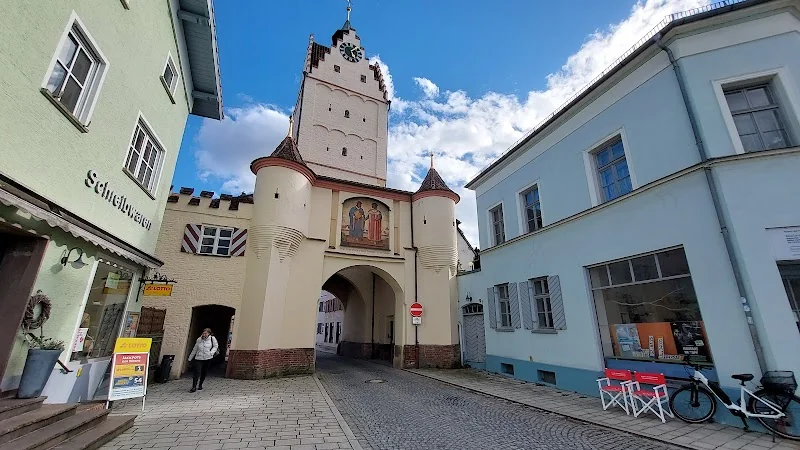
Weißenhorn
Hauptpl. 2-4, 89264 Weißenhorn, Deutschland
Fountain at the Church Square | History & Events
The fountain at the Church Square is one of the most prominent places in the historic downtown of Weißenhorn. Entering the square places you in the heart of a city that describes itself as the oldest and uniquely historical town in the Neu-Ulm district, with over 850 years of history. The medieval town center and the entire downtown area are designated as a heritage protection ensemble, and it is in this context that the Church Square unfolds its special effect. The fountain is not only a design element but also a piece of urban history that visibly reflects the transformation of Weißenhorn. Already in the 19th century, the square was a fountain site; later, the fountain disappeared from the scene for decades before it returned as a consciously placed focal point during the old town renovation. Today, the Church Square is a place where history, everyday life, and event culture intertwine. It serves as a meeting point, a backdrop, and a point of orientation for guests who want to discover Weißenhorn through tours, markets, or concerts. ([weissenhorn.de](https://www.weissenhorn.de/unsere-stadt/ueber-weissenhorn))
History of the Fountain at the Church Square
The history of the fountain at the Church Square goes back much further than today's view of the square might suggest. According to city history, the fountain was built on the Church Square before the collapse of the old parish church on February 22, 1859. Thus, it was already part of the square's layout before the current image of the surroundings developed. The fountain was incorporated into the design of the Church Square after the church was rebuilt, resulting in a harmonious overall picture. The city history also notes that the fountain is documented through numerous photographs. This is important for the city's culture of remembrance, as the square thus not only shows a beautiful center of the old town but also a continuous development that can be traced over generations. Especially in a place located in the historical center, this continuity constitutes a large part of its charm. Therefore, when looking at the fountain, one sees not only water, stone, or design but also a long series of urban planning decisions that have shaped the Church Square. ([geschichten-aus-weissenhorn.de](https://geschichten-aus-weissenhorn.de/2024/12/21/der-brunnen-am-kirchplatz/))
In 1915, the previously repaired fountain was repainted by master painter Albert Heinle, the founder of the Weißenhorn local museum, for 93 marks. In 1924, it was connected to the new municipal pressurized water supply. These details show that the fountain was not treated as a mere decorative object but was integrated into the technical and design everyday life of the city. Particularly interesting is the connection between craftsmanship, urban development, and water supply. The fountain was thus not only an eye-catcher but also a sign of the modernizing urban space. For historical consideration, it is also important that the documentation here becomes very concrete: repair, repainting, and connection to the pressurized water supply are not vague memories but clearly named stations in the history of the square. Such details explain why the fountain at the Church Square is still perceived today as a place of identity. It stands for the connection of practical use, public design, and communal self-understanding. ([geschichten-aus-weissenhorn.de](https://geschichten-aus-weissenhorn.de/2024/12/21/der-brunnen-am-kirchplatz/))
Between 1942 and 1944, the fountain at the Church Square was removed. According to the existing meeting minutes, there is no corresponding city council resolution found in the city history specialized in Weißenhorn. Unconfirmed sources suspect that the material was used during metal collections during World War II, and a photo from 1942 still shows the fountain. After that, the Church Square remained without a fountain for about 45 years. The city history also notes that the city council decided on July 25, 1947, to build a new fountain at the appropriate opportunity instead of the removed cast-iron fountain. That it would take so long for this plan to become reality says a lot about the development of the square in the 20th century. During this time, the Church Square lost its design focal point, which was also reflected in the increasing parking and changes in the path layout. For today's visitors, this phase is particularly important because it explains why the fountain is not just any object but the regained center of a long-changed place. ([geschichten-aus-weissenhorn.de](https://geschichten-aus-weissenhorn.de/2024/12/21/der-brunnen-am-kirchplatz/))
The New Fountain and the Old Town Renovation
The return of the fountain to the urban landscape is closely linked to the old town renovation. On December 3, 1984, the architect of the redesign of the Church Square, Dr. Amslinger, presented the overall planning. An octagonal fountain was already planned, which the planner envisioned as simply as Model 85. These early plans show that the fountain was not intended as an afterthought decoration but as an integral part of an urban restructuring. The discussion about how the Church Square could regain a clear center was therefore not coincidental but part of a conscious redesign. The city history describes that the city council fundamentally agreed with this idea. For today's visitors, this is particularly interesting: The fountain is not just there because a square can have a fountain, but because its shape and position were conceived as a response to the loss of the previous fountain center. It is therefore a very good example of how historical places in Weißenhorn have been carefully renewed. ([geschichten-aus-weissenhorn.de](https://geschichten-aus-weissenhorn.de/2024/12/21/der-brunnen-am-kirchplatz/))
At the suggestion of some city council members, an open competition was finally decided, in which local artists and all citizens could participate. The announcement took place on January 11, 1985, in the city newspaper. Even in the selection of a model, the citizens of Weißenhorn were to be involved, and so the designs were exhibited on April 28, 1985, in the city theater. There, visitors could vote for their favorite. However, only 40 out of 130 visitors participated in the voting, which the city history describes as neither helpful nor representative. Despite this limited participation, the process is a good example of local co-design. The fountain at the Church Square did not emerge from a quiet administrative process but from the interplay of urban planning, public discussion, and design selection. This continues to shape the perception of the square today, as the fountain was not only created historically but also emerged from citizen involvement. This mix of history and participation makes it a particularly interesting place for people who want to not only see urban development but also understand it. ([geschichten-aus-weissenhorn.de](https://geschichten-aus-weissenhorn.de/2024/12/21/der-brunnen-am-kirchplatz/))
With the new fountain, the Church Square regained an optical and functional center. The old town renovation aimed not just to repair the square but to give it a contemporary form that fits the historical surroundings. The fact that the fountain was deliberately kept simple and described as Model 85 underscores this claim. It was not about spectacle but about a restrained, harmonious solution for a place shaped by church, old town, and public life. Today, the square does not appear as an artificially imposed stage but as a regained center. Those who stand there see a place where the historical context and everyday use come together. Especially in conjunction with the surrounding events, city tours, and markets, the fountain unfolds its full significance. It marks not only a point in urban space but also a piece of regained identity. This integration explains why the Church Square is perceived so naturally as a meeting point today and why the fountain plays such an important role in Weißenhorn's city narrative. ([geschichten-aus-weissenhorn.de](https://geschichten-aus-weissenhorn.de/2024/12/21/der-brunnen-am-kirchplatz/))
Events at the Church Square in Weißenhorn
The Church Square is today much more than a historical place to look at. The city of Weißenhorn regularly uses it as an event space, and it is precisely through this that the fountain becomes part of a vibrant everyday life. This is particularly evident during the town hall concerts: In the summer months, the Church Square transforms into an atmospheric stage for the popular open-air concerts on Wednesday evenings. The local brass bands play a varied repertoire from traditional classics to modern pieces. Against the picturesque backdrop of the old town, a special atmosphere is created that invites you to linger, listen, and enjoy. This description by the city makes it clear that the Church Square is not just a backdrop but itself a cultural actor. Those who experience the fountain as a meeting point simultaneously experience the public character of the square: music, audience, open air, and historical surroundings combine to create a typical Weißenhorn summer moment. For visitors, this is particularly attractive because here, history and the present are not perceived separately but in the same space. ([weissenhorn.de](https://www.weissenhorn.de/tourismus-und-freizeit/was-ist-los-in-weissenhorn/veranstaltungskalender/veranstaltung/rathauskonzerte-mit-der-schuetzenkapelle-wallenhausen))
During Carnival and market season, the Church Square also plays a central role. On Shrove Thursday, the carnival festivities of superlatives take place at the Church Square and the main street; the official event page explicitly names the Church Square as the place of action. At the spring market, the downtown of Weißenhorn is filled with life, and the street food market at the Church Square offers dishes from around the world. The Nikolaus market, in turn, transforms the church and castle square into a pre-Christmas sea of lights with decorated huts, mulled wine, punch, and a stage program. These recurring formats clearly show that the Church Square is a flexible urban space: sometimes it serves as a concert venue, sometimes as a festival ground, sometimes as a market area. This versatility is what defines its quality. It is not only historical but also practical for everyday use and can take on very different functions depending on the season without losing its character. ([weissenhorn.de](https://www.weissenhorn.de/tourismus-und-freizeit/was-ist-los-in-weissenhorn/veranstaltungskalender/veranstaltung/donau-3-fm-gumpiger-donnerstag))
Further formats underscore the special significance of the place. The city promotes the offer Summer in the City - Sound. Culture. Church Square. This already marks the Church Square as a cultural stage in the title. The Prosecco in the Old Town action also shows how much the center around the Church Square understands itself as a place for lingering and enjoyment. There are, among other things, 6 places at the Church Square for sitting together. This is no coincidence but an expression of an understanding of the downtown where public spaces are not just crossed but consciously used. For guests, this means: The fountain at the Church Square is a very good starting point to experience the culinary, musical, and communal side of Weißenhorn. So, if you are looking for events, city festivals, music evenings, or seasonal activities, you will find a remarkable density of dates at the Church Square. The variety ranges from small evening concerts to large market Sundays and makes the place one of the most important public meeting points in the city. ([weissenhorn.de](https://www.weissenhorn.de/tourismus-und-freizeit/was-ist-los-in-weissenhorn/veranstaltungskalender/veranstaltung/sommer-im-staedtle-klang-kultur-kirchplatz-mit-maximilian-jaeger))
Access, Parking, and Orientation in the Center
For practical planning of a visit, the Church Square is well connected. The city of Weißenhorn provides its own parking overview and names, among others, the P1 parking lot downtown and the P2 parking lot theater. The offer is supplemented by additional parking spaces such as camper parking, parking at Jägerweg, Waldfriedhof parking, Fuggerhalle parking, and the train station parking lots south and north. So, anyone wanting to visit the fountain at the Church Square will find several suitable options for different modes of arrival in the official overview. Especially because the Church Square is located in the downtown area, central parking options are particularly relevant. The city communicates these parking areas transparently and thus supports an uncomplicated visit to the historic core. This is important for everyone arriving for shopping, an event, or a tour. Instead of searching for orientation for a long time, one can directly incorporate the parking infrastructure into the visit planning. ([weissenhorn.de](https://www.weissenhorn.de/unsere-stadt/lernen-sie-uns-kennen/parken))
The general connection of Weißenhorn is also helpful for a visit. The city describes itself as well accessible via the highway connections to the A7 and A8. In addition, the railway line (Ulm)-Senden-Weißenhorn was reactivated in December 2013, making the major center of Ulm/Neu-Ulm reachable by public transport in just under 25 minutes. There is also a well-developed network of bike paths throughout the city. For the fountain at the Church Square, this means in practice: Visitors can reach the downtown area by car, train, or bike, depending on their starting point. The old town is not organized as a secluded museum space but as a functioning urban core with good accessibility. This makes the square attractive for spontaneous visits as well. Anyone already traveling in the region can easily incorporate the Church Square into a day trip without having to plan complicated routes. The official city description confirms that Weißenhorn is not only historically interesting but also practically well accessible. ([weissenhorn.de](https://www.weissenhorn.de/unsere-stadt/ueber-weissenhorn))
From the city information, it can also be inferred that the Church Square is particularly sensible as a starting point for a visit to the old town. This is a practical conclusion from the combination of central parking lots, compact downtown area, and the role of the square as a meeting point for tours and events. Those coming for the night watchman tour start directly at the fountain at the Church Square. Those arriving for a market, concert, or festival also end up in the immediate vicinity of the historic center. For pedestrians and cyclists, this is particularly pleasant because the paths remain short and the place easily integrates into a tour through the old town. Even though the city does not specify exact walking distances in meters to the fountain, the context is clear: The Church Square is a central, well-connected, and everyday point in the urban core. This mix of historical significance and good accessibility makes it so usable for visitors. ([weissenhorn.de](https://www.weissenhorn.de/unsere-stadt/lernen-sie-uns-kennen/parken))
Discover Weißenhorn: Old Town, History, and Tours
Those who visit the fountain at the Church Square automatically discover more than just a single point. Weißenhorn describes its medieval town center as a heritage protection ensemble, and therein lies the charm of the entire environment. The city refers to a lively downtown, well-maintained gastronomy, and cultural institutions such as the newly built Fuggerhalle with event offerings of up to 1600 standing places, the historic town theater as a unique feature in Bavaria, the old town hall, and the Schranne as the oldest building in the city. The offer is complemented by the local museum with a permanent exhibition on local history and changing exhibitions. The fountain is thus not isolated but situated in an environment that consciously engages with history, culture, and public life. This makes the Church Square so interesting for guests: You not only get a beautiful motif there but also an entry into the urban identity of Weißenhorn. The old town is compact enough to experience on foot and rich enough in stations to create an entire tour. ([weissenhorn.de](https://www.weissenhorn.de/unsere-stadt/ueber-weissenhorn))
A particularly beautiful indication of the role of the fountain as a meeting point is the night watchman tour. The city invites you to discover the Weißenhorn old town even in darkness. Accompanied by night watchman Paul Silberbaur, it goes with halberd, horn, and lantern through quiet alleys and squares, past historic half-timbered houses and significant buildings of the old town. The meeting point for this tour is explicitly the fountain at the Church Square. This is more than a practical indication: It shows that the fountain is anchored in public memory as a point of orientation and starting mark. Those who meet there begin their tour at a place that connects history, present, and narrative. This is ideal for visitors experiencing Weißenhorn for the first time. They do not start somewhere but directly at a place with a clear atmosphere and historical reference. ([weissenhorn.de](https://www.weissenhorn.de/tourismus-und-freizeit/was-ist-los-in-weissenhorn/veranstaltungskalender/veranstaltung/nachtwaechterfuehrung-durch-die-weissenhorner-altstadt-im-april))
Thus, the fountain at the Church Square becomes a place where different levels overlap. It reminds of old fountain sites, the redesign of the Church Square, years without a fountain, and the conscious restoration of an urban center. At the same time, it is part of a vibrant urban core that hosts markets, concerts, tours, and seasonal festivals. This connection of memory and use is typical for Weißenhorn. Visitors experience not just a single monument here but a city that actively engages with its historical space. Those who take the time to not only photograph the square but also observe it quickly understand why the fountain is so present in the city's everyday life. It marks what makes Weißenhorn great in the best sense: a historical backdrop that has not stood still but continues to live. ([geschichten-aus-weissenhorn.de](https://geschichten-aus-weissenhorn.de/2024/12/21/der-brunnen-am-kirchplatz/))
When the Church Square is Particularly Lively
The fountain at the Church Square is most lively when the city brings its public formats to the square. The town hall concerts provide music under the open sky on Wednesday evenings during the summer months. On Shrove Thursday, the Church Square fills up along with the main street with carnival festivities. The spring market brings together street food, downtown flair, and family visits, while the Nikolaus market transforms the church and castle square into a pre-Christmas sea of lights. So, if you want to experience the square's effect not just as a monument but truly, you should take a look at the event calendar. This is particularly worthwhile because the dates vary greatly depending on the season, giving the square a different character each time. Sometimes it is a concert stage, sometimes a market area, sometimes a festive meeting point. This flexibility makes it so typical for a city center that does not limit itself to one function. ([weissenhorn.de](https://www.weissenhorn.de/tourismus-und-freizeit/was-ist-los-in-weissenhorn/veranstaltungskalender/veranstaltung/rathauskonzerte-mit-der-schuetzenkapelle-wallenhausen))
Even outside of the major event days, a visit is worthwhile. The old town of Weißenhorn is, according to the city, a historically grown, renovated, and at the same time lively space. This means: The Church Square is interesting not only during festivals but also when you want to perceive the architecture and the calm effect of the square. Especially the fountain gives the square a clear center from which other stations of the downtown area can be easily oriented. For walkers, this is pleasant because from there, other stations of the downtown can be easily placed. For guests visiting Weißenhorn for the first time, this is an easy entry into the city. And for people returning, it is a recognizable symbol. The city itself consciously uses this mix of use and atmosphere, which can be seen in the regular events, city tours, and cultural offerings in the vicinity. The Church Square thrives on being both an everyday space and a festival site. ([weissenhorn.de](https://www.weissenhorn.de/unsere-stadt/ueber-weissenhorn))
Therefore, those who consciously plan a stop at the fountain at the Church Square get a very rounded Weißenhorn experience: historical context, short distances, cultural diversity, and a downtown that does not hide its history. The square is suitable as a starting point for a walk, as a meeting point for a tour, or as a place for a relaxed stay in the middle of the old town. This usability also makes it attractive for visitors who do not plan a large program tour. A short stop at the fountain can be the beginning of a longer city visit. And if a festival, market, or concert is currently taking place, the stop quickly becomes a whole experience. The fountain at the Church Square is therefore not a marginal detail but a strong local symbol: It connects Weißenhorn's past with the present of the city. Those who visit it see very well how a historical center functions in the 21st century. ([geschichten-aus-weissenhorn.de](https://geschichten-aus-weissenhorn.de/2024/12/21/der-brunnen-am-kirchplatz/))
Sources:
- Stories from Weißenhorn - The Fountain at the Church Square
- City of Weißenhorn - About Weißenhorn
- City of Weißenhorn - Parking
- City of Weißenhorn - Town Hall Concerts with the Wallenhausen Marksmen Band
- City of Weißenhorn - Night Watchman Tour through the Weißenhorn Old Town in April
- City of Weißenhorn - Spring Market Weißenhorn with Open Sunday, Street Food Market, and Schranne Market
- City of Weißenhorn - DONAU 3 FM Shrove Thursday
- City of Weißenhorn - Nikolaus Market
- City of Weißenhorn - Summer in the City Sound. Culture. Church Square.
- City of Weißenhorn - Prosecco in the Old Town
Show moreShow less
Fountain at the Church Square | History & Events
The fountain at the Church Square is one of the most prominent places in the historic downtown of Weißenhorn. Entering the square places you in the heart of a city that describes itself as the oldest and uniquely historical town in the Neu-Ulm district, with over 850 years of history. The medieval town center and the entire downtown area are designated as a heritage protection ensemble, and it is in this context that the Church Square unfolds its special effect. The fountain is not only a design element but also a piece of urban history that visibly reflects the transformation of Weißenhorn. Already in the 19th century, the square was a fountain site; later, the fountain disappeared from the scene for decades before it returned as a consciously placed focal point during the old town renovation. Today, the Church Square is a place where history, everyday life, and event culture intertwine. It serves as a meeting point, a backdrop, and a point of orientation for guests who want to discover Weißenhorn through tours, markets, or concerts. ([weissenhorn.de](https://www.weissenhorn.de/unsere-stadt/ueber-weissenhorn))
History of the Fountain at the Church Square
The history of the fountain at the Church Square goes back much further than today's view of the square might suggest. According to city history, the fountain was built on the Church Square before the collapse of the old parish church on February 22, 1859. Thus, it was already part of the square's layout before the current image of the surroundings developed. The fountain was incorporated into the design of the Church Square after the church was rebuilt, resulting in a harmonious overall picture. The city history also notes that the fountain is documented through numerous photographs. This is important for the city's culture of remembrance, as the square thus not only shows a beautiful center of the old town but also a continuous development that can be traced over generations. Especially in a place located in the historical center, this continuity constitutes a large part of its charm. Therefore, when looking at the fountain, one sees not only water, stone, or design but also a long series of urban planning decisions that have shaped the Church Square. ([geschichten-aus-weissenhorn.de](https://geschichten-aus-weissenhorn.de/2024/12/21/der-brunnen-am-kirchplatz/))
In 1915, the previously repaired fountain was repainted by master painter Albert Heinle, the founder of the Weißenhorn local museum, for 93 marks. In 1924, it was connected to the new municipal pressurized water supply. These details show that the fountain was not treated as a mere decorative object but was integrated into the technical and design everyday life of the city. Particularly interesting is the connection between craftsmanship, urban development, and water supply. The fountain was thus not only an eye-catcher but also a sign of the modernizing urban space. For historical consideration, it is also important that the documentation here becomes very concrete: repair, repainting, and connection to the pressurized water supply are not vague memories but clearly named stations in the history of the square. Such details explain why the fountain at the Church Square is still perceived today as a place of identity. It stands for the connection of practical use, public design, and communal self-understanding. ([geschichten-aus-weissenhorn.de](https://geschichten-aus-weissenhorn.de/2024/12/21/der-brunnen-am-kirchplatz/))
Between 1942 and 1944, the fountain at the Church Square was removed. According to the existing meeting minutes, there is no corresponding city council resolution found in the city history specialized in Weißenhorn. Unconfirmed sources suspect that the material was used during metal collections during World War II, and a photo from 1942 still shows the fountain. After that, the Church Square remained without a fountain for about 45 years. The city history also notes that the city council decided on July 25, 1947, to build a new fountain at the appropriate opportunity instead of the removed cast-iron fountain. That it would take so long for this plan to become reality says a lot about the development of the square in the 20th century. During this time, the Church Square lost its design focal point, which was also reflected in the increasing parking and changes in the path layout. For today's visitors, this phase is particularly important because it explains why the fountain is not just any object but the regained center of a long-changed place. ([geschichten-aus-weissenhorn.de](https://geschichten-aus-weissenhorn.de/2024/12/21/der-brunnen-am-kirchplatz/))
The New Fountain and the Old Town Renovation
The return of the fountain to the urban landscape is closely linked to the old town renovation. On December 3, 1984, the architect of the redesign of the Church Square, Dr. Amslinger, presented the overall planning. An octagonal fountain was already planned, which the planner envisioned as simply as Model 85. These early plans show that the fountain was not intended as an afterthought decoration but as an integral part of an urban restructuring. The discussion about how the Church Square could regain a clear center was therefore not coincidental but part of a conscious redesign. The city history describes that the city council fundamentally agreed with this idea. For today's visitors, this is particularly interesting: The fountain is not just there because a square can have a fountain, but because its shape and position were conceived as a response to the loss of the previous fountain center. It is therefore a very good example of how historical places in Weißenhorn have been carefully renewed. ([geschichten-aus-weissenhorn.de](https://geschichten-aus-weissenhorn.de/2024/12/21/der-brunnen-am-kirchplatz/))
At the suggestion of some city council members, an open competition was finally decided, in which local artists and all citizens could participate. The announcement took place on January 11, 1985, in the city newspaper. Even in the selection of a model, the citizens of Weißenhorn were to be involved, and so the designs were exhibited on April 28, 1985, in the city theater. There, visitors could vote for their favorite. However, only 40 out of 130 visitors participated in the voting, which the city history describes as neither helpful nor representative. Despite this limited participation, the process is a good example of local co-design. The fountain at the Church Square did not emerge from a quiet administrative process but from the interplay of urban planning, public discussion, and design selection. This continues to shape the perception of the square today, as the fountain was not only created historically but also emerged from citizen involvement. This mix of history and participation makes it a particularly interesting place for people who want to not only see urban development but also understand it. ([geschichten-aus-weissenhorn.de](https://geschichten-aus-weissenhorn.de/2024/12/21/der-brunnen-am-kirchplatz/))
With the new fountain, the Church Square regained an optical and functional center. The old town renovation aimed not just to repair the square but to give it a contemporary form that fits the historical surroundings. The fact that the fountain was deliberately kept simple and described as Model 85 underscores this claim. It was not about spectacle but about a restrained, harmonious solution for a place shaped by church, old town, and public life. Today, the square does not appear as an artificially imposed stage but as a regained center. Those who stand there see a place where the historical context and everyday use come together. Especially in conjunction with the surrounding events, city tours, and markets, the fountain unfolds its full significance. It marks not only a point in urban space but also a piece of regained identity. This integration explains why the Church Square is perceived so naturally as a meeting point today and why the fountain plays such an important role in Weißenhorn's city narrative. ([geschichten-aus-weissenhorn.de](https://geschichten-aus-weissenhorn.de/2024/12/21/der-brunnen-am-kirchplatz/))
Events at the Church Square in Weißenhorn
The Church Square is today much more than a historical place to look at. The city of Weißenhorn regularly uses it as an event space, and it is precisely through this that the fountain becomes part of a vibrant everyday life. This is particularly evident during the town hall concerts: In the summer months, the Church Square transforms into an atmospheric stage for the popular open-air concerts on Wednesday evenings. The local brass bands play a varied repertoire from traditional classics to modern pieces. Against the picturesque backdrop of the old town, a special atmosphere is created that invites you to linger, listen, and enjoy. This description by the city makes it clear that the Church Square is not just a backdrop but itself a cultural actor. Those who experience the fountain as a meeting point simultaneously experience the public character of the square: music, audience, open air, and historical surroundings combine to create a typical Weißenhorn summer moment. For visitors, this is particularly attractive because here, history and the present are not perceived separately but in the same space. ([weissenhorn.de](https://www.weissenhorn.de/tourismus-und-freizeit/was-ist-los-in-weissenhorn/veranstaltungskalender/veranstaltung/rathauskonzerte-mit-der-schuetzenkapelle-wallenhausen))
During Carnival and market season, the Church Square also plays a central role. On Shrove Thursday, the carnival festivities of superlatives take place at the Church Square and the main street; the official event page explicitly names the Church Square as the place of action. At the spring market, the downtown of Weißenhorn is filled with life, and the street food market at the Church Square offers dishes from around the world. The Nikolaus market, in turn, transforms the church and castle square into a pre-Christmas sea of lights with decorated huts, mulled wine, punch, and a stage program. These recurring formats clearly show that the Church Square is a flexible urban space: sometimes it serves as a concert venue, sometimes as a festival ground, sometimes as a market area. This versatility is what defines its quality. It is not only historical but also practical for everyday use and can take on very different functions depending on the season without losing its character. ([weissenhorn.de](https://www.weissenhorn.de/tourismus-und-freizeit/was-ist-los-in-weissenhorn/veranstaltungskalender/veranstaltung/donau-3-fm-gumpiger-donnerstag))
Further formats underscore the special significance of the place. The city promotes the offer Summer in the City - Sound. Culture. Church Square. This already marks the Church Square as a cultural stage in the title. The Prosecco in the Old Town action also shows how much the center around the Church Square understands itself as a place for lingering and enjoyment. There are, among other things, 6 places at the Church Square for sitting together. This is no coincidence but an expression of an understanding of the downtown where public spaces are not just crossed but consciously used. For guests, this means: The fountain at the Church Square is a very good starting point to experience the culinary, musical, and communal side of Weißenhorn. So, if you are looking for events, city festivals, music evenings, or seasonal activities, you will find a remarkable density of dates at the Church Square. The variety ranges from small evening concerts to large market Sundays and makes the place one of the most important public meeting points in the city. ([weissenhorn.de](https://www.weissenhorn.de/tourismus-und-freizeit/was-ist-los-in-weissenhorn/veranstaltungskalender/veranstaltung/sommer-im-staedtle-klang-kultur-kirchplatz-mit-maximilian-jaeger))
Access, Parking, and Orientation in the Center
For practical planning of a visit, the Church Square is well connected. The city of Weißenhorn provides its own parking overview and names, among others, the P1 parking lot downtown and the P2 parking lot theater. The offer is supplemented by additional parking spaces such as camper parking, parking at Jägerweg, Waldfriedhof parking, Fuggerhalle parking, and the train station parking lots south and north. So, anyone wanting to visit the fountain at the Church Square will find several suitable options for different modes of arrival in the official overview. Especially because the Church Square is located in the downtown area, central parking options are particularly relevant. The city communicates these parking areas transparently and thus supports an uncomplicated visit to the historic core. This is important for everyone arriving for shopping, an event, or a tour. Instead of searching for orientation for a long time, one can directly incorporate the parking infrastructure into the visit planning. ([weissenhorn.de](https://www.weissenhorn.de/unsere-stadt/lernen-sie-uns-kennen/parken))
The general connection of Weißenhorn is also helpful for a visit. The city describes itself as well accessible via the highway connections to the A7 and A8. In addition, the railway line (Ulm)-Senden-Weißenhorn was reactivated in December 2013, making the major center of Ulm/Neu-Ulm reachable by public transport in just under 25 minutes. There is also a well-developed network of bike paths throughout the city. For the fountain at the Church Square, this means in practice: Visitors can reach the downtown area by car, train, or bike, depending on their starting point. The old town is not organized as a secluded museum space but as a functioning urban core with good accessibility. This makes the square attractive for spontaneous visits as well. Anyone already traveling in the region can easily incorporate the Church Square into a day trip without having to plan complicated routes. The official city description confirms that Weißenhorn is not only historically interesting but also practically well accessible. ([weissenhorn.de](https://www.weissenhorn.de/unsere-stadt/ueber-weissenhorn))
From the city information, it can also be inferred that the Church Square is particularly sensible as a starting point for a visit to the old town. This is a practical conclusion from the combination of central parking lots, compact downtown area, and the role of the square as a meeting point for tours and events. Those coming for the night watchman tour start directly at the fountain at the Church Square. Those arriving for a market, concert, or festival also end up in the immediate vicinity of the historic center. For pedestrians and cyclists, this is particularly pleasant because the paths remain short and the place easily integrates into a tour through the old town. Even though the city does not specify exact walking distances in meters to the fountain, the context is clear: The Church Square is a central, well-connected, and everyday point in the urban core. This mix of historical significance and good accessibility makes it so usable for visitors. ([weissenhorn.de](https://www.weissenhorn.de/unsere-stadt/lernen-sie-uns-kennen/parken))
Discover Weißenhorn: Old Town, History, and Tours
Those who visit the fountain at the Church Square automatically discover more than just a single point. Weißenhorn describes its medieval town center as a heritage protection ensemble, and therein lies the charm of the entire environment. The city refers to a lively downtown, well-maintained gastronomy, and cultural institutions such as the newly built Fuggerhalle with event offerings of up to 1600 standing places, the historic town theater as a unique feature in Bavaria, the old town hall, and the Schranne as the oldest building in the city. The offer is complemented by the local museum with a permanent exhibition on local history and changing exhibitions. The fountain is thus not isolated but situated in an environment that consciously engages with history, culture, and public life. This makes the Church Square so interesting for guests: You not only get a beautiful motif there but also an entry into the urban identity of Weißenhorn. The old town is compact enough to experience on foot and rich enough in stations to create an entire tour. ([weissenhorn.de](https://www.weissenhorn.de/unsere-stadt/ueber-weissenhorn))
A particularly beautiful indication of the role of the fountain as a meeting point is the night watchman tour. The city invites you to discover the Weißenhorn old town even in darkness. Accompanied by night watchman Paul Silberbaur, it goes with halberd, horn, and lantern through quiet alleys and squares, past historic half-timbered houses and significant buildings of the old town. The meeting point for this tour is explicitly the fountain at the Church Square. This is more than a practical indication: It shows that the fountain is anchored in public memory as a point of orientation and starting mark. Those who meet there begin their tour at a place that connects history, present, and narrative. This is ideal for visitors experiencing Weißenhorn for the first time. They do not start somewhere but directly at a place with a clear atmosphere and historical reference. ([weissenhorn.de](https://www.weissenhorn.de/tourismus-und-freizeit/was-ist-los-in-weissenhorn/veranstaltungskalender/veranstaltung/nachtwaechterfuehrung-durch-die-weissenhorner-altstadt-im-april))
Thus, the fountain at the Church Square becomes a place where different levels overlap. It reminds of old fountain sites, the redesign of the Church Square, years without a fountain, and the conscious restoration of an urban center. At the same time, it is part of a vibrant urban core that hosts markets, concerts, tours, and seasonal festivals. This connection of memory and use is typical for Weißenhorn. Visitors experience not just a single monument here but a city that actively engages with its historical space. Those who take the time to not only photograph the square but also observe it quickly understand why the fountain is so present in the city's everyday life. It marks what makes Weißenhorn great in the best sense: a historical backdrop that has not stood still but continues to live. ([geschichten-aus-weissenhorn.de](https://geschichten-aus-weissenhorn.de/2024/12/21/der-brunnen-am-kirchplatz/))
When the Church Square is Particularly Lively
The fountain at the Church Square is most lively when the city brings its public formats to the square. The town hall concerts provide music under the open sky on Wednesday evenings during the summer months. On Shrove Thursday, the Church Square fills up along with the main street with carnival festivities. The spring market brings together street food, downtown flair, and family visits, while the Nikolaus market transforms the church and castle square into a pre-Christmas sea of lights. So, if you want to experience the square's effect not just as a monument but truly, you should take a look at the event calendar. This is particularly worthwhile because the dates vary greatly depending on the season, giving the square a different character each time. Sometimes it is a concert stage, sometimes a market area, sometimes a festive meeting point. This flexibility makes it so typical for a city center that does not limit itself to one function. ([weissenhorn.de](https://www.weissenhorn.de/tourismus-und-freizeit/was-ist-los-in-weissenhorn/veranstaltungskalender/veranstaltung/rathauskonzerte-mit-der-schuetzenkapelle-wallenhausen))
Even outside of the major event days, a visit is worthwhile. The old town of Weißenhorn is, according to the city, a historically grown, renovated, and at the same time lively space. This means: The Church Square is interesting not only during festivals but also when you want to perceive the architecture and the calm effect of the square. Especially the fountain gives the square a clear center from which other stations of the downtown area can be easily oriented. For walkers, this is pleasant because from there, other stations of the downtown can be easily placed. For guests visiting Weißenhorn for the first time, this is an easy entry into the city. And for people returning, it is a recognizable symbol. The city itself consciously uses this mix of use and atmosphere, which can be seen in the regular events, city tours, and cultural offerings in the vicinity. The Church Square thrives on being both an everyday space and a festival site. ([weissenhorn.de](https://www.weissenhorn.de/unsere-stadt/ueber-weissenhorn))
Therefore, those who consciously plan a stop at the fountain at the Church Square get a very rounded Weißenhorn experience: historical context, short distances, cultural diversity, and a downtown that does not hide its history. The square is suitable as a starting point for a walk, as a meeting point for a tour, or as a place for a relaxed stay in the middle of the old town. This usability also makes it attractive for visitors who do not plan a large program tour. A short stop at the fountain can be the beginning of a longer city visit. And if a festival, market, or concert is currently taking place, the stop quickly becomes a whole experience. The fountain at the Church Square is therefore not a marginal detail but a strong local symbol: It connects Weißenhorn's past with the present of the city. Those who visit it see very well how a historical center functions in the 21st century. ([geschichten-aus-weissenhorn.de](https://geschichten-aus-weissenhorn.de/2024/12/21/der-brunnen-am-kirchplatz/))
Sources:
- Stories from Weißenhorn - The Fountain at the Church Square
- City of Weißenhorn - About Weißenhorn
- City of Weißenhorn - Parking
- City of Weißenhorn - Town Hall Concerts with the Wallenhausen Marksmen Band
- City of Weißenhorn - Night Watchman Tour through the Weißenhorn Old Town in April
- City of Weißenhorn - Spring Market Weißenhorn with Open Sunday, Street Food Market, and Schranne Market
- City of Weißenhorn - DONAU 3 FM Shrove Thursday
- City of Weißenhorn - Nikolaus Market
- City of Weißenhorn - Summer in the City Sound. Culture. Church Square.
- City of Weißenhorn - Prosecco in the Old Town
Fountain at the Church Square | History & Events
The fountain at the Church Square is one of the most prominent places in the historic downtown of Weißenhorn. Entering the square places you in the heart of a city that describes itself as the oldest and uniquely historical town in the Neu-Ulm district, with over 850 years of history. The medieval town center and the entire downtown area are designated as a heritage protection ensemble, and it is in this context that the Church Square unfolds its special effect. The fountain is not only a design element but also a piece of urban history that visibly reflects the transformation of Weißenhorn. Already in the 19th century, the square was a fountain site; later, the fountain disappeared from the scene for decades before it returned as a consciously placed focal point during the old town renovation. Today, the Church Square is a place where history, everyday life, and event culture intertwine. It serves as a meeting point, a backdrop, and a point of orientation for guests who want to discover Weißenhorn through tours, markets, or concerts. ([weissenhorn.de](https://www.weissenhorn.de/unsere-stadt/ueber-weissenhorn))
History of the Fountain at the Church Square
The history of the fountain at the Church Square goes back much further than today's view of the square might suggest. According to city history, the fountain was built on the Church Square before the collapse of the old parish church on February 22, 1859. Thus, it was already part of the square's layout before the current image of the surroundings developed. The fountain was incorporated into the design of the Church Square after the church was rebuilt, resulting in a harmonious overall picture. The city history also notes that the fountain is documented through numerous photographs. This is important for the city's culture of remembrance, as the square thus not only shows a beautiful center of the old town but also a continuous development that can be traced over generations. Especially in a place located in the historical center, this continuity constitutes a large part of its charm. Therefore, when looking at the fountain, one sees not only water, stone, or design but also a long series of urban planning decisions that have shaped the Church Square. ([geschichten-aus-weissenhorn.de](https://geschichten-aus-weissenhorn.de/2024/12/21/der-brunnen-am-kirchplatz/))
In 1915, the previously repaired fountain was repainted by master painter Albert Heinle, the founder of the Weißenhorn local museum, for 93 marks. In 1924, it was connected to the new municipal pressurized water supply. These details show that the fountain was not treated as a mere decorative object but was integrated into the technical and design everyday life of the city. Particularly interesting is the connection between craftsmanship, urban development, and water supply. The fountain was thus not only an eye-catcher but also a sign of the modernizing urban space. For historical consideration, it is also important that the documentation here becomes very concrete: repair, repainting, and connection to the pressurized water supply are not vague memories but clearly named stations in the history of the square. Such details explain why the fountain at the Church Square is still perceived today as a place of identity. It stands for the connection of practical use, public design, and communal self-understanding. ([geschichten-aus-weissenhorn.de](https://geschichten-aus-weissenhorn.de/2024/12/21/der-brunnen-am-kirchplatz/))
Between 1942 and 1944, the fountain at the Church Square was removed. According to the existing meeting minutes, there is no corresponding city council resolution found in the city history specialized in Weißenhorn. Unconfirmed sources suspect that the material was used during metal collections during World War II, and a photo from 1942 still shows the fountain. After that, the Church Square remained without a fountain for about 45 years. The city history also notes that the city council decided on July 25, 1947, to build a new fountain at the appropriate opportunity instead of the removed cast-iron fountain. That it would take so long for this plan to become reality says a lot about the development of the square in the 20th century. During this time, the Church Square lost its design focal point, which was also reflected in the increasing parking and changes in the path layout. For today's visitors, this phase is particularly important because it explains why the fountain is not just any object but the regained center of a long-changed place. ([geschichten-aus-weissenhorn.de](https://geschichten-aus-weissenhorn.de/2024/12/21/der-brunnen-am-kirchplatz/))
The New Fountain and the Old Town Renovation
The return of the fountain to the urban landscape is closely linked to the old town renovation. On December 3, 1984, the architect of the redesign of the Church Square, Dr. Amslinger, presented the overall planning. An octagonal fountain was already planned, which the planner envisioned as simply as Model 85. These early plans show that the fountain was not intended as an afterthought decoration but as an integral part of an urban restructuring. The discussion about how the Church Square could regain a clear center was therefore not coincidental but part of a conscious redesign. The city history describes that the city council fundamentally agreed with this idea. For today's visitors, this is particularly interesting: The fountain is not just there because a square can have a fountain, but because its shape and position were conceived as a response to the loss of the previous fountain center. It is therefore a very good example of how historical places in Weißenhorn have been carefully renewed. ([geschichten-aus-weissenhorn.de](https://geschichten-aus-weissenhorn.de/2024/12/21/der-brunnen-am-kirchplatz/))
At the suggestion of some city council members, an open competition was finally decided, in which local artists and all citizens could participate. The announcement took place on January 11, 1985, in the city newspaper. Even in the selection of a model, the citizens of Weißenhorn were to be involved, and so the designs were exhibited on April 28, 1985, in the city theater. There, visitors could vote for their favorite. However, only 40 out of 130 visitors participated in the voting, which the city history describes as neither helpful nor representative. Despite this limited participation, the process is a good example of local co-design. The fountain at the Church Square did not emerge from a quiet administrative process but from the interplay of urban planning, public discussion, and design selection. This continues to shape the perception of the square today, as the fountain was not only created historically but also emerged from citizen involvement. This mix of history and participation makes it a particularly interesting place for people who want to not only see urban development but also understand it. ([geschichten-aus-weissenhorn.de](https://geschichten-aus-weissenhorn.de/2024/12/21/der-brunnen-am-kirchplatz/))
With the new fountain, the Church Square regained an optical and functional center. The old town renovation aimed not just to repair the square but to give it a contemporary form that fits the historical surroundings. The fact that the fountain was deliberately kept simple and described as Model 85 underscores this claim. It was not about spectacle but about a restrained, harmonious solution for a place shaped by church, old town, and public life. Today, the square does not appear as an artificially imposed stage but as a regained center. Those who stand there see a place where the historical context and everyday use come together. Especially in conjunction with the surrounding events, city tours, and markets, the fountain unfolds its full significance. It marks not only a point in urban space but also a piece of regained identity. This integration explains why the Church Square is perceived so naturally as a meeting point today and why the fountain plays such an important role in Weißenhorn's city narrative. ([geschichten-aus-weissenhorn.de](https://geschichten-aus-weissenhorn.de/2024/12/21/der-brunnen-am-kirchplatz/))
Events at the Church Square in Weißenhorn
The Church Square is today much more than a historical place to look at. The city of Weißenhorn regularly uses it as an event space, and it is precisely through this that the fountain becomes part of a vibrant everyday life. This is particularly evident during the town hall concerts: In the summer months, the Church Square transforms into an atmospheric stage for the popular open-air concerts on Wednesday evenings. The local brass bands play a varied repertoire from traditional classics to modern pieces. Against the picturesque backdrop of the old town, a special atmosphere is created that invites you to linger, listen, and enjoy. This description by the city makes it clear that the Church Square is not just a backdrop but itself a cultural actor. Those who experience the fountain as a meeting point simultaneously experience the public character of the square: music, audience, open air, and historical surroundings combine to create a typical Weißenhorn summer moment. For visitors, this is particularly attractive because here, history and the present are not perceived separately but in the same space. ([weissenhorn.de](https://www.weissenhorn.de/tourismus-und-freizeit/was-ist-los-in-weissenhorn/veranstaltungskalender/veranstaltung/rathauskonzerte-mit-der-schuetzenkapelle-wallenhausen))
During Carnival and market season, the Church Square also plays a central role. On Shrove Thursday, the carnival festivities of superlatives take place at the Church Square and the main street; the official event page explicitly names the Church Square as the place of action. At the spring market, the downtown of Weißenhorn is filled with life, and the street food market at the Church Square offers dishes from around the world. The Nikolaus market, in turn, transforms the church and castle square into a pre-Christmas sea of lights with decorated huts, mulled wine, punch, and a stage program. These recurring formats clearly show that the Church Square is a flexible urban space: sometimes it serves as a concert venue, sometimes as a festival ground, sometimes as a market area. This versatility is what defines its quality. It is not only historical but also practical for everyday use and can take on very different functions depending on the season without losing its character. ([weissenhorn.de](https://www.weissenhorn.de/tourismus-und-freizeit/was-ist-los-in-weissenhorn/veranstaltungskalender/veranstaltung/donau-3-fm-gumpiger-donnerstag))
Further formats underscore the special significance of the place. The city promotes the offer Summer in the City - Sound. Culture. Church Square. This already marks the Church Square as a cultural stage in the title. The Prosecco in the Old Town action also shows how much the center around the Church Square understands itself as a place for lingering and enjoyment. There are, among other things, 6 places at the Church Square for sitting together. This is no coincidence but an expression of an understanding of the downtown where public spaces are not just crossed but consciously used. For guests, this means: The fountain at the Church Square is a very good starting point to experience the culinary, musical, and communal side of Weißenhorn. So, if you are looking for events, city festivals, music evenings, or seasonal activities, you will find a remarkable density of dates at the Church Square. The variety ranges from small evening concerts to large market Sundays and makes the place one of the most important public meeting points in the city. ([weissenhorn.de](https://www.weissenhorn.de/tourismus-und-freizeit/was-ist-los-in-weissenhorn/veranstaltungskalender/veranstaltung/sommer-im-staedtle-klang-kultur-kirchplatz-mit-maximilian-jaeger))
Access, Parking, and Orientation in the Center
For practical planning of a visit, the Church Square is well connected. The city of Weißenhorn provides its own parking overview and names, among others, the P1 parking lot downtown and the P2 parking lot theater. The offer is supplemented by additional parking spaces such as camper parking, parking at Jägerweg, Waldfriedhof parking, Fuggerhalle parking, and the train station parking lots south and north. So, anyone wanting to visit the fountain at the Church Square will find several suitable options for different modes of arrival in the official overview. Especially because the Church Square is located in the downtown area, central parking options are particularly relevant. The city communicates these parking areas transparently and thus supports an uncomplicated visit to the historic core. This is important for everyone arriving for shopping, an event, or a tour. Instead of searching for orientation for a long time, one can directly incorporate the parking infrastructure into the visit planning. ([weissenhorn.de](https://www.weissenhorn.de/unsere-stadt/lernen-sie-uns-kennen/parken))
The general connection of Weißenhorn is also helpful for a visit. The city describes itself as well accessible via the highway connections to the A7 and A8. In addition, the railway line (Ulm)-Senden-Weißenhorn was reactivated in December 2013, making the major center of Ulm/Neu-Ulm reachable by public transport in just under 25 minutes. There is also a well-developed network of bike paths throughout the city. For the fountain at the Church Square, this means in practice: Visitors can reach the downtown area by car, train, or bike, depending on their starting point. The old town is not organized as a secluded museum space but as a functioning urban core with good accessibility. This makes the square attractive for spontaneous visits as well. Anyone already traveling in the region can easily incorporate the Church Square into a day trip without having to plan complicated routes. The official city description confirms that Weißenhorn is not only historically interesting but also practically well accessible. ([weissenhorn.de](https://www.weissenhorn.de/unsere-stadt/ueber-weissenhorn))
From the city information, it can also be inferred that the Church Square is particularly sensible as a starting point for a visit to the old town. This is a practical conclusion from the combination of central parking lots, compact downtown area, and the role of the square as a meeting point for tours and events. Those coming for the night watchman tour start directly at the fountain at the Church Square. Those arriving for a market, concert, or festival also end up in the immediate vicinity of the historic center. For pedestrians and cyclists, this is particularly pleasant because the paths remain short and the place easily integrates into a tour through the old town. Even though the city does not specify exact walking distances in meters to the fountain, the context is clear: The Church Square is a central, well-connected, and everyday point in the urban core. This mix of historical significance and good accessibility makes it so usable for visitors. ([weissenhorn.de](https://www.weissenhorn.de/unsere-stadt/lernen-sie-uns-kennen/parken))
Discover Weißenhorn: Old Town, History, and Tours
Those who visit the fountain at the Church Square automatically discover more than just a single point. Weißenhorn describes its medieval town center as a heritage protection ensemble, and therein lies the charm of the entire environment. The city refers to a lively downtown, well-maintained gastronomy, and cultural institutions such as the newly built Fuggerhalle with event offerings of up to 1600 standing places, the historic town theater as a unique feature in Bavaria, the old town hall, and the Schranne as the oldest building in the city. The offer is complemented by the local museum with a permanent exhibition on local history and changing exhibitions. The fountain is thus not isolated but situated in an environment that consciously engages with history, culture, and public life. This makes the Church Square so interesting for guests: You not only get a beautiful motif there but also an entry into the urban identity of Weißenhorn. The old town is compact enough to experience on foot and rich enough in stations to create an entire tour. ([weissenhorn.de](https://www.weissenhorn.de/unsere-stadt/ueber-weissenhorn))
A particularly beautiful indication of the role of the fountain as a meeting point is the night watchman tour. The city invites you to discover the Weißenhorn old town even in darkness. Accompanied by night watchman Paul Silberbaur, it goes with halberd, horn, and lantern through quiet alleys and squares, past historic half-timbered houses and significant buildings of the old town. The meeting point for this tour is explicitly the fountain at the Church Square. This is more than a practical indication: It shows that the fountain is anchored in public memory as a point of orientation and starting mark. Those who meet there begin their tour at a place that connects history, present, and narrative. This is ideal for visitors experiencing Weißenhorn for the first time. They do not start somewhere but directly at a place with a clear atmosphere and historical reference. ([weissenhorn.de](https://www.weissenhorn.de/tourismus-und-freizeit/was-ist-los-in-weissenhorn/veranstaltungskalender/veranstaltung/nachtwaechterfuehrung-durch-die-weissenhorner-altstadt-im-april))
Thus, the fountain at the Church Square becomes a place where different levels overlap. It reminds of old fountain sites, the redesign of the Church Square, years without a fountain, and the conscious restoration of an urban center. At the same time, it is part of a vibrant urban core that hosts markets, concerts, tours, and seasonal festivals. This connection of memory and use is typical for Weißenhorn. Visitors experience not just a single monument here but a city that actively engages with its historical space. Those who take the time to not only photograph the square but also observe it quickly understand why the fountain is so present in the city's everyday life. It marks what makes Weißenhorn great in the best sense: a historical backdrop that has not stood still but continues to live. ([geschichten-aus-weissenhorn.de](https://geschichten-aus-weissenhorn.de/2024/12/21/der-brunnen-am-kirchplatz/))
When the Church Square is Particularly Lively
The fountain at the Church Square is most lively when the city brings its public formats to the square. The town hall concerts provide music under the open sky on Wednesday evenings during the summer months. On Shrove Thursday, the Church Square fills up along with the main street with carnival festivities. The spring market brings together street food, downtown flair, and family visits, while the Nikolaus market transforms the church and castle square into a pre-Christmas sea of lights. So, if you want to experience the square's effect not just as a monument but truly, you should take a look at the event calendar. This is particularly worthwhile because the dates vary greatly depending on the season, giving the square a different character each time. Sometimes it is a concert stage, sometimes a market area, sometimes a festive meeting point. This flexibility makes it so typical for a city center that does not limit itself to one function. ([weissenhorn.de](https://www.weissenhorn.de/tourismus-und-freizeit/was-ist-los-in-weissenhorn/veranstaltungskalender/veranstaltung/rathauskonzerte-mit-der-schuetzenkapelle-wallenhausen))
Even outside of the major event days, a visit is worthwhile. The old town of Weißenhorn is, according to the city, a historically grown, renovated, and at the same time lively space. This means: The Church Square is interesting not only during festivals but also when you want to perceive the architecture and the calm effect of the square. Especially the fountain gives the square a clear center from which other stations of the downtown area can be easily oriented. For walkers, this is pleasant because from there, other stations of the downtown can be easily placed. For guests visiting Weißenhorn for the first time, this is an easy entry into the city. And for people returning, it is a recognizable symbol. The city itself consciously uses this mix of use and atmosphere, which can be seen in the regular events, city tours, and cultural offerings in the vicinity. The Church Square thrives on being both an everyday space and a festival site. ([weissenhorn.de](https://www.weissenhorn.de/unsere-stadt/ueber-weissenhorn))
Therefore, those who consciously plan a stop at the fountain at the Church Square get a very rounded Weißenhorn experience: historical context, short distances, cultural diversity, and a downtown that does not hide its history. The square is suitable as a starting point for a walk, as a meeting point for a tour, or as a place for a relaxed stay in the middle of the old town. This usability also makes it attractive for visitors who do not plan a large program tour. A short stop at the fountain can be the beginning of a longer city visit. And if a festival, market, or concert is currently taking place, the stop quickly becomes a whole experience. The fountain at the Church Square is therefore not a marginal detail but a strong local symbol: It connects Weißenhorn's past with the present of the city. Those who visit it see very well how a historical center functions in the 21st century. ([geschichten-aus-weissenhorn.de](https://geschichten-aus-weissenhorn.de/2024/12/21/der-brunnen-am-kirchplatz/))
Sources:
- Stories from Weißenhorn - The Fountain at the Church Square
- City of Weißenhorn - About Weißenhorn
- City of Weißenhorn - Parking
- City of Weißenhorn - Town Hall Concerts with the Wallenhausen Marksmen Band
- City of Weißenhorn - Night Watchman Tour through the Weißenhorn Old Town in April
- City of Weißenhorn - Spring Market Weißenhorn with Open Sunday, Street Food Market, and Schranne Market
- City of Weißenhorn - DONAU 3 FM Shrove Thursday
- City of Weißenhorn - Nikolaus Market
- City of Weißenhorn - Summer in the City Sound. Culture. Church Square.
- City of Weißenhorn - Prosecco in the Old Town
Upcoming Events
No events found
Frequently Asked Questions
Reviews
No reviews found