
Ulm
Hans-Krebs-Weg, 89081 Ulm, Deutschland
Botanical Garden of the University of Ulm | Directions & Parking
The Botanical Garden of the University of Ulm is much more than a green backdrop at the edge of the campus. It connects research, teaching, nature conservation, and recreation in a facility that extends over approximately 28 hectares at the Upper Eselsberg, making it one of the large scientific gardens in Baden-Württemberg. The university describes the garden as a central institution where scientific collections are maintained and further developed in the open air, in greenhouses, and in the herbarium. Therefore, visitors to the garden experience not only plant diversity but also a piece of living university history: The site was developed on a former shooting range, was topographically modeled in 1980, and was founded as a central institution in 1981. Today, the Botanical Garden is a place where education, biodiversity, and relaxed walks naturally connect. Visitors will find natural areas, tropical collections, educational offerings, and a diverse annual program ranging from quiet strolls to special events. ([uni-ulm.de](https://www.uni-ulm.de/einrichtungen/garten/gartenueberblick/geschichte/))
Opening Hours, Admission, and Tickets
For planning a visit, the current opening hours are particularly important, as the Botanical Garden distinguishes between the open-air area and the greenhouses. On the university's homepage, the open-air area is currently indicated as open daily from 9:00 AM to 8:00 PM and free of charge. The greenhouses are accessible according to the current visitor information on Tuesdays and Thursdays from 1:00 PM to 3:00 PM and Sundays from 2:00 PM to 5:00 PM; they are closed on public holidays, with exceptions noted on the website. Those specifically wanting to see the tropical collections should keep an eye on the time slots for the greenhouses, while there is significantly more flexibility for a walk through the open-air area. This clear distinction makes the Botanical Garden Ulm attractive for different visiting occasions: a short walk in the afternoon, a longer family outing on the weekend, or a focused visit as part of a guided tour. ([uni-ulm.de](https://www.uni-ulm.de/einrichtungen/garten/))
The ticketing system is also straightforward. The open-air area is freely accessible and can be visited without an admission fee. For the greenhouses, the university charges an admission fee of 3 euros; at the same time, there is free admission for schoolchildren, students, and members of the Friends of the Botanical Garden Association. This keeps the Botanical Garden attractive for both spontaneous visits and regular return visits. Particularly practical is that the offering is not limited to a single seasonal highlight: The university regularly provides current events, tours, and educational offerings on its page, so a visit can look very different depending on interest. Therefore, those looking for a targeted outing with clear costs will find a clear structure of free garden experience, paid greenhouse visit, and additional program points. ([uni-ulm.de](https://www.uni-ulm.de/einrichtungen/garten/))
Directions and Parking at Hans-Krebs-Weg
The location at the Upper Eselsberg makes the Botanical Garden of the University of Ulm easily accessible by both public transport and car. The university describes the garden as located southeast of the university; for visitors using buses and trams, several routes are possible. The tram line 2 and bus lines 5, 6, 8, and 13 go to the stops Botanical Garden and University South for the greenhouse entrance. The Eselsberg entrance can be reached by tram line 2 and bus lines 5, 6, and 8 to Eselsberg Hasenkopf. For the Lehrer Tal entrance, bus line 49 is intended to stop at Schießstände. This variety is practical as it offers different travel options depending on the starting point in Ulm and makes the garden accessible without the need to search for parking. ([uni-ulm.de](https://www.uni-ulm.de/einrichtungen/garten/information/informationen-fuer-besucher/))
By car, the greenhouse entrance is particularly relevant. The university recommends the East parking garage on Helmholtzstraße, which is subject to fees. The directions lead from the B10 exit University through the large intersection, then left and at the roundabout take the third exit into Helmholtzstraße; the East parking garage is on the left side. At the same time, the university points out that since the introduction of parking management on campus, no free parking spaces are available. An important exception is the Lehrer Tal entrance: there is a free parking lot available. For navigation and orientation, the address Hans-Krebs-Weg or the area around the Helmholtzstraße Uni Ulm parking garage is helpful. Therefore, those planning a relaxed visit should decide early whether the paid but very close option at the East parking garage or the free parking lot at Lehrer Tal is more suitable. ([uni-ulm.de](https://www.uni-ulm.de/einrichtungen/garten/information/informationen-fuer-besucher/))
Greenhouses and Tropical Collections
The greenhouses are among the most exciting parts of the Botanical Garden and demonstrate how strongly the location is oriented as a scientific and educational institution. In the houses, a variety of important utility and medicinal plants, epiphytes, ferns, African violets, and pineapple plants are cultivated for students and visitors. The collections are supplemented by research trips and plant exchanges with other gardens, ensuring that the inventory is continuously expanded. This lively character makes the greenhouses so valuable: they are not merely an exhibition but a place where botanical diversity, research, and illustrative communication directly meet. The university also describes that tropical plants make up a large share of global flowering plant diversity and that the fascination of the rainforest can be experienced in the greenhouses. This is particularly attractive for groups, school classes, and nature-interested visitors who want to understand plants not just visually but in context. ([uni-ulm.de](https://www.uni-ulm.de/einrichtungen/garten/garten/gewaechshaeuser/))
The guided tours in the greenhouses deepen this experience with topics ranging from tropical rainforests to spice plants to prehistoric landscapes. The university offers tours such as “Colorful Diversity of the Tropics,” “In a Forest Before Our Time,” and seasonal themed walks. Notable plants such as bird of paradise, banana plants, Ceylon cinnamon, jade vine, or various strangler figs are explained, as well as economically important species such as cocoa, vanilla, or rubber trees. Therefore, those visiting the greenhouses experience a mix of illustrative teaching and sensory discovery. This is an important SEO and informational point, as many search queries related to the Botanical Garden specifically target this type of experience: What is there to see, how does a tour proceed, and why is the visit worthwhile even in bad weather? The official page provides a clear answer: The greenhouses are a compact but content-rich window into tropical habitats. ([uni-ulm.de](https://www.uni-ulm.de/en/einrichtungen/garten/information/fuehrungen/))
Open Air, Rosarium, and Thematic Garden Areas
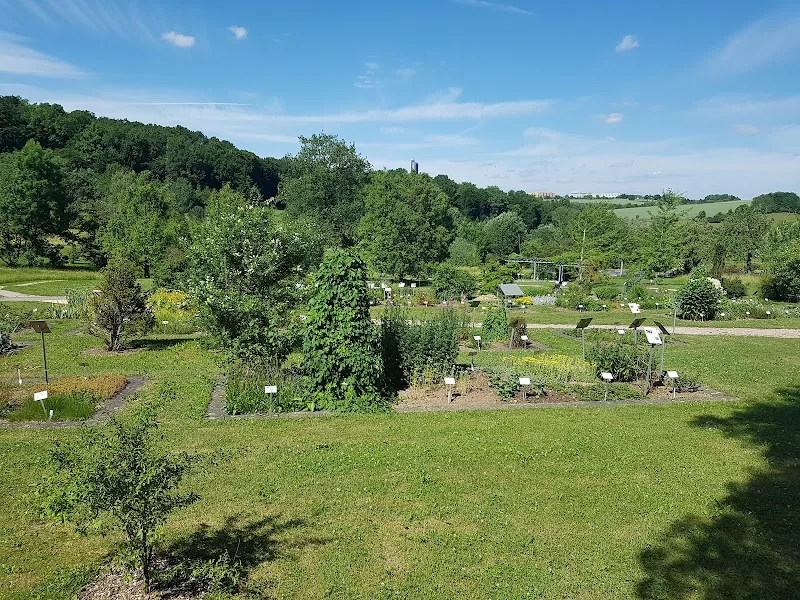
The open-air area is the heart of the Botanical Garden and connects different habitats into a large, walkable learning space. The official open-air page mentions numerous areas: field wild herbs, old Ulm utility plants, cultivation, arboretum, farmer's garden, biological section, flower meadow, three-field farming, fern valley, wet biotopes, utility plants section, pergola, rosarium, traditional orchard, and daylily garden. This thematic diversity makes the garden particularly interesting, as the walk does not feel monotonous but continually opens up new perspectives. The pergola with climbing plants and seating forms a central point, the rosarium is described with about 200 species and varieties of roses, and the nearby farmer's garden showcases well-known utility and ornamental plants. Directly in front lies the section of old Ulm utility plants, while towards the Eselsberg exit, traditional three-field farming and the traditional orchard with old fruit trees set accents. ([uni-ulm.de](https://www.uni-ulm.de/einrichtungen/garten/garten/freiland/))
The open-air area is particularly strong where ecological relationships become visible. The fern valley conveys its own atmosphere with its shady, quiet areas, the wet biotopes show habitats with high structural diversity, and the traditional orchard is, according to the university, an ecologically valuable habitat for numerous animal and plant species. Additionally, the university describes the free access to the garden as frequently used; every year, several tens of thousands of people visit the site, including many who participate in tours or lessons in the Green Classroom. This makes it clear why the Botanical Garden is relevant not only as a destination but also as an educational space: it offers a mix of walking, nature observation, and scientific communication. For people looking for photos, impressions, or initial orientation, these thematic areas are particularly helpful as they explain the garden in clear, recognizable motifs: pergola, roses, meadows, fruit trees, ferns, and utility plants. This is botanical diversity that can be experienced in a single walk. ([uni-ulm.de](https://www.uni-ulm.de/einrichtungen/garten/garten/freiland/))
Guided Tours, Events, and Bat Night
Another reason for the high attractiveness of the Botanical Garden of the University of Ulm is the wide range of events and guided tours. The university emphasizes that the annual program includes numerous public events for individuals as well as guided tours for groups. According to the official page, open-air tours are primarily possible from mid-April to the end of September, and the topics range from tropical diversity to special tours on Christmas spices to natural history walks through various garden areas. In addition, regular program points such as the Botanical Lunch Break, workshops, and offerings for children and teenagers are included. This shows that the garden should not only be perceived seasonally but as a place where knowledge, encounters, and nature experiences come together throughout the year. For search queries related to programs, tours, or calendars, this is a particularly important point, as the university regularly publishes current dates and thus offers a real, ongoing event structure. ([uni-ulm.de](https://www.uni-ulm.de/en/einrichtungen/garten/information/fuehrungen/))
A specific highlight is the Bat Night. The official date page mentions Friday, June 19, 2026, starting at 9:00 PM, lasting two hours, meeting at the greenhouse entrance, costing 6 euros per person, and requiring registration. The tour in the open-air area is organized together with Bat Protection Neu-Ulm. Such formats highlight the special character of the Botanical Garden: it is not only about plants but also about ecological relationships, nightlife in the garden, and nature educational experiences that remain memorable. This is complemented by larger program points such as the summer festival, educational offerings, and the year 2026 focusing on “Wild Diversity in the Garden.” For visitors, this means: those who only see the location as a quiet green space miss its actual added value. The Botanical Garden is a vibrant stage for natural sciences, family experiences, guided tours, and thematic events that continually make the visit interesting. ([uni-ulm.de](https://www.uni-ulm.de/einrichtungen/garten/terminansicht/article/fledermausnacht/))
Sources:
Show moreShow less
Botanical Garden of the University of Ulm | Directions & Parking
The Botanical Garden of the University of Ulm is much more than a green backdrop at the edge of the campus. It connects research, teaching, nature conservation, and recreation in a facility that extends over approximately 28 hectares at the Upper Eselsberg, making it one of the large scientific gardens in Baden-Württemberg. The university describes the garden as a central institution where scientific collections are maintained and further developed in the open air, in greenhouses, and in the herbarium. Therefore, visitors to the garden experience not only plant diversity but also a piece of living university history: The site was developed on a former shooting range, was topographically modeled in 1980, and was founded as a central institution in 1981. Today, the Botanical Garden is a place where education, biodiversity, and relaxed walks naturally connect. Visitors will find natural areas, tropical collections, educational offerings, and a diverse annual program ranging from quiet strolls to special events. ([uni-ulm.de](https://www.uni-ulm.de/einrichtungen/garten/gartenueberblick/geschichte/))
Opening Hours, Admission, and Tickets
For planning a visit, the current opening hours are particularly important, as the Botanical Garden distinguishes between the open-air area and the greenhouses. On the university's homepage, the open-air area is currently indicated as open daily from 9:00 AM to 8:00 PM and free of charge. The greenhouses are accessible according to the current visitor information on Tuesdays and Thursdays from 1:00 PM to 3:00 PM and Sundays from 2:00 PM to 5:00 PM; they are closed on public holidays, with exceptions noted on the website. Those specifically wanting to see the tropical collections should keep an eye on the time slots for the greenhouses, while there is significantly more flexibility for a walk through the open-air area. This clear distinction makes the Botanical Garden Ulm attractive for different visiting occasions: a short walk in the afternoon, a longer family outing on the weekend, or a focused visit as part of a guided tour. ([uni-ulm.de](https://www.uni-ulm.de/einrichtungen/garten/))
The ticketing system is also straightforward. The open-air area is freely accessible and can be visited without an admission fee. For the greenhouses, the university charges an admission fee of 3 euros; at the same time, there is free admission for schoolchildren, students, and members of the Friends of the Botanical Garden Association. This keeps the Botanical Garden attractive for both spontaneous visits and regular return visits. Particularly practical is that the offering is not limited to a single seasonal highlight: The university regularly provides current events, tours, and educational offerings on its page, so a visit can look very different depending on interest. Therefore, those looking for a targeted outing with clear costs will find a clear structure of free garden experience, paid greenhouse visit, and additional program points. ([uni-ulm.de](https://www.uni-ulm.de/einrichtungen/garten/))
Directions and Parking at Hans-Krebs-Weg
The location at the Upper Eselsberg makes the Botanical Garden of the University of Ulm easily accessible by both public transport and car. The university describes the garden as located southeast of the university; for visitors using buses and trams, several routes are possible. The tram line 2 and bus lines 5, 6, 8, and 13 go to the stops Botanical Garden and University South for the greenhouse entrance. The Eselsberg entrance can be reached by tram line 2 and bus lines 5, 6, and 8 to Eselsberg Hasenkopf. For the Lehrer Tal entrance, bus line 49 is intended to stop at Schießstände. This variety is practical as it offers different travel options depending on the starting point in Ulm and makes the garden accessible without the need to search for parking. ([uni-ulm.de](https://www.uni-ulm.de/einrichtungen/garten/information/informationen-fuer-besucher/))
By car, the greenhouse entrance is particularly relevant. The university recommends the East parking garage on Helmholtzstraße, which is subject to fees. The directions lead from the B10 exit University through the large intersection, then left and at the roundabout take the third exit into Helmholtzstraße; the East parking garage is on the left side. At the same time, the university points out that since the introduction of parking management on campus, no free parking spaces are available. An important exception is the Lehrer Tal entrance: there is a free parking lot available. For navigation and orientation, the address Hans-Krebs-Weg or the area around the Helmholtzstraße Uni Ulm parking garage is helpful. Therefore, those planning a relaxed visit should decide early whether the paid but very close option at the East parking garage or the free parking lot at Lehrer Tal is more suitable. ([uni-ulm.de](https://www.uni-ulm.de/einrichtungen/garten/information/informationen-fuer-besucher/))
Greenhouses and Tropical Collections
The greenhouses are among the most exciting parts of the Botanical Garden and demonstrate how strongly the location is oriented as a scientific and educational institution. In the houses, a variety of important utility and medicinal plants, epiphytes, ferns, African violets, and pineapple plants are cultivated for students and visitors. The collections are supplemented by research trips and plant exchanges with other gardens, ensuring that the inventory is continuously expanded. This lively character makes the greenhouses so valuable: they are not merely an exhibition but a place where botanical diversity, research, and illustrative communication directly meet. The university also describes that tropical plants make up a large share of global flowering plant diversity and that the fascination of the rainforest can be experienced in the greenhouses. This is particularly attractive for groups, school classes, and nature-interested visitors who want to understand plants not just visually but in context. ([uni-ulm.de](https://www.uni-ulm.de/einrichtungen/garten/garten/gewaechshaeuser/))
The guided tours in the greenhouses deepen this experience with topics ranging from tropical rainforests to spice plants to prehistoric landscapes. The university offers tours such as “Colorful Diversity of the Tropics,” “In a Forest Before Our Time,” and seasonal themed walks. Notable plants such as bird of paradise, banana plants, Ceylon cinnamon, jade vine, or various strangler figs are explained, as well as economically important species such as cocoa, vanilla, or rubber trees. Therefore, those visiting the greenhouses experience a mix of illustrative teaching and sensory discovery. This is an important SEO and informational point, as many search queries related to the Botanical Garden specifically target this type of experience: What is there to see, how does a tour proceed, and why is the visit worthwhile even in bad weather? The official page provides a clear answer: The greenhouses are a compact but content-rich window into tropical habitats. ([uni-ulm.de](https://www.uni-ulm.de/en/einrichtungen/garten/information/fuehrungen/))
Open Air, Rosarium, and Thematic Garden Areas
The open-air area is the heart of the Botanical Garden and connects different habitats into a large, walkable learning space. The official open-air page mentions numerous areas: field wild herbs, old Ulm utility plants, cultivation, arboretum, farmer's garden, biological section, flower meadow, three-field farming, fern valley, wet biotopes, utility plants section, pergola, rosarium, traditional orchard, and daylily garden. This thematic diversity makes the garden particularly interesting, as the walk does not feel monotonous but continually opens up new perspectives. The pergola with climbing plants and seating forms a central point, the rosarium is described with about 200 species and varieties of roses, and the nearby farmer's garden showcases well-known utility and ornamental plants. Directly in front lies the section of old Ulm utility plants, while towards the Eselsberg exit, traditional three-field farming and the traditional orchard with old fruit trees set accents. ([uni-ulm.de](https://www.uni-ulm.de/einrichtungen/garten/garten/freiland/))
The open-air area is particularly strong where ecological relationships become visible. The fern valley conveys its own atmosphere with its shady, quiet areas, the wet biotopes show habitats with high structural diversity, and the traditional orchard is, according to the university, an ecologically valuable habitat for numerous animal and plant species. Additionally, the university describes the free access to the garden as frequently used; every year, several tens of thousands of people visit the site, including many who participate in tours or lessons in the Green Classroom. This makes it clear why the Botanical Garden is relevant not only as a destination but also as an educational space: it offers a mix of walking, nature observation, and scientific communication. For people looking for photos, impressions, or initial orientation, these thematic areas are particularly helpful as they explain the garden in clear, recognizable motifs: pergola, roses, meadows, fruit trees, ferns, and utility plants. This is botanical diversity that can be experienced in a single walk. ([uni-ulm.de](https://www.uni-ulm.de/einrichtungen/garten/garten/freiland/))
Guided Tours, Events, and Bat Night
Another reason for the high attractiveness of the Botanical Garden of the University of Ulm is the wide range of events and guided tours. The university emphasizes that the annual program includes numerous public events for individuals as well as guided tours for groups. According to the official page, open-air tours are primarily possible from mid-April to the end of September, and the topics range from tropical diversity to special tours on Christmas spices to natural history walks through various garden areas. In addition, regular program points such as the Botanical Lunch Break, workshops, and offerings for children and teenagers are included. This shows that the garden should not only be perceived seasonally but as a place where knowledge, encounters, and nature experiences come together throughout the year. For search queries related to programs, tours, or calendars, this is a particularly important point, as the university regularly publishes current dates and thus offers a real, ongoing event structure. ([uni-ulm.de](https://www.uni-ulm.de/en/einrichtungen/garten/information/fuehrungen/))
A specific highlight is the Bat Night. The official date page mentions Friday, June 19, 2026, starting at 9:00 PM, lasting two hours, meeting at the greenhouse entrance, costing 6 euros per person, and requiring registration. The tour in the open-air area is organized together with Bat Protection Neu-Ulm. Such formats highlight the special character of the Botanical Garden: it is not only about plants but also about ecological relationships, nightlife in the garden, and nature educational experiences that remain memorable. This is complemented by larger program points such as the summer festival, educational offerings, and the year 2026 focusing on “Wild Diversity in the Garden.” For visitors, this means: those who only see the location as a quiet green space miss its actual added value. The Botanical Garden is a vibrant stage for natural sciences, family experiences, guided tours, and thematic events that continually make the visit interesting. ([uni-ulm.de](https://www.uni-ulm.de/einrichtungen/garten/terminansicht/article/fledermausnacht/))
Sources:
Botanical Garden of the University of Ulm | Directions & Parking
The Botanical Garden of the University of Ulm is much more than a green backdrop at the edge of the campus. It connects research, teaching, nature conservation, and recreation in a facility that extends over approximately 28 hectares at the Upper Eselsberg, making it one of the large scientific gardens in Baden-Württemberg. The university describes the garden as a central institution where scientific collections are maintained and further developed in the open air, in greenhouses, and in the herbarium. Therefore, visitors to the garden experience not only plant diversity but also a piece of living university history: The site was developed on a former shooting range, was topographically modeled in 1980, and was founded as a central institution in 1981. Today, the Botanical Garden is a place where education, biodiversity, and relaxed walks naturally connect. Visitors will find natural areas, tropical collections, educational offerings, and a diverse annual program ranging from quiet strolls to special events. ([uni-ulm.de](https://www.uni-ulm.de/einrichtungen/garten/gartenueberblick/geschichte/))
Opening Hours, Admission, and Tickets
For planning a visit, the current opening hours are particularly important, as the Botanical Garden distinguishes between the open-air area and the greenhouses. On the university's homepage, the open-air area is currently indicated as open daily from 9:00 AM to 8:00 PM and free of charge. The greenhouses are accessible according to the current visitor information on Tuesdays and Thursdays from 1:00 PM to 3:00 PM and Sundays from 2:00 PM to 5:00 PM; they are closed on public holidays, with exceptions noted on the website. Those specifically wanting to see the tropical collections should keep an eye on the time slots for the greenhouses, while there is significantly more flexibility for a walk through the open-air area. This clear distinction makes the Botanical Garden Ulm attractive for different visiting occasions: a short walk in the afternoon, a longer family outing on the weekend, or a focused visit as part of a guided tour. ([uni-ulm.de](https://www.uni-ulm.de/einrichtungen/garten/))
The ticketing system is also straightforward. The open-air area is freely accessible and can be visited without an admission fee. For the greenhouses, the university charges an admission fee of 3 euros; at the same time, there is free admission for schoolchildren, students, and members of the Friends of the Botanical Garden Association. This keeps the Botanical Garden attractive for both spontaneous visits and regular return visits. Particularly practical is that the offering is not limited to a single seasonal highlight: The university regularly provides current events, tours, and educational offerings on its page, so a visit can look very different depending on interest. Therefore, those looking for a targeted outing with clear costs will find a clear structure of free garden experience, paid greenhouse visit, and additional program points. ([uni-ulm.de](https://www.uni-ulm.de/einrichtungen/garten/))
Directions and Parking at Hans-Krebs-Weg
The location at the Upper Eselsberg makes the Botanical Garden of the University of Ulm easily accessible by both public transport and car. The university describes the garden as located southeast of the university; for visitors using buses and trams, several routes are possible. The tram line 2 and bus lines 5, 6, 8, and 13 go to the stops Botanical Garden and University South for the greenhouse entrance. The Eselsberg entrance can be reached by tram line 2 and bus lines 5, 6, and 8 to Eselsberg Hasenkopf. For the Lehrer Tal entrance, bus line 49 is intended to stop at Schießstände. This variety is practical as it offers different travel options depending on the starting point in Ulm and makes the garden accessible without the need to search for parking. ([uni-ulm.de](https://www.uni-ulm.de/einrichtungen/garten/information/informationen-fuer-besucher/))
By car, the greenhouse entrance is particularly relevant. The university recommends the East parking garage on Helmholtzstraße, which is subject to fees. The directions lead from the B10 exit University through the large intersection, then left and at the roundabout take the third exit into Helmholtzstraße; the East parking garage is on the left side. At the same time, the university points out that since the introduction of parking management on campus, no free parking spaces are available. An important exception is the Lehrer Tal entrance: there is a free parking lot available. For navigation and orientation, the address Hans-Krebs-Weg or the area around the Helmholtzstraße Uni Ulm parking garage is helpful. Therefore, those planning a relaxed visit should decide early whether the paid but very close option at the East parking garage or the free parking lot at Lehrer Tal is more suitable. ([uni-ulm.de](https://www.uni-ulm.de/einrichtungen/garten/information/informationen-fuer-besucher/))
Greenhouses and Tropical Collections
The greenhouses are among the most exciting parts of the Botanical Garden and demonstrate how strongly the location is oriented as a scientific and educational institution. In the houses, a variety of important utility and medicinal plants, epiphytes, ferns, African violets, and pineapple plants are cultivated for students and visitors. The collections are supplemented by research trips and plant exchanges with other gardens, ensuring that the inventory is continuously expanded. This lively character makes the greenhouses so valuable: they are not merely an exhibition but a place where botanical diversity, research, and illustrative communication directly meet. The university also describes that tropical plants make up a large share of global flowering plant diversity and that the fascination of the rainforest can be experienced in the greenhouses. This is particularly attractive for groups, school classes, and nature-interested visitors who want to understand plants not just visually but in context. ([uni-ulm.de](https://www.uni-ulm.de/einrichtungen/garten/garten/gewaechshaeuser/))
The guided tours in the greenhouses deepen this experience with topics ranging from tropical rainforests to spice plants to prehistoric landscapes. The university offers tours such as “Colorful Diversity of the Tropics,” “In a Forest Before Our Time,” and seasonal themed walks. Notable plants such as bird of paradise, banana plants, Ceylon cinnamon, jade vine, or various strangler figs are explained, as well as economically important species such as cocoa, vanilla, or rubber trees. Therefore, those visiting the greenhouses experience a mix of illustrative teaching and sensory discovery. This is an important SEO and informational point, as many search queries related to the Botanical Garden specifically target this type of experience: What is there to see, how does a tour proceed, and why is the visit worthwhile even in bad weather? The official page provides a clear answer: The greenhouses are a compact but content-rich window into tropical habitats. ([uni-ulm.de](https://www.uni-ulm.de/en/einrichtungen/garten/information/fuehrungen/))
Open Air, Rosarium, and Thematic Garden Areas
The open-air area is the heart of the Botanical Garden and connects different habitats into a large, walkable learning space. The official open-air page mentions numerous areas: field wild herbs, old Ulm utility plants, cultivation, arboretum, farmer's garden, biological section, flower meadow, three-field farming, fern valley, wet biotopes, utility plants section, pergola, rosarium, traditional orchard, and daylily garden. This thematic diversity makes the garden particularly interesting, as the walk does not feel monotonous but continually opens up new perspectives. The pergola with climbing plants and seating forms a central point, the rosarium is described with about 200 species and varieties of roses, and the nearby farmer's garden showcases well-known utility and ornamental plants. Directly in front lies the section of old Ulm utility plants, while towards the Eselsberg exit, traditional three-field farming and the traditional orchard with old fruit trees set accents. ([uni-ulm.de](https://www.uni-ulm.de/einrichtungen/garten/garten/freiland/))
The open-air area is particularly strong where ecological relationships become visible. The fern valley conveys its own atmosphere with its shady, quiet areas, the wet biotopes show habitats with high structural diversity, and the traditional orchard is, according to the university, an ecologically valuable habitat for numerous animal and plant species. Additionally, the university describes the free access to the garden as frequently used; every year, several tens of thousands of people visit the site, including many who participate in tours or lessons in the Green Classroom. This makes it clear why the Botanical Garden is relevant not only as a destination but also as an educational space: it offers a mix of walking, nature observation, and scientific communication. For people looking for photos, impressions, or initial orientation, these thematic areas are particularly helpful as they explain the garden in clear, recognizable motifs: pergola, roses, meadows, fruit trees, ferns, and utility plants. This is botanical diversity that can be experienced in a single walk. ([uni-ulm.de](https://www.uni-ulm.de/einrichtungen/garten/garten/freiland/))
Guided Tours, Events, and Bat Night
Another reason for the high attractiveness of the Botanical Garden of the University of Ulm is the wide range of events and guided tours. The university emphasizes that the annual program includes numerous public events for individuals as well as guided tours for groups. According to the official page, open-air tours are primarily possible from mid-April to the end of September, and the topics range from tropical diversity to special tours on Christmas spices to natural history walks through various garden areas. In addition, regular program points such as the Botanical Lunch Break, workshops, and offerings for children and teenagers are included. This shows that the garden should not only be perceived seasonally but as a place where knowledge, encounters, and nature experiences come together throughout the year. For search queries related to programs, tours, or calendars, this is a particularly important point, as the university regularly publishes current dates and thus offers a real, ongoing event structure. ([uni-ulm.de](https://www.uni-ulm.de/en/einrichtungen/garten/information/fuehrungen/))
A specific highlight is the Bat Night. The official date page mentions Friday, June 19, 2026, starting at 9:00 PM, lasting two hours, meeting at the greenhouse entrance, costing 6 euros per person, and requiring registration. The tour in the open-air area is organized together with Bat Protection Neu-Ulm. Such formats highlight the special character of the Botanical Garden: it is not only about plants but also about ecological relationships, nightlife in the garden, and nature educational experiences that remain memorable. This is complemented by larger program points such as the summer festival, educational offerings, and the year 2026 focusing on “Wild Diversity in the Garden.” For visitors, this means: those who only see the location as a quiet green space miss its actual added value. The Botanical Garden is a vibrant stage for natural sciences, family experiences, guided tours, and thematic events that continually make the visit interesting. ([uni-ulm.de](https://www.uni-ulm.de/einrichtungen/garten/terminansicht/article/fledermausnacht/))
Sources:
Upcoming Events
No events found
Frequently Asked Questions
Reviews
Subha Jana
14. July 2025
Amazing place! There are various sections in the park such as, rosary, bonsai etc. The park is not flat and kind of has a hilly vibe, thus the view from some places are amazing. Near the rosary there is a cute place to picnic or relax.
Expat Properties Mumbai
2. November 2021
Wilderbliss at its best. Innumerable visits to paradise, photos attached are indicative to the love affair I have with nature. 26 hectares of greenery with an assortment of wicked plants/flowers & trees. A Must visit for those who like to commune with nature.
Luis Lopez Videla G.
30. September 2025
Really nice place to take a walk and relax, lots of different types of plants, flowers and trees which they are all labeled. You can tell this garden is really taken care of.
Piter Pan
14. June 2025
A nice large virtually virgin forest. A little advice: don't go to the east entrance, from lerher-tal street. Take tram #2 and go to Botanishe Garten stop, just after Universitat Sud. Follow the signs and enter the garten from the West. This way you will be going DOWN through the park, not UP, much easier. Unless you want to exercise, of course.
Anton Ivanov
24. April 2021
Touch in the huge variety of flora in Ulm's Botanical Garden...