
Ulm
Schloßstraße 38, 89079 Ulm, Deutschland
Basilica St. Martin Ulm | History & Access
The Basilica St. Martin in Ulm-Wiblingen is much more than a beautiful church space. It belongs to the Wiblingen Monastery, which is now perceived as a monumental monastery with a magnificent library hall, significant history, and a high cultural rank. Visitors to the basilica experience a place where pilgrimage tradition, baroque architecture, early classicist design, and vibrant church music impressively overlap. For this reason, the basilica is interesting for people looking for history, atmosphere, photo opportunities, quiet moments, or a special destination in Ulm. It is a house of worship with a pronounced identity, an art-historically significant sight, and a place where the past remains visible and tangible to this day. ([kloster-wiblingen.de](https://www.kloster-wiblingen.de/?utm_source=openai))
The History of the Basilica St. Martin and the Wiblingen Cross Relic
The history of the basilica does not begin with the baroque reconstruction, but with the founding of the monastery in 1093. For over 900 years, a precious cross relic has been venerated in Wiblingen, which is said to consist of several larger pieces of wood from the cross of Jesus. According to the official information from the pastoral care unit, this cross relic is the most significant treasure of the monastery church. Since the founding of the monastery, it has been closely associated with the identity of the place, as the iconography of the church is still strongly influenced by the theme of the cross. The relic was attributed to the founding lords, the Counts of Kirchberg, and handed over to the first abbot, Werner von Ellerbach. It is framed in the form of a patriarchal cross and is still kept in the Mount of Olives altar today. ([ulm-basilika.de](https://www.ulm-basilika.de/seelsorgeeinheit/kirchenkapellen/basilika-st-martin/))
The veneration of the cross relic not only shapes the religious significance of the basilica but also the visitor experience. According to the official representation, the cross relic is the destination for numerous pilgrims to this day, and the Feast of the Exaltation of the Holy Cross holds great importance in Wiblingen. This shows that the basilica is not merely a monument from a bygone era, but a place where faith, history, and lived tradition intertwine. In the 18th century, this long history took on its baroque form: in 1714, the medieval monastery complex was expanded into a baroque ensemble, in 1772, the construction of the monastery church began with the laying of the foundation stone, and in 1783, the church was solemnly consecrated. This historical arc from medieval relic veneration to the late baroque monastery church makes St. Martin one of the most exciting church locations in the Ulm area. ([ulm-basilika.de](https://www.ulm-basilika.de/seelsorgeeinheit/kirchenkapellen/basilika-st-martin/))
Architecture, Spatial Effect, and the Great Baroque Monastery Church
The Basilica St. Martin impresses with its clear, generous spatial effect. The official visitor information describes the monastery church as a massive and clear creation of late baroque architecture with monumental dimensions of 72 meters in length and 27 meters in width. At the same time, it is emphasized that the roof structure, begun in 1774, represents a technical masterpiece of baroque carpentry, as it spans the entire church space. The roof, the proportions, and the brightness of the interior make clear why the basilica is also so attractive to architecture-interested visitors. Upon entering the space, one does not experience cramped sacred architecture, but rather a wide, bright church space designed for overview, tranquility, and impact. ([schloesser-und-gaerten.de](https://www.schloesser-und-gaerten.de/fileadmin/Broschueren/monumentflyer_2025-26_deutsch/ssg_kloster-wiblingen_monumentbroschuere-D_2025.pdf))
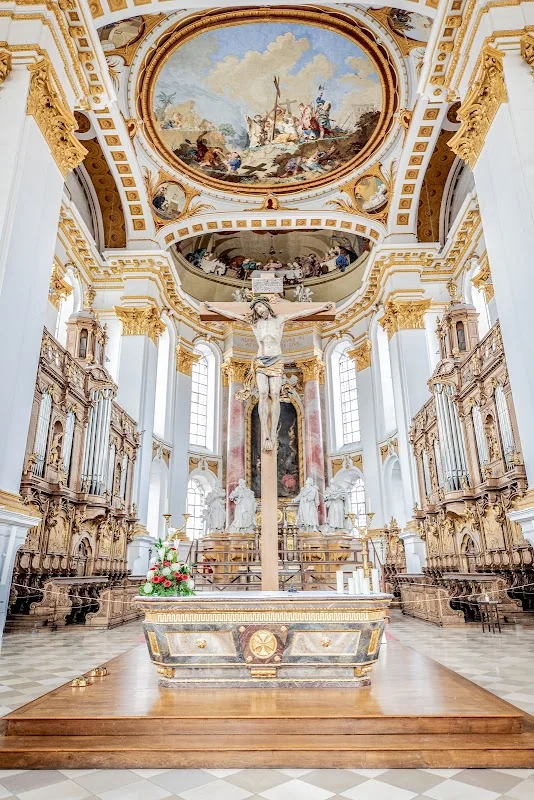
Januarius Zick was responsible for the artistic design of the interior, shaping the house of worship in a style between late baroque and early classicism. The official representation emphasizes that the color scheme of white and gold creates a cool and elegant atmosphere inside. Particularly significant are the ceiling frescoes in bright colors, described as some of the most beautiful frescoes in southern Germany at the end of the 18th century. The ornamentation also points to the French braid style and ancient templates; geometric forms and a well-thought-out overall concept shape the impression. Thus, St. Martin is not only a religious site but also an art-historical document of the transition from late baroque to early classicism. This mixture of spaciousness, light, gold, white clarity, and carefully composed decoration is what gives the interior its special charm. ([schloesser-und-gaerten.de](https://www.schloesser-und-gaerten.de/presse/pressemeldungen/pressemeldung-detailansicht/6648/2023/september/18))
Opening Hours, Admission, and On-Site Visits
The official visitor information of the Wiblingen Monastery is particularly helpful for planning a visit. It describes the Basilica St. Martin as open year-round; visits are possible with and without a guided tour. At the same time, the website recommends checking the current opening and closing times before the visit, as offerings and times may change. For visitors, this means: The basilica is generally well accessible, but a quick look at the current website before traveling remains sensible. Those who want to experience the place in a relaxed manner can combine the visit with a tour of the rest of the monastery, thus combining the sacred area with the museum and library hall. ([schloesser-und-gaerten.de](https://www.schloesser-und-gaerten.de/fileadmin/Broschueren/monumentflyer_2025-26_deutsch/ssg_kloster-wiblingen_monumentbroschuere-D_2025.pdf))
Another important point is admission. Admission to the Basilica St. Martin itself is free. This is remarkable for such a significant church and cultural site and makes the visit particularly accessible. However, regular admission prices apply to the library hall and museum in the convent building; the official press information mentions adult rates, discounts, and family prices. The museum in the convent building presents the history of the abbey with a focus on the secular aspects of monastic rule and monastic economy. Therefore, those who want to not only see the church but also understand the entire monastic world should meaningfully extend their visit. This creates a coherent overall picture of sacred space, order history, art, and everyday culture. ([schloesser-und-gaerten.de](https://www.schloesser-und-gaerten.de/presse/pressemeldungen/pressemeldung-detailansicht/6648/2023/september/18))
Access, Parking, and the Best Connection to Ulm-Wiblingen
Getting to the Basilica St. Martin is relatively uncomplicated. Officially, it is stated that one takes public transport from the Ehinger Tor stop with line 4 to Kloster Wiblingen. According to a press release, it is about a four-minute walk from the Pranger stop to the monastery. This makes the basilica easily accessible for a spontaneous half-day trip, even if one is traveling without a car. Those arriving from the center of Ulm can conveniently switch between the city center and Wiblingen and plan the visit as a calm contrast to the urban hustle and bustle. ([kloster-wiblingen.de](https://www.kloster-wiblingen.de/besuchsinformation/anfahrt/?utm_source=openai))
There are also good conditions for drivers and travel groups. According to the official access page, there are 100 public, free parking spaces for cars and three public, free parking spaces for buses or motorhomes within walking distance. Additionally, the official visitor information points out the good accessibility in the vicinity of the monastery and its location at Schlossstraße 38 in Ulm-Wiblingen. Those arriving by bicycle also benefit from nearby routes along the Iller; the state castles and gardens highlight the Iller bike path in their excursion information. Thus, the basilica is suitable not only for the classic church visit but also as a destination for a bike tour, a walk, or a day trip with a cultural focus. ([kloster-wiblingen.de](https://www.kloster-wiblingen.de/besuchsinformation/anfahrt/?utm_source=openai))
Organ, Church Music, and Concerts in the Basilica
A key reason to visit the Basilica St. Martin is its musical significance. The pastoral care unit Ulm-Basilica makes it clear that church music has a far-reaching impact in the region with the construction of the new Winterhalter main organ in 2021. The official site also hosts a regional cantor, and the organ support association supports these activities. Music is therefore not only part of the services but is an independent cultural focus of the place. Those who want to experience the basilica not only as a quiet space but also as a sound space will find a lively access to church music here. ([ulm-basilika.de](https://www.ulm-basilika.de/?utm_source=openai))
The official organ documentation states that the main organ was built by Winterhalter, completed in 2021, has 54 registers, and includes three manuals and a pedal. This is a notable detail for a church space of this significance, as the organ connects historical architecture with contemporary sound practice. Although the basilica is not a classic multipurpose hall, concerts and church music formats regularly take place in its vicinity; the website of the pastoral care unit features a dedicated section for concerts. In connection with services on major feasts, solemn liturgical occasions, and the special holidays of the church year, a versatile musical profile emerges. Therefore, visitors to the basilica should not only pay attention to frescoes and architecture but also consider the acoustics and the lively musical use. ([ulm-basilika.de](https://www.ulm-basilika.de/wp-content/uploads/2024/08/Hauptorgel-Basilika-Sankt-Martin.pdf))
Photos, Digital Church Guide, and Special Motifs for the Visit
The Basilica St. Martin is also interesting for people looking for beautiful motifs and a well-documented sight. The official information pages of the Wiblingen Monastery explicitly mention that photography for private purposes is generally permitted in the museum, library hall, and monastery church, as long as it is for personal use. This makes the visit planable for all who wish to capture their impressions. At the same time, the basilica is a place where one photographs with respect and tranquility; this fits the atmosphere of the space and the religious significance of the site. Therefore, those searching for images will find not only exterior views but also strong interior motifs with bright spatial effects, altar cross, and wide views. ([kloster-wiblingen.de](https://www.kloster-wiblingen.de/besuchsinformation/hinweise/?utm_source=openai))
Additionally, the digital church guide is particularly helpful. The pastoral care unit refers to a digital tour of the basilica and another digital church guide that complements the visit. This is especially practical if one wants to orient oneself in advance or if one wants to understand individual details better during the tour. Among the most important motifs is, of course, the Wiblingen cross relic, which today lies for veneration in the Mount of Olives altar on the left side of the nave. Thus, those who view the basilica calmly experience not only a beautiful church space but a coherent cultural-historical narrative of relic veneration, early classicist design, baroque monumentality, and modern use. This is precisely where the special strength of St. Martin in Ulm-Wiblingen lies: The place is simultaneously impressive, accessible, and deeply rooted in its history. ([ulm-basilika.de](https://www.ulm-basilika.de/seelsorgeeinheit/kirchenkapellen/basilika-st-martin/))
Sources:
Mehr anzeigenWeniger anzeigen
Basilica St. Martin Ulm | History & Access
The Basilica St. Martin in Ulm-Wiblingen is much more than a beautiful church space. It belongs to the Wiblingen Monastery, which is now perceived as a monumental monastery with a magnificent library hall, significant history, and a high cultural rank. Visitors to the basilica experience a place where pilgrimage tradition, baroque architecture, early classicist design, and vibrant church music impressively overlap. For this reason, the basilica is interesting for people looking for history, atmosphere, photo opportunities, quiet moments, or a special destination in Ulm. It is a house of worship with a pronounced identity, an art-historically significant sight, and a place where the past remains visible and tangible to this day. ([kloster-wiblingen.de](https://www.kloster-wiblingen.de/?utm_source=openai))
The History of the Basilica St. Martin and the Wiblingen Cross Relic
The history of the basilica does not begin with the baroque reconstruction, but with the founding of the monastery in 1093. For over 900 years, a precious cross relic has been venerated in Wiblingen, which is said to consist of several larger pieces of wood from the cross of Jesus. According to the official information from the pastoral care unit, this cross relic is the most significant treasure of the monastery church. Since the founding of the monastery, it has been closely associated with the identity of the place, as the iconography of the church is still strongly influenced by the theme of the cross. The relic was attributed to the founding lords, the Counts of Kirchberg, and handed over to the first abbot, Werner von Ellerbach. It is framed in the form of a patriarchal cross and is still kept in the Mount of Olives altar today. ([ulm-basilika.de](https://www.ulm-basilika.de/seelsorgeeinheit/kirchenkapellen/basilika-st-martin/))
The veneration of the cross relic not only shapes the religious significance of the basilica but also the visitor experience. According to the official representation, the cross relic is the destination for numerous pilgrims to this day, and the Feast of the Exaltation of the Holy Cross holds great importance in Wiblingen. This shows that the basilica is not merely a monument from a bygone era, but a place where faith, history, and lived tradition intertwine. In the 18th century, this long history took on its baroque form: in 1714, the medieval monastery complex was expanded into a baroque ensemble, in 1772, the construction of the monastery church began with the laying of the foundation stone, and in 1783, the church was solemnly consecrated. This historical arc from medieval relic veneration to the late baroque monastery church makes St. Martin one of the most exciting church locations in the Ulm area. ([ulm-basilika.de](https://www.ulm-basilika.de/seelsorgeeinheit/kirchenkapellen/basilika-st-martin/))
Architecture, Spatial Effect, and the Great Baroque Monastery Church
The Basilica St. Martin impresses with its clear, generous spatial effect. The official visitor information describes the monastery church as a massive and clear creation of late baroque architecture with monumental dimensions of 72 meters in length and 27 meters in width. At the same time, it is emphasized that the roof structure, begun in 1774, represents a technical masterpiece of baroque carpentry, as it spans the entire church space. The roof, the proportions, and the brightness of the interior make clear why the basilica is also so attractive to architecture-interested visitors. Upon entering the space, one does not experience cramped sacred architecture, but rather a wide, bright church space designed for overview, tranquility, and impact. ([schloesser-und-gaerten.de](https://www.schloesser-und-gaerten.de/fileadmin/Broschueren/monumentflyer_2025-26_deutsch/ssg_kloster-wiblingen_monumentbroschuere-D_2025.pdf))
Januarius Zick was responsible for the artistic design of the interior, shaping the house of worship in a style between late baroque and early classicism. The official representation emphasizes that the color scheme of white and gold creates a cool and elegant atmosphere inside. Particularly significant are the ceiling frescoes in bright colors, described as some of the most beautiful frescoes in southern Germany at the end of the 18th century. The ornamentation also points to the French braid style and ancient templates; geometric forms and a well-thought-out overall concept shape the impression. Thus, St. Martin is not only a religious site but also an art-historical document of the transition from late baroque to early classicism. This mixture of spaciousness, light, gold, white clarity, and carefully composed decoration is what gives the interior its special charm. ([schloesser-und-gaerten.de](https://www.schloesser-und-gaerten.de/presse/pressemeldungen/pressemeldung-detailansicht/6648/2023/september/18))
Opening Hours, Admission, and On-Site Visits
The official visitor information of the Wiblingen Monastery is particularly helpful for planning a visit. It describes the Basilica St. Martin as open year-round; visits are possible with and without a guided tour. At the same time, the website recommends checking the current opening and closing times before the visit, as offerings and times may change. For visitors, this means: The basilica is generally well accessible, but a quick look at the current website before traveling remains sensible. Those who want to experience the place in a relaxed manner can combine the visit with a tour of the rest of the monastery, thus combining the sacred area with the museum and library hall. ([schloesser-und-gaerten.de](https://www.schloesser-und-gaerten.de/fileadmin/Broschueren/monumentflyer_2025-26_deutsch/ssg_kloster-wiblingen_monumentbroschuere-D_2025.pdf))
Another important point is admission. Admission to the Basilica St. Martin itself is free. This is remarkable for such a significant church and cultural site and makes the visit particularly accessible. However, regular admission prices apply to the library hall and museum in the convent building; the official press information mentions adult rates, discounts, and family prices. The museum in the convent building presents the history of the abbey with a focus on the secular aspects of monastic rule and monastic economy. Therefore, those who want to not only see the church but also understand the entire monastic world should meaningfully extend their visit. This creates a coherent overall picture of sacred space, order history, art, and everyday culture. ([schloesser-und-gaerten.de](https://www.schloesser-und-gaerten.de/presse/pressemeldungen/pressemeldung-detailansicht/6648/2023/september/18))
Access, Parking, and the Best Connection to Ulm-Wiblingen
Getting to the Basilica St. Martin is relatively uncomplicated. Officially, it is stated that one takes public transport from the Ehinger Tor stop with line 4 to Kloster Wiblingen. According to a press release, it is about a four-minute walk from the Pranger stop to the monastery. This makes the basilica easily accessible for a spontaneous half-day trip, even if one is traveling without a car. Those arriving from the center of Ulm can conveniently switch between the city center and Wiblingen and plan the visit as a calm contrast to the urban hustle and bustle. ([kloster-wiblingen.de](https://www.kloster-wiblingen.de/besuchsinformation/anfahrt/?utm_source=openai))
There are also good conditions for drivers and travel groups. According to the official access page, there are 100 public, free parking spaces for cars and three public, free parking spaces for buses or motorhomes within walking distance. Additionally, the official visitor information points out the good accessibility in the vicinity of the monastery and its location at Schlossstraße 38 in Ulm-Wiblingen. Those arriving by bicycle also benefit from nearby routes along the Iller; the state castles and gardens highlight the Iller bike path in their excursion information. Thus, the basilica is suitable not only for the classic church visit but also as a destination for a bike tour, a walk, or a day trip with a cultural focus. ([kloster-wiblingen.de](https://www.kloster-wiblingen.de/besuchsinformation/anfahrt/?utm_source=openai))
Organ, Church Music, and Concerts in the Basilica
A key reason to visit the Basilica St. Martin is its musical significance. The pastoral care unit Ulm-Basilica makes it clear that church music has a far-reaching impact in the region with the construction of the new Winterhalter main organ in 2021. The official site also hosts a regional cantor, and the organ support association supports these activities. Music is therefore not only part of the services but is an independent cultural focus of the place. Those who want to experience the basilica not only as a quiet space but also as a sound space will find a lively access to church music here. ([ulm-basilika.de](https://www.ulm-basilika.de/?utm_source=openai))
The official organ documentation states that the main organ was built by Winterhalter, completed in 2021, has 54 registers, and includes three manuals and a pedal. This is a notable detail for a church space of this significance, as the organ connects historical architecture with contemporary sound practice. Although the basilica is not a classic multipurpose hall, concerts and church music formats regularly take place in its vicinity; the website of the pastoral care unit features a dedicated section for concerts. In connection with services on major feasts, solemn liturgical occasions, and the special holidays of the church year, a versatile musical profile emerges. Therefore, visitors to the basilica should not only pay attention to frescoes and architecture but also consider the acoustics and the lively musical use. ([ulm-basilika.de](https://www.ulm-basilika.de/wp-content/uploads/2024/08/Hauptorgel-Basilika-Sankt-Martin.pdf))
Photos, Digital Church Guide, and Special Motifs for the Visit
The Basilica St. Martin is also interesting for people looking for beautiful motifs and a well-documented sight. The official information pages of the Wiblingen Monastery explicitly mention that photography for private purposes is generally permitted in the museum, library hall, and monastery church, as long as it is for personal use. This makes the visit planable for all who wish to capture their impressions. At the same time, the basilica is a place where one photographs with respect and tranquility; this fits the atmosphere of the space and the religious significance of the site. Therefore, those searching for images will find not only exterior views but also strong interior motifs with bright spatial effects, altar cross, and wide views. ([kloster-wiblingen.de](https://www.kloster-wiblingen.de/besuchsinformation/hinweise/?utm_source=openai))
Additionally, the digital church guide is particularly helpful. The pastoral care unit refers to a digital tour of the basilica and another digital church guide that complements the visit. This is especially practical if one wants to orient oneself in advance or if one wants to understand individual details better during the tour. Among the most important motifs is, of course, the Wiblingen cross relic, which today lies for veneration in the Mount of Olives altar on the left side of the nave. Thus, those who view the basilica calmly experience not only a beautiful church space but a coherent cultural-historical narrative of relic veneration, early classicist design, baroque monumentality, and modern use. This is precisely where the special strength of St. Martin in Ulm-Wiblingen lies: The place is simultaneously impressive, accessible, and deeply rooted in its history. ([ulm-basilika.de](https://www.ulm-basilika.de/seelsorgeeinheit/kirchenkapellen/basilika-st-martin/))
Sources:
Basilica St. Martin Ulm | History & Access
The Basilica St. Martin in Ulm-Wiblingen is much more than a beautiful church space. It belongs to the Wiblingen Monastery, which is now perceived as a monumental monastery with a magnificent library hall, significant history, and a high cultural rank. Visitors to the basilica experience a place where pilgrimage tradition, baroque architecture, early classicist design, and vibrant church music impressively overlap. For this reason, the basilica is interesting for people looking for history, atmosphere, photo opportunities, quiet moments, or a special destination in Ulm. It is a house of worship with a pronounced identity, an art-historically significant sight, and a place where the past remains visible and tangible to this day. ([kloster-wiblingen.de](https://www.kloster-wiblingen.de/?utm_source=openai))
The History of the Basilica St. Martin and the Wiblingen Cross Relic
The history of the basilica does not begin with the baroque reconstruction, but with the founding of the monastery in 1093. For over 900 years, a precious cross relic has been venerated in Wiblingen, which is said to consist of several larger pieces of wood from the cross of Jesus. According to the official information from the pastoral care unit, this cross relic is the most significant treasure of the monastery church. Since the founding of the monastery, it has been closely associated with the identity of the place, as the iconography of the church is still strongly influenced by the theme of the cross. The relic was attributed to the founding lords, the Counts of Kirchberg, and handed over to the first abbot, Werner von Ellerbach. It is framed in the form of a patriarchal cross and is still kept in the Mount of Olives altar today. ([ulm-basilika.de](https://www.ulm-basilika.de/seelsorgeeinheit/kirchenkapellen/basilika-st-martin/))
The veneration of the cross relic not only shapes the religious significance of the basilica but also the visitor experience. According to the official representation, the cross relic is the destination for numerous pilgrims to this day, and the Feast of the Exaltation of the Holy Cross holds great importance in Wiblingen. This shows that the basilica is not merely a monument from a bygone era, but a place where faith, history, and lived tradition intertwine. In the 18th century, this long history took on its baroque form: in 1714, the medieval monastery complex was expanded into a baroque ensemble, in 1772, the construction of the monastery church began with the laying of the foundation stone, and in 1783, the church was solemnly consecrated. This historical arc from medieval relic veneration to the late baroque monastery church makes St. Martin one of the most exciting church locations in the Ulm area. ([ulm-basilika.de](https://www.ulm-basilika.de/seelsorgeeinheit/kirchenkapellen/basilika-st-martin/))
Architecture, Spatial Effect, and the Great Baroque Monastery Church
The Basilica St. Martin impresses with its clear, generous spatial effect. The official visitor information describes the monastery church as a massive and clear creation of late baroque architecture with monumental dimensions of 72 meters in length and 27 meters in width. At the same time, it is emphasized that the roof structure, begun in 1774, represents a technical masterpiece of baroque carpentry, as it spans the entire church space. The roof, the proportions, and the brightness of the interior make clear why the basilica is also so attractive to architecture-interested visitors. Upon entering the space, one does not experience cramped sacred architecture, but rather a wide, bright church space designed for overview, tranquility, and impact. ([schloesser-und-gaerten.de](https://www.schloesser-und-gaerten.de/fileadmin/Broschueren/monumentflyer_2025-26_deutsch/ssg_kloster-wiblingen_monumentbroschuere-D_2025.pdf))
Januarius Zick was responsible for the artistic design of the interior, shaping the house of worship in a style between late baroque and early classicism. The official representation emphasizes that the color scheme of white and gold creates a cool and elegant atmosphere inside. Particularly significant are the ceiling frescoes in bright colors, described as some of the most beautiful frescoes in southern Germany at the end of the 18th century. The ornamentation also points to the French braid style and ancient templates; geometric forms and a well-thought-out overall concept shape the impression. Thus, St. Martin is not only a religious site but also an art-historical document of the transition from late baroque to early classicism. This mixture of spaciousness, light, gold, white clarity, and carefully composed decoration is what gives the interior its special charm. ([schloesser-und-gaerten.de](https://www.schloesser-und-gaerten.de/presse/pressemeldungen/pressemeldung-detailansicht/6648/2023/september/18))
Opening Hours, Admission, and On-Site Visits
The official visitor information of the Wiblingen Monastery is particularly helpful for planning a visit. It describes the Basilica St. Martin as open year-round; visits are possible with and without a guided tour. At the same time, the website recommends checking the current opening and closing times before the visit, as offerings and times may change. For visitors, this means: The basilica is generally well accessible, but a quick look at the current website before traveling remains sensible. Those who want to experience the place in a relaxed manner can combine the visit with a tour of the rest of the monastery, thus combining the sacred area with the museum and library hall. ([schloesser-und-gaerten.de](https://www.schloesser-und-gaerten.de/fileadmin/Broschueren/monumentflyer_2025-26_deutsch/ssg_kloster-wiblingen_monumentbroschuere-D_2025.pdf))
Another important point is admission. Admission to the Basilica St. Martin itself is free. This is remarkable for such a significant church and cultural site and makes the visit particularly accessible. However, regular admission prices apply to the library hall and museum in the convent building; the official press information mentions adult rates, discounts, and family prices. The museum in the convent building presents the history of the abbey with a focus on the secular aspects of monastic rule and monastic economy. Therefore, those who want to not only see the church but also understand the entire monastic world should meaningfully extend their visit. This creates a coherent overall picture of sacred space, order history, art, and everyday culture. ([schloesser-und-gaerten.de](https://www.schloesser-und-gaerten.de/presse/pressemeldungen/pressemeldung-detailansicht/6648/2023/september/18))
Access, Parking, and the Best Connection to Ulm-Wiblingen
Getting to the Basilica St. Martin is relatively uncomplicated. Officially, it is stated that one takes public transport from the Ehinger Tor stop with line 4 to Kloster Wiblingen. According to a press release, it is about a four-minute walk from the Pranger stop to the monastery. This makes the basilica easily accessible for a spontaneous half-day trip, even if one is traveling without a car. Those arriving from the center of Ulm can conveniently switch between the city center and Wiblingen and plan the visit as a calm contrast to the urban hustle and bustle. ([kloster-wiblingen.de](https://www.kloster-wiblingen.de/besuchsinformation/anfahrt/?utm_source=openai))
There are also good conditions for drivers and travel groups. According to the official access page, there are 100 public, free parking spaces for cars and three public, free parking spaces for buses or motorhomes within walking distance. Additionally, the official visitor information points out the good accessibility in the vicinity of the monastery and its location at Schlossstraße 38 in Ulm-Wiblingen. Those arriving by bicycle also benefit from nearby routes along the Iller; the state castles and gardens highlight the Iller bike path in their excursion information. Thus, the basilica is suitable not only for the classic church visit but also as a destination for a bike tour, a walk, or a day trip with a cultural focus. ([kloster-wiblingen.de](https://www.kloster-wiblingen.de/besuchsinformation/anfahrt/?utm_source=openai))
Organ, Church Music, and Concerts in the Basilica
A key reason to visit the Basilica St. Martin is its musical significance. The pastoral care unit Ulm-Basilica makes it clear that church music has a far-reaching impact in the region with the construction of the new Winterhalter main organ in 2021. The official site also hosts a regional cantor, and the organ support association supports these activities. Music is therefore not only part of the services but is an independent cultural focus of the place. Those who want to experience the basilica not only as a quiet space but also as a sound space will find a lively access to church music here. ([ulm-basilika.de](https://www.ulm-basilika.de/?utm_source=openai))
The official organ documentation states that the main organ was built by Winterhalter, completed in 2021, has 54 registers, and includes three manuals and a pedal. This is a notable detail for a church space of this significance, as the organ connects historical architecture with contemporary sound practice. Although the basilica is not a classic multipurpose hall, concerts and church music formats regularly take place in its vicinity; the website of the pastoral care unit features a dedicated section for concerts. In connection with services on major feasts, solemn liturgical occasions, and the special holidays of the church year, a versatile musical profile emerges. Therefore, visitors to the basilica should not only pay attention to frescoes and architecture but also consider the acoustics and the lively musical use. ([ulm-basilika.de](https://www.ulm-basilika.de/wp-content/uploads/2024/08/Hauptorgel-Basilika-Sankt-Martin.pdf))
Photos, Digital Church Guide, and Special Motifs for the Visit
The Basilica St. Martin is also interesting for people looking for beautiful motifs and a well-documented sight. The official information pages of the Wiblingen Monastery explicitly mention that photography for private purposes is generally permitted in the museum, library hall, and monastery church, as long as it is for personal use. This makes the visit planable for all who wish to capture their impressions. At the same time, the basilica is a place where one photographs with respect and tranquility; this fits the atmosphere of the space and the religious significance of the site. Therefore, those searching for images will find not only exterior views but also strong interior motifs with bright spatial effects, altar cross, and wide views. ([kloster-wiblingen.de](https://www.kloster-wiblingen.de/besuchsinformation/hinweise/?utm_source=openai))
Additionally, the digital church guide is particularly helpful. The pastoral care unit refers to a digital tour of the basilica and another digital church guide that complements the visit. This is especially practical if one wants to orient oneself in advance or if one wants to understand individual details better during the tour. Among the most important motifs is, of course, the Wiblingen cross relic, which today lies for veneration in the Mount of Olives altar on the left side of the nave. Thus, those who view the basilica calmly experience not only a beautiful church space but a coherent cultural-historical narrative of relic veneration, early classicist design, baroque monumentality, and modern use. This is precisely where the special strength of St. Martin in Ulm-Wiblingen lies: The place is simultaneously impressive, accessible, and deeply rooted in its history. ([ulm-basilika.de](https://www.ulm-basilika.de/seelsorgeeinheit/kirchenkapellen/basilika-st-martin/))
Sources:
Upcoming Events
No events found
Frequently Asked Questions
Reviews
Hoàng Tâm Thái
9. June 2025
The ceiling is beautiful
Dr. Thomas Dress (Tom_35)
30. March 2025
The Basilica of Wiblingen Monastery – Baroque Grandeur and Resounding Splendor The basilica of the former Benedictine monastery Wiblingen is a masterpiece of Southern German Baroque. With its magnificent architecture, intricate decorations, and spiritual atmosphere, it is among the most impressive sacred buildings in the region. Recently, the church has been enriched by an extraordinary organ, further elevating its significance as a place of worship and music. Architecture and Furnishings The basilica, built in the 18th century in the late Baroque style, impresses with its harmonious spatial concept and overwhelming light design. The spacious, bright interiors are characterized by elaborate stucco work, impressive frescoes, and finely crafted altars. Particularly noteworthy is the ceiling fresco, depicting heavenly scenes with dramatic expression and masterful coloring. The high altar, with its gilded columns and central figure of Mary, inevitably draws the eye and underscores the sacred grandeur of the space. The New Organ – A Masterpiece of Organ Building The recently installed organ represents an outstanding enhancement for the basilica. Crafted by a renowned organ builder, it combines artisanal perfection with tonal brilliance. With its numerous stops and tonal possibilities, it is suitable for both liturgical accompaniment and demanding concert music. The full, warm sound fills the nave impressively and contributes to making the spiritual atmosphere of the basilica even more intensely experienced. A Place for Music and Worship In addition to regular services, the basilica is increasingly used as a concert venue. The acoustics of the space and the new organ make it an ideal place for spiritual and classical music performances. Organists from around the world are thrilled by the tonal possibilities of the instrument and appreciate the inspiring atmosphere of the basilica. Conclusion The basilica of Wiblingen Monastery is a place that uniquely combines art, history, and spirituality. The new organ adds an extra dimension and makes it a significant center for sacred music. A visit is worthwhile for both art and history enthusiasts as well as music lovers who want to experience the extraordinary sound of the new instrument in this magnificent setting.
Videoblik
13. July 2023
Step into the basilica and you're immediately greeted by the majestic architecture that leaves you in awe. It feels like heaven itself outsourced its building plans to a team of divine architects. You’d almost expect to see an angel wandering around with a measuring tape and a hard hat on! And let’s not forget the altar piece, folks. It’s like a reunion of saints and apostles all crammed onto a stage. They seem to be asking each other, "Who looks best in the photo?" It’s a wonder they don’t argue over the best spot! But beware, the Basilica of St. Martin has a cheeky side too. Rumor has it that some visitors have heard soft whispers and gentle jokes that seem to come out of nowhere. Maybe one of those saints has a good sense of humor and enjoys cracking a joke now and then!
Жанна
15. May 2025
The church is very beautiful, renovations are currently underway, and there’s plenty to stroll around and admire. There’s also a museum with a library.
Sonja Roy
24. October 2023
Beautiful basilica with excellent acoustics. Even the softest sounds carry all the way to the back. It's great that a new main organ was installed just a few years ago.