Adult Education Center Neu Ulm: Languages, Linux & Creativity
Adult Education Center, Workshops & Courses in Neu-Ulm: How to Learn Something New
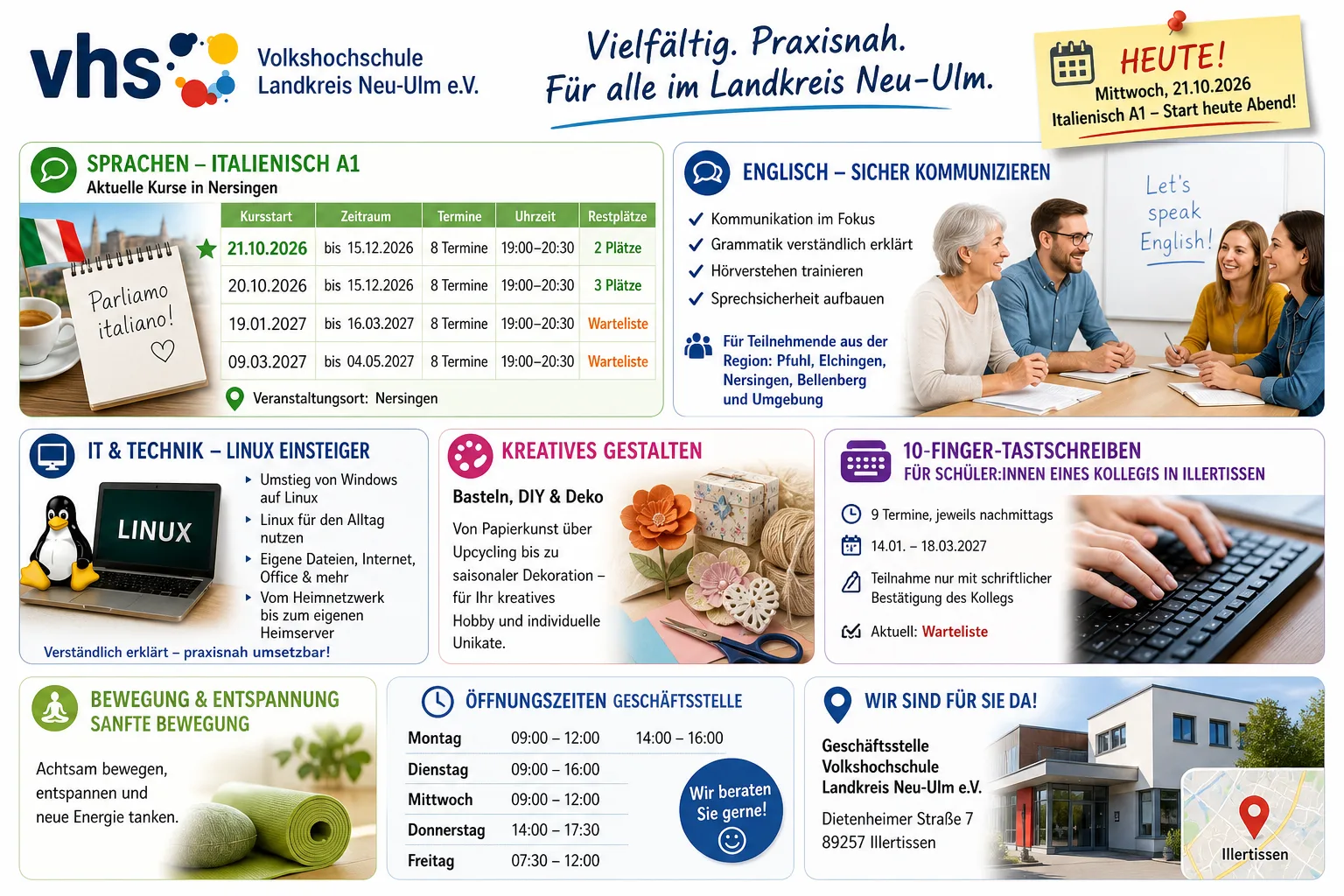
Whether languages, Linux, touch typing, creative design, or gentle movement: The Adult Education Center (VHS) in the Neu-Ulm region continuously offers new course starts at various learning locations in the district. This overview helps you find suitable options for upcoming course phases, make realistic choices, and get off to a good start.
Learning Languages: From A1 to Conversation
Language courses are among the classics at the VHS: They help with travel, work, and interacting with people from other cultures. Many offerings are based on the Common European Framework of Reference for Languages (CEFR), so you can clearly classify your level (e.g., A1, A2, B1).
Italian & Other Languages: Structured and Practical for Everyday Life
For upcoming course starts, adult education centers often plan beginner and continuation formats with several sessions—often in the evenings, so they are compatible with work, training, or family life. When choosing, pay particular attention to:
- Level Assessment: Does A1/A2/B1 really match your level (use a placement test if necessary)?
- Session Frequency: Prefer weekly (routine) or more compact (faster progress)?
- Learning Goal: Everyday travel, exam preparation, or free speaking?
English with a Focus on Conversation and Speaking Confidence
Many participants don't want "even more grammar," but rather to speak more confidently. Conversation courses therefore typically focus on realistic situations and lots of active speaking time. Common elements include:
- Dialogues and role plays for everyday life & work
- Listening comprehension with authentic examples
- Targeted mini-grammar that transitions directly into speaking
- Pronunciation training for better intelligibility
If you mainly want to overcome inhibitions, formats with a lot of conversation are often the best choice—ideally with a clear course description (level, topics, methods).
IT & Linux: Digital Skills for Everyday Life
Digital independence is central in everyday life: online forms, banking, device settings, data backup. VHS courses in the IT field address this—from entry-level to advanced topics.
Understanding Linux: From Switching Over to Your Own Projects
Linux courses are especially helpful if you want more control over your system or want to use older devices for longer. Beginner formats often cover:
- Basic concepts and differences from other operating systems
- First steps after installation (users, updates, software management)
- Everyday software for office, internet, and media
- Data backup and sensible basic settings
If you already have experience, advanced formats (depending on the offering) may also touch on topics such as file permissions, terminal basics, or small home network projects. The key is: Choose a course level that matches your prior knowledge so you can really keep up.
Touch Typing: An Advantage for School, Training, and Work
Those who type fluently noticeably save time on homework, research, applications, and office work. Courses on the 10-finger system are therefore a pragmatic investment—for both students and adults.
What to Look for in 10-Finger Courses
- Practice Share: Regular practice is more important than "theory."
- Ergonomics: Sitting position, hand posture, and breaks help avoid overuse.
- Goal Setting: Is it about error-free writing, speed, or both?
- Format: Several sessions over weeks (better for habits) vs. compact intensive courses.
Especially for student courses, there may be organizational requirements (e.g., participation conditions or group assignment). Therefore, check the course description carefully and register early if places are limited.
Creative Design, Movement & Relaxation
VHS offerings are not just "mental work." Creative and health formats help many people reduce stress, find new routines, and make social contacts in the region.
Crafting & DIY: Unique Pieces Instead of Screen Time
Creative workshops are often designed so that you can join in without much prior knowledge. The focus is often on trying out techniques, getting to know materials, and taking something tangible home at the end. When choosing a course, pay attention to notes on material costs, required tools, and difficulty level.
Gentle Movement: Stay Mobile and Switch Off Consciously
"Gentle movement" usually describes joint-friendly, mindful formats that focus not on performance but on well-being. Typical are:
- Mobilization and light strengthening
- Breathing and relaxation exercises
- Movement sequences focusing on body awareness
If you have health restrictions, it makes sense to clarify with a doctor before the course starts which level of exertion is suitable for you and to inform the course instructor about relevant limitations.
Practical Tips: How to Find Your Course
1) Set a Goal: What Should Improve in the Next Few Weeks?
- Make everyday life easier: e.g., touch typing or basic computer skills.
- Benefit professionally: e.g., English conversation or digital skills.
- Create balance: e.g., creative workshop or gentle movement.
2) Plan Realistically: Time, Distance, and Energy
It's better to choose a format you can reliably stick with. A course within easy reach (Neu-Ulm or surrounding area) is often more sustainable than a "perfect" topic with too long a commute.
3) Read the Course Description Carefully: Level, Materials, Requirements
Especially for languages and IT, the right entry level determines learning success. If a placement is recommended, use it. For creative courses, check material lists; for movement courses, pay attention to notes on exertion and any required equipment.
4) Register Early and Have Alternatives Ready
Popular courses can fill up quickly. It's worth registering early and, if in doubt, considering an alternative date or a comparable level.