Time Travel through Neu-Ulm: old photos & stories
Time Travel through Neu-Ulm: Old Photos, Stories & People – as a Program for Upcoming Events
This page exclusively describes formats and procedures for future time travel events in Neu-Ulm (and, if desired, in the twin city with Ulm): film evenings with archival material, photo walks, lectures, and sound walks. All information is intended as planning and implementation suggestions for upcoming dates.
Goal: What visitors should experience
A future “Time Travel through Neu-Ulm” should not be backward-looking nostalgia, but rather comprehensible, source-secure, and collaborative: people see, hear, and discuss how places and everyday life have changed over generations, and how the culture of remembrance is responsibly shaped today.
- Orientation: Which streets, squares, and riverbank areas are suitable as “time windows”?
- Classification: What context do images and films need so they are not misunderstood?
- Contribution: How can private photos, home movies, or sound recordings be preserved for future generations?
Formats for the coming months: Film, Photo, Sound & Walk
1) Curated Film Evening with Moderated Discussion
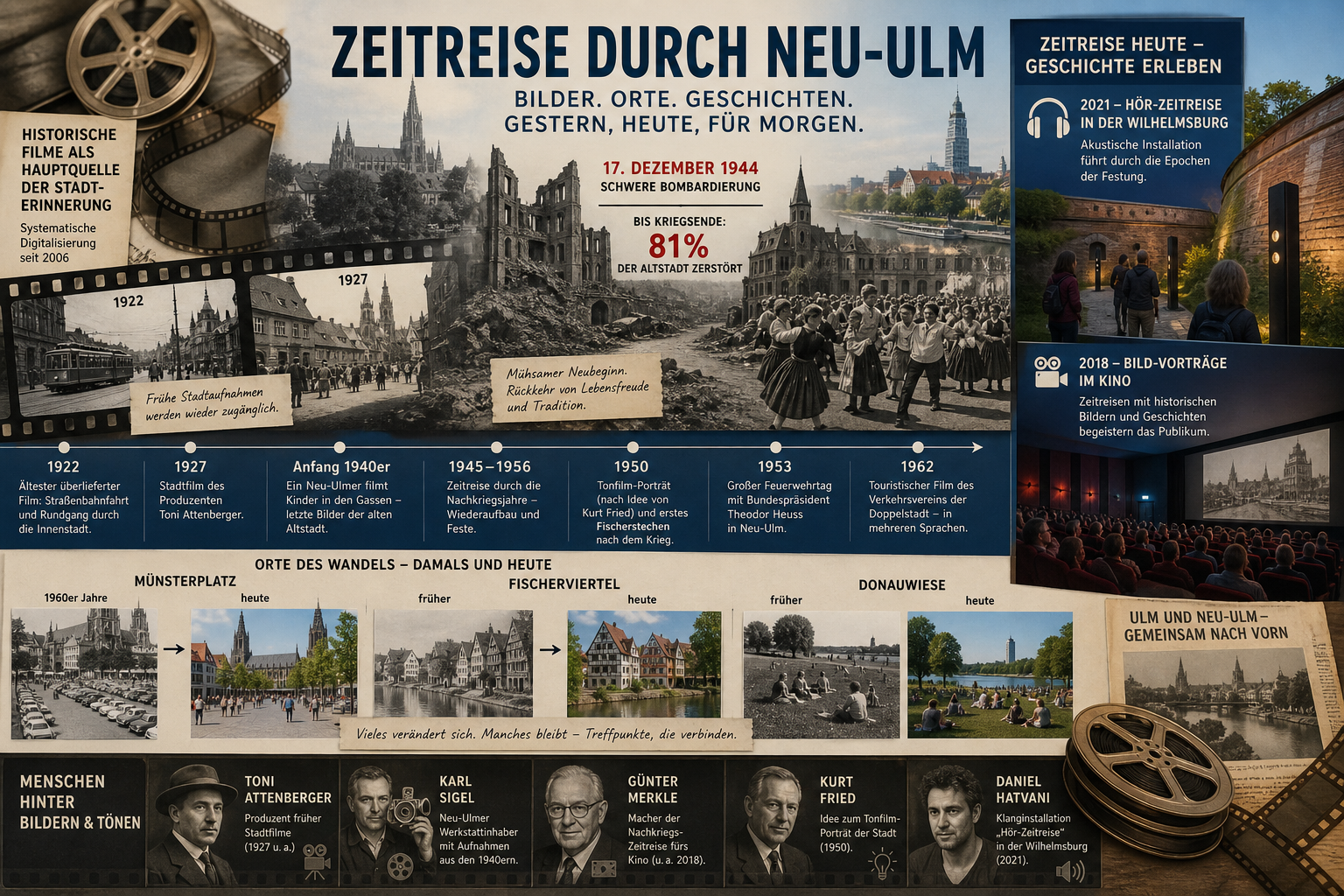
For upcoming cultural events, a cinema or hall format with digitized city footage (film reels, amateur films, newsreel clips, documentaries) from archives and collections is suitable. Moderation is crucial: origin, dating, perspective, and possible gaps are explained transparently.
- Before the screening: short introduction to source, creation, and editing
- During: optional subtle chapter boards (without over-interpretation)
- Afterwards: moderated audience discussion with guiding questions (“What do we know for sure? What is speculation?”)
2) Photo Walk (“Then/Now” on site)
A guided tour can take place at 6–10 stops in the future. At each station, a historical photo (or image section) is shown and compared with today’s view. Important: clarify image rights, keep captions clean, and encourage the group to look closely (building types, signage, usage, traffic routing, vegetation).
3) Sound Walk or Listening Stations
For upcoming programs, an audio format is particularly low-threshold: at selected points, short sound chapters (interviews, soundscapes, read contemporary documents) can be played via headphones or mobile speakers. This works as a guided walk or as a freely accessible offer with QR codes.
4) “Participatory Archive”: Collection Day for Private Holdings
As a future event, a public collection and consultation day can be planned: citizens bring photos, albums, negatives, or home movies. On site, conditions are assessed, sensible digitization methods explained, and—if desired—legally secure agreements for use are prepared.
Schedule for a Time Travel Evening (Example)
The following schedule is intended as a template for future cultural evenings and can be adapted depending on location, audience, and material.
- Admission & Context (10–15 min.): Purpose of the evening, source principle, note on sensitive content.
- Block 1 (15–25 min.): City views & everyday scenes, with brief classification.
- Block 2 (15–25 min.): Change of places and infrastructure; focus on “What do we see—and what not?”
- Discussion (20–30 min.): Questions from the audience, memories as contemporary witness (with note on possible memory distortions).
- Outlook (5 min.): Notes on next dates (walk, collection day, audio format).
Recommendation for moderation: Clearly separate statements into proven (source available), plausible (indications), open (still to be checked). This keeps the format credible and close to science, without seeming dry.
Places suitable for future stops
For a future time travel, places that are heavily used today and at the same time offer good comparison points for image material are suitable. From the twin city perspective, stations on both sides of the Danube can be connected.
- Danube banks & bridge areas: Sight lines, riverbank design, recreational use.
- Central squares: Places where usage (traffic, market, recreation) can be particularly well read.
- Neighborhood edges: Transitions between old stock, new buildings, and green spaces.
- Cultural and fortress sites: For film/audio formats with spatial effect and acoustics.
Practical tip for future walks: Only one core motif (photo/clip) and one guiding question per station. This increases comprehensibility and prevents information overload.
Curation Principles: Accuracy, Sources, Context
So that future time travel formats appear E-E-A-T-compliant (and not “just nice pictures”), they should be curated according to comprehensible rules:
- Show provenance: Where does the image/film come from (archive, collection, private holding)?
- Explain dating: Is the date certain (caption/source) or inferred (indications)?
- Provide context: Occasion of the recording, possible staging, viewing direction, image section.
- Limit interpretation: No firm claims without evidence; remain open in case of uncertainty.
- Polyphony: Invite different perspectives (e.g., urban history, building culture, everyday history).
A future companion booklet (printed or as PDF) can bundle all shown motifs with short sources, dating, and a brief glossary. This increases usefulness and trust.
Rights, Data Protection & Respectful Handling of Contemporary Witnesses
Future events with photos/films often touch on copyright and data protection. For a serious implementation, usage rights should be checked in advance and sensitive content carefully classified.
- Copyright: Before public screening and online publication, clarify whether the work is still protected or a usage license is available (e.g., from the rights holder or archive).
- Personal reference: If people are recognizable, a legal review is advisable for new publications (especially for more recent recordings or if private contexts are involved).
- Sensitive topics: Violence, war, discrimination, or propaganda contexts should not be shown “unfiltered” in the future; instead, classify and, if necessary, provide trigger warnings.
- Respect: Private material is not “exploited” but used in consultation; clearly communicate return rules and revocation options.
Note: This page does not replace legal advice. For specific programs, an individual review is advisable (e.g., by sponsor, archive, or legal advice).
Accessibility & Participation
To ensure that future time travel offerings reach as many people as possible, they should be planned to be low-barrier:
- Subtitles for film and video material (or live transcription for lectures).
- Good readability of image boards (large font, high contrast, short captions).
- Route planning for the walk: curbs, inclines, seating breaks, WC options.
- Audio alternatives: Text versions of audio content and vice versa.
Get Involved: How citizens can contribute material
For future collection or participation dates, a clear framework helps to ensure contributions are safe, respectful, and usable:
- Advance info: Which formats are accepted (photos, negatives, slides, Super-8, tapes, digital files)?
- Metadata checklist: Location, approximate year, occasion, people involved (if known), photographer/source.
- Usage options: “Digitization for the family only” vs. “Use for exhibitions/screenings” (separate in writing).
- Safe handling: Transport instructions (sleeves, no tape on originals), as well as gentle digitization.
This creates a growing collection that is not only “nice” but comprehensibly documented.
Sources & Further Information
- Copyright Act (UrhG) — Legal basis for protection, usage rights, and public performance (accessed 2026-05-27)
- General Data Protection Regulation (GDPR) — Framework for personal data, relevant for identifiable persons in digitized materials (accessed 2026-05-27)
- German Digital Library — Overview and access to digital cultural heritage, including collection and context information (accessed 2026-05-27)
- FIAF (International Federation of Film Archives) — Guidelines and standards in the field of film archiving and presentation (accessed 2026-05-27)