Pilgrimage routes around Neu Ulm – quiet places & nature
Pilgrimage Routes & Quiet Places around Neu-Ulm: Ideas for Your Next Steps (from Autumn 2026)
If you are planning a mindful break around Neu-Ulm in the coming weeks or months, you can combine pilgrimage and quiet nature experiences so that "just walking" becomes a clear mind and a calmer rhythm.
Important: This article is intended as a planning and idea list for your upcoming tours (from today's date). Please check current information about trails, opening hours, protected areas, and public transport before you travel.
How to Start Your Next Pilgrimage Break from Neu-Ulm
- Set a time frame: 60–120 minutes (after work), 3–6 hours (half day), or 1–2 days (weekend).
- Choose an intention for the walk: "I want to wind down," "I want to reflect," "I want to regain strength" – one sentence is enough.
- Take a light structure with you: Start in silence for 10 minutes, walk for 30–90 minutes, sit for 10 minutes, write for 5 minutes.
- Plan your return: If you want to walk a one-way route, decide in advance how you will get back (train/bus/pick-up).
Three Tour Ideas You Can Implement from September 2026
1) "Danube Start": 90 Minutes Walking Meditation by the Water (After-Work Format)
For your next short break, you can plan a Danube loop where it's not about the kilometers, but about repetition: steady steps, calm breathing, and conscious perception.
- Arrival (5–10 min): Put your phone on airplane mode, relax your shoulders, take three deep breaths.
- Walking (45–70 min): Walk at a pace where you can still breathe comfortably through your nose.
- Silent break (10–15 min): Sit on a bench, gaze aimlessly, and let your thoughts pass by.
- Conclusion (2–5 min): Write down one sentence: "Today I take with me ..."
For the next date you set for yourself: Plan the loop consciously at a time of day when you expect less foot traffic (early morning or late evening), so that silence is easier to achieve.
2) "Reed & Fog": Quiet Nature Time with Consideration for Sensitive Areas (Autumn 2026)
If you are looking for a particularly quiet atmosphere in autumn 2026, you can plan a tour towards moor and wetland landscapes. It's best to plan it so that you stay on marked trails and allow yourself time to observe.
- Goal for your next outing: a loop with at least 20 minutes of sitting time (binoculars optional, notebook helpful).
- Quiet focus: Count sounds (e.g. "10 things I hear") instead of measuring distance.
- Conservation thought: Stay on designated trails and respect seasonal notices (e.g. breeding or retreat times).
This turns a nature walk into a conscious "pilgrimage without a program": You give space to the place – and to yourself as well.
3) "Monastery Calm": A Weekend Block with Silence, Culture, and Slow Walking (from Winter 2026/27)
For an upcoming weekend (e.g. from winter 2026/27), you can plan a break where you choose a monastery-influenced place as a quiet center. It's not about a performance tour, but about a rhythm of walking, sitting, reading, and conscious reduction.
- Day 1 (Arrival): Arrive relaxed, take a short walk (30–60 minutes), and reduce stimuli (no "program marathon").
- Day 2 (Slowness): Plan a longer loop (2–4 hours) plus a fixed break in silence.
- Day 3 (Rounding off): Take a short final stretch and formulate a concrete mini-change for the next week (e.g. "15 minutes a day without a phone").
Tip for your planning: Check in advance which areas are accessible, whether there are guided tours or quiet visiting times, and whether arrival by public transport is possible.
How You Can "Connect" to Regional Pilgrimage Routes in 2026/2027
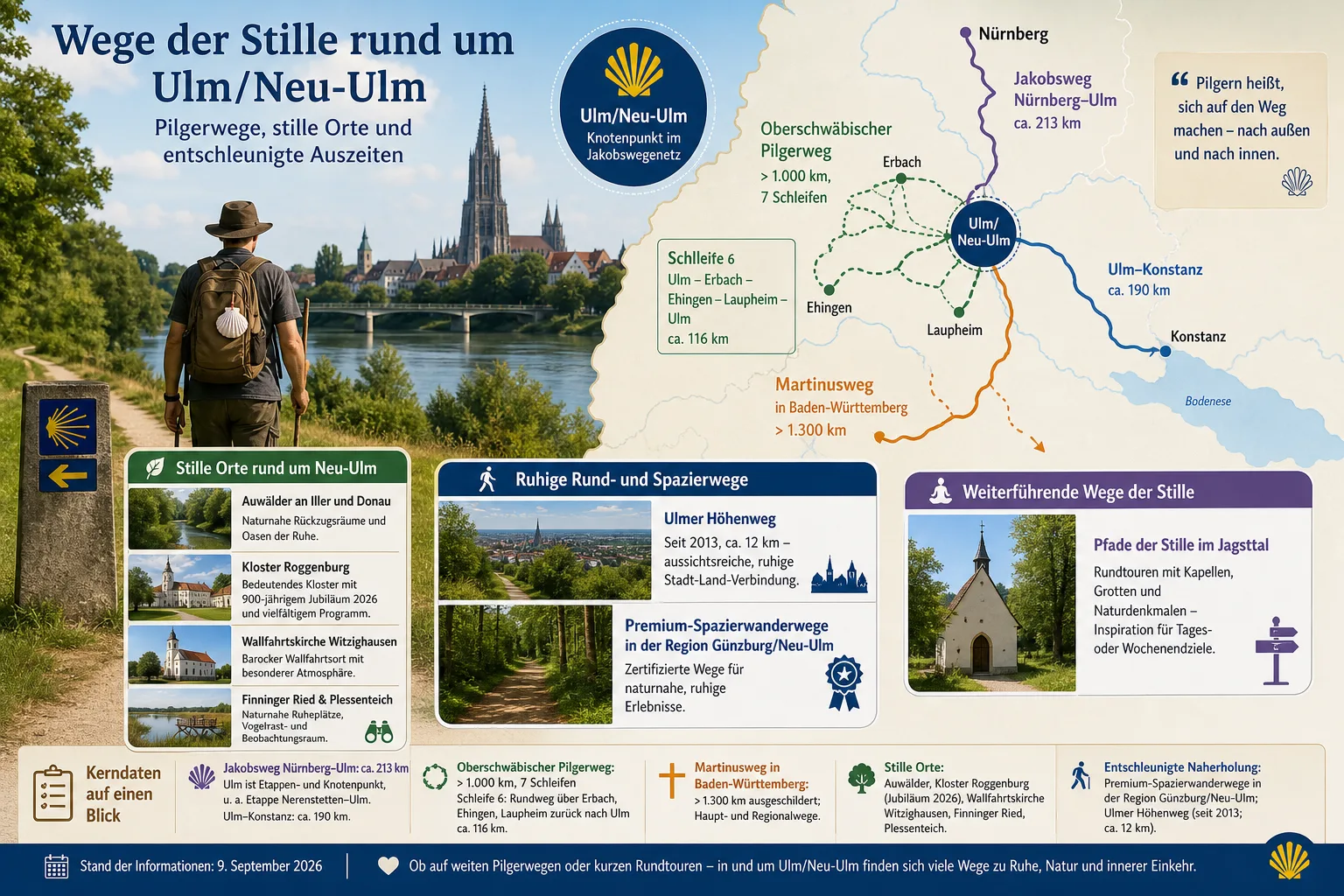
If you want to plan a longer stage in the coming months, you can orient yourself on existing, marked pilgrimage routes. For your specific route: Set the start and end point so that you walk a realistic daily distance and the return journey works safely.
- Jakobswege (Ways of St. James): For an upcoming day or weekend stage, you can choose a section connected to the German Jakobsweg network and plan your route so that you end at train stations or bus hubs.
- Oberschwäbischer Pilgerweg (Upper Swabian Pilgrimage Route): For a later multi-day break, you can plan a loop or section and consciously schedule "stopping points" along the way (churches, chapels, quiet places).
- Martinusweg (St. Martin's Way): For a future tour, you can select an entry point in the wider region and combine the journey with the train to walk a spiritually influenced route without a car.
Planning rule for your next stage: Calculate roughly 3–4 km/h walking speed plus breaks. This keeps the route calm and manageable.
So Your Next Tour Is Truly Slowed Down: Equipment, Consideration, Safety
- Weather & daylight: If you walk in autumn/winter 2026/27, plan early enough so you don't get caught in dusk (headlamp helps).
- Shoes & ground: For wet sections, take shoes with good tread and walk carefully on wooden walkways or wet leaves.
- Drinks & snack: Pack water and a small snack so you don't "skip" breaks.
- Nature conservation: Stay on trails, take your trash with you, and keep your distance from animals (especially in quiet morning and evening hours).
- Respect in sacred spaces: When you visit churches/chapels in the future, behave quietly, pay attention to notices about services, and only take photos if allowed.