Industrial Culture & Postwar Architecture in Neu-Ulm
Industrial Culture & Architecture in Neu-Ulm: Future Program 2026 (Tours, Talks & Photo Walks)
Neu-Ulm is best discovered on foot: bridges, striking infrastructure buildings, sacred spaces, and neighborhoods in transition. This program bundles upcoming dates only for all who want to consciously experience industrial culture and architecture in the urban space.
The Grand Tour: Route & Stops
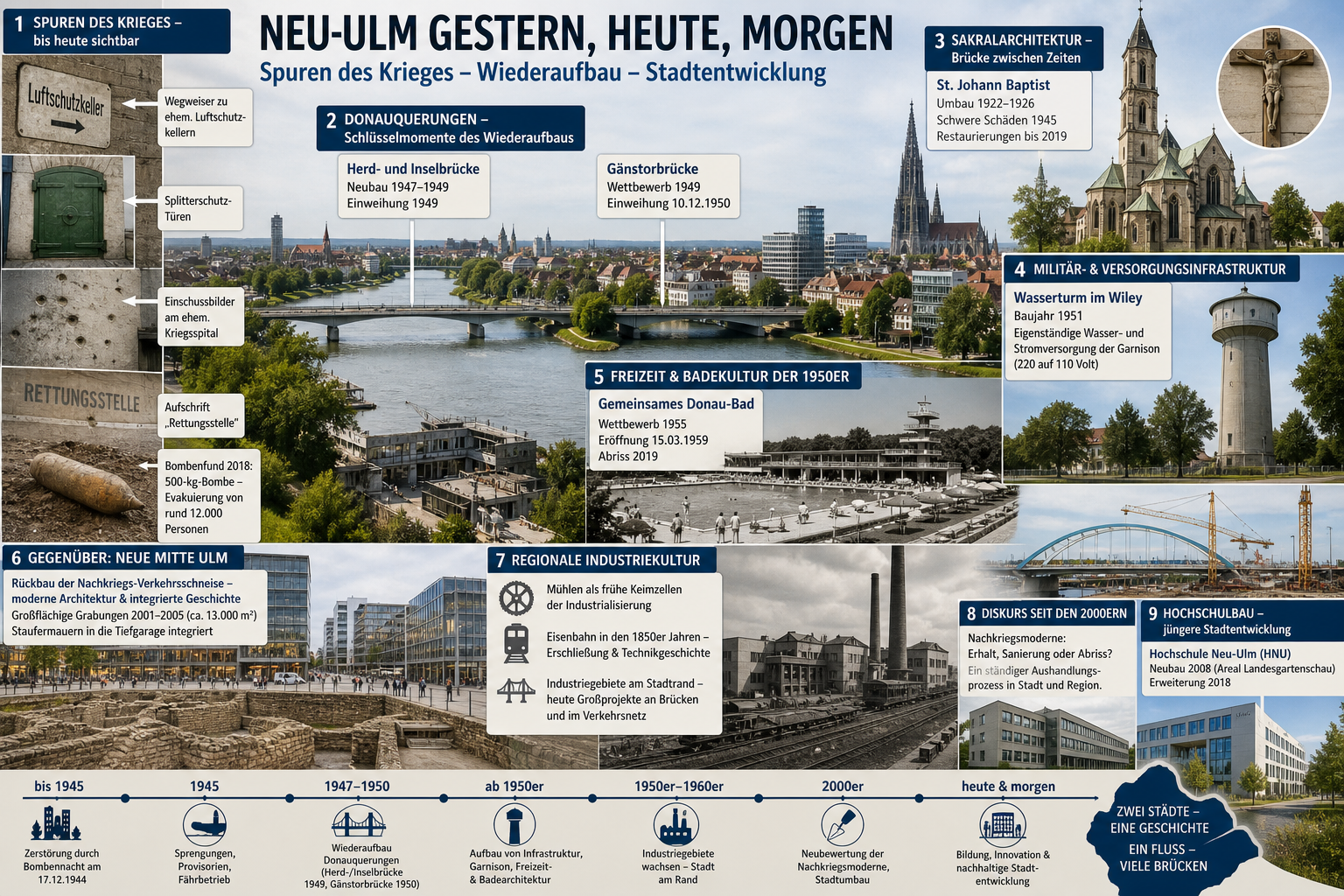
The route connects central places of city perception: Danube crossings, striking buildings, neighborhoods with visible layers of different construction phases, as well as infrastructure objects as orientation points.
Planned Procedure (Sample Route)
-
Start at the Danube bank: Introduction via sightlines, riverbank edges, path guidance, and the role of crossings as urban space joints.
-
Bridge stops (including Herdbrücke and Gänstorbrücke): Observation of structural logic (from the pedestrian perspective), soundscapes, transitions between traffic space and places to stay.
-
City center passage: Short exercises in "reading" facades (grids, window divisions, base zones), ground floor uses, and square edges.
-
Sacred space (St. Johann Baptist as a program point): Focus on spatial effect, light guidance, and acoustic perception (visit only if open and without ongoing events).
-
Wiley (water tower as a landmark): Orientation in the neighborhood via high points, path relationships, open space edges, and the readability of technical building forms in today's cityscape.
-
Danube section with leisure reference (Donaubad area as a topic): Discussion about leisure architecture, safety/path guidance, and the question of how memorial markers work in urban space.
-
Final round: What do you take away? Which observation techniques help to perceive architecture more consciously in everyday life?
Workshops & Additional Formats
Micro-workshop during the tour: "3-Minute Sketch"
Optionally integrated mini-block: Participants sketch a bridge silhouette or a facade grid in three minutes. The goal is not "beautiful drawing," but recognizing structures.
Optional follow-up date (online, 30 minutes): "Your Photos – Our Analysis"
A short, voluntary online appointment (2026-07-30, 19:00–19:30) for image discussion: Which perspectives best explain structure, space edge, or use? Please only bring your own photos from public space.
Participation, Accessibility & Notes
- Duration: 2 hours (tour), 60 minutes (talk), 90 minutes (photo walk).
- Pace: moderate, with regular stops.
- Recommendation: comfortable shoes, weatherproof clothing, water.
- Accessibility: The route is planned so that it mainly leads over paved paths. Individual sections can be adjusted depending on construction site situations; stairs are avoided where possible.
- Respect in urban space: We stay on public paths, do not photograph people without consent, and are considerate in areas with ongoing operations or church services.
Further Sources
The following basics help to systematically classify industrial culture, monument preservation, and building culture:
- TICCIH – The International Committee for the Conservation of the Industrial Heritage — international basic site on industrial culture (accessed 2026-05-20)
- ICOMOS – International Council on Monuments and Sites — standards and position papers on monument preservation (accessed 2026-05-20)
- German Foundation for Monument Protection — understandable classifications on monument protection & building culture (accessed 2026-05-20)
- UNESCO – Culture — framework terms on cultural heritage and protection perspectives (accessed 2026-05-20)