How Neu Ulm Becomes Smart: IDEK, Data Platform & Co.
How Neu Ulm Is to Become a Smart City: Digital, Sustainable, and Close to the People
Neu Ulm plans to use digitalization in a targeted way for climate protection, mobility, education, administration, and responsible data use. This article describes the planned building blocks of a smart city strategy—with a focus on what is to be developed next.
What Does “Smart City” Specifically Mean for Neu Ulm in the Future?
“Smart City” in Neu Ulm is not meant to be just a tech buzzword, but rather an approach to organize urban tasks (e.g., energy, traffic, urban greenery, services) more efficiently, transparently, and sustainably using digital tools. The key is that digital solutions provide tangible benefits in everyday life: understandable information, reliable services, resource-saving processes, and transparent decisions.
To achieve this, smart city programs typically interlink three levels:
- Strategy: clear goals (e.g., climate protection, participation), priorities, and responsibilities
- Technology & Data: secure infrastructure, open standards, data protection, meaningful sensors
- People & Organization: participation, digital skills, clear communication
Strategic Framework: IDEK as a Compass for the Next Steps
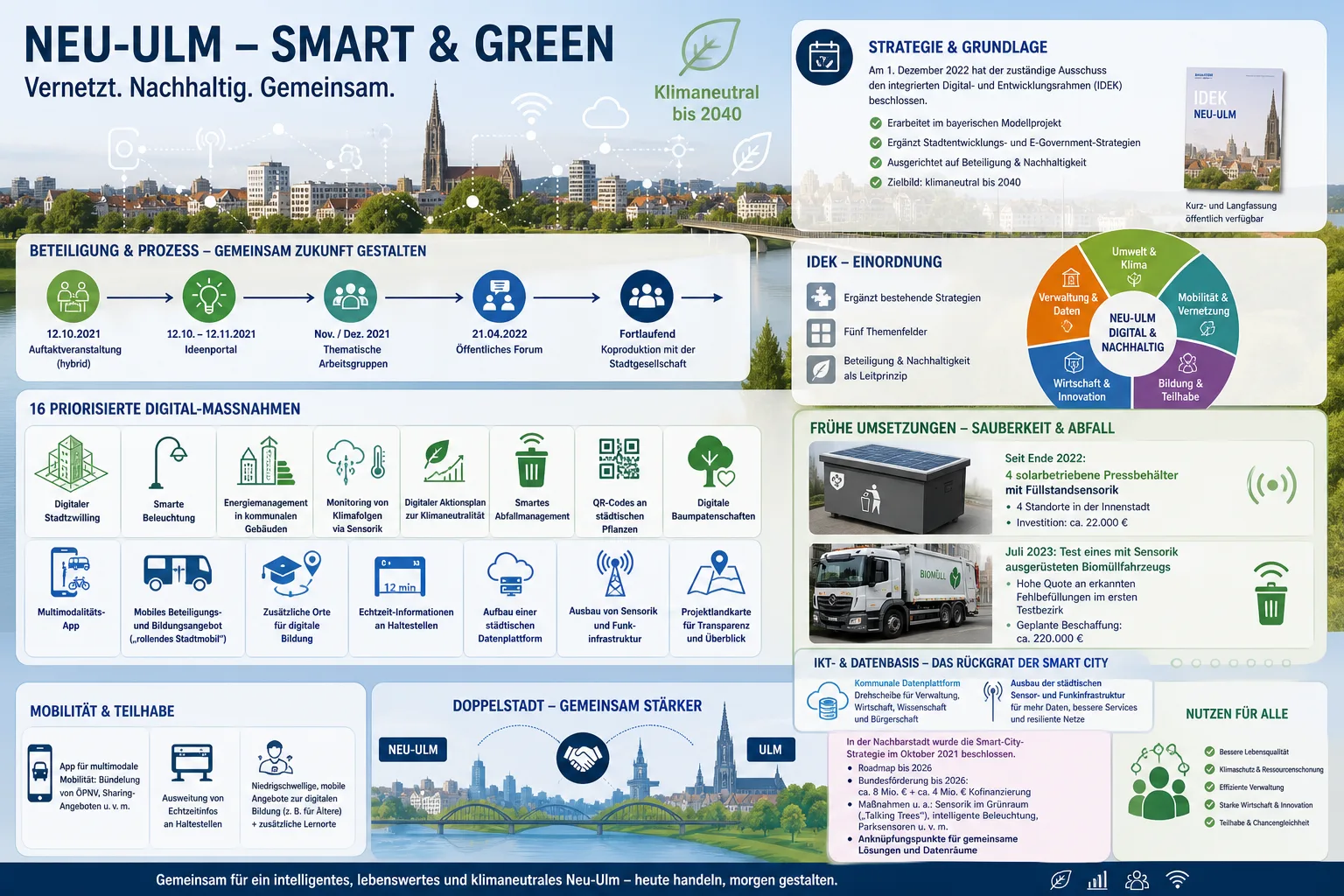
As a guideline for further smart city development, Neu Ulm aims to establish an integrated digital and development concept (IDEK) as the framework: Digitalization is understood as a cross-cutting issue that connects urban development, administrative modernization, and sustainability. The goal is not to introduce individual measures (apps, sensors, platforms) in isolation, but to embed them in a shared vision.
In practice, this means that projects will in the future be evaluated based on whether they
- deliver a tangible public benefit,
- are compatible with data protection and security requirements,
- can be operated and financed sustainably (operation, maintenance, responsibilities),
- and measurably contribute to climate, mobility, or participation goals.
Five Areas of Action to Which Smart City Projects Should Contribute
- climate-friendly urban development and energy
- smart mobility and traffic
- digital education and participation
- modern, digital administration
- data, infrastructure, and city organization
Participation as a Principle: How the Urban Society Is to Be Involved in the Future
To ensure that smart city solutions do not miss the needs of the population, participation is to be a permanent feature: as recurring dialogue formats, clear project communication, and transparent feedback (“What was proposed—what is being implemented—why/why not?”).
For the next implementation phases, the following are particularly effective from an E‑E‑A‑T and governance perspective:
- low-threshold participation: online and on-site, accessible, in everyday language
- regular status updates: timelines, milestones, results, risks
- co-production: pilot projects together with associations, schools, businesses, academia
- evaluation: measurable criteria (e.g., energy savings, service quality, usage numbers)
From Strategy to Implementation: Which Building Blocks Could Be Developed Next
Smart city programs become credible when visions turn into concrete, actionable projects. For Neu Ulm, the planned or typical smart city building blocks can be bundled into four implementation-oriented packages.
1) Digital Foundations: Data Platform and “Digital Twin”
A key next step is to build a municipal data platform: as a technically and organizationally regulated hub through which data from administration, infrastructure, and (where appropriate) sensors can be consolidated, documented, and used in a controlled way. The important thing is: not “as much data as possible,” but purpose-specific data with clear rules for access, storage, quality, and transparency.
Building on this, a digital twin can be created—a digital representation of relevant city structures (e.g., streets, buildings, green spaces) that supports planning and simulation activities. In the future, this could allow for more transparent evaluation of options for traffic management, climate resilience (heat/unsealing/greenery), or renovation priorities.
For trust and reusability, the following are particularly important:
- data catalog with understandable descriptions (origin, timeliness, accuracy)
- privacy by design (data minimization, pseudonymization/anonymization, purpose limitation)
- IT security concept for operation and interfaces (especially for IoT/sensors)
- transparent rules on which data is public and which is not
2) Sustainability & Climate Adaptation: Smart Infrastructure with Measurable Effect
Digitalization in Neu Ulm is to be used in a targeted way to conserve resources and improve decisions based on data. Typical next steps are projects that are easy to measure and quickly provide benefits:
- needs-based lighting: intelligent control can adjust brightness depending on the situation and thus save energy—while also considering safety and nature conservation
- energy monitoring of municipal buildings: consumption data, operating times, and optimization suggestions can support renovation and operational decisions
- climate monitoring: selected measuring points (e.g., heat islands, air quality, soil moisture) can help plan climate adaptation measures more effectively
- climate transparency: progress and key figures can be published in an understandable form (e.g., as a regular report or dashboard)
To prevent such projects from being “technology for technology’s sake,” benefit indicators should be defined from the outset—such as energy consumption per building, downtime, maintenance effort, or the impact of greening measures at hotspots.
3) Smarter Everyday Life: Cleanliness, Waste Logistics, and Easily Understandable Information in Public Spaces
Smart city projects become especially visible when they improve everyday processes. For Neu Ulm, depending on priorities and funding, two main lines are particularly relevant here:
- data-based waste logistics: fill level notifications and route optimization can reduce empty runs and avoid overflows, provided sensors work reliably and maintenance is planned
- information points in public spaces: digital notices (e.g., via QR code) can explain urban greenery, biodiversity, or care instructions in an understandable way and thus increase acceptance of measures
Important for trust: For all “smart” systems in public spaces, it should be clearly communicated which data is collected (and which is not), for what purpose it is used, and how long it is stored.
4) Mobility, Education, and Participation: Smart City as a Service for Everyone
A smart city is only future-proof if it designs digital offerings so that as many people as possible can use them—regardless of age, income, or technical affinity.
Multimodal Mobility and Better Real-Time Information
An obvious next building block is a multimodal information system that bundles various mobility options in a user-friendly interface (public transport, sharing, possibly park & ride or bicycle). In addition, real-time information at stops and digitally (e.g., disruption notifications, departures) can increase reliability.
Digital Education and Support in the Neighborhood
To ensure no one is left behind, there also needs to be analog access and learning opportunities: consultation hours, workshops, easy-to-understand explanations, and formats that go where people are (e.g., temporary information stands or mobile offerings). Particularly effective are collaborations with libraries, educational providers, schools, and social institutions.
Trust as a Prerequisite: Data Protection, IT Security, and Transparency
The more networked systems a city uses, the more important data protection and IT security become. For smart city projects, the following principles should therefore be binding:
- purpose limitation & data minimization: only collect what is necessary for the specific purpose
- transparency: clear information about which data is processed and why
- security: secured interfaces, role and authorization concepts, monitoring and update processes
- accountability & control: documented responsibilities, data protection impact assessments where required
This creates systems that not only work technically, but are also accepted by society—and can be operated in the long term.
Outlook: How Neu Ulm’s Smart City Can Be Measured in the Future
Whether Neu Ulm “works” as a smart city will be shown less by the number of individual tools than by tangible improvements. Meaningful metrics for the coming years include, for example:
- service quality: faster procedures, better accessibility, understandable digital offerings
- climate impact: measurable savings and effective adaptation measures at hotspots
- mobility: more reliable information, better linking of services, higher usability
- participation: genuine involvement, accessible offerings, digital education in everyday life
- trust: transparent data rules, clear security and data protection standards
If these points are met, “smart” in Neu Ulm will not be seen as an end in itself, but as a practical contribution to a livable, sustainable city.