Discover Old Town & Historic Buildings in Neu-Ulm
Old Town & Historic Buildings in Neu-Ulm: Your Walk & Your Next Experiences (now plannable)
If you want to explore Neu-Ulm's city center in the coming days or weeks, you can expect a city experience that works less through medieval alleys and more through striking buildings, squares, and paths that make history visible in the urban space. This guide helps you concretely plan your next visit—with a manageable route, options for families, and tips for photos, breaks, and accessibility.
Overview: What you will see on your next tour
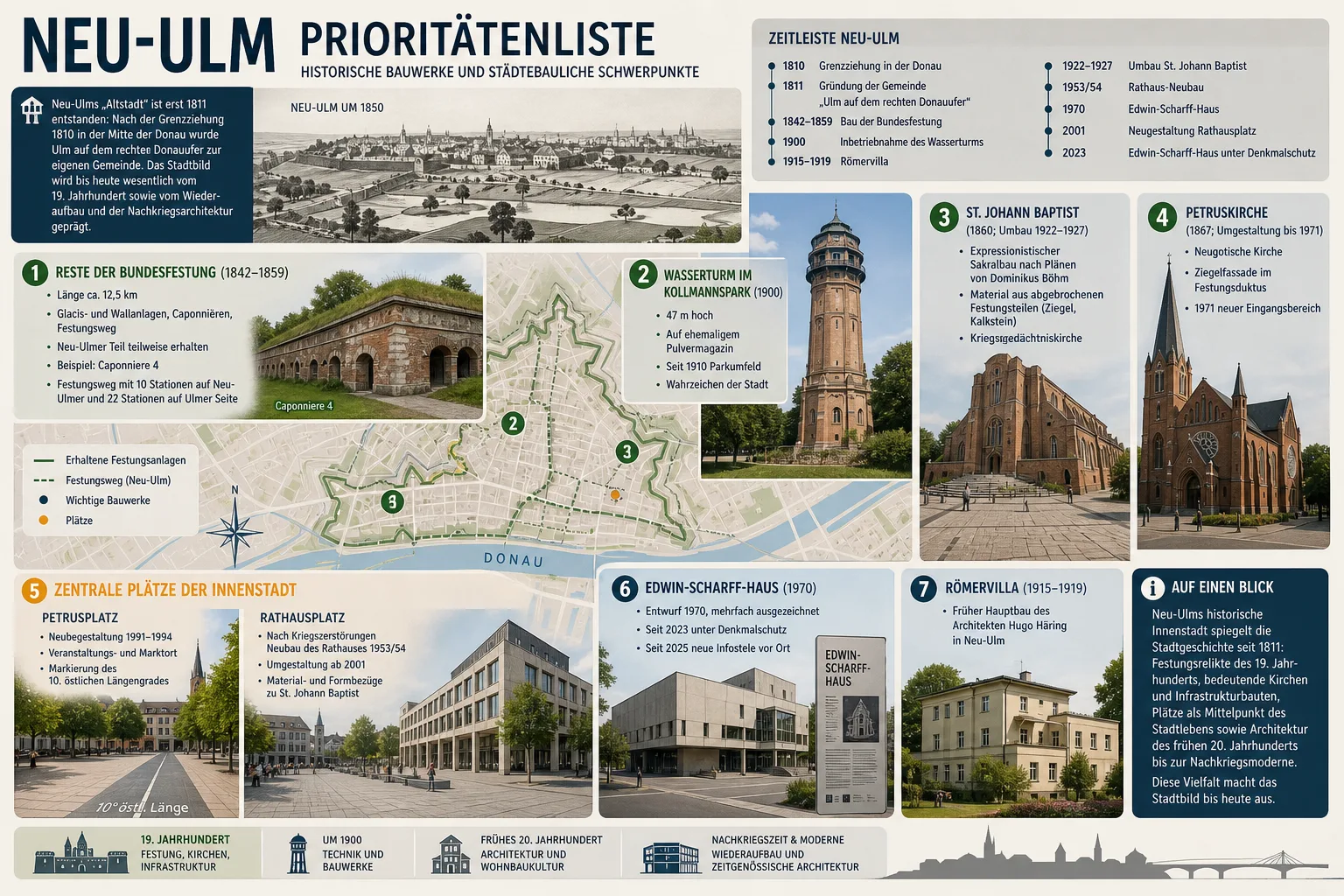
- City center squares as starting points: Petrusplatz and Rathausplatz as central orientation points.
- Architectural highlights along short routes: Churches, striking public buildings, and modern urban elements.
- Green corridor & wall remains as an “open-air” history trail: The Glacis and the Fortress Path as a quiet, easily walkable route.
- Technical landmark in the park: The water tower in Kollmannspark as a photo stop and destination.
All stops can be combined so that you can flexibly adapt your visit to the weather, time budget, and interests.
Route for your next visit (approx. 60–120 minutes, flexibly extendable)
1) Start at Rathausplatz: Arrive, get an overview
Begin your tour at Rathausplatz. Here you can prepare for short distances: From this point, you can reach the main stops in just a few minutes. It's best to plan a short break right away (e.g., for a coffee nearby) before continuing towards Petrusplatz.
2) Continue to Petrusplatz: Discover details
At Petrusplatz, it's worth taking a look at the lines and markings on the ground as well as the spatial effect between the church, shops, and residential buildings during your next visit. Take your time for a photo from a low perspective: This makes the edges of the square and facades appear particularly clear.
3) Churches in direct comparison: Shapes, materials, atmosphere
In the next section of your route, you can experience two sacred buildings in close proximity. For a more intense experience, it's recommended to consciously pay attention to material changes (brick, stone, plaster) and the entrance situations: How do portals, stairs, and forecourts lead into the interior? (Please note possible opening times and notices on site.)
4) Glacis & Fortress Path: Quiet walk in the green
Your next stage then leads into the Glacis. There you will experience a much quieter, park-like section. If you follow the Fortress Path, you can “read” the stops one after another—ideal if you like to go at your own pace. For families, this is a good route because movement, green spaces, and short info texts can be combined.
5) Destination Kollmannspark: Water tower as the finale
As a conclusion, the water tower in Kollmannspark is a good choice. Plan a moment here to consciously change your perspective: Photograph the tower once up close (details, structure) and once from a greater distance (integration into the park). This creates a small visual “story” of your visit.
Three options for your next tour
Option A: “Compact & central” (approx. 45–75 minutes)
- Rathausplatz
- Petrusplatz
- Church stops in the area
- Short detour into the Glacis
Option B: “Green & relaxed” (approx. 90–150 minutes)
- Start at Petrusplatz
- Glacis & Fortress Path as the main route
- Kollmannspark with water tower
- Return via the city center
Option C: “Modernity & city history” (approx. 120–180 minutes)
- City center squares (Rathausplatz, Petrusplatz)
- Architecture stops focusing on the 20th century
- Extension to cultural and event venues (depending on the current program)
This option is particularly suitable if you want to combine your next visit with a concert, exhibition, or congress program in Neu-Ulm. Check the current program information of the respective venues in advance.
Upcoming occasions: How to find future tours & dates
If you want to plan your visit around a future city tour, a themed walk, or a cultural event, the most reliable way is as follows:
- Check official program pages: The city of Neu-Ulm, tourism/cultural calendars, and event venues continuously publish future dates.
- Filter tour topics: Look for keywords such as “fortress,” “Glacis,” “architecture,” “city center,” or “city tour.”
- Book early: For highly sought-after dates (e.g., weekends, holiday periods), early booking is advisable.
- Plan a weather alternative: Optionally have an indoor program (e.g., exhibition/event) ready for your visit in case rain is forecast.
This ensures that you only use reliable information about future offers and can plan your day on site in a relaxed manner.
Practical tips for your next visit
Accessible on the go
For the most accessible route possible, it is recommended to prefer larger square areas and paved paths in the Glacis. If you are traveling with a wheelchair, walker, or stroller, plan short detours to avoid steps, steep sections, or narrow passages.
Safety & consideration in urban space
If you are on bike and pedestrian paths, please pay attention to shared use: In popular green and park areas, there may be mixed traffic. At dusk, reflective clothing or a light (e.g., on the stroller/bicycle) is helpful.
Photos that make “city history” visible
- Lines & edges: Use ground markings, square edges, and wall elements as leading lines.
- Material contrasts: Consciously photograph brick, stone, and concrete in alternation.
- Before–after without the past: Instead, focus on “change of perspective” (near/far, inside/outside) to show development as an experience.